Despite the increasing use of Species Distribution Models (SDM) for predicting current or future animal distribution, only a few studies have linked the gradient of habitat suitability to demographic parameters.
Species Distribution Models are a niche modelling framework based on a statistical approach linking spatial data on the presence/absence of species to predictive environmental variables. Because they do not account for demographic and ecological processes that may constrain responses to environmental factors at a population level, the projections of SDM cannot be used directly to predict the associated extinction risk. In this context, approaches accounting for mechanistic processes directly linked with extinction across distribution ranges are considered as promising steps to better understand and predict the response of species to environmental change. While such approaches can improve the reliability of models, empirical works are essential to further develop our understanding of processes underlying distribution patterns and potentially develop better SDM that could integrate factors driving species distribution and persistence. Moreover, the adequacy of projections with demographic parameters is a critical issue when they have to be applied for conservation planning.
In our study “Evidence of a link between demographic rates and species habitat suitability from post release movements in a reinforced bird population” just published in Oikos, we tested whether the spatial variation in habitat suitability along the individual movement path is related to survival.
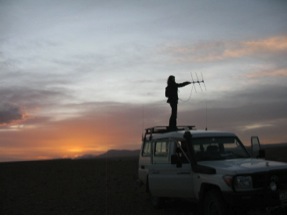
Radio-tracking of North African Houbara Bustard in Eastern Morocco
We used an extensive tracking data collected from captive-born individuals translocated to reinforce the wild populations of Houbara bustard (Chlamydotis undulata undulata). This translocation program provides an ideal study framework including information on the spatial distribution of wild-born individuals and intensive individual-based monitoring of captive-bred released individuals.
We first modelled and mapped the habitat suitability from presence data of wild individuals using niche models in a consensus framework (BIOMOD platform). We further analysed survival of 957 released individuals using capture-recapture modelling and its links to habitat suitability, as the trend in suitability from the release sites along movements.
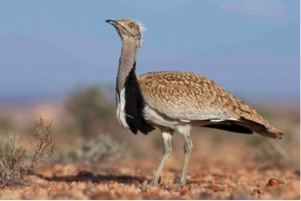
North African Houbara Bustard (Chlamydotis undulata undulata)
We found that the survival of released individuals was related to changes in habitat suitability along their movements. For instance, individuals which moved to sites of lower habitat suitability than their release sites have lower survival probabilities than the others, independently of the habitat suitability of the release sites and daily movement rate. Interestingly, the most positive changes in habitat suitability were not characterized by highest survival probabilities, likely due to density-dependant processes.
We provide an empirical support of the relationship between habitat suitability and survival, a major fitness component. These results illustrate the relevance of linking demographic processes with Species Distribution models, but also underline the importance of other mechanisms acting on demographic parameters and possibly mitigating such relationship (social organisation, density dependence).
The authors through Anne-Christine Monnet