Tag Archives: against

Appalachia: a small city’s fight against toxic waste incineration Updated for 2026


About 100 miles Southeast of Cleveland, nestled in the foothills of the Appalachian Mountains along the Ohio River, sits the small city of East Liverpool, Ohio.

Once known as the pottery capital of the world, many of the China and glassware factories have closed, as have the steel mills where many East Liverpool residents once worked.

In its heyday during World War II, almost 50,000 people lived in East Liverpool. Today the city’s population tops off at just above 10,000.

Nearly 30% of all residents live below the poverty level. The per capita income is just over $16,000. The unemployment rate is 15%, three times the state average. It’s a city where almost every second or third house seems to be abandoned, and not just abandoned. Some are burnt out. Some are falling down.

A ‘dumping ground for the detritus of the global economy’

The locals talk about the incessant and merciless drug traffic. They say dealers have come up to the city from the east coast – having found a robust market for heroin and other opiates. The drug trade wreaks constant havoc on the streets. In late September, five people were shot there in a single night.

East Liverpool enjoys another dubious honor: a staggeringly high cancer rate. In 2009, data showed that East Liverpool’s cancer rate is 615.8 people per 100,000. The Ohio average is 450.4.

East Liverpool and the tiny towns and villages that surround it are part of the forgotten rural poor in America. Devoid of all economic opportunity, they’ve become a dumping ground for the detritus of the global economy while simultaneously fueling it by providing coal, oil and natural gas.

If you haven’t heard of East Liverpool, don’t be too hard on yourself. Until about a year ago, I hadn’t either. My job as an organizer for the Ohio Organizing Collaborative took me there. I joined the OOC to start organizing communities affected by fracking, the process of extracting oil and gas from shale formations deep within the Earth.

As I began exploring the rural areas of Eastern Ohio, a colleague introduced me to three men – one in his seventies, two in their eighties – who had been fighting for environmental justice for East Liverpool since the 1980s: Alonzo Spencer, Virgil Reynolds and Mike Walton. Each has been seeking justice for their community.

The toxic waste incinerator – thanks Bill, thanks Hillary!

They are the remnants of a once robust movement to shut down one of the world’s largest hazardous waste incinerators, constructed in 1994 and run by Heritage Thermal Services (formerly WTI). Burning 60,000 tons of hazardous waste a year, it has wreaked havoc on our health and our quality of life.

Alonzo, Virgil and Mike still write letters to the EPA, the governor and anyone else they can think of. They are still seeking answers to a huge cloud of ash (see photo) that burst out of the incinerator on 14 July 2013, which coated homes and cars in the surrounding area. No one has given them an explanation.

And despite countless violations on its permit, that very same incinerator is now pursuing a permit to expand by 25% – further burdening this distressed community.

They are encouraging all who can to help by sending a letter to the Ohio EPA asking them to refuse the permit – before the 9th December 2014 deadline!

Meanwhile the cancer cases continue to mount. A friend and coworker of mine from East Liverpool knows 12 people who suffer or passed away from blood or bone cancer. Within the last two weeks, she lost two close friends to cancer. In a city this small – this is outrageous.

The common notion is that Democrats are environmentalists and Republicans are not. But the Clinton family and administration had a hand in constructing and protecting the incinerator. Friends and former colleagues of President Bill Clinton and former Secretary of State Hillary Clinton were the incinerator’s initial investors.

The Clinton administration allowed the incinerator to be constructed – 1,100 feet from an elementary school, in the middle of an African American neighborhood, on a flood plain along the Ohio River.

A city under corporate occupation

Indeed, as the area surround East Liverpool de-industrialized and residents could not longer find work that pays a living wage, the area’s main industry seems to have become waste disposal and resource extraction.

Across the river in Beaver County PA is a coal ash impoundment pond affectionately known as ‘Little Blue’, possibly because it literally glows neon blue. There are more than 600 permits for horizontal fracking wells within 50 miles of the city in Ohio only. Include western Pennsylvania it’s more like 1,300.

Just south of it, in the equally stressed village of Wellsvile, cancer-causing silica sand used for fracking operations is stored in huge uncovered piles just several hundred feet from a residential neighborhood. Down river in Jefferson County is First Energy’s dilapidated Coal Fire Power Plant WH Sammis – which the EPA says is one of Ohio’s top five polluters.

Last year, as a student at Kent State University, my colleague Amanda Kiger helped researchers from The University of Cincinnati study the effect of manganese emissions on residents of East Liverpool. Preliminary results show a link between the emissions and high rates of ADHD and other cognitive problems among residents. She even saw children display symptoms similar to those with Parkinson’s Disease.

And we all wonder why poor folks living in areas like these just can’t get a job and make something of themselves?

My family was helped up by a social infrastructure that’s no longer there

I’m not from East Liverpool. I am not poor, nor have I ever known poverty. I grew up in a comfortable suburb far from the shootings, drug trade and hazardous waste incinerators.

I am the granddaughter of poor Irish immigrants who came to Cleveland in the 1920s for economic opportunity and political freedom. My grandfather got a WPA job under President Roosevelt during the New Deal. He was a laborer who helped build the Terminal Tower. He eventually got a union job at the Cleveland Graphite Bronze Factory.

He took three buses to work every day, but made enough money to send his seven kids to Catholic school (It only cost $12 for each child to attend.) They lived in the bottom apartment of a double on West 93rd Street, often sleeping several children to a bed and my mother on the couch in the living room.

Life was hard for my mom’s family – but each and every one of those seven children joined the ranks of at least the middle class. My uncles served in the military, and the GI bill sent them to college and law school.

One uncle became a Vice President at both Notre Dame and Ohio State University and another became a judge in Cuyahoga County. My mom received her master’s degree from Boston College.

Not only was the social safety net present, but my family was not exposed to the same level of concentrated toxic contamination. Cleveland’s air quality was bad when my mom was a child in the 1950s and ’60s – but the economic opportunities she had gave her a fighting chance to move someplace healthier. Few people in East Liverpool have that chance. Those that did are already gone.

Time to invest in America’s people!

My family is smart and driven – but no more so than many of the people I have met in East Liverpool. The difference is, we benefitted from a more robust social safety net, unions and economic opportunity.

Without access to public transportation, my grandfather wouldn’t have been able to make it to work. Without a union, he wouldn’t have made a living wage. Without the programs put in place under the New Deal, my struggling young grandparents and their children might not have climbed out of poverty.

In poor neighborhoods across America, rural and urban alike, we must return to investing in our people. Without the New Deal, there would be no Caitlin Johnson – of this I am certain.

It’s time to realize that dream for all Americans. And it’s time to move to a new economy – one based on investing in people, not investing in resource extraction and waste disposal.

The areas riches in natural resources should not be the areas most plagued by crippling poverty. It doesn’t add up. The patterns are far too clear for us to continue blaming individual behavior when the game appears to be rigged in favor of nameless, faceless corporations.

As one resident comments: “We could restore towns and cities like East Liverpool. I mean, we spend billions and billions of dollars on bombs and fighter jets that can kill people many times over, but we won’t even invest a dime towards fixing up our old towns and cities that served as the country’s foundry.”


Action: Ohio EPA is accepting comments about the proposed expansion until 9th December 2014. Be sure to make your voice heard on this issue! Submit your comments to Ohio EPA today. 

Caitlin Johnson is Lead Organizer, Communities United for Responsible Energy – Ohio Organizing Collaborative. She works as a journalist on PBS, and was formerly with CBS News and ABC News, and a Fellow with the George Gund Foundation in Cleveland Ohio.

This article is an extended version of one originally published on Rustwire.


387777

Appalachia: a small city’s fight against toxic waste incineration Updated for 2026


About 100 miles Southeast of Cleveland, nestled in the foothills of the Appalachian Mountains along the Ohio River, sits the small city of East Liverpool, Ohio.

Once known as the pottery capital of the world, many of the China and glassware factories have closed, as have the steel mills where many East Liverpool residents once worked.

In its heyday during World War II, almost 50,000 people lived in East Liverpool. Today the city’s population tops off at just above 10,000.

Nearly 30% of all residents live below the poverty level. The per capita income is just over $16,000. The unemployment rate is 15%, three times the state average. It’s a city where almost every second or third house seems to be abandoned, and not just abandoned. Some are burnt out. Some are falling down.

A ‘dumping ground for the detritus of the global economy’

The locals talk about the incessant and merciless drug traffic. They say dealers have come up to the city from the east coast – having found a robust market for heroin and other opiates. The drug trade wreaks constant havoc on the streets. In late September, five people were shot there in a single night.

East Liverpool enjoys another dubious honor: a staggeringly high cancer rate. In 2009, data showed that East Liverpool’s cancer rate is 615.8 people per 100,000. The Ohio average is 450.4.

East Liverpool and the tiny towns and villages that surround it are part of the forgotten rural poor in America. Devoid of all economic opportunity, they’ve become a dumping ground for the detritus of the global economy while simultaneously fueling it by providing coal, oil and natural gas.

If you haven’t heard of East Liverpool, don’t be too hard on yourself. Until about a year ago, I hadn’t either. My job as an organizer for the Ohio Organizing Collaborative took me there. I joined the OOC to start organizing communities affected by fracking, the process of extracting oil and gas from shale formations deep within the Earth.

As I began exploring the rural areas of Eastern Ohio, a colleague introduced me to three men – one in his seventies, two in their eighties – who had been fighting for environmental justice for East Liverpool since the 1980s: Alonzo Spencer, Virgil Reynolds and Mike Walton. Each has been seeking justice for their community.

The toxic waste incinerator – thanks Bill, thanks Hillary!

They are the remnants of a once robust movement to shut down one of the world’s largest hazardous waste incinerators, constructed in 1994 and run by Heritage Thermal Services (formerly WTI). Burning 60,000 tons of hazardous waste a year, it has wreaked havoc on our health and our quality of life.

Alonzo, Virgil and Mike still write letters to the EPA, the governor and anyone else they can think of. They are still seeking answers to a huge cloud of ash (see photo) that burst out of the incinerator on 14 July 2013, which coated homes and cars in the surrounding area. No one has given them an explanation.

And despite countless violations on its permit, that very same incinerator is now pursuing a permit to expand by 25% – further burdening this distressed community.

They are encouraging all who can to help by sending a letter to the Ohio EPA asking them to refuse the permit – before the 9th December 2014 deadline!

Meanwhile the cancer cases continue to mount. A friend and coworker of mine from East Liverpool knows 12 people who suffer or passed away from blood or bone cancer. Within the last two weeks, she lost two close friends to cancer. In a city this small – this is outrageous.

The common notion is that Democrats are environmentalists and Republicans are not. But the Clinton family and administration had a hand in constructing and protecting the incinerator. Friends and former colleagues of President Bill Clinton and former Secretary of State Hillary Clinton were the incinerator’s initial investors.

The Clinton administration allowed the incinerator to be constructed – 1,100 feet from an elementary school, in the middle of an African American neighborhood, on a flood plain along the Ohio River.

A city under corporate occupation

Indeed, as the area surround East Liverpool de-industrialized and residents could not longer find work that pays a living wage, the area’s main industry seems to have become waste disposal and resource extraction.

Across the river in Beaver County PA is a coal ash impoundment pond affectionately known as ‘Little Blue’, possibly because it literally glows neon blue. There are more than 600 permits for horizontal fracking wells within 50 miles of the city in Ohio only. Include western Pennsylvania it’s more like 1,300.

Just south of it, in the equally stressed village of Wellsvile, cancer-causing silica sand used for fracking operations is stored in huge uncovered piles just several hundred feet from a residential neighborhood. Down river in Jefferson County is First Energy’s dilapidated Coal Fire Power Plant WH Sammis – which the EPA says is one of Ohio’s top five polluters.

Last year, as a student at Kent State University, my colleague Amanda Kiger helped researchers from The University of Cincinnati study the effect of manganese emissions on residents of East Liverpool. Preliminary results show a link between the emissions and high rates of ADHD and other cognitive problems among residents. She even saw children display symptoms similar to those with Parkinson’s Disease.

And we all wonder why poor folks living in areas like these just can’t get a job and make something of themselves?

My family was helped up by a social infrastructure that’s no longer there

I’m not from East Liverpool. I am not poor, nor have I ever known poverty. I grew up in a comfortable suburb far from the shootings, drug trade and hazardous waste incinerators.

I am the granddaughter of poor Irish immigrants who came to Cleveland in the 1920s for economic opportunity and political freedom. My grandfather got a WPA job under President Roosevelt during the New Deal. He was a laborer who helped build the Terminal Tower. He eventually got a union job at the Cleveland Graphite Bronze Factory.

He took three buses to work every day, but made enough money to send his seven kids to Catholic school (It only cost $12 for each child to attend.) They lived in the bottom apartment of a double on West 93rd Street, often sleeping several children to a bed and my mother on the couch in the living room.

Life was hard for my mom’s family – but each and every one of those seven children joined the ranks of at least the middle class. My uncles served in the military, and the GI bill sent them to college and law school.

One uncle became a Vice President at both Notre Dame and Ohio State University and another became a judge in Cuyahoga County. My mom received her master’s degree from Boston College.

Not only was the social safety net present, but my family was not exposed to the same level of concentrated toxic contamination. Cleveland’s air quality was bad when my mom was a child in the 1950s and ’60s – but the economic opportunities she had gave her a fighting chance to move someplace healthier. Few people in East Liverpool have that chance. Those that did are already gone.

Time to invest in America’s people!

My family is smart and driven – but no more so than many of the people I have met in East Liverpool. The difference is, we benefitted from a more robust social safety net, unions and economic opportunity.

Without access to public transportation, my grandfather wouldn’t have been able to make it to work. Without a union, he wouldn’t have made a living wage. Without the programs put in place under the New Deal, my struggling young grandparents and their children might not have climbed out of poverty.

In poor neighborhoods across America, rural and urban alike, we must return to investing in our people. Without the New Deal, there would be no Caitlin Johnson – of this I am certain.

It’s time to realize that dream for all Americans. And it’s time to move to a new economy – one based on investing in people, not investing in resource extraction and waste disposal.

The areas riches in natural resources should not be the areas most plagued by crippling poverty. It doesn’t add up. The patterns are far too clear for us to continue blaming individual behavior when the game appears to be rigged in favor of nameless, faceless corporations.

As one resident comments: “We could restore towns and cities like East Liverpool. I mean, we spend billions and billions of dollars on bombs and fighter jets that can kill people many times over, but we won’t even invest a dime towards fixing up our old towns and cities that served as the country’s foundry.”


Action: Ohio EPA is accepting comments about the proposed expansion until 9th December 2014. Be sure to make your voice heard on this issue! Submit your comments to Ohio EPA today. 

Caitlin Johnson is Lead Organizer, Communities United for Responsible Energy – Ohio Organizing Collaborative. She works as a journalist on PBS, and was formerly with CBS News and ABC News, and a Fellow with the George Gund Foundation in Cleveland Ohio.

This article is an extended version of one originally published on Rustwire.



387777

Appalachia: a small city’s fight against toxic waste incineration Updated for 2026


About 100 miles Southeast of Cleveland, nestled in the foothills of the Appalachian Mountains along the Ohio River, sits the small city of East Liverpool, Ohio.

Once known as the pottery capital of the world, many of the China and glassware factories have closed, as have the steel mills where many East Liverpool residents once worked.

In its heyday during World War II, almost 50,000 people lived in East Liverpool. Today the city’s population tops off at just above 10,000.

Nearly 30% of all residents live below the poverty level. The per capita income is just over $16,000. The unemployment rate is 15%, three times the state average. It’s a city where almost every second or third house seems to be abandoned, and not just abandoned. Some are burnt out. Some are falling down.

A ‘dumping ground for the detritus of the global economy’

The locals talk about the incessant and merciless drug traffic. They say dealers have come up to the city from the east coast – having found a robust market for heroin and other opiates. The drug trade wreaks constant havoc on the streets. In late September, five people were shot there in a single night.

East Liverpool enjoys another dubious honor: a staggeringly high cancer rate. In 2009, data showed that East Liverpool’s cancer rate is 615.8 people per 100,000. The Ohio average is 450.4.

East Liverpool and the tiny towns and villages that surround it are part of the forgotten rural poor in America. Devoid of all economic opportunity, they’ve become a dumping ground for the detritus of the global economy while simultaneously fueling it by providing coal, oil and natural gas.

If you haven’t heard of East Liverpool, don’t be too hard on yourself. Until about a year ago, I hadn’t either. My job as an organizer for the Ohio Organizing Collaborative took me there. I joined the OOC to start organizing communities affected by fracking, the process of extracting oil and gas from shale formations deep within the Earth.

As I began exploring the rural areas of Eastern Ohio, a colleague introduced me to three men – one in his seventies, two in their eighties – who had been fighting for environmental justice for East Liverpool since the 1980s: Alonzo Spencer, Virgil Reynolds and Mike Walton. Each has been seeking justice for their community.

The toxic waste incinerator – thanks Bill, thanks Hillary!

They are the remnants of a once robust movement to shut down one of the world’s largest hazardous waste incinerators, constructed in 1994 and run by Heritage Thermal Services (formerly WTI). Burning 60,000 tons of hazardous waste a year, it has wreaked havoc on our health and our quality of life.

Alonzo, Virgil and Mike still write letters to the EPA, the governor and anyone else they can think of. They are still seeking answers to a huge cloud of ash (see photo) that burst out of the incinerator on 14 July 2013, which coated homes and cars in the surrounding area. No one has given them an explanation.

And despite countless violations on its permit, that very same incinerator is now pursuing a permit to expand by 25% – further burdening this distressed community.

They are encouraging all who can to help by sending a letter to the Ohio EPA asking them to refuse the permit – before the 9th December 2014 deadline!

Meanwhile the cancer cases continue to mount. A friend and coworker of mine from East Liverpool knows 12 people who suffer or passed away from blood or bone cancer. Within the last two weeks, she lost two close friends to cancer. In a city this small – this is outrageous.

The common notion is that Democrats are environmentalists and Republicans are not. But the Clinton family and administration had a hand in constructing and protecting the incinerator. Friends and former colleagues of President Bill Clinton and former Secretary of State Hillary Clinton were the incinerator’s initial investors.

The Clinton administration allowed the incinerator to be constructed – 1,100 feet from an elementary school, in the middle of an African American neighborhood, on a flood plain along the Ohio River.

A city under corporate occupation

Indeed, as the area surround East Liverpool de-industrialized and residents could not longer find work that pays a living wage, the area’s main industry seems to have become waste disposal and resource extraction.

Across the river in Beaver County PA is a coal ash impoundment pond affectionately known as ‘Little Blue’, possibly because it literally glows neon blue. There are more than 600 permits for horizontal fracking wells within 50 miles of the city in Ohio only. Include western Pennsylvania it’s more like 1,300.

Just south of it, in the equally stressed village of Wellsvile, cancer-causing silica sand used for fracking operations is stored in huge uncovered piles just several hundred feet from a residential neighborhood. Down river in Jefferson County is First Energy’s dilapidated Coal Fire Power Plant WH Sammis – which the EPA says is one of Ohio’s top five polluters.

Last year, as a student at Kent State University, my colleague Amanda Kiger helped researchers from The University of Cincinnati study the effect of manganese emissions on residents of East Liverpool. Preliminary results show a link between the emissions and high rates of ADHD and other cognitive problems among residents. She even saw children display symptoms similar to those with Parkinson’s Disease.

And we all wonder why poor folks living in areas like these just can’t get a job and make something of themselves?

My family was helped up by a social infrastructure that’s no longer there

I’m not from East Liverpool. I am not poor, nor have I ever known poverty. I grew up in a comfortable suburb far from the shootings, drug trade and hazardous waste incinerators.

I am the granddaughter of poor Irish immigrants who came to Cleveland in the 1920s for economic opportunity and political freedom. My grandfather got a WPA job under President Roosevelt during the New Deal. He was a laborer who helped build the Terminal Tower. He eventually got a union job at the Cleveland Graphite Bronze Factory.

He took three buses to work every day, but made enough money to send his seven kids to Catholic school (It only cost $12 for each child to attend.) They lived in the bottom apartment of a double on West 93rd Street, often sleeping several children to a bed and my mother on the couch in the living room.

Life was hard for my mom’s family – but each and every one of those seven children joined the ranks of at least the middle class. My uncles served in the military, and the GI bill sent them to college and law school.

One uncle became a Vice President at both Notre Dame and Ohio State University and another became a judge in Cuyahoga County. My mom received her master’s degree from Boston College.

Not only was the social safety net present, but my family was not exposed to the same level of concentrated toxic contamination. Cleveland’s air quality was bad when my mom was a child in the 1950s and ’60s – but the economic opportunities she had gave her a fighting chance to move someplace healthier. Few people in East Liverpool have that chance. Those that did are already gone.

Time to invest in America’s people!

My family is smart and driven – but no more so than many of the people I have met in East Liverpool. The difference is, we benefitted from a more robust social safety net, unions and economic opportunity.

Without access to public transportation, my grandfather wouldn’t have been able to make it to work. Without a union, he wouldn’t have made a living wage. Without the programs put in place under the New Deal, my struggling young grandparents and their children might not have climbed out of poverty.

In poor neighborhoods across America, rural and urban alike, we must return to investing in our people. Without the New Deal, there would be no Caitlin Johnson – of this I am certain.

It’s time to realize that dream for all Americans. And it’s time to move to a new economy – one based on investing in people, not investing in resource extraction and waste disposal.

The areas riches in natural resources should not be the areas most plagued by crippling poverty. It doesn’t add up. The patterns are far too clear for us to continue blaming individual behavior when the game appears to be rigged in favor of nameless, faceless corporations.

As one resident comments: “We could restore towns and cities like East Liverpool. I mean, we spend billions and billions of dollars on bombs and fighter jets that can kill people many times over, but we won’t even invest a dime towards fixing up our old towns and cities that served as the country’s foundry.”


Action: Ohio EPA is accepting comments about the proposed expansion until 9th December 2014. Be sure to make your voice heard on this issue! Submit your comments to Ohio EPA today. 

Caitlin Johnson is Lead Organizer, Communities United for Responsible Energy – Ohio Organizing Collaborative. She works as a journalist on PBS, and was formerly with CBS News and ABC News, and a Fellow with the George Gund Foundation in Cleveland Ohio.

This article is an extended version of one originally published on Rustwire.


387777

Appalachia: a small city’s fight against toxic waste incineration Updated for 2026


About 100 miles Southeast of Cleveland, nestled in the foothills of the Appalachian Mountains along the Ohio River, sits the small city of East Liverpool, Ohio.

Once known as the pottery capital of the world, many of the China and glassware factories have closed, as have the steel mills where many East Liverpool residents once worked.

In its heyday during World War II, almost 50,000 people lived in East Liverpool. Today the city’s population tops off at just above 10,000.

Nearly 30% of all residents live below the poverty level. The per capita income is just over $16,000. The unemployment rate is 15%, three times the state average. It’s a city where almost every second or third house seems to be abandoned, and not just abandoned. Some are burnt out. Some are falling down.

A ‘dumping ground for the detritus of the global economy’

The locals talk about the incessant and merciless drug traffic. They say dealers have come up to the city from the east coast – having found a robust market for heroin and other opiates. The drug trade wreaks constant havoc on the streets. In late September, five people were shot there in a single night.

East Liverpool enjoys another dubious honor: a staggeringly high cancer rate. In 2009, data showed that East Liverpool’s cancer rate is 615.8 people per 100,000. The Ohio average is 450.4.

East Liverpool and the tiny towns and villages that surround it are part of the forgotten rural poor in America. Devoid of all economic opportunity, they’ve become a dumping ground for the detritus of the global economy while simultaneously fueling it by providing coal, oil and natural gas.

If you haven’t heard of East Liverpool, don’t be too hard on yourself. Until about a year ago, I hadn’t either. My job as an organizer for the Ohio Organizing Collaborative took me there. I joined the OOC to start organizing communities affected by fracking, the process of extracting oil and gas from shale formations deep within the Earth.

As I began exploring the rural areas of Eastern Ohio, a colleague introduced me to three men – one in his seventies, two in their eighties – who had been fighting for environmental justice for East Liverpool since the 1980s: Alonzo Spencer, Virgil Reynolds and Mike Walton. Each has been seeking justice for their community.

The toxic waste incinerator – thanks Bill, thanks Hillary!

They are the remnants of a once robust movement to shut down one of the world’s largest hazardous waste incinerators, constructed in 1994 and run by Heritage Thermal Services (formerly WTI). Burning 60,000 tons of hazardous waste a year, it has wreaked havoc on our health and our quality of life.

Alonzo, Virgil and Mike still write letters to the EPA, the governor and anyone else they can think of. They are still seeking answers to a huge cloud of ash (see photo) that burst out of the incinerator on 14 July 2013, which coated homes and cars in the surrounding area. No one has given them an explanation.

And despite countless violations on its permit, that very same incinerator is now pursuing a permit to expand by 25% – further burdening this distressed community.

They are encouraging all who can to help by sending a letter to the Ohio EPA asking them to refuse the permit – before the 9th December 2014 deadline!

Meanwhile the cancer cases continue to mount. A friend and coworker of mine from East Liverpool knows 12 people who suffer or passed away from blood or bone cancer. Within the last two weeks, she lost two close friends to cancer. In a city this small – this is outrageous.

The common notion is that Democrats are environmentalists and Republicans are not. But the Clinton family and administration had a hand in constructing and protecting the incinerator. Friends and former colleagues of President Bill Clinton and former Secretary of State Hillary Clinton were the incinerator’s initial investors.

The Clinton administration allowed the incinerator to be constructed – 1,100 feet from an elementary school, in the middle of an African American neighborhood, on a flood plain along the Ohio River.

A city under corporate occupation

Indeed, as the area surround East Liverpool de-industrialized and residents could not longer find work that pays a living wage, the area’s main industry seems to have become waste disposal and resource extraction.

Across the river in Beaver County PA is a coal ash impoundment pond affectionately known as ‘Little Blue’, possibly because it literally glows neon blue. There are more than 600 permits for horizontal fracking wells within 50 miles of the city in Ohio only. Include western Pennsylvania it’s more like 1,300.

Just south of it, in the equally stressed village of Wellsvile, cancer-causing silica sand used for fracking operations is stored in huge uncovered piles just several hundred feet from a residential neighborhood. Down river in Jefferson County is First Energy’s dilapidated Coal Fire Power Plant WH Sammis – which the EPA says is one of Ohio’s top five polluters.

Last year, as a student at Kent State University, my colleague Amanda Kiger helped researchers from The University of Cincinnati study the effect of manganese emissions on residents of East Liverpool. Preliminary results show a link between the emissions and high rates of ADHD and other cognitive problems among residents. She even saw children display symptoms similar to those with Parkinson’s Disease.

And we all wonder why poor folks living in areas like these just can’t get a job and make something of themselves?

My family was helped up by a social infrastructure that’s no longer there

I’m not from East Liverpool. I am not poor, nor have I ever known poverty. I grew up in a comfortable suburb far from the shootings, drug trade and hazardous waste incinerators.

I am the granddaughter of poor Irish immigrants who came to Cleveland in the 1920s for economic opportunity and political freedom. My grandfather got a WPA job under President Roosevelt during the New Deal. He was a laborer who helped build the Terminal Tower. He eventually got a union job at the Cleveland Graphite Bronze Factory.

He took three buses to work every day, but made enough money to send his seven kids to Catholic school (It only cost $12 for each child to attend.) They lived in the bottom apartment of a double on West 93rd Street, often sleeping several children to a bed and my mother on the couch in the living room.

Life was hard for my mom’s family – but each and every one of those seven children joined the ranks of at least the middle class. My uncles served in the military, and the GI bill sent them to college and law school.

One uncle became a Vice President at both Notre Dame and Ohio State University and another became a judge in Cuyahoga County. My mom received her master’s degree from Boston College.

Not only was the social safety net present, but my family was not exposed to the same level of concentrated toxic contamination. Cleveland’s air quality was bad when my mom was a child in the 1950s and ’60s – but the economic opportunities she had gave her a fighting chance to move someplace healthier. Few people in East Liverpool have that chance. Those that did are already gone.

Time to invest in America’s people!

My family is smart and driven – but no more so than many of the people I have met in East Liverpool. The difference is, we benefitted from a more robust social safety net, unions and economic opportunity.

Without access to public transportation, my grandfather wouldn’t have been able to make it to work. Without a union, he wouldn’t have made a living wage. Without the programs put in place under the New Deal, my struggling young grandparents and their children might not have climbed out of poverty.

In poor neighborhoods across America, rural and urban alike, we must return to investing in our people. Without the New Deal, there would be no Caitlin Johnson – of this I am certain.

It’s time to realize that dream for all Americans. And it’s time to move to a new economy – one based on investing in people, not investing in resource extraction and waste disposal.

The areas riches in natural resources should not be the areas most plagued by crippling poverty. It doesn’t add up. The patterns are far too clear for us to continue blaming individual behavior when the game appears to be rigged in favor of nameless, faceless corporations.

As one resident comments: “We could restore towns and cities like East Liverpool. I mean, we spend billions and billions of dollars on bombs and fighter jets that can kill people many times over, but we won’t even invest a dime towards fixing up our old towns and cities that served as the country’s foundry.”


Action: Ohio EPA is accepting comments about the proposed expansion until 9th December 2014. Be sure to make your voice heard on this issue! Submit your comments to Ohio EPA today. 

Caitlin Johnson is Lead Organizer, Communities United for Responsible Energy – Ohio Organizing Collaborative. She works as a journalist on PBS, and was formerly with CBS News and ABC News, and a Fellow with the George Gund Foundation in Cleveland Ohio.

This article is an extended version of one originally published on Rustwire.



387777

Appalachia: a small city’s fight against toxic waste incineration Updated for 2026


About 100 miles Southeast of Cleveland, nestled in the foothills of the Appalachian Mountains along the Ohio River, sits the small city of East Liverpool, Ohio.

Once known as the pottery capital of the world, many of the China and glassware factories have closed, as have the steel mills where many East Liverpool residents once worked.

In its heyday during World War II, almost 50,000 people lived in East Liverpool. Today the city’s population tops off at just above 10,000.

Nearly 30% of all residents live below the poverty level. The per capita income is just over $16,000. The unemployment rate is 15%, three times the state average. It’s a city where almost every second or third house seems to be abandoned, and not just abandoned. Some are burnt out. Some are falling down.

A ‘dumping ground for the detritus of the global economy’

The locals talk about the incessant and merciless drug traffic. They say dealers have come up to the city from the east coast – having found a robust market for heroin and other opiates. The drug trade wreaks constant havoc on the streets. In late September, five people were shot there in a single night.

East Liverpool enjoys another dubious honor: a staggeringly high cancer rate. In 2009, data showed that East Liverpool’s cancer rate is 615.8 people per 100,000. The Ohio average is 450.4.

East Liverpool and the tiny towns and villages that surround it are part of the forgotten rural poor in America. Devoid of all economic opportunity, they’ve become a dumping ground for the detritus of the global economy while simultaneously fueling it by providing coal, oil and natural gas.

If you haven’t heard of East Liverpool, don’t be too hard on yourself. Until about a year ago, I hadn’t either. My job as an organizer for the Ohio Organizing Collaborative took me there. I joined the OOC to start organizing communities affected by fracking, the process of extracting oil and gas from shale formations deep within the Earth.

As I began exploring the rural areas of Eastern Ohio, a colleague introduced me to three men – one in his seventies, two in their eighties – who had been fighting for environmental justice for East Liverpool since the 1980s: Alonzo Spencer, Virgil Reynolds and Mike Walton. Each has been seeking justice for their community.

The toxic waste incinerator – thanks Bill, thanks Hillary!

They are the remnants of a once robust movement to shut down one of the world’s largest hazardous waste incinerators, constructed in 1994 and run by Heritage Thermal Services (formerly WTI). Burning 60,000 tons of hazardous waste a year, it has wreaked havoc on our health and our quality of life.

Alonzo, Virgil and Mike still write letters to the EPA, the governor and anyone else they can think of. They are still seeking answers to a huge cloud of ash (see photo) that burst out of the incinerator on 14 July 2013, which coated homes and cars in the surrounding area. No one has given them an explanation.

And despite countless violations on its permit, that very same incinerator is now pursuing a permit to expand by 25% – further burdening this distressed community.

They are encouraging all who can to help by sending a letter to the Ohio EPA asking them to refuse the permit – before the 9th December 2014 deadline!

Meanwhile the cancer cases continue to mount. A friend and coworker of mine from East Liverpool knows 12 people who suffer or passed away from blood or bone cancer. Within the last two weeks, she lost two close friends to cancer. In a city this small – this is outrageous.

The common notion is that Democrats are environmentalists and Republicans are not. But the Clinton family and administration had a hand in constructing and protecting the incinerator. Friends and former colleagues of President Bill Clinton and former Secretary of State Hillary Clinton were the incinerator’s initial investors.

The Clinton administration allowed the incinerator to be constructed – 1,100 feet from an elementary school, in the middle of an African American neighborhood, on a flood plain along the Ohio River.

A city under corporate occupation

Indeed, as the area surround East Liverpool de-industrialized and residents could not longer find work that pays a living wage, the area’s main industry seems to have become waste disposal and resource extraction.

Across the river in Beaver County PA is a coal ash impoundment pond affectionately known as ‘Little Blue’, possibly because it literally glows neon blue. There are more than 600 permits for horizontal fracking wells within 50 miles of the city in Ohio only. Include western Pennsylvania it’s more like 1,300.

Just south of it, in the equally stressed village of Wellsvile, cancer-causing silica sand used for fracking operations is stored in huge uncovered piles just several hundred feet from a residential neighborhood. Down river in Jefferson County is First Energy’s dilapidated Coal Fire Power Plant WH Sammis – which the EPA says is one of Ohio’s top five polluters.

Last year, as a student at Kent State University, my colleague Amanda Kiger helped researchers from The University of Cincinnati study the effect of manganese emissions on residents of East Liverpool. Preliminary results show a link between the emissions and high rates of ADHD and other cognitive problems among residents. She even saw children display symptoms similar to those with Parkinson’s Disease.

And we all wonder why poor folks living in areas like these just can’t get a job and make something of themselves?

My family was helped up by a social infrastructure that’s no longer there

I’m not from East Liverpool. I am not poor, nor have I ever known poverty. I grew up in a comfortable suburb far from the shootings, drug trade and hazardous waste incinerators.

I am the granddaughter of poor Irish immigrants who came to Cleveland in the 1920s for economic opportunity and political freedom. My grandfather got a WPA job under President Roosevelt during the New Deal. He was a laborer who helped build the Terminal Tower. He eventually got a union job at the Cleveland Graphite Bronze Factory.

He took three buses to work every day, but made enough money to send his seven kids to Catholic school (It only cost $12 for each child to attend.) They lived in the bottom apartment of a double on West 93rd Street, often sleeping several children to a bed and my mother on the couch in the living room.

Life was hard for my mom’s family – but each and every one of those seven children joined the ranks of at least the middle class. My uncles served in the military, and the GI bill sent them to college and law school.

One uncle became a Vice President at both Notre Dame and Ohio State University and another became a judge in Cuyahoga County. My mom received her master’s degree from Boston College.

Not only was the social safety net present, but my family was not exposed to the same level of concentrated toxic contamination. Cleveland’s air quality was bad when my mom was a child in the 1950s and ’60s – but the economic opportunities she had gave her a fighting chance to move someplace healthier. Few people in East Liverpool have that chance. Those that did are already gone.

Time to invest in America’s people!

My family is smart and driven – but no more so than many of the people I have met in East Liverpool. The difference is, we benefitted from a more robust social safety net, unions and economic opportunity.

Without access to public transportation, my grandfather wouldn’t have been able to make it to work. Without a union, he wouldn’t have made a living wage. Without the programs put in place under the New Deal, my struggling young grandparents and their children might not have climbed out of poverty.

In poor neighborhoods across America, rural and urban alike, we must return to investing in our people. Without the New Deal, there would be no Caitlin Johnson – of this I am certain.

It’s time to realize that dream for all Americans. And it’s time to move to a new economy – one based on investing in people, not investing in resource extraction and waste disposal.

The areas riches in natural resources should not be the areas most plagued by crippling poverty. It doesn’t add up. The patterns are far too clear for us to continue blaming individual behavior when the game appears to be rigged in favor of nameless, faceless corporations.

As one resident comments: “We could restore towns and cities like East Liverpool. I mean, we spend billions and billions of dollars on bombs and fighter jets that can kill people many times over, but we won’t even invest a dime towards fixing up our old towns and cities that served as the country’s foundry.”


Action: Ohio EPA is accepting comments about the proposed expansion until 9th December 2014. Be sure to make your voice heard on this issue! Submit your comments to Ohio EPA today. 

Caitlin Johnson is Lead Organizer, Communities United for Responsible Energy – Ohio Organizing Collaborative. She works as a journalist on PBS, and was formerly with CBS News and ABC News, and a Fellow with the George Gund Foundation in Cleveland Ohio.

This article is an extended version of one originally published on Rustwire.



387777

Appalachia: a small city’s fight against toxic waste incineration Updated for 2026


About 100 miles Southeast of Cleveland, nestled in the foothills of the Appalachian Mountains along the Ohio River, sits the small city of East Liverpool, Ohio.

Once known as the pottery capital of the world, many of the China and glassware factories have closed, as have the steel mills where many East Liverpool residents once worked.

In its heyday during World War II, almost 50,000 people lived in East Liverpool. Today the city’s population tops off at just above 10,000.

Nearly 30% of all residents live below the poverty level. The per capita income is just over $16,000. The unemployment rate is 15%, three times the state average. It’s a city where almost every second or third house seems to be abandoned, and not just abandoned. Some are burnt out. Some are falling down.

A ‘dumping ground for the detritus of the global economy’

The locals talk about the incessant and merciless drug traffic. They say dealers have come up to the city from the east coast – having found a robust market for heroin and other opiates. The drug trade wreaks constant havoc on the streets. In late September, five people were shot there in a single night.

East Liverpool enjoys another dubious honor: a staggeringly high cancer rate. In 2009, data showed that East Liverpool’s cancer rate is 615.8 people per 100,000. The Ohio average is 450.4.

East Liverpool and the tiny towns and villages that surround it are part of the forgotten rural poor in America. Devoid of all economic opportunity, they’ve become a dumping ground for the detritus of the global economy while simultaneously fueling it by providing coal, oil and natural gas.

If you haven’t heard of East Liverpool, don’t be too hard on yourself. Until about a year ago, I hadn’t either. My job as an organizer for the Ohio Organizing Collaborative took me there. I joined the OOC to start organizing communities affected by fracking, the process of extracting oil and gas from shale formations deep within the Earth.

As I began exploring the rural areas of Eastern Ohio, a colleague introduced me to three men – one in his seventies, two in their eighties – who had been fighting for environmental justice for East Liverpool since the 1980s: Alonzo Spencer, Virgil Reynolds and Mike Walton. Each has been seeking justice for their community.

The toxic waste incinerator – thanks Bill, thanks Hillary!

They are the remnants of a once robust movement to shut down one of the world’s largest hazardous waste incinerators, constructed in 1994 and run by Heritage Thermal Services (formerly WTI). Burning 60,000 tons of hazardous waste a year, it has wreaked havoc on our health and our quality of life.

Alonzo, Virgil and Mike still write letters to the EPA, the governor and anyone else they can think of. They are still seeking answers to a huge cloud of ash (see photo) that burst out of the incinerator on 14 July 2013, which coated homes and cars in the surrounding area. No one has given them an explanation.

And despite countless violations on its permit, that very same incinerator is now pursuing a permit to expand by 25% – further burdening this distressed community.

They are encouraging all who can to help by sending a letter to the Ohio EPA asking them to refuse the permit – before the 9th December 2014 deadline!

Meanwhile the cancer cases continue to mount. A friend and coworker of mine from East Liverpool knows 12 people who suffer or passed away from blood or bone cancer. Within the last two weeks, she lost two close friends to cancer. In a city this small – this is outrageous.

The common notion is that Democrats are environmentalists and Republicans are not. But the Clinton family and administration had a hand in constructing and protecting the incinerator. Friends and former colleagues of President Bill Clinton and former Secretary of State Hillary Clinton were the incinerator’s initial investors.

The Clinton administration allowed the incinerator to be constructed – 1,100 feet from an elementary school, in the middle of an African American neighborhood, on a flood plain along the Ohio River.

A city under corporate occupation

Indeed, as the area surround East Liverpool de-industrialized and residents could not longer find work that pays a living wage, the area’s main industry seems to have become waste disposal and resource extraction.

Across the river in Beaver County PA is a coal ash impoundment pond affectionately known as ‘Little Blue’, possibly because it literally glows neon blue. There are more than 600 permits for horizontal fracking wells within 50 miles of the city in Ohio only. Include western Pennsylvania it’s more like 1,300.

Just south of it, in the equally stressed village of Wellsvile, cancer-causing silica sand used for fracking operations is stored in huge uncovered piles just several hundred feet from a residential neighborhood. Down river in Jefferson County is First Energy’s dilapidated Coal Fire Power Plant WH Sammis – which the EPA says is one of Ohio’s top five polluters.

Last year, as a student at Kent State University, my colleague Amanda Kiger helped researchers from The University of Cincinnati study the effect of manganese emissions on residents of East Liverpool. Preliminary results show a link between the emissions and high rates of ADHD and other cognitive problems among residents. She even saw children display symptoms similar to those with Parkinson’s Disease.

And we all wonder why poor folks living in areas like these just can’t get a job and make something of themselves?

My family was helped up by a social infrastructure that’s no longer there

I’m not from East Liverpool. I am not poor, nor have I ever known poverty. I grew up in a comfortable suburb far from the shootings, drug trade and hazardous waste incinerators.

I am the granddaughter of poor Irish immigrants who came to Cleveland in the 1920s for economic opportunity and political freedom. My grandfather got a WPA job under President Roosevelt during the New Deal. He was a laborer who helped build the Terminal Tower. He eventually got a union job at the Cleveland Graphite Bronze Factory.

He took three buses to work every day, but made enough money to send his seven kids to Catholic school (It only cost $12 for each child to attend.) They lived in the bottom apartment of a double on West 93rd Street, often sleeping several children to a bed and my mother on the couch in the living room.

Life was hard for my mom’s family – but each and every one of those seven children joined the ranks of at least the middle class. My uncles served in the military, and the GI bill sent them to college and law school.

One uncle became a Vice President at both Notre Dame and Ohio State University and another became a judge in Cuyahoga County. My mom received her master’s degree from Boston College.

Not only was the social safety net present, but my family was not exposed to the same level of concentrated toxic contamination. Cleveland’s air quality was bad when my mom was a child in the 1950s and ’60s – but the economic opportunities she had gave her a fighting chance to move someplace healthier. Few people in East Liverpool have that chance. Those that did are already gone.

Time to invest in America’s people!

My family is smart and driven – but no more so than many of the people I have met in East Liverpool. The difference is, we benefitted from a more robust social safety net, unions and economic opportunity.

Without access to public transportation, my grandfather wouldn’t have been able to make it to work. Without a union, he wouldn’t have made a living wage. Without the programs put in place under the New Deal, my struggling young grandparents and their children might not have climbed out of poverty.

In poor neighborhoods across America, rural and urban alike, we must return to investing in our people. Without the New Deal, there would be no Caitlin Johnson – of this I am certain.

It’s time to realize that dream for all Americans. And it’s time to move to a new economy – one based on investing in people, not investing in resource extraction and waste disposal.

The areas riches in natural resources should not be the areas most plagued by crippling poverty. It doesn’t add up. The patterns are far too clear for us to continue blaming individual behavior when the game appears to be rigged in favor of nameless, faceless corporations.

As one resident comments: “We could restore towns and cities like East Liverpool. I mean, we spend billions and billions of dollars on bombs and fighter jets that can kill people many times over, but we won’t even invest a dime towards fixing up our old towns and cities that served as the country’s foundry.”


Action: Ohio EPA is accepting comments about the proposed expansion until 9th December 2014. Be sure to make your voice heard on this issue! Submit your comments to Ohio EPA today. 

Caitlin Johnson is Lead Organizer, Communities United for Responsible Energy – Ohio Organizing Collaborative. She works as a journalist on PBS, and was formerly with CBS News and ABC News, and a Fellow with the George Gund Foundation in Cleveland Ohio.

This article is an extended version of one originally published on Rustwire.



387777

Appalachia: a small city’s fight against toxic waste incineration Updated for 2026


About 100 miles Southeast of Cleveland, nestled in the foothills of the Appalachian Mountains along the Ohio River, sits the small city of East Liverpool, Ohio.

Once known as the pottery capital of the world, many of the China and glassware factories have closed, as have the steel mills where many East Liverpool residents once worked.

In its heyday during World War II, almost 50,000 people lived in East Liverpool. Today the city’s population tops off at just above 10,000.

Nearly 30% of all residents live below the poverty level. The per capita income is just over $16,000. The unemployment rate is 15%, three times the state average. It’s a city where almost every second or third house seems to be abandoned, and not just abandoned. Some are burnt out. Some are falling down.

A ‘dumping ground for the detritus of the global economy’

The locals talk about the incessant and merciless drug traffic. They say dealers have come up to the city from the east coast – having found a robust market for heroin and other opiates. The drug trade wreaks constant havoc on the streets. In late September, five people were shot there in a single night.

East Liverpool enjoys another dubious honor: a staggeringly high cancer rate. In 2009, data showed that East Liverpool’s cancer rate is 615.8 people per 100,000. The Ohio average is 450.4.

East Liverpool and the tiny towns and villages that surround it are part of the forgotten rural poor in America. Devoid of all economic opportunity, they’ve become a dumping ground for the detritus of the global economy while simultaneously fueling it by providing coal, oil and natural gas.

If you haven’t heard of East Liverpool, don’t be too hard on yourself. Until about a year ago, I hadn’t either. My job as an organizer for the Ohio Organizing Collaborative took me there. I joined the OOC to start organizing communities affected by fracking, the process of extracting oil and gas from shale formations deep within the Earth.

As I began exploring the rural areas of Eastern Ohio, a colleague introduced me to three men – one in his seventies, two in their eighties – who had been fighting for environmental justice for East Liverpool since the 1980s: Alonzo Spencer, Virgil Reynolds and Mike Walton. Each has been seeking justice for their community.

The toxic waste incinerator – thanks Bill, thanks Hillary!

They are the remnants of a once robust movement to shut down one of the world’s largest hazardous waste incinerators, constructed in 1994 and run by Heritage Thermal Services (formerly WTI). Burning 60,000 tons of hazardous waste a year, it has wreaked havoc on our health and our quality of life.

Alonzo, Virgil and Mike still write letters to the EPA, the governor and anyone else they can think of. They are still seeking answers to a huge cloud of ash (see photo) that burst out of the incinerator on 14 July 2013, which coated homes and cars in the surrounding area. No one has given them an explanation.

And despite countless violations on its permit, that very same incinerator is now pursuing a permit to expand by 25% – further burdening this distressed community.

They are encouraging all who can to help by sending a letter to the Ohio EPA asking them to refuse the permit – before the 9th December 2014 deadline!

Meanwhile the cancer cases continue to mount. A friend and coworker of mine from East Liverpool knows 12 people who suffer or passed away from blood or bone cancer. Within the last two weeks, she lost two close friends to cancer. In a city this small – this is outrageous.

The common notion is that Democrats are environmentalists and Republicans are not. But the Clinton family and administration had a hand in constructing and protecting the incinerator. Friends and former colleagues of President Bill Clinton and former Secretary of State Hillary Clinton were the incinerator’s initial investors.

The Clinton administration allowed the incinerator to be constructed – 1,100 feet from an elementary school, in the middle of an African American neighborhood, on a flood plain along the Ohio River.

A city under corporate occupation

Indeed, as the area surround East Liverpool de-industrialized and residents could not longer find work that pays a living wage, the area’s main industry seems to have become waste disposal and resource extraction.

Across the river in Beaver County PA is a coal ash impoundment pond affectionately known as ‘Little Blue’, possibly because it literally glows neon blue. There are more than 600 permits for horizontal fracking wells within 50 miles of the city in Ohio only. Include western Pennsylvania it’s more like 1,300.

Just south of it, in the equally stressed village of Wellsvile, cancer-causing silica sand used for fracking operations is stored in huge uncovered piles just several hundred feet from a residential neighborhood. Down river in Jefferson County is First Energy’s dilapidated Coal Fire Power Plant WH Sammis – which the EPA says is one of Ohio’s top five polluters.

Last year, as a student at Kent State University, my colleague Amanda Kiger helped researchers from The University of Cincinnati study the effect of manganese emissions on residents of East Liverpool. Preliminary results show a link between the emissions and high rates of ADHD and other cognitive problems among residents. She even saw children display symptoms similar to those with Parkinson’s Disease.

And we all wonder why poor folks living in areas like these just can’t get a job and make something of themselves?

My family was helped up by a social infrastructure that’s no longer there

I’m not from East Liverpool. I am not poor, nor have I ever known poverty. I grew up in a comfortable suburb far from the shootings, drug trade and hazardous waste incinerators.

I am the granddaughter of poor Irish immigrants who came to Cleveland in the 1920s for economic opportunity and political freedom. My grandfather got a WPA job under President Roosevelt during the New Deal. He was a laborer who helped build the Terminal Tower. He eventually got a union job at the Cleveland Graphite Bronze Factory.

He took three buses to work every day, but made enough money to send his seven kids to Catholic school (It only cost $12 for each child to attend.) They lived in the bottom apartment of a double on West 93rd Street, often sleeping several children to a bed and my mother on the couch in the living room.

Life was hard for my mom’s family – but each and every one of those seven children joined the ranks of at least the middle class. My uncles served in the military, and the GI bill sent them to college and law school.

One uncle became a Vice President at both Notre Dame and Ohio State University and another became a judge in Cuyahoga County. My mom received her master’s degree from Boston College.

Not only was the social safety net present, but my family was not exposed to the same level of concentrated toxic contamination. Cleveland’s air quality was bad when my mom was a child in the 1950s and ’60s – but the economic opportunities she had gave her a fighting chance to move someplace healthier. Few people in East Liverpool have that chance. Those that did are already gone.

Time to invest in America’s people!

My family is smart and driven – but no more so than many of the people I have met in East Liverpool. The difference is, we benefitted from a more robust social safety net, unions and economic opportunity.

Without access to public transportation, my grandfather wouldn’t have been able to make it to work. Without a union, he wouldn’t have made a living wage. Without the programs put in place under the New Deal, my struggling young grandparents and their children might not have climbed out of poverty.

In poor neighborhoods across America, rural and urban alike, we must return to investing in our people. Without the New Deal, there would be no Caitlin Johnson – of this I am certain.

It’s time to realize that dream for all Americans. And it’s time to move to a new economy – one based on investing in people, not investing in resource extraction and waste disposal.

The areas riches in natural resources should not be the areas most plagued by crippling poverty. It doesn’t add up. The patterns are far too clear for us to continue blaming individual behavior when the game appears to be rigged in favor of nameless, faceless corporations.

As one resident comments: “We could restore towns and cities like East Liverpool. I mean, we spend billions and billions of dollars on bombs and fighter jets that can kill people many times over, but we won’t even invest a dime towards fixing up our old towns and cities that served as the country’s foundry.”


Action: Ohio EPA is accepting comments about the proposed expansion until 9th December 2014. Be sure to make your voice heard on this issue! Submit your comments to Ohio EPA today. 

Caitlin Johnson is Lead Organizer, Communities United for Responsible Energy – Ohio Organizing Collaborative. She works as a journalist on PBS, and was formerly with CBS News and ABC News, and a Fellow with the George Gund Foundation in Cleveland Ohio.

This article is an extended version of one originally published on Rustwire.



387777

Appalachia: a small city’s fight against toxic waste incineration Updated for 2026


About 100 miles Southeast of Cleveland, nestled in the foothills of the Appalachian Mountains along the Ohio River, sits the small city of East Liverpool, Ohio.

Once known as the pottery capital of the world, many of the China and glassware factories have closed, as have the steel mills where many East Liverpool residents once worked.

In its heyday during World War II, almost 50,000 people lived in East Liverpool. Today the city’s population tops off at just above 10,000.

Nearly 30% of all residents live below the poverty level. The per capita income is just over $16,000. The unemployment rate is 15%, three times the state average. It’s a city where almost every second or third house seems to be abandoned, and not just abandoned. Some are burnt out. Some are falling down.

A ‘dumping ground for the detritus of the global economy’

The locals talk about the incessant and merciless drug traffic. They say dealers have come up to the city from the east coast – having found a robust market for heroin and other opiates. The drug trade wreaks constant havoc on the streets. In late September, five people were shot there in a single night.

East Liverpool enjoys another dubious honor: a staggeringly high cancer rate. In 2009, data showed that East Liverpool’s cancer rate is 615.8 people per 100,000. The Ohio average is 450.4.

East Liverpool and the tiny towns and villages that surround it are part of the forgotten rural poor in America. Devoid of all economic opportunity, they’ve become a dumping ground for the detritus of the global economy while simultaneously fueling it by providing coal, oil and natural gas.

If you haven’t heard of East Liverpool, don’t be too hard on yourself. Until about a year ago, I hadn’t either. My job as an organizer for the Ohio Organizing Collaborative took me there. I joined the OOC to start organizing communities affected by fracking, the process of extracting oil and gas from shale formations deep within the Earth.

As I began exploring the rural areas of Eastern Ohio, a colleague introduced me to three men – one in his seventies, two in their eighties – who had been fighting for environmental justice for East Liverpool since the 1980s: Alonzo Spencer, Virgil Reynolds and Mike Walton. Each has been seeking justice for their community.

The toxic waste incinerator – thanks Bill, thanks Hillary!

They are the remnants of a once robust movement to shut down one of the world’s largest hazardous waste incinerators, constructed in 1994 and run by Heritage Thermal Services (formerly WTI). Burning 60,000 tons of hazardous waste a year, it has wreaked havoc on our health and our quality of life.

Alonzo, Virgil and Mike still write letters to the EPA, the governor and anyone else they can think of. They are still seeking answers to a huge cloud of ash (see photo) that burst out of the incinerator on 14 July 2013, which coated homes and cars in the surrounding area. No one has given them an explanation.

And despite countless violations on its permit, that very same incinerator is now pursuing a permit to expand by 25% – further burdening this distressed community.

They are encouraging all who can to help by sending a letter to the Ohio EPA asking them to refuse the permit – before the 9th December 2014 deadline!

Meanwhile the cancer cases continue to mount. A friend and coworker of mine from East Liverpool knows 12 people who suffer or passed away from blood or bone cancer. Within the last two weeks, she lost two close friends to cancer. In a city this small – this is outrageous.

The common notion is that Democrats are environmentalists and Republicans are not. But the Clinton family and administration had a hand in constructing and protecting the incinerator. Friends and former colleagues of President Bill Clinton and former Secretary of State Hillary Clinton were the incinerator’s initial investors.

The Clinton administration allowed the incinerator to be constructed – 1,100 feet from an elementary school, in the middle of an African American neighborhood, on a flood plain along the Ohio River.

A city under corporate occupation

Indeed, as the area surround East Liverpool de-industrialized and residents could not longer find work that pays a living wage, the area’s main industry seems to have become waste disposal and resource extraction.

Across the river in Beaver County PA is a coal ash impoundment pond affectionately known as ‘Little Blue’, possibly because it literally glows neon blue. There are more than 600 permits for horizontal fracking wells within 50 miles of the city in Ohio only. Include western Pennsylvania it’s more like 1,300.

Just south of it, in the equally stressed village of Wellsvile, cancer-causing silica sand used for fracking operations is stored in huge uncovered piles just several hundred feet from a residential neighborhood. Down river in Jefferson County is First Energy’s dilapidated Coal Fire Power Plant WH Sammis – which the EPA says is one of Ohio’s top five polluters.

Last year, as a student at Kent State University, my colleague Amanda Kiger helped researchers from The University of Cincinnati study the effect of manganese emissions on residents of East Liverpool. Preliminary results show a link between the emissions and high rates of ADHD and other cognitive problems among residents. She even saw children display symptoms similar to those with Parkinson’s Disease.

And we all wonder why poor folks living in areas like these just can’t get a job and make something of themselves?

My family was helped up by a social infrastructure that’s no longer there

I’m not from East Liverpool. I am not poor, nor have I ever known poverty. I grew up in a comfortable suburb far from the shootings, drug trade and hazardous waste incinerators.

I am the granddaughter of poor Irish immigrants who came to Cleveland in the 1920s for economic opportunity and political freedom. My grandfather got a WPA job under President Roosevelt during the New Deal. He was a laborer who helped build the Terminal Tower. He eventually got a union job at the Cleveland Graphite Bronze Factory.

He took three buses to work every day, but made enough money to send his seven kids to Catholic school (It only cost $12 for each child to attend.) They lived in the bottom apartment of a double on West 93rd Street, often sleeping several children to a bed and my mother on the couch in the living room.

Life was hard for my mom’s family – but each and every one of those seven children joined the ranks of at least the middle class. My uncles served in the military, and the GI bill sent them to college and law school.

One uncle became a Vice President at both Notre Dame and Ohio State University and another became a judge in Cuyahoga County. My mom received her master’s degree from Boston College.

Not only was the social safety net present, but my family was not exposed to the same level of concentrated toxic contamination. Cleveland’s air quality was bad when my mom was a child in the 1950s and ’60s – but the economic opportunities she had gave her a fighting chance to move someplace healthier. Few people in East Liverpool have that chance. Those that did are already gone.

Time to invest in America’s people!

My family is smart and driven – but no more so than many of the people I have met in East Liverpool. The difference is, we benefitted from a more robust social safety net, unions and economic opportunity.

Without access to public transportation, my grandfather wouldn’t have been able to make it to work. Without a union, he wouldn’t have made a living wage. Without the programs put in place under the New Deal, my struggling young grandparents and their children might not have climbed out of poverty.

In poor neighborhoods across America, rural and urban alike, we must return to investing in our people. Without the New Deal, there would be no Caitlin Johnson – of this I am certain.

It’s time to realize that dream for all Americans. And it’s time to move to a new economy – one based on investing in people, not investing in resource extraction and waste disposal.

The areas riches in natural resources should not be the areas most plagued by crippling poverty. It doesn’t add up. The patterns are far too clear for us to continue blaming individual behavior when the game appears to be rigged in favor of nameless, faceless corporations.

As one resident comments: “We could restore towns and cities like East Liverpool. I mean, we spend billions and billions of dollars on bombs and fighter jets that can kill people many times over, but we won’t even invest a dime towards fixing up our old towns and cities that served as the country’s foundry.”


Action: Ohio EPA is accepting comments about the proposed expansion until 9th December 2014. Be sure to make your voice heard on this issue! Submit your comments to Ohio EPA today. 

Caitlin Johnson is Lead Organizer, Communities United for Responsible Energy – Ohio Organizing Collaborative. She works as a journalist on PBS, and was formerly with CBS News and ABC News, and a Fellow with the George Gund Foundation in Cleveland Ohio.

This article is an extended version of one originally published on Rustwire.


387777

The struggle for safety: caterpillar against birds Updated for 2026

Aptly described by the naturalist Arthur-Miles Moss, the life of a caterpillar is a virtual struggle for safety from formidable predators, ruthless parasites, and fatal pathogens. To cope, caterpillars possess an array of anti-predator adaptations, or defenses, which aid them in the struggle. An individual caterpillar might employ camouflage, chemical defenses, hairs, spines, and aggressive behaviors to escape or repel its enemies. Despite the fact that these defenses constitute some of the classic examples of adaption, we still know very little about their effectiveness against predators in a natural community context.


The bold, gaudy colors of certain insects have arrested the eye of many a naturalist. Alfred Russel Wallace and Henry Bates, who collected butterflies in the Amazon, proposed an ingenious evolutionary explanation for the flashy appearances of many insects. They argued that conspicuous colors on insects are actually warning signals to would-be predators, such as birds, which advertise underlying chemical defenses. The stronger the signal, the clearer would be the message: “Don’t mess with me, I’m poisonous.” Thorough experimental confirmation of this idea, called aposematism, did not come until the second half of the 20th century.

Cat1

Figure 1. Aposematic caterpillar of the monarch butterfly on its milkweed host plant. Photo by Michael S. Singer.

The great Victorian naturalists likewise surmised that camouflage was another important defense of insects against bird predation. Observations of caterpillars, katydids, and walking sticks in their natural environments revealed a wondrous precision in the match between the insect’s appearance and the vegetation upon which it lived. Darwin’s and Wallace’s theory of natural selection was the best scientific explanation: only the best camouflaged individuals of each species would escape detection by predators.


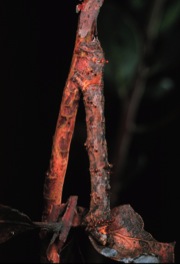
Figure 2. Camouflaged inchworm caterpillar on its host plant, manzanita, in southern Arizona. Photo by Michael S. Singer.

Figure 2. Camouflaged inchworm caterpillar on its host plant, manzanita, in southern Arizona. Photo by Michael S. Singer.


Over the last 50 years, many additional, important observations and experiments have reinforced these evolutionary theories of prey defense. But the vast majority of experimental studies used captive avian predators or artificial prey (such as dead or artificial insects) exposed to wild birds, leaving some question about the effectiveness of aposematism and camouflage in natural predator-prey interactions, which are notoriously difficult to observe directly in the wild. In the mean time, new techniques and technologies have emerged that allow researchers new modes of studying prey defenses in the wild.

Figure 3. Black-capped chickadee with a captured caterpillar in one of the forest sites used to study bird predation of caterpillars in Connecticut. Photo by Christian Skorik.

Figure 3. Black-capped chickadee with a captured caterpillar in one of the forest sites used to study bird predation of caterpillars in Connecticut. Photo by Christian Skorik.


Enter the new study by Lichter-Marck and colleagues, “The struggle for safety: effectiveness of caterpillar defenses against bird predation.” This study used a bird-exclusion field experiment set in the forests of Connecticut, USA to test evolutionary theories of prey defense in the context of a natural ecological community. Over four years, the research team surrounded hundreds of experimental tree branches with garden-variety bird-proof netting, matching each experimental branch with a control branch lacking netting. The netting was applied at the beginning of each growing season, and allowed caterpillars to come and go while preventing access to insectivorous birds. Three weeks later, the researchers returned to each branch and collected the caterpillars living on them. By experiment’s end, the caterpillar species with the largest proportional increase in numbers in experimental branches (protected from bird predation) relative to control branches (open to bird predation) were inferred to suffer the most bird predation. By measuring the defensive traits of each caterpillar species and correlating them with the inferred magnitude of bird predation, the researchers could determine which traits were most effective as defenses against bird predation.


Figure 4. Red maple branch covered with a bird-exclusion net, one of the experimental branches used in this study. Photo by Christian Skorik.

Figure 4. Red maple branch covered with a bird-exclusion net, one of the experimental branches used in this study. Photo by Christian Skorik.


This unique methodological approach supported the main prediction of aposematism theory: among the 38 species of caterpillars that were numerous enough to analyze, those that possessed warning signals, such as bright coloration, received the most protection from birds. But the study revealed another, critical aspect of the warning strategy of defense: stereotypical resting location. The caterpillar species most protected from birds combined warning signals with highly stereotypical resting locations on the plant. That is, their appearance and their location together provided the warning signal to birds. This finding highlights the relatively neglected behavioral aspect of warning strategy of defense.


Figure 5. A warningly-signaled caterpillar species (Nola triquetrana) on its host plant, witch hazel, at one of the forest sites used in this study. Photo by Michael S. Singer.

Figure 5. A warningly-signaled caterpillar species (Nola triquetrana) on its host plant, witch hazel, at one of the forest sites used in this study. Photo by Michael S. Singer.


Yet the majority of the 38 caterpillar species did not possess warning signals, instead employing camouflage as their primary defensive strategy. Because visual camouflage can result from several different tricks in appearance (disruptive patterns, countershading, etc.), the magnitude of camouflage can be difficult to measure. The researchers turned to an increasingly used method, the human proxy predator assay. In this assay, human participants were shown digital images of the caterpillar species resting on their host plants, and a computer program was designed to record how quickly each participant located each caterpillar with an accurate click of the mouse. The longer it took, on average, to find a caterpillar species, the greater the magnitude of camouflage was inferred.


Figure 6. A camouflaged caterpillar species (Catocala ultronia) on its host plant, black cherry, at one of the forest sites used in this study. Photo by Michael S. Singer.

Figure 6. A camouflaged caterpillar species (Catocala ultronia) on its host plant, black cherry, at one of the forest sites used in this study. Photo by Michael S. Singer.


In support of evolutionary theory of prey defense, the study found that the caterpillar species with the greatest inferred magnitudes of camouflage received the most protection from birds. Once again, this part of the study revealed a behavioral twist. A caterpillar species’ frequency of behavioral responsiveness to attack, measured independently, worked against the effectiveness of camouflage. This finding suggests that effective camouflage requires not only an appearance that matches the prey’s background, but also behavioral maintenance of the cryptic posture in the face of physical disturbance.

The authors, through Michael S. Singer

Western blind spot: the Kurds’ war against Islamic State in Syria Updated for 2026


The current narrative from Cameron and Obama is simple: the head-chopping Islamic State is a threat to all of humanity, so western forces need to return to the Middle East.

Yet this narrative is far from supported by the empirical evidence. Non-existent weapons of mass destruction and non-existent Islamic fundamentalist jihadists were used to justify the invasion of Iraq in 2003 by George Bush and Tony Blair.

Iraq was transformed from secular totalitarianism to chaos: in turn, chaos and opposition to occupation seeded a jihadist movement.

Western support for opponents of Assad in Syria gave the so-called ‘Islamic State’ an opportunity to take territory. ISIS was able to seize huge quantities of heavy weaponry supplied by the USA and its allies.

Thus, if US intervention has created or at least massively accelerated the growth of a monster, critics argue that more intervention will no doubt provide the Islamic State with more weapons, more support and more chaos on which to thrive.

Islamic State’s most successful enemy is Turkey’s enemy

Another reason for doubting the narrative is the fact that the most successful opponents of ISIS are not only unsupported by the west but are effectively at war with a NATO ally.

If the ‘war on terror’ was real, the words ‘Kobane’, ‘Rojava’ and ‘YPG’ would be on our TV screens more often than a marriage date with George Clooney. In fact, few of us have much knowledge of the forgotten war in the Middle East. This is a war that ISIS, up until a few days ago, was losing.

But a NATO country has joined to help defeat not the jihadist beheaders, but their most feared opponents.

As I write, the city of Kobane in the mostly Kurdish city in northern Syria is under threat from ISIS, who have laid siege to the city for several weeks, and media reports today suggest the city is about to fall.

ISIS forces from all over the region – equipped with tanks and missiles stolen from Iraqi forces supplied by Qatar and the USA – have sustained a huge attack on this city on the border of Turkey.

You won’t hear about Kobane on much of the media and not so far in speeches from Obama and Cameron. These are the Kurds the west does not support, and mentioning their very existence is virtually an existential threat.

In Rojava, religious pluralism is strongly promoted

The Kurds, who are said to be the largest stateless nation and are spread across Turkey, Syria, Iran and Iraq, have been fighting for autonomy for decades. The Kurdistan Workers Party (PKK) in Turkey saw their leader Ocalan captured in 1999. He remains in prison.

In Syria, as a result of the civil war, the Kurds have created an autonomous self-governing republic, made up of three cantons, one of which is Kobane. The three cantons are known collectively as Rojava [western Kurdistan]. For several years the Rojavans have been fighting and beating ISIS and other jihadists like the Al Nusra front.

When ISIS threatened thousands of Yazidi in Iraq, killing many and forcing others into apparently slavery, this triggered international outrage. It is largely forgotten that the People’s Protection Units (YPG), the community self-defence force from Rojava, crossed to Mount Sinjar and rescued many Yazidis.

While Rojava is known as a Kurdish territory, political and religious pluralism is strongly promoted. Syriac Christian militias are allied with the YPG, which also draws in Arab and Armenian fighters. Most Kurds are Sunni Muslims, although others are Yazidis.

A unique democratic experiment is being crushed with NATO weapons

The Kurdish Democratic Union Party (PYD) is usually seen as a sister party of the PKK but there are many other Kurdish and non Kurdish political parties in Rojava. The PKK affiliated party advocates political diversity, feminism and self-governance.

Originally a Marxist-Leninist organisation, remarkably the PKK sees itself as an anarchist political organisation inspired by the ideas of the American social ecologist and green anarchist, Murray Bookchin!

An anarchist from North London who visited Rojava noted that they are carrying out an almost unique democratic experiment:

“We went to a meeting of one the communes based in the neighborhood of Cornish in the town of Qamishlo. There were 16 to 17 people in the meeting. The majority of them were young women. We engaged in a deep conversation about their activities and their tasks.

“They told us that in their neighborhood they have 10 Communes and the membership of each Commune is 16 people. They told us ‘We act in the same way as community workers including meeting people, attending the weekly meetings, checking any problems in the places we are based, protecting people in the community and sorting out their problems, collecting the rubbish in the area, protecting the environment and attending the biggest meeting to report back about what happened in the last week.’

“In response to one of my questions, they confirmed that nobody, including any of the political parties, intervenes in their decision making and that they make all the decisions collectively.”

Others have termed Rojava the Chiapas of the Middle East, in reference to the Zapatistas of Mexico.

True freedom and ecological balance

The Rojava Charter, a kind of constitution, is a remarkable document. It states:

“We the peoples of the democratic self-administration areas; Kurds, Arabs, Assyrians (Assyrian Chaldeans, Arameans), Turkmen, Armenians, and Chechens, by our free will, announce this to ensure justice, freedom, democracy, and the rights of women and children in accordance with the principles of ecological balance, freedom of religions and beliefs, and equality without discrimination on the basis of race, religion, creed, doctrine or gender, to achieve the political and moral fabric of a democratic society in order to function with mutual understanding and coexistence within diversity and respect for the principle of self-determination and self-defense of the peoples …

“The autonomous areas of the democratic self-administration do not recognize the concept of the nation state and the state based on the grounds of military power, religion, and centralism.”

The feminist part of their ideology reflects a strong commitment: in fact 30% of YPG members are women, all-woman fighting units (YPJ), are common, and women share the highest military rank with men.

The threat of a good example?

Rojava offers the threat of a good example. A self-governing anarchist society with ecological aspirations may or may not be the utopia it sounds like, however the west has little time for alternatives to capitalism that might just work. The allies of the US and UK tell us all we need to know about their war on terror.

These allies include Saudi Arabia, which beheads citizens on a regular basis, outlaws LGBT people, doesn’t allow women to drive and like ISIS, does not tolerate churches, Shia mosques or the advocacy of religions other than the most constrained form of Islam.

Like Saudi Arabia, Qatar has funded jihadists, and then we come to Bahrain which has been heavily repressing their population.

The roll call of allies is a list of shame, which includes some of the most repressive states on our planet. It is an oil-soaked catalogue of monsters. The Kurds currently armed and supported by the US in Iraq belong to a rival political organisation to the PYD.

The suspicion is that Islamic State attacks, which were moving in on the shopping malls and US centres in Iraqi Kurdistan, prompted the US intervention. For, however loud the calls are to oppose ISIS, the YPG who so far have been the most effective opponents of jihadism are largely ignored.

A NATO member’s military and economic links with Islamic State

Turkey, another NATO ally, has been accused of supporting ISIS, as part of its longstanding conflict with the Kurds. Turkey has refused to fight ISIS, their border has been porous to jihadists wishing to join ISIS and the recent release of over 49 Turkish hostages by ISIS has been met with a suggestion of a deal between Turkey and the so-called Islamic State.

Turkey has been strongly repressing the Kurds, and has argued for a buffer zone, which would essentially remove Rojava and replace it with Turkish troops. Turkey has also attempted to prevent thousands of Kurds from crossing the border to fight ISIS as they besiege Kobane.

It has been alleged that $800 million of oil has been sold by ISIS in Turkey. There is also evidence that Turkish troops have been training ISIS.

ISIS are currently concentrating their forces against their most effective opponents, the YPG and its independent democratic cause. In Kobane, the forces of ISIS terror, against which the west is supposedly at war, are at the door and massively outgun the besieged Kurds, thanks to the help of the west and its allies.

The dark ironies of geopolitics cannot be made clearer: ISIS is armed with weapons captured from the US, who flooded the region with weapons, while Turkey, a NATO member, is further strengthening the terrorism against which NATO has declared war, by repressing a democratic movement fighting indigenously against ISIS.

There have been reports of US attacks on ISIS positions near Kobane, but there is some debate as to whether these have been effective. Meryem Kobanê, Commander of the YPJ (Women’s Protection Units) in Kobane, noted on Saturday, September 27, that the strikes missed the ISIS forces.

The ‘war on Islamic terror’ is one of rhetoric, not reality

The US and UK intervention has brought nothing but misery to the Middle East. The silence from Obama and Cameron regarding Turkey’s repression of the Kurds, shows that the ‘war on terror’ is more about the rhetoric than reality.

All of us who want to see societies based on pluralism, self-governance, respect for minorities and empowerment of women, need to confront our elected leaders over their failure to challenge Turkish opposition to Rojava.

A victory for the Kurds and their allies in Rojava is a victory for all who want a future that is dictated neither by fundamentalists nor imperialists.


Derek Wall is International Coordinator of the Green Party of England and Wales.  He is a political economist, whose last book was ‘The Sustainable Economics of Elinor Ostrom‘, Routledge 2014. He is married to the community musician Emily Blyth and is a founder of Green Left, the anti-capitalist network in the Green Party.

He is also a columnist with the Morning Star and is completing his new book for Pluto ‘The Economics of anti-capitalism‘ which will be published in 2015. You can find him on twitter at @anothergreen.

This article was originally published by Open Democracy.

For more information on Rojava and the struggle against ISIS, see the following websites:


384950