Tag Archives: fish

For the love of cod, let’s save our disappearing seagrass Updated for 2026


Seagrass is one of the most important coastal habitats where young ocean-going fish such as Atlantic cod can grow and develop before setting out on the journey of life.

But these critically important habitats, revealed in new research, are being damaged the world over and its not just threatening biodiversity but our food security.

Some 30,000 km2 of seagrass (Zostera marina) has disappeared over the past two decades, about 18% of the global area. This is incredibly important.

One hectare of seagrass absorbs 1.2 kilogrammes of nutrients each year, equivalent to the treated effluent of 200 people. It can produce 100,000 litres of oxygen per day, can support 80,000 fish and 100m invertebrates – and absorb ten times as much CO2 as a pristine area of Amazon rainforest.

A vital habitat for marine life

Providing shallow-water habitats where young ocean-going fish can grow and develop is one of the key ecosystem services that our coastal seas provide, but unfortunately we largely don’t recognise the value of them in supporting the fishery resources of vast ocean basins.

We continue to allow the loss of this coastal habitat to occur throughout the world – in spite of regulations in many nations to protect key habitats and biodiversity.

The diminished status of fisheries for species such as the Atlantic cod (Gadus morhua) means we need to move beyond purely managing adult fish stocks and consider the interaction of individual high-value species within the whole seascape and the critical habitats within that.

This is critical as our declining fishery stocks do not align with the needs of the region or the planet as a whole. To meet the needs of the predicted human population of 2050, an additional 75m tons of protein from fish and aquatic invertebrates will be required – this is a 50% increase in current supply.

Seagrass as a nursery for juvenile cod

The Atlantic cod is a species of significant economic and historic importance but is now better known for its catastrophic decline. Apart from overfishing, the causes of this decline and its subsequent lack of recovery remain largely unresolved.

The degree to which specific coastal and shallow-water habitats are important for this species still remains unquantified at the scale of the North Atlantic.

There is extensive evidence of the presence of juvenile Atlantic cod in seagrass throughout the North Atlantic. Juvenile cod have been recorded in such high density in seagrass that they average 246 individuals per hectare.

This density of juvenile Atlantic cod is higher in seagrass meadows compared to alternative habitats. This includes an incredible dataset from Norway where researchers have sampled juvenile cod in seagrass annually since 1919 and other recent studies observing juvenile cod in seagrass in North Wales by our team at Swansea University using stereo Baited Remote Underwater Video systems and seine nets.

Juvenile Atlantic cod have greater long-term viability after having spent time in seagrass, which improves their chances of reaching maturity. Our new analysis, published in the open access journal, Global Ecology and Conservation, illustrates how juvenile Atlantic cod grow faster in seagrass than in surrounding alternative habitat types and have higher survival rates from predation.

Although juvenile Atlantic cod do not always need to use seagrass meadows as juvenile habitats, it appears that they may intentionally select seagrass as a nursery habitat. This data comes from studies throughout the Atlantic including Newfoundland in the west and Sweden in the east.

Biodiversity and food security

The study, conducted in collaboration with Richard Lilley at Cardiff University, was an extensive meta-analysis of research on the life history of the Atlantic cod resulting in a review and synthesis of its nursery habitat usage.

It includes data sources from throughout the region, ranging from Newfoundland, to Norway, to Scotland and to Sweden.

Our work provides strong evidence that seagrass meadows are of significant importance to contributing to Atlantic cod stocks, and our review presents extensive quantitative evidence of the role of seagrass as valuable nursery habitat for Atlantic cod. These findings are of major significance given the continued threats to these systems.

Seagrass meadows are globally important resources that are being threatened by a whole series of issues ranging from climate change and major weather events to boating activity, poor water quality and coastal development.

This work clearly illustrates how key habitats in our coastal seas such as seagrass need protecting, not just for biodiversity but for the continued food security provided by our oceans.


Richard K.F. Unsworth is Research Officer (Marine Ecology) at the University of Swansea. He does not work for, consult to, own shares in or receive funding from any company or organisation that would benefit from this article, and has no relevant affiliations.

This article was originally published on The Conversation. Read the original article.

The Conversation


386327

For the love of cod, let’s save our disappearing seagrass Updated for 2026


Seagrass is one of the most important coastal habitats where young ocean-going fish such as Atlantic cod can grow and develop before setting out on the journey of life.

But these critically important habitats, revealed in new research, are being damaged the world over and its not just threatening biodiversity but our food security.

Some 30,000 km2 of seagrass (Zostera marina) has disappeared over the past two decades, about 18% of the global area. This is incredibly important.

One hectare of seagrass absorbs 1.2 kilogrammes of nutrients each year, equivalent to the treated effluent of 200 people. It can produce 100,000 litres of oxygen per day, can support 80,000 fish and 100m invertebrates – and absorb ten times as much CO2 as a pristine area of Amazon rainforest.

A vital habitat for marine life

Providing shallow-water habitats where young ocean-going fish can grow and develop is one of the key ecosystem services that our coastal seas provide, but unfortunately we largely don’t recognise the value of them in supporting the fishery resources of vast ocean basins.

We continue to allow the loss of this coastal habitat to occur throughout the world – in spite of regulations in many nations to protect key habitats and biodiversity.

The diminished status of fisheries for species such as the Atlantic cod (Gadus morhua) means we need to move beyond purely managing adult fish stocks and consider the interaction of individual high-value species within the whole seascape and the critical habitats within that.

This is critical as our declining fishery stocks do not align with the needs of the region or the planet as a whole. To meet the needs of the predicted human population of 2050, an additional 75m tons of protein from fish and aquatic invertebrates will be required – this is a 50% increase in current supply.

Seagrass as a nursery for juvenile cod

The Atlantic cod is a species of significant economic and historic importance but is now better known for its catastrophic decline. Apart from overfishing, the causes of this decline and its subsequent lack of recovery remain largely unresolved.

The degree to which specific coastal and shallow-water habitats are important for this species still remains unquantified at the scale of the North Atlantic.

There is extensive evidence of the presence of juvenile Atlantic cod in seagrass throughout the North Atlantic. Juvenile cod have been recorded in such high density in seagrass that they average 246 individuals per hectare.

This density of juvenile Atlantic cod is higher in seagrass meadows compared to alternative habitats. This includes an incredible dataset from Norway where researchers have sampled juvenile cod in seagrass annually since 1919 and other recent studies observing juvenile cod in seagrass in North Wales by our team at Swansea University using stereo Baited Remote Underwater Video systems and seine nets.

Juvenile Atlantic cod have greater long-term viability after having spent time in seagrass, which improves their chances of reaching maturity. Our new analysis, published in the open access journal, Global Ecology and Conservation, illustrates how juvenile Atlantic cod grow faster in seagrass than in surrounding alternative habitat types and have higher survival rates from predation.

Although juvenile Atlantic cod do not always need to use seagrass meadows as juvenile habitats, it appears that they may intentionally select seagrass as a nursery habitat. This data comes from studies throughout the Atlantic including Newfoundland in the west and Sweden in the east.

Biodiversity and food security

The study, conducted in collaboration with Richard Lilley at Cardiff University, was an extensive meta-analysis of research on the life history of the Atlantic cod resulting in a review and synthesis of its nursery habitat usage.

It includes data sources from throughout the region, ranging from Newfoundland, to Norway, to Scotland and to Sweden.

Our work provides strong evidence that seagrass meadows are of significant importance to contributing to Atlantic cod stocks, and our review presents extensive quantitative evidence of the role of seagrass as valuable nursery habitat for Atlantic cod. These findings are of major significance given the continued threats to these systems.

Seagrass meadows are globally important resources that are being threatened by a whole series of issues ranging from climate change and major weather events to boating activity, poor water quality and coastal development.

This work clearly illustrates how key habitats in our coastal seas such as seagrass need protecting, not just for biodiversity but for the continued food security provided by our oceans.


Richard K.F. Unsworth is Research Officer (Marine Ecology) at the University of Swansea. He does not work for, consult to, own shares in or receive funding from any company or organisation that would benefit from this article, and has no relevant affiliations.

This article was originally published on The Conversation. Read the original article.

The Conversation


386327

For the love of cod, let’s save our disappearing seagrass Updated for 2026


Seagrass is one of the most important coastal habitats where young ocean-going fish such as Atlantic cod can grow and develop before setting out on the journey of life.

But these critically important habitats, revealed in new research, are being damaged the world over and its not just threatening biodiversity but our food security.

Some 30,000 km2 of seagrass (Zostera marina) has disappeared over the past two decades, about 18% of the global area. This is incredibly important.

One hectare of seagrass absorbs 1.2 kilogrammes of nutrients each year, equivalent to the treated effluent of 200 people. It can produce 100,000 litres of oxygen per day, can support 80,000 fish and 100m invertebrates – and absorb ten times as much CO2 as a pristine area of Amazon rainforest.

A vital habitat for marine life

Providing shallow-water habitats where young ocean-going fish can grow and develop is one of the key ecosystem services that our coastal seas provide, but unfortunately we largely don’t recognise the value of them in supporting the fishery resources of vast ocean basins.

We continue to allow the loss of this coastal habitat to occur throughout the world – in spite of regulations in many nations to protect key habitats and biodiversity.

The diminished status of fisheries for species such as the Atlantic cod (Gadus morhua) means we need to move beyond purely managing adult fish stocks and consider the interaction of individual high-value species within the whole seascape and the critical habitats within that.

This is critical as our declining fishery stocks do not align with the needs of the region or the planet as a whole. To meet the needs of the predicted human population of 2050, an additional 75m tons of protein from fish and aquatic invertebrates will be required – this is a 50% increase in current supply.

Seagrass as a nursery for juvenile cod

The Atlantic cod is a species of significant economic and historic importance but is now better known for its catastrophic decline. Apart from overfishing, the causes of this decline and its subsequent lack of recovery remain largely unresolved.

The degree to which specific coastal and shallow-water habitats are important for this species still remains unquantified at the scale of the North Atlantic.

There is extensive evidence of the presence of juvenile Atlantic cod in seagrass throughout the North Atlantic. Juvenile cod have been recorded in such high density in seagrass that they average 246 individuals per hectare.

This density of juvenile Atlantic cod is higher in seagrass meadows compared to alternative habitats. This includes an incredible dataset from Norway where researchers have sampled juvenile cod in seagrass annually since 1919 and other recent studies observing juvenile cod in seagrass in North Wales by our team at Swansea University using stereo Baited Remote Underwater Video systems and seine nets.

Juvenile Atlantic cod have greater long-term viability after having spent time in seagrass, which improves their chances of reaching maturity. Our new analysis, published in the open access journal, Global Ecology and Conservation, illustrates how juvenile Atlantic cod grow faster in seagrass than in surrounding alternative habitat types and have higher survival rates from predation.

Although juvenile Atlantic cod do not always need to use seagrass meadows as juvenile habitats, it appears that they may intentionally select seagrass as a nursery habitat. This data comes from studies throughout the Atlantic including Newfoundland in the west and Sweden in the east.

Biodiversity and food security

The study, conducted in collaboration with Richard Lilley at Cardiff University, was an extensive meta-analysis of research on the life history of the Atlantic cod resulting in a review and synthesis of its nursery habitat usage.

It includes data sources from throughout the region, ranging from Newfoundland, to Norway, to Scotland and to Sweden.

Our work provides strong evidence that seagrass meadows are of significant importance to contributing to Atlantic cod stocks, and our review presents extensive quantitative evidence of the role of seagrass as valuable nursery habitat for Atlantic cod. These findings are of major significance given the continued threats to these systems.

Seagrass meadows are globally important resources that are being threatened by a whole series of issues ranging from climate change and major weather events to boating activity, poor water quality and coastal development.

This work clearly illustrates how key habitats in our coastal seas such as seagrass need protecting, not just for biodiversity but for the continued food security provided by our oceans.


Richard K.F. Unsworth is Research Officer (Marine Ecology) at the University of Swansea. He does not work for, consult to, own shares in or receive funding from any company or organisation that would benefit from this article, and has no relevant affiliations.

This article was originally published on The Conversation. Read the original article.

The Conversation


386327

For the love of cod, let’s save our disappearing seagrass Updated for 2026


Seagrass is one of the most important coastal habitats where young ocean-going fish such as Atlantic cod can grow and develop before setting out on the journey of life.

But these critically important habitats, revealed in new research, are being damaged the world over and its not just threatening biodiversity but our food security.

Some 30,000 km2 of seagrass (Zostera marina) has disappeared over the past two decades, about 18% of the global area. This is incredibly important.

One hectare of seagrass absorbs 1.2 kilogrammes of nutrients each year, equivalent to the treated effluent of 200 people. It can produce 100,000 litres of oxygen per day, can support 80,000 fish and 100m invertebrates – and absorb ten times as much CO2 as a pristine area of Amazon rainforest.

A vital habitat for marine life

Providing shallow-water habitats where young ocean-going fish can grow and develop is one of the key ecosystem services that our coastal seas provide, but unfortunately we largely don’t recognise the value of them in supporting the fishery resources of vast ocean basins.

We continue to allow the loss of this coastal habitat to occur throughout the world – in spite of regulations in many nations to protect key habitats and biodiversity.

The diminished status of fisheries for species such as the Atlantic cod (Gadus morhua) means we need to move beyond purely managing adult fish stocks and consider the interaction of individual high-value species within the whole seascape and the critical habitats within that.

This is critical as our declining fishery stocks do not align with the needs of the region or the planet as a whole. To meet the needs of the predicted human population of 2050, an additional 75m tons of protein from fish and aquatic invertebrates will be required – this is a 50% increase in current supply.

Seagrass as a nursery for juvenile cod

The Atlantic cod is a species of significant economic and historic importance but is now better known for its catastrophic decline. Apart from overfishing, the causes of this decline and its subsequent lack of recovery remain largely unresolved.

The degree to which specific coastal and shallow-water habitats are important for this species still remains unquantified at the scale of the North Atlantic.

There is extensive evidence of the presence of juvenile Atlantic cod in seagrass throughout the North Atlantic. Juvenile cod have been recorded in such high density in seagrass that they average 246 individuals per hectare.

This density of juvenile Atlantic cod is higher in seagrass meadows compared to alternative habitats. This includes an incredible dataset from Norway where researchers have sampled juvenile cod in seagrass annually since 1919 and other recent studies observing juvenile cod in seagrass in North Wales by our team at Swansea University using stereo Baited Remote Underwater Video systems and seine nets.

Juvenile Atlantic cod have greater long-term viability after having spent time in seagrass, which improves their chances of reaching maturity. Our new analysis, published in the open access journal, Global Ecology and Conservation, illustrates how juvenile Atlantic cod grow faster in seagrass than in surrounding alternative habitat types and have higher survival rates from predation.

Although juvenile Atlantic cod do not always need to use seagrass meadows as juvenile habitats, it appears that they may intentionally select seagrass as a nursery habitat. This data comes from studies throughout the Atlantic including Newfoundland in the west and Sweden in the east.

Biodiversity and food security

The study, conducted in collaboration with Richard Lilley at Cardiff University, was an extensive meta-analysis of research on the life history of the Atlantic cod resulting in a review and synthesis of its nursery habitat usage.

It includes data sources from throughout the region, ranging from Newfoundland, to Norway, to Scotland and to Sweden.

Our work provides strong evidence that seagrass meadows are of significant importance to contributing to Atlantic cod stocks, and our review presents extensive quantitative evidence of the role of seagrass as valuable nursery habitat for Atlantic cod. These findings are of major significance given the continued threats to these systems.

Seagrass meadows are globally important resources that are being threatened by a whole series of issues ranging from climate change and major weather events to boating activity, poor water quality and coastal development.

This work clearly illustrates how key habitats in our coastal seas such as seagrass need protecting, not just for biodiversity but for the continued food security provided by our oceans.


Richard K.F. Unsworth is Research Officer (Marine Ecology) at the University of Swansea. He does not work for, consult to, own shares in or receive funding from any company or organisation that would benefit from this article, and has no relevant affiliations.

This article was originally published on The Conversation. Read the original article.

The Conversation


386327

For the love of cod, let’s save our disappearing seagrass Updated for 2026


Seagrass is one of the most important coastal habitats where young ocean-going fish such as Atlantic cod can grow and develop before setting out on the journey of life.

But these critically important habitats, revealed in new research, are being damaged the world over and its not just threatening biodiversity but our food security.

Some 30,000 km2 of seagrass (Zostera marina) has disappeared over the past two decades, about 18% of the global area. This is incredibly important.

One hectare of seagrass absorbs 1.2 kilogrammes of nutrients each year, equivalent to the treated effluent of 200 people. It can produce 100,000 litres of oxygen per day, can support 80,000 fish and 100m invertebrates – and absorb ten times as much CO2 as a pristine area of Amazon rainforest.

A vital habitat for marine life

Providing shallow-water habitats where young ocean-going fish can grow and develop is one of the key ecosystem services that our coastal seas provide, but unfortunately we largely don’t recognise the value of them in supporting the fishery resources of vast ocean basins.

We continue to allow the loss of this coastal habitat to occur throughout the world – in spite of regulations in many nations to protect key habitats and biodiversity.

The diminished status of fisheries for species such as the Atlantic cod (Gadus morhua) means we need to move beyond purely managing adult fish stocks and consider the interaction of individual high-value species within the whole seascape and the critical habitats within that.

This is critical as our declining fishery stocks do not align with the needs of the region or the planet as a whole. To meet the needs of the predicted human population of 2050, an additional 75m tons of protein from fish and aquatic invertebrates will be required – this is a 50% increase in current supply.

Seagrass as a nursery for juvenile cod

The Atlantic cod is a species of significant economic and historic importance but is now better known for its catastrophic decline. Apart from overfishing, the causes of this decline and its subsequent lack of recovery remain largely unresolved.

The degree to which specific coastal and shallow-water habitats are important for this species still remains unquantified at the scale of the North Atlantic.

There is extensive evidence of the presence of juvenile Atlantic cod in seagrass throughout the North Atlantic. Juvenile cod have been recorded in such high density in seagrass that they average 246 individuals per hectare.

This density of juvenile Atlantic cod is higher in seagrass meadows compared to alternative habitats. This includes an incredible dataset from Norway where researchers have sampled juvenile cod in seagrass annually since 1919 and other recent studies observing juvenile cod in seagrass in North Wales by our team at Swansea University using stereo Baited Remote Underwater Video systems and seine nets.

Juvenile Atlantic cod have greater long-term viability after having spent time in seagrass, which improves their chances of reaching maturity. Our new analysis, published in the open access journal, Global Ecology and Conservation, illustrates how juvenile Atlantic cod grow faster in seagrass than in surrounding alternative habitat types and have higher survival rates from predation.

Although juvenile Atlantic cod do not always need to use seagrass meadows as juvenile habitats, it appears that they may intentionally select seagrass as a nursery habitat. This data comes from studies throughout the Atlantic including Newfoundland in the west and Sweden in the east.

Biodiversity and food security

The study, conducted in collaboration with Richard Lilley at Cardiff University, was an extensive meta-analysis of research on the life history of the Atlantic cod resulting in a review and synthesis of its nursery habitat usage.

It includes data sources from throughout the region, ranging from Newfoundland, to Norway, to Scotland and to Sweden.

Our work provides strong evidence that seagrass meadows are of significant importance to contributing to Atlantic cod stocks, and our review presents extensive quantitative evidence of the role of seagrass as valuable nursery habitat for Atlantic cod. These findings are of major significance given the continued threats to these systems.

Seagrass meadows are globally important resources that are being threatened by a whole series of issues ranging from climate change and major weather events to boating activity, poor water quality and coastal development.

This work clearly illustrates how key habitats in our coastal seas such as seagrass need protecting, not just for biodiversity but for the continued food security provided by our oceans.


Richard K.F. Unsworth is Research Officer (Marine Ecology) at the University of Swansea. He does not work for, consult to, own shares in or receive funding from any company or organisation that would benefit from this article, and has no relevant affiliations.

This article was originally published on The Conversation. Read the original article.

The Conversation


386327

For the love of cod, let’s save our disappearing seagrass Updated for 2026


Seagrass is one of the most important coastal habitats where young ocean-going fish such as Atlantic cod can grow and develop before setting out on the journey of life.

But these critically important habitats, revealed in new research, are being damaged the world over and its not just threatening biodiversity but our food security.

Some 30,000 km2 of seagrass (Zostera marina) has disappeared over the past two decades, about 18% of the global area. This is incredibly important.

One hectare of seagrass absorbs 1.2 kilogrammes of nutrients each year, equivalent to the treated effluent of 200 people. It can produce 100,000 litres of oxygen per day, can support 80,000 fish and 100m invertebrates – and absorb ten times as much CO2 as a pristine area of Amazon rainforest.

A vital habitat for marine life

Providing shallow-water habitats where young ocean-going fish can grow and develop is one of the key ecosystem services that our coastal seas provide, but unfortunately we largely don’t recognise the value of them in supporting the fishery resources of vast ocean basins.

We continue to allow the loss of this coastal habitat to occur throughout the world – in spite of regulations in many nations to protect key habitats and biodiversity.

The diminished status of fisheries for species such as the Atlantic cod (Gadus morhua) means we need to move beyond purely managing adult fish stocks and consider the interaction of individual high-value species within the whole seascape and the critical habitats within that.

This is critical as our declining fishery stocks do not align with the needs of the region or the planet as a whole. To meet the needs of the predicted human population of 2050, an additional 75m tons of protein from fish and aquatic invertebrates will be required – this is a 50% increase in current supply.

Seagrass as a nursery for juvenile cod

The Atlantic cod is a species of significant economic and historic importance but is now better known for its catastrophic decline. Apart from overfishing, the causes of this decline and its subsequent lack of recovery remain largely unresolved.

The degree to which specific coastal and shallow-water habitats are important for this species still remains unquantified at the scale of the North Atlantic.

There is extensive evidence of the presence of juvenile Atlantic cod in seagrass throughout the North Atlantic. Juvenile cod have been recorded in such high density in seagrass that they average 246 individuals per hectare.

This density of juvenile Atlantic cod is higher in seagrass meadows compared to alternative habitats. This includes an incredible dataset from Norway where researchers have sampled juvenile cod in seagrass annually since 1919 and other recent studies observing juvenile cod in seagrass in North Wales by our team at Swansea University using stereo Baited Remote Underwater Video systems and seine nets.

Juvenile Atlantic cod have greater long-term viability after having spent time in seagrass, which improves their chances of reaching maturity. Our new analysis, published in the open access journal, Global Ecology and Conservation, illustrates how juvenile Atlantic cod grow faster in seagrass than in surrounding alternative habitat types and have higher survival rates from predation.

Although juvenile Atlantic cod do not always need to use seagrass meadows as juvenile habitats, it appears that they may intentionally select seagrass as a nursery habitat. This data comes from studies throughout the Atlantic including Newfoundland in the west and Sweden in the east.

Biodiversity and food security

The study, conducted in collaboration with Richard Lilley at Cardiff University, was an extensive meta-analysis of research on the life history of the Atlantic cod resulting in a review and synthesis of its nursery habitat usage.

It includes data sources from throughout the region, ranging from Newfoundland, to Norway, to Scotland and to Sweden.

Our work provides strong evidence that seagrass meadows are of significant importance to contributing to Atlantic cod stocks, and our review presents extensive quantitative evidence of the role of seagrass as valuable nursery habitat for Atlantic cod. These findings are of major significance given the continued threats to these systems.

Seagrass meadows are globally important resources that are being threatened by a whole series of issues ranging from climate change and major weather events to boating activity, poor water quality and coastal development.

This work clearly illustrates how key habitats in our coastal seas such as seagrass need protecting, not just for biodiversity but for the continued food security provided by our oceans.


Richard K.F. Unsworth is Research Officer (Marine Ecology) at the University of Swansea. He does not work for, consult to, own shares in or receive funding from any company or organisation that would benefit from this article, and has no relevant affiliations.

This article was originally published on The Conversation. Read the original article.

The Conversation


386327

Happy Flumpaween! Updated for 2026

1024px-Cymothoa_exigua_parassita_Lithognathus_mormyrus

It’s Friday and it’s October 31, so you are in store for a super spoooooky edition of our weekly list of links.

Zombies? Whatevs, anyone who studies parasites knows that zombies are all over the place in nature!

In the Pacific Northwest, the Sockeye salmon are running, and boy do they look like something out of Walking Dead. As they start the migration, they give up on fighting disease and other, you know, life-sustaining processes in favor of makin’ babies. By the time they are spawning, they are completely falling apart, covered in fungal lesions (increased local diversity!), with totally shredded fins. Hey LADIES!

And because poor spiders get such a bad rap this time of year, here is some spider public image enhancement propaganda. – Emily Grason

For your Halloween enjoyment, here’s Cymothoa exigua, a marine isopod that destroys and then replaces the tongue of an unlucky fish host. Females of this species crawl in through the fish’s gills, feed on the blood from the tongue (causing the organ to atrophy and die), and then spend the rest of their life as the new, more terrifying fish tongue. The worst part? C. exigua doesn’t actually kill the fish, meaning its host has to live out the rest of its life with a tiny little crustacean just inside its mouth.

You may know crinoids as the ancient, visually appealing stalked echinoderms commonly called sea lilies or feather stars. What you may not know is that though they’re mostly sessile, they are able to crawl along the seafloor in an unsettling, Samara-like manner. Speaking of unsuspecting scares, here’s an amazing video of a Clione (sea angel) catching its prey. – Nate Johnson

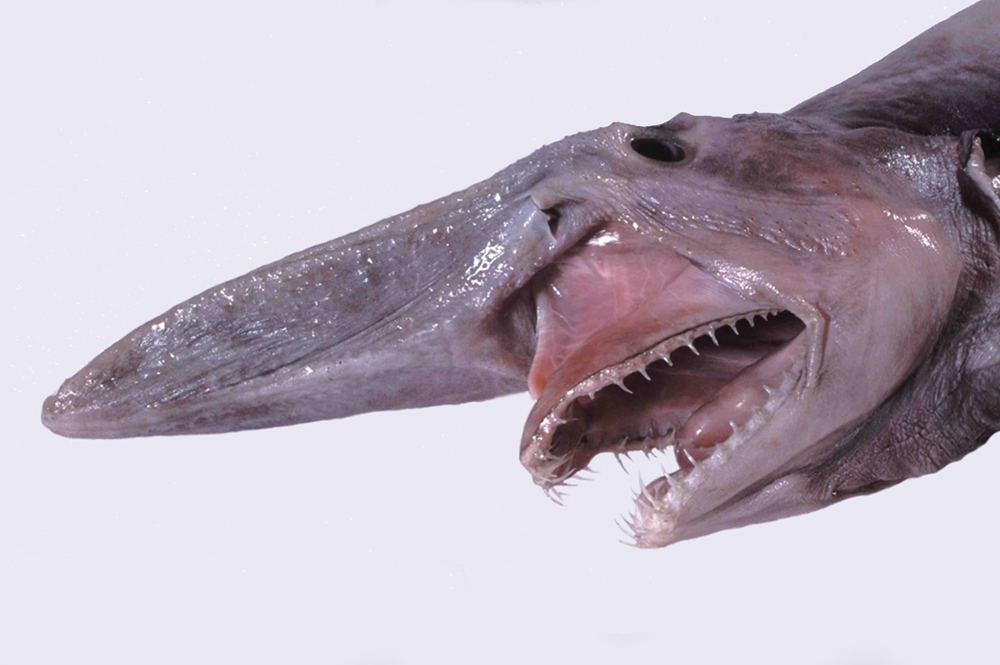
What’s that lurking in the deep dark cold waters of the abyss? Maybe it was a goblin shark with 30+ rows of teeth and a protrusible jaw to snap up its prey… hopefully, it was Vampyroteuthis infernalis… the “vampire” “squid” from hell. Check out this video for why this ghost of cephalopods past is really neither. If you make it into shallower waters, beware the Desmarestia spp. which produce sulfuric acid for that slow painful burn. Dubbing it the acid kelp. -Kylla Benes

I would have to say that nothing in nature is creepier than flesh eating bacteria, such as the Group A streptococcus, that can cause  Necrotizing fasciitis,  an infirmity commonly known as flesh-eating disease or flesh-eating bacteria syndrome that infects and kills thousands of people every year. 

If you want to learn a little bit more about mathematical modeling, while celebrating Halloween, here are a couple of interesting and educative papers inspired on some popular fictional characters: zombies and vampires. Both papers use differential equations and ecological and behavioral data “collected” from classic movies, books and/or TV series in order to understand the spread of these scary creatures in the human population; Munz et al. modeled the spread of a zombie outbreak among humans. Their results are very disturbing; a zombie outbreak is very likely to lead to the collapse of our civilized world, unless we deal with it right away, using aggressive “control methods”.  Strielkowski et al. modeled the co-existence of humans and vampires, under three different scenarios: i) the Stoker-King model, which was based on Bram Stoker’s “Dracula” and Stephen King’s “Salem’s Lot”; the Rice model, based on Anne Rice’s  “Vampire Chronicles”; iii)  the Harris-Meyer-Kostova model, based on Stephenie Meyer’s “Twilight series”, Charlaine Harris’ “Sookie Stockhouse, “True Blood”  and Elizabeth Kostova’s “The Historian”. Their results seem to be a little more comforting than Munz et al., as they show that, at least, the Harris-Meyer-Kostova model indicates that we could peacefully co-exist with vampires, without even noticing their existence. I guess, it comes as no surprise that the Stoker-King model is the most dramatic scenario, leading to a rapid extinction of both, humans and vampires… – Vinicius Bastazini.

Here’s a creepy, but (maybe psuedo)scientific book asking what the world will look like 50 million years after humans go extinct. A friend of mine found a first edition, and we’ve been thumbing through it over the past few weeks. My favorites are the creatures that inhabit the island of batavia – where bats have evolved to fill every ecological niche from flower-mimicking insectivores to seal-like creatures evocative humanity’s descendants in Kurt Vonnegut’s Galapagos.

5224704811_b1c98ea92b_b

The book was published two years after Gould and Lewontin’s Spandrels of San Marco, and I can’t help but wonder what they would have thought flipping through the pages. You can read through the entire book and check out all of the pictures here. -Fletcher Halliday

October 31, 2014

Fish before agribusiness! California river tribes demand water Updated for 2026


Hundreds of Tribal members and supporters from the Trinity and Klamath Rivers are protesting this week at the Bureau of Reclamation in Sacramento this week to demand increased water flows to prevent a mass killing of wild Chinook salmon.

‘Preventative flows’ are desperately needed from Lewiston Dam into the Trinity River, the largest tributary of the Klamath River, they said.

Campaigners also asked that more water be let out of Iron Gate Dam on the Klamath – and denounced Reclamation’s recent decision to withhold emergency releases until large numbers of adult salmon die.

They say that emergency flow releases from Lewiston Dam would take four days to reach the struggling Klamath River salmon – leaving few if any survivors.

Large scale fish kill is now ‘likely’

Fisheries biologists agree that by the time the emergency flows are triggered and the water has traveled from the dam, it would be too late to prevent a large-scale fish die-off.

“Klamath River flows are lower than they were during the 2002 fish kill”, says Nat Pennington, Fisheries Biologist for the Salmon River Restoration Council.

“River temperatures are consistently higher than the acute stress level for Chinook salmon at 72 degrees Fahrenheit. If this trend continues, a large-scale fish kill is likely and the Klamath could loose the entire run.”

And tribal members say Reclamation is ignoring the beginning stages of a disaster. “Fish are pooled up at cold water tributaries because the water in the river is so warm and polluted”, said Hoopa Valley Tribal member, Kayla Brown.

“These fish are diseased and dying. Once the disease starts to spread, it can’t be stopped and we will have a fish kill on our hands, courtesy of the Bureau of Reclamation.”

According to the Klamath Fish Health Assessment Team, much of the Klamath River and its tributaries are on an ‘orange’ alert level, signifying high temperatures, a critically dry water year designation, and increased fish mortality. “A die-off is imminent and management levels in agencies need to be alerted.”

Wild salmon before agribusiness irrigation!

The protestors said they support Klamath River fisheries biologists’ assertion that a minimum of 2,500 cubic feet per second be maintained near the mouth of the Klamath River. This can be achieved if the Bureau of Reclamation approves preventative releases from the Lewiston Dam reservoir.

When the dams and diversion tunnels were built on the Trinity, laws were set up to protect the river and fish, before exporting water to the Central Valley. These laws established that fish, and the tribes that depend on them, are the top priority for the Trinity River flows.

But currently, five times more water is diverted to the Sacramento Basin for Central Valley irrigators than is released into the Trinity River. Even at this critical time, the Bureau of Reclamation appears set to ignore the law in order to favour California’s powerful agribusiness interests.

We will not give up our fight for the salmon

Karuk tribal member Molli White said: “Reclamation says they need the water for Sacramento River salmon, but our rivers are actually being exported to meet the demands of corporate agriculture like the Westland’s Water district.”

California’s almond growers are projecting an 8% increase in harvests, he added, while the rest of California experiences a devastating drought year.

“We need these releases now more then ever”, said Frankie Myers of the Yurok Tribe Watershed Restoration Program,

“The Klamath fish kill of 2002 was devastating for our tribal communities and to the West Coast Fisheries. Previously, Tribes, fisheries scientists, and the Department of the Interior have worked together to avert fish kills by releasing preventative flows during drought years.”

Klamath Justice Coalition members have made it clear that Tribal people and traditional fishermen will not give up until Reclamation releases water.

“Historically, the Klamath River was one of the three most productive salmon rivers in America”, according to California’s Friends of the River campaign group. “Today dams, diversions, and other basin activities have caused coho and fall Chinook salmon populations to decline to 10% of historic numbers.”


Follow the Klamath Justice Coalition on twitter at #releasethewater #savethesalmon #stopafishkill #neveragain

Information about current river conditions and fisheries health.

Past Articles:


383055