Tag Archives: know

Profits before whales! To know why TTIP would be a nightmare, look to Canada Updated for 2026


If anyone tries to convince you that TTIP is no threat to a government’s ability to protect its people, just point them to Canada.

Last week, Canada’s government was successfully sued for daring to turn down a large mining quarry which threatened to cause environmental damage in Nova Scotia.

It is the latest in a long line of cases which have been brought against Canada for attempting to introduce environmental protection, under NAFTA – the North America Free Trade Agreement. These cases have been brought about under exactly the same mechanism – known as ISDS (Investor State Dispute Settlement) – which is at the centre of the TTIP deal.

ISDS is essentially a corporate court system – allowing foreign corporations to sue governments in secret tribunals, overseen by corporate lawyers, with no right of appeal. Even winning can cost a country a small fortune in legal costs.

Canada has to pay $100s of millions in ‘compensation’

The most recent ruling focuses on Canada’s decision, following an environmental review, to block the White’s Point 152-hectare basalt quarry on Digby Neck in Nova Scotia – which happens to be a key breeding area for cetaceans, increasingly popular among whale-watchers.

Among the species regularly frequenting nearby waters are Finback Whales, Minke Whales, Harbor Porpoises, Humpback Whales, Whitesided Dolphins, the endangered North Atlantic Right Whale, and there have been sightings of Pilot, Beluga, Sei, Sperm Whales and Orcas.

US corporation Bilcon wanted to open the quarry and argued that it had put time and money into the development. The province’s environmental review, however, found that the project clashed with community core values, and the quarry blasting and shipping movements would be detrimental to the area’s cetaceans.

The company argued that the government shouldn’t even have resorted to an environmental review. It has now won its case before the NAFTA arbitration panel, which ruled in its 260-page judgment that Bilcon was “denied a fair environmental hearing”. It is now demanding $300 million in compensation.

Two aspects of this case prove what critics have always said about these corporate courts. First, the case didn’t relate to a breach of contract or to discrimination in favour of a domestic company. It simply related to a regulation which a foreign corporation didn’t like.

Second, the case is a challenge to Canada’s ability to make decisions based on environmental protection, as pointed out by the one dissenting voice in this tribunal, that of Ottawa law professor Donald McRae who warned:

“A chill will be imposed on environmental review panels which will be concerned not to give too much weight to socio-economic considerations or other considerations of the human environment in case the result is a claim for damages under NAFTA.”

The ruling, he continued “will be seen as a remarkable step backwards in environmental protection” and a “significant intrusion into domestic jurisdiction.”

Environmental protection subordinate to corporate profit

Canada has been sued for environmental protection regulations again and again. Previous cases include Canada being taken to task for attempting to ban the import of toxic waste and for trying to prohibit dangerous chemical MMT from petrol. In the latter case, Canada reversed its ban.

And only days before the Bilcon ruling, Canada had a $17.3-million award made against it for a regulation which required oil giant Exxon Mobil and Murphy Oil (along with other offshore oil producers) to invest some of their profits from offshore drilling in the local economy.

It has been suggested that unless the requirement is withdrawn, this will be the tip of the iceberg in terms of ‘compensation’ – another example of a completely moderate and sensible government regulation being threatened by unelected, unaccountable corporate lawyers. 

It is often claimed that these corporate courts ‘only’ effect developing countries with dubious standards of law. That would be bad enough, but Canada is not a developing country, yet has lost millions of dollars to these corporate courts after signing an investment deal like TTIP with the US. These cases should be instructive to European governments.

The European Commission is keen to tell us that they are reforming the corporate court procedure for TTIP, so there’s no need to worry. But from what we’ve seen of such reforms to date, they may actually make matters worse. Veteran investment arbitrator Todd Weiler said of the reformed system:

“I love it, the new Canadian-EU treaty … we used to have to argue about all of those [foreign investor rights] … And now we have this great list. I just love it when they try to explain things.”

In the UK, the political divide is laid bare

In a ground-breaking report, the House of Commons Business Select Committee came out today saying it wasn’t convinced of the need for the corporate court system. Against them are ranged Conservatives and Liberal Democrats who support TTIP and its ISDS provisions, often with great enthusiasm.

Lobbying of MPs and MEPs has shown that Labour representatives are looking for significant reform of ISDS before they will be persuaded to vote for CETA or TTIP, while Green Party, SNP and UKIP MEPs are voting against the deal.

It has recently been flagged by a number of US Senate Democrats as a reason to oppose TTIP. 

Negotiations on TTIP between the EU and the US are continuing, amid reports of “problems” over the inclusion of ISDS in the agreement. In an earlier public consultation on ISDS in TTIP, over 150,000 respondents participated – 97% of them opposing ISDS. The next round of negotiations will take place in Washington DC in the week starting 20th April.

Canada’s experience shows why it’s important for progressive politicians to stick to their guns – and for those now supporting ISDS to rethink their position. The corporate court system fundamentally challenges our ability to protect the environment. However you reform it, it has no role in a democratic society.


Action: an International Day of Action against all ‘free trade’ deals is planned for Saturday 18 April in association with Stop TTIP.

Sign an EU-wide petition against TTIP – it already has 1.6 million signatures and has a target of 2 million by October 2015.

Nick Dearden is director of the Global Justice Now (formerly World Development Movement), and former director of the Jubilee Debt Campaign.

This article is an updated version of one first published by Global Justice Now.


391620

NATO invents Russian threats in the Baltic – but Putin’s next big play is Greece Updated for 2026


Russian President Vladimir Putin will “launch a campaign of undercover attacks to destabilise the Baltic states on Nato’s eastern flank”, the Telegraph reports today – along with all other mainstream news media.

How do we know this? Because the UK’s Defence Secretary Michael Fallon has said so. Lithuania, Estonia and Latvia watch out – the Russian peril is fast coming your way.

“There are lots of worries”, Fallon told the newspaper. “I’m worried about Putin. There’s no effective control of the border, I’m worried about his pressure on the Baltics, the way he is testing NATO, the submarines and aircraft … They are modernising their conventional forces, they are modernising their nuclear forces and they are testing NATO, so we need to respond.”

Covert attack by Russia on the Baltic states is “a very real and present danger”, Fallon insisted. Now where did we hear that before? Ah yes. On 16th December 1998 President Bill Clinton said that that Iraqi President Saddam Hussein presented a clear and present dangerto the stability of the Persian Gulf and the safety of people everywhere.

We all know where that led: the Iraq war followed a few years later. We also know that the claim was a monstrous untruth: Saddam had no chemical, biological or nuclear weapons. So why should we believe Fallon now? Where is his evidence? He has none. When you already know the truth, who needs evidence?

Fallon – and NATO – should keep their eyes on the ball

But while Fallon’s attention is focused on the imaginary threat to the Baltic states, there is another country that really could be ‘at risk’ – and not because of cyber-attack, invasion by ‘green men’ or a campaign of destabilisation emanating from the Kremlin.

No, the EU, the European Central Bank, the IMF and European finance ministers have already been doing all the destabilisation that’s needed – forcing Greece into a deep programme of austerity that has seen the economy shrink by 25% over five years, the closure of vital public services, mass unemployment and the forced sell-off of public assets.

And now the Greeks – and their newly elected Syriza government – have had enough. This week the Greek prime minister Alexis Tsipras flatly refused to renew the €240 billion ‘bailout’ package, which comes with all the austerity strings, and he today advanced proposals for a ‘six-month assistance package’ free of harsh conditions to give Greece time to renegotiate its debt.

The standoff continues, and will be decided tomorrow by EU finance ministers. It’s not looking good: Germany has already stated that the Greek proposal “does not meet the conditions”. But if the finance minsters don’t agree, then what?

You guessed it: Tsipras will turn to Russia. Earlier this month Tsipras and Putin agreed on a range of bilateral ties, including the construction of a pipeline that would carry Russian natural gas from the Turkish border across Greece to the other countries of southern Europe.

This follows the re-routing of the ‘South Stream’ pipeline, which had been due to cross Bulgaria but was effectively blocked by the EU’s retrospective application of energy market rules, under heavy pressure from the USA. Last November and December Putin negotiated the pipeline’s realignment across Turkey with Turkish President Erdogan – right up to the Greek border.

Following the agreement between Putin and Tsipras, which came complete with an invitation to Moscow on Victory over the Nazis day, 9th May, the pipeline link to the major countries of southern Europe is now complete, at least on paper. And once it’s built, Greece will effectively control – and profit from – that gas supply, and take a strategic position in Europe’s energy landscape.

But Greece is a NATO member!

Greece’s increasingly warm relationship with Russia is already causing concern among other EU and NATO countries. German Defense Minister Ursula von Der Leyen has said that Greece was “putting at risk its position in the NATO alliance with its approach to Russia.”

This provoked a fierce retort from Greek Defense Minister Panos Kammenos who branded the attack as “unacceptable and extortionate” – noting that “Greece was always on the side of the Allies when they pushed back German occupation troops.”

“Statements that replace the EU and NATO’s institutional bodies are unacceptable as blackmailing”, he added. “They undermine the European institutions except if Germany’s aim is to dissolve the European Union and the NATO.”

So if Tsipras’s refinancing proposal is refused tomorrow will Greece quit NATO and the EU, to join the Eurasian Union? Not if Mr Putin gets his way: Greece is worth much more to Russia as an ally within the EU and NATO than outside – where it can veto more trade sanctions against Russia, block the TTIP and CETA trade deals with the USA and Canada, and oppose NATO’s increasing belligerence from within.

But we could see Greece simply renouncing its manifestly unpayable and unjust €320 billion national debt, and quitting the Eurozone straitjacket – while receiving an emergency liquidity package from Russia to support the launch of the New Drachma.

In fact, we could see a re-run of important elements of the Ukraine play of December 2013, when Russia offered a support package under which it would buy $15 billion in bonds from Ukraine, supporting its collapsing currency, and supply it with deeply discounted gas – £268 per cubic metre rather than the maarket price of $400.

A $15 billion purchase of New Drachma denominated Greek bonds would be a superb launch for Greece’s new currency, and would firmly cement Greece’s long term alliance with Russia, providing it with a valuable long term bridgehead into both the EU and NATO.

This move would also give inspiration and confidence to progressive political movements across Europe that take inspiration from Syriza’s fight for economic justice – in Spain, Portugal, Ireland, Italy, the UK and beyond – and bear the powerful message: there is an alternative.

And while NATO, the EU, the USA and their loyal servants, among them the UK’s Michael Fallon, deliberately whip up a fictitious threat in the Baltic, ignoring the real danger they face to the south, the masterly Mr Putin would once again make fools of them all.


Oliver Tickell edits The Ecologist, but this article is written in a personal capacity.


390438

Happy Flumpaween! Updated for 2026

1024px-Cymothoa_exigua_parassita_Lithognathus_mormyrus

It’s Friday and it’s October 31, so you are in store for a super spoooooky edition of our weekly list of links.

Zombies? Whatevs, anyone who studies parasites knows that zombies are all over the place in nature!

In the Pacific Northwest, the Sockeye salmon are running, and boy do they look like something out of Walking Dead. As they start the migration, they give up on fighting disease and other, you know, life-sustaining processes in favor of makin’ babies. By the time they are spawning, they are completely falling apart, covered in fungal lesions (increased local diversity!), with totally shredded fins. Hey LADIES!

And because poor spiders get such a bad rap this time of year, here is some spider public image enhancement propaganda. – Emily Grason

For your Halloween enjoyment, here’s Cymothoa exigua, a marine isopod that destroys and then replaces the tongue of an unlucky fish host. Females of this species crawl in through the fish’s gills, feed on the blood from the tongue (causing the organ to atrophy and die), and then spend the rest of their life as the new, more terrifying fish tongue. The worst part? C. exigua doesn’t actually kill the fish, meaning its host has to live out the rest of its life with a tiny little crustacean just inside its mouth.

You may know crinoids as the ancient, visually appealing stalked echinoderms commonly called sea lilies or feather stars. What you may not know is that though they’re mostly sessile, they are able to crawl along the seafloor in an unsettling, Samara-like manner. Speaking of unsuspecting scares, here’s an amazing video of a Clione (sea angel) catching its prey. – Nate Johnson

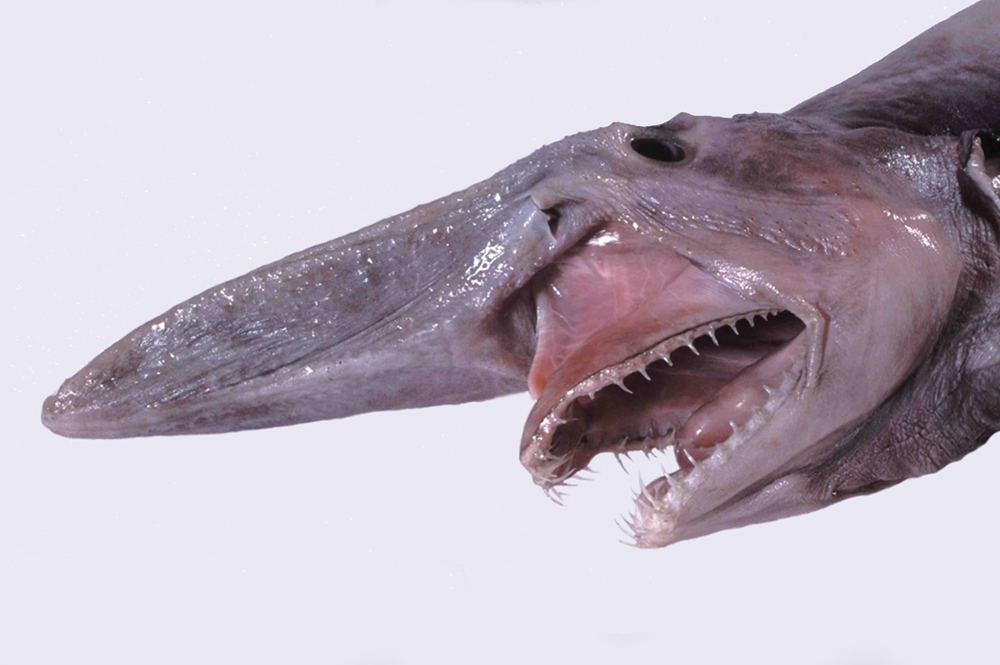
What’s that lurking in the deep dark cold waters of the abyss? Maybe it was a goblin shark with 30+ rows of teeth and a protrusible jaw to snap up its prey… hopefully, it was Vampyroteuthis infernalis… the “vampire” “squid” from hell. Check out this video for why this ghost of cephalopods past is really neither. If you make it into shallower waters, beware the Desmarestia spp. which produce sulfuric acid for that slow painful burn. Dubbing it the acid kelp. -Kylla Benes

I would have to say that nothing in nature is creepier than flesh eating bacteria, such as the Group A streptococcus, that can cause  Necrotizing fasciitis,  an infirmity commonly known as flesh-eating disease or flesh-eating bacteria syndrome that infects and kills thousands of people every year. 

If you want to learn a little bit more about mathematical modeling, while celebrating Halloween, here are a couple of interesting and educative papers inspired on some popular fictional characters: zombies and vampires. Both papers use differential equations and ecological and behavioral data “collected” from classic movies, books and/or TV series in order to understand the spread of these scary creatures in the human population; Munz et al. modeled the spread of a zombie outbreak among humans. Their results are very disturbing; a zombie outbreak is very likely to lead to the collapse of our civilized world, unless we deal with it right away, using aggressive “control methods”.  Strielkowski et al. modeled the co-existence of humans and vampires, under three different scenarios: i) the Stoker-King model, which was based on Bram Stoker’s “Dracula” and Stephen King’s “Salem’s Lot”; the Rice model, based on Anne Rice’s  “Vampire Chronicles”; iii)  the Harris-Meyer-Kostova model, based on Stephenie Meyer’s “Twilight series”, Charlaine Harris’ “Sookie Stockhouse, “True Blood”  and Elizabeth Kostova’s “The Historian”. Their results seem to be a little more comforting than Munz et al., as they show that, at least, the Harris-Meyer-Kostova model indicates that we could peacefully co-exist with vampires, without even noticing their existence. I guess, it comes as no surprise that the Stoker-King model is the most dramatic scenario, leading to a rapid extinction of both, humans and vampires… – Vinicius Bastazini.

Here’s a creepy, but (maybe psuedo)scientific book asking what the world will look like 50 million years after humans go extinct. A friend of mine found a first edition, and we’ve been thumbing through it over the past few weeks. My favorites are the creatures that inhabit the island of batavia – where bats have evolved to fill every ecological niche from flower-mimicking insectivores to seal-like creatures evocative humanity’s descendants in Kurt Vonnegut’s Galapagos.

5224704811_b1c98ea92b_b

The book was published two years after Gould and Lewontin’s Spandrels of San Marco, and I can’t help but wonder what they would have thought flipping through the pages. You can read through the entire book and check out all of the pictures here. -Fletcher Halliday

October 31, 2014