Biotic interactions play a central role in determining species distribution and abundance. Indeed, some organisms can have particularly strong effects on the distribution of other species because they act as keystone species or ecosystem engineers whose effects cascade to other trophic levels – beavers are one well-known example of this. In coffee agroecosystems in Southern Mexico we studied how a keystone species, the dominant arboreal ant A. sericeasur, influences the distribution and abundance of Pocobletus sp. nova, tiny spiders that spin their webs in coffee plants (Fig. 1 and Fig. 2). The results are now published Early View in Oikos in the paper “A positive association between ants and spiders and potential mechanisms driving the pattern”
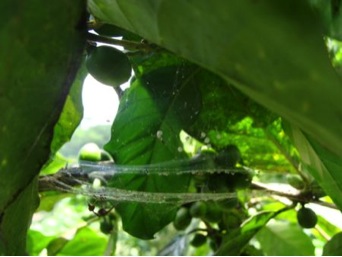
Figure 1. Pocobletus sp. nova on a coffee bush. Notice the hammock web; the white little balls are Pocobletus ovisacs
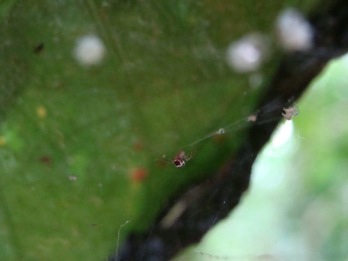
Figure 2. Close up of a female of Pocobletus sp. and its spiderlings. Ovisacs in the background.
The first thing that we noticed when sampling spiders in coffee plants was that Pocobletus spiders tended to be very abundant in the presence of A. sericeasur. So we asked ourselves, why are these tiny spiders associated with these ants? To what extent do the dominant A. sericeasur ants influence the spatial distribution of Pocobletus?
In the summer of 2010, we set up four plots around shade trees that had A. sericeasur nests in Finca Irlanda, a coffee farm in Chiapas, Mexico (Fig. 3). In each plot we assigned a unique number to each coffee plant, recorded which coffee plants were patrolled by A. sericeasur or other ants, and sampled spiders. We also sampled the webs of Pocobletus in coffee plants that were and were not patrolled by A. sericeasur.

Figure 3. At finca Irlanda, before sampling spiders.
We were very excited by our results. We discovered that the spatial distribution of Pocobletus spiders is indeed strongly associated with A. sericeasur. In addition, we found that the webs of Pocobletus spiders have more prey items in the presence of A. sericeasur than in its absence.
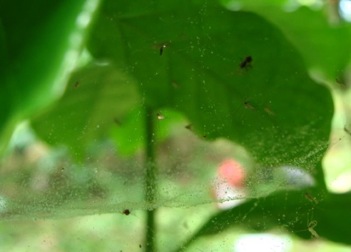
Figure 4. Pocobletus sp. and its predators. Notice the small Pocobletus in the lower section of the web and the slightly bigger Argyrodinae spider in the upper part.
We were also very surprised to discover that Pocobletus spiders have a wide variety of predators, and that these predators are other spiders! (Fig. 4). But we were even more surprised when we found out that the abundance of these predators decreases in the presence of A. sericeasur. So, contrary to what you might expect, a coffee plant full of bustling A. sericeasur ants can be a great place for a tiny spider to be, with plenty of food and fewer enemies. If you want to know more about this research, read our paper to find out the whole fascinating story!
Linda marin and co-authors

