Tag Archives: populations

How do ants affect spider populations in coffee plants? Updated for 2026

Biotic interactions play a central role in determining species distribution and abundance. Indeed, some organisms can have particularly strong effects on the distribution of other species because they act as keystone species or ecosystem engineers whose effects cascade to other trophic levels – beavers are one well-known example of this. In coffee agroecosystems in Southern Mexico we studied how a keystone species, the dominant arboreal ant A. sericeasur, influences the distribution and abundance of Pocobletus sp. nova, tiny spiders that spin their webs in coffee plants (Fig. 1 and Fig. 2). The results are now published Early View in Oikos in the paper “A positive association between ants and spiders and potential mechanisms driving the pattern”
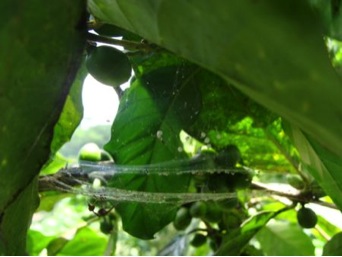
 

Figure 1. Pocobletus sp. nova on a coffee bush. Notice the hammock web; the white little balls are Pocobletus ovisacs
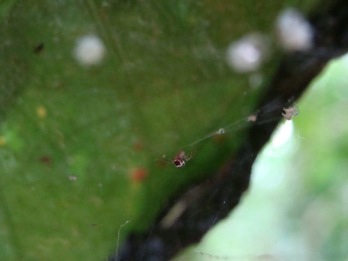
Figure 1. Pocobletus sp. nova on a coffee bush. Notice the hammock web; the white little balls are Pocobletus ovisacs


Figure 2. Close up of a female of Pocobletus sp. and its spiderlings. Ovisacs in the background.

Figure 2. Close up of a female of Pocobletus sp. and its spiderlings. Ovisacs in the background.


The first thing that we noticed when sampling spiders in coffee plants was that Pocobletus spiders tended to be very abundant in the presence of A. sericeasur. So we asked ourselves, why are these tiny spiders associated with these ants? To what extent do the dominant A. sericeasur ants influence the spatial distribution of Pocobletus?


In the summer of 2010, we set up four plots around shade trees that had A. sericeasur nests in Finca Irlanda, a coffee farm in Chiapas, Mexico (Fig. 3). In each plot we assigned a unique number to each coffee plant, recorded which coffee plants were patrolled by A. sericeasur or other ants, and sampled spiders. We also sampled the webs of Pocobletus in coffee plants that were and were not patrolled by A. sericeasur.

 

Figure 3. At finca Irlanda, before sampling spiders.

Figure 3. At finca Irlanda, before sampling spiders.


We were very excited by our results. We discovered that the spatial distribution of Pocobletus spiders is indeed strongly associated with A. sericeasur. In addition, we found that the webs of Pocobletus spiders have more prey items in the presence of A. sericeasur than in its absence.
Linda4

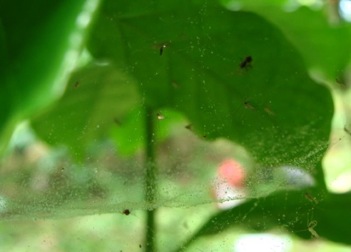
Figure 4. Pocobletus sp. and its predators. Notice the small Pocobletus in the lower section of the web and the slightly bigger Argyrodinae spider in the upper part.


We were also very surprised to discover that Pocobletus spiders have a wide variety of predators, and that these predators are other spiders! (Fig. 4). But we were even more surprised when we found out that the abundance of these predators decreases in the presence of A. sericeasur. So, contrary to what you might expect, a coffee plant full of bustling A. sericeasur ants can be a great place for a tiny spider to be, with plenty of food and fewer enemies. If you want to know more about this research, read our paper to find out the whole fascinating story!

Linda marin and co-authors
Herbivory effects of climate change Updated for 2026

Herbivory may be changed by climate change and how does that affect the host plants? Find out in the Early View paper “Colonization of a host tree by herbivorous insects under a changing climate” by Kaisa Heimonen and co-workers. Below is their summary of the paper: Climate warming is predicted to increase the abundance of herbivorous insects due to increased survival, growth and multivoltinism. In addition, due to warming climate many insect species are predicted to shift their ranges to higher latitudes. Host plants are adapted to the present day herbivore pressure and insect communities but in the future the abundance of insects and the composition of herbivorous insect communities might change which can lead to more intense herbivore damage. We wanted to study the susceptibility of silver birch (Betula pendula Roth) populations from different latitudes to the insect herbivores that are expected to spread northwards in the future. To do this we established three common gardens with 26 genotypes of silver birch from six latitudinal populations in Finland ranging from 60°N to 67°N. The common gardens were located at three different latitudes 60°N, 62°N and 67°N. At each study site 260 silver birches were growing. This experimental setup is being used also for several other studies (see the project homepage: http://www.uef.fi/fi/birchadaption).

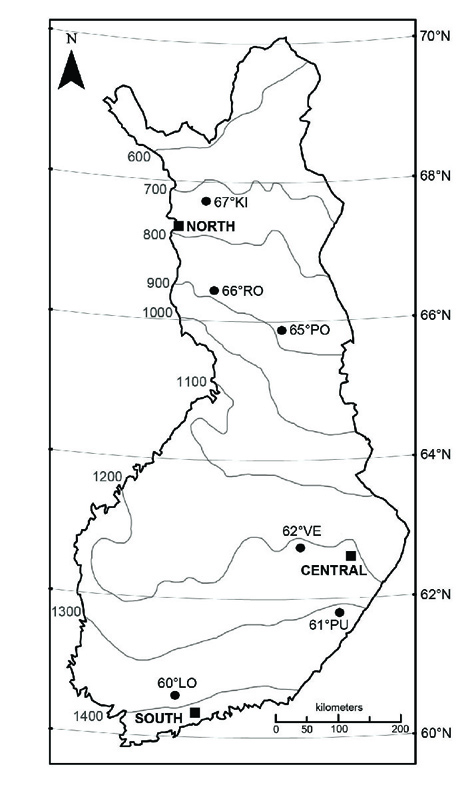
Figure 1. Map showing the three common garden sites (filled squares) and the six source populations (filled circles). Mean annual temperature isoclines are shown in grey.

Figure 1. Map showing the three common garden sites (filled squares) and the six source populations (filled circles). Mean annual temperature isoclines are shown in grey.

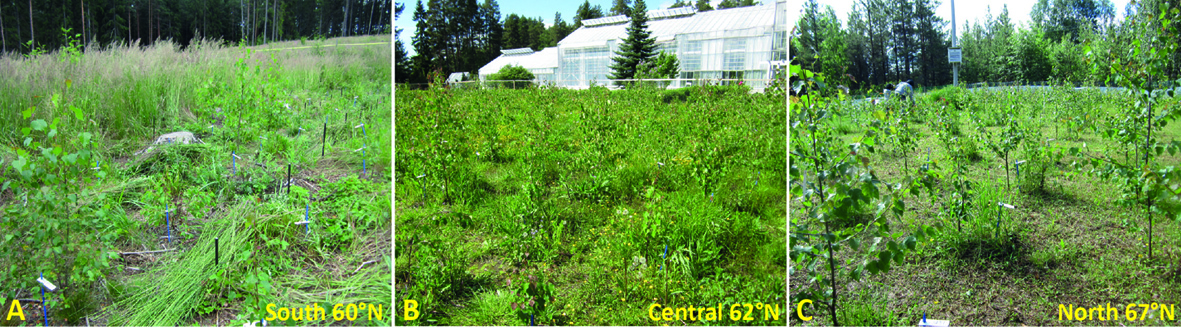
Figure 2. The three common garden sites in Finland where the study was conducted. A) Southern study site is located in Tuusula 60°N, B) Central study site is located in Joensuu 62°N and C) Northern study site is located in Kolari 67°N. Photo credits: Kaisa Heimonen.

Figure 2. The three common garden sites in Finland where the study was conducted. A) Southern study site is located in Tuusula 60°N, B) Central study site is located in Joensuu 62°N and C) Northern study site is located in Kolari 67°N. Photo credits: Kaisa Heimonen.

We wanted to study how the local insects at each of the common garden sites colonized the translocated birch genotypes. We asked if the insect herbivore density, species richness or community composition could be explained by the source population of the birch or by the direction or distance of the latitudinal translocation. The herbivore community on the study birches was examined during two growing seasons in 2011 and in 2012.

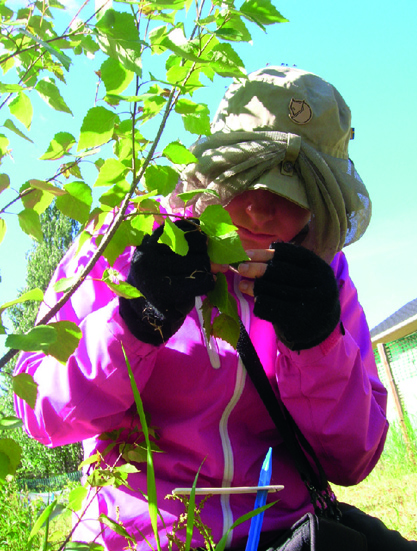
Figure 3. Kaisa Heimonen (lead author) observing the herbivorous insects on silver birch at the northern study site in 2012. Photo credits: Sari Kontunen-Soppela.

Figure 3. Kaisa Heimonen (lead author) observing the herbivorous insects on silver birch at the northern study site in 2012. Photo credits: Sari Kontunen-Soppela.

Herbivore density among the source populations differed in 2012 but not in 2011 and species richness was not affected by the source population. Latitudinal translocation could not explain the variation in the herbivore density or in the species richness. Community composition of the herbivores differed among the source populations at two of the three study sites and the similarity of the herbivore communities decreased with increasing latitudinal distance of the source populations.

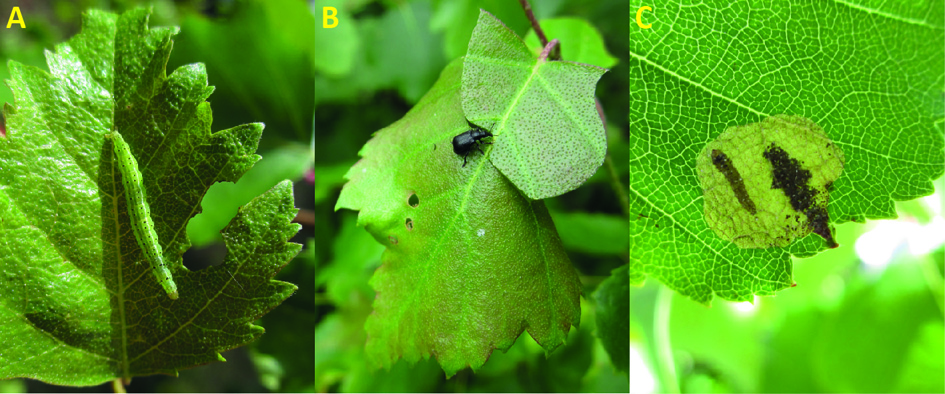
Figure 4. Common insect species on silver birch belonging to the orders Lepidoptera, Coleoptera and Hymenoptera. A) White-shouldered smudge (Ypsolopha parenthesella), B) Birch leaf roller (Deporaus betulae) and C) Early birch leaf edgeminer (Fenusella nana). Photo credits: Kaisa Heimonen.

Figure 4. Common insect species on silver birch belonging to the orders Lepidoptera, Coleoptera and Hymenoptera. A) White-shouldered smudge (Ypsolopha parenthesella), B) Birch leaf roller (Deporaus betulae) and C) Early birch leaf edgeminer (Fenusella nana). Photo credits: Kaisa Heimonen.

Silver birch genotypes from source populations originating from closer geographical distance had more similar herbivore community composition at our experimental sites possibly because they are genetically more similar than the geographically more distant birch genotypes. All birch genotypes were colonized by some of the local herbivores at all three study sites suggesting that in the future herbivorous insects are able to colonize novel host plant genotypes. The results of this study show that compositional changes in the insect communities on their host plants are expected in the future. Newly structured herbivore communities might affect the herbivore damage and thereby also the plant growth.

FLUMP – Plant populations, insect diversity, Extended Synthesis of Evolution and evolutionary ecology of specialization Updated for 2026

616px-Insect_collage

It’s Friday and that means that it’s time for our Friday link dump, where we highlight some recent papers (and other stuff) that we found interesting but didn’t have the time to write an entire post about. If you think there’s something we missed, or have something to say, please share in the comments section!

Some cool articles from the latest issue of Ecology:

– Benno Simmons

An article published in Proceedings of the Royal Society B uses historical data on different insect families to examine the contribution of different adaptations to their taxonomic richness.  The team, led by David Nicholson from the University of York in the U.K., found that metamorphosis, and to a lesser extent the presence of wings, had the greatest effect on the diversification of insects. – Nate Johnson

Following Nate’s indication, take a look at the Proceedings of the Royal Society B special issue: “Evolutionary ecology of specialization: insights from phylogenetic analysis”.

Last week, Nature published an interesting comment paper on the Extend Synthesis of Evolution (we have a post on this subject here), “Does evolutionary theory need a rethink?” The paper is authored by both, scientists pro and against the new extend synthesis.

– Vinicius Bastazini. 

October 10, 2014