Tag Archives: drought

Climate change sparked Syria’s ruinous war Updated for 2026


In a dire chain of cause and effect, the drought that devastated parts of Syria from 2006 to 2010 was probably the result of climate change driven by human activities, a new study says.

And the study’s authors think that the drought may also have contributed to the outbreak of Syria’s uprising in 2011. The ensuing civil war has left at least 200,000 people dead, and has displaced millions of others.

The drought, which was the worst ever recorded in the region, ravaged agriculture in the breadbasket region of northern Syria, driving dispossessed farmers to the cities where poverty, government mismanagement and other factors created the unrest that exploded four years ago.

The study, by scientists from Lamont-Doherty Earth Observatory at Columbia University, US, is published in the Proceedings of the National Academy of Sciences.

The authors are clear that the climatic changes were human-driven (anthropogenic) and cannot be attributed simply to natural variability – but are careful to stress that their findings are tentative.

“We’re not saying the drought caused the war”, says Richard Seager, one of the co-authors. “We’re saying that, added to all the other stressors, it helped kick things over the threshold into open conflict. And a drought of that severity was made much more likely by the ongoing human-driven drying of that region.”

Climate link to violence

Their study, although it contains new material, is not the first to suggest a possible link between extreme weather and the likelihood of violence.

Some researchers have investigated whether there may be a link between El Niño and La Niña – the periodic Pacific weather disruptions – and outbreaks of unrest. Suggestions of a global connection between climate change and political instability is being taken seriously by two influential groups – insurers and military planners.

Syria was not the only country affected by the drought. It struck the Fertile Crescent, linking Turkey, Syria and Iraq, where agriculture and animal herding are believed to have started around 12,000 years ago.

The Levant has always seen natural weather swings. Other research has suggested that the Akkadian empire, spanning much of the Fertile Crescent about 4,000 years ago, probably collapsed during a long drought.

But the authors of the Lamont-Doherty study, using existing studies and their own research, showed that the area has warmed by between 1°C and 1.2°C since 1900, and has undergone a 10% reduction in wet season precipitation. They say this trend is a neat match for models of human-influenced global warming, and so cannot be attributed to natural variability.

Global warming has had two effects, they say. First, it appears to have indirectly weakened wind patterns that bring rain-laden air from the Mediterranean, reducing precipitation during the usual November-April wet season. And higher temperatures have increased the evaporation of moisture from soils during the hot summers.

Other researchers have observed the long-term drying trend across the Mediterranean region, and have attributed at least part of it to anthropogenic warming.

Government stuck with water-intensive cash crops

The government has also encouraged water-intensive export crops such as cotton, while illegal drilling of irrigation wells depleted groundwater, says co-author Shahrzad Mohtadi, an international affairs consultant at the US Department of State.

The drought’s effects were immediate and overwhelming. Agricultural production – typically, a quarter of Syria’s gross domestic product – fell by a third. In the northeast, livestock was practically wiped out, cereal prices doubled, and nutrition-related diseases among children increased steeply.

And Syria was especially vulnerable because of other factors – including a huge increase in population from four million in the 1950s to 22 million in recent years. As many as 1.5 million people fled from the countryside to cities already strained by waves of refugees from the war in neighbouring Iraq.

“Rapid demographic change encourages instability”, the authors say. “Whether it was a primary or substantial factor is impossible to know, but drought can lead to devastating consequences when coupled with pre-existing acute vulnerability.”

Solomon Hsiang, professor of public policy at the University of California, Berkeley, says the study is “the first scientific paper to make the case that human-caused climate change is already altering the risk of large-scale social unrest and violence.”


Alex Kirby writes for Climate News Network.


391003

Climate change sparked Syria’s ruinous war Updated for 2026


In a dire chain of cause and effect, the drought that devastated parts of Syria from 2006 to 2010 was probably the result of climate change driven by human activities, a new study says.

And the study’s authors think that the drought may also have contributed to the outbreak of Syria’s uprising in 2011. The ensuing civil war has left at least 200,000 people dead, and has displaced millions of others.

The drought, which was the worst ever recorded in the region, ravaged agriculture in the breadbasket region of northern Syria, driving dispossessed farmers to the cities where poverty, government mismanagement and other factors created the unrest that exploded four years ago.

The study, by scientists from Lamont-Doherty Earth Observatory at Columbia University, US, is published in the Proceedings of the National Academy of Sciences.

The authors are clear that the climatic changes were human-driven (anthropogenic) and cannot be attributed simply to natural variability – but are careful to stress that their findings are tentative.

“We’re not saying the drought caused the war”, says Richard Seager, one of the co-authors. “We’re saying that, added to all the other stressors, it helped kick things over the threshold into open conflict. And a drought of that severity was made much more likely by the ongoing human-driven drying of that region.”

Climate link to violence

Their study, although it contains new material, is not the first to suggest a possible link between extreme weather and the likelihood of violence.

Some researchers have investigated whether there may be a link between El Niño and La Niña – the periodic Pacific weather disruptions – and outbreaks of unrest. Suggestions of a global connection between climate change and political instability is being taken seriously by two influential groups – insurers and military planners.

Syria was not the only country affected by the drought. It struck the Fertile Crescent, linking Turkey, Syria and Iraq, where agriculture and animal herding are believed to have started around 12,000 years ago.

The Levant has always seen natural weather swings. Other research has suggested that the Akkadian empire, spanning much of the Fertile Crescent about 4,000 years ago, probably collapsed during a long drought.

But the authors of the Lamont-Doherty study, using existing studies and their own research, showed that the area has warmed by between 1°C and 1.2°C since 1900, and has undergone a 10% reduction in wet season precipitation. They say this trend is a neat match for models of human-influenced global warming, and so cannot be attributed to natural variability.

Global warming has had two effects, they say. First, it appears to have indirectly weakened wind patterns that bring rain-laden air from the Mediterranean, reducing precipitation during the usual November-April wet season. And higher temperatures have increased the evaporation of moisture from soils during the hot summers.

Other researchers have observed the long-term drying trend across the Mediterranean region, and have attributed at least part of it to anthropogenic warming.

Government stuck with water-intensive cash crops

The government has also encouraged water-intensive export crops such as cotton, while illegal drilling of irrigation wells depleted groundwater, says co-author Shahrzad Mohtadi, an international affairs consultant at the US Department of State.

The drought’s effects were immediate and overwhelming. Agricultural production – typically, a quarter of Syria’s gross domestic product – fell by a third. In the northeast, livestock was practically wiped out, cereal prices doubled, and nutrition-related diseases among children increased steeply.

And Syria was especially vulnerable because of other factors – including a huge increase in population from four million in the 1950s to 22 million in recent years. As many as 1.5 million people fled from the countryside to cities already strained by waves of refugees from the war in neighbouring Iraq.

“Rapid demographic change encourages instability”, the authors say. “Whether it was a primary or substantial factor is impossible to know, but drought can lead to devastating consequences when coupled with pre-existing acute vulnerability.”

Solomon Hsiang, professor of public policy at the University of California, Berkeley, says the study is “the first scientific paper to make the case that human-caused climate change is already altering the risk of large-scale social unrest and violence.”


Alex Kirby writes for Climate News Network.


391003

Climate change sparked Syria’s ruinous war Updated for 2026


In a dire chain of cause and effect, the drought that devastated parts of Syria from 2006 to 2010 was probably the result of climate change driven by human activities, a new study says.

And the study’s authors think that the drought may also have contributed to the outbreak of Syria’s uprising in 2011. The ensuing civil war has left at least 200,000 people dead, and has displaced millions of others.

The drought, which was the worst ever recorded in the region, ravaged agriculture in the breadbasket region of northern Syria, driving dispossessed farmers to the cities where poverty, government mismanagement and other factors created the unrest that exploded four years ago.

The study, by scientists from Lamont-Doherty Earth Observatory at Columbia University, US, is published in the Proceedings of the National Academy of Sciences.

The authors are clear that the climatic changes were human-driven (anthropogenic) and cannot be attributed simply to natural variability – but are careful to stress that their findings are tentative.

“We’re not saying the drought caused the war”, says Richard Seager, one of the co-authors. “We’re saying that, added to all the other stressors, it helped kick things over the threshold into open conflict. And a drought of that severity was made much more likely by the ongoing human-driven drying of that region.”

Climate link to violence

Their study, although it contains new material, is not the first to suggest a possible link between extreme weather and the likelihood of violence.

Some researchers have investigated whether there may be a link between El Niño and La Niña – the periodic Pacific weather disruptions – and outbreaks of unrest. Suggestions of a global connection between climate change and political instability is being taken seriously by two influential groups – insurers and military planners.

Syria was not the only country affected by the drought. It struck the Fertile Crescent, linking Turkey, Syria and Iraq, where agriculture and animal herding are believed to have started around 12,000 years ago.

The Levant has always seen natural weather swings. Other research has suggested that the Akkadian empire, spanning much of the Fertile Crescent about 4,000 years ago, probably collapsed during a long drought.

But the authors of the Lamont-Doherty study, using existing studies and their own research, showed that the area has warmed by between 1°C and 1.2°C since 1900, and has undergone a 10% reduction in wet season precipitation. They say this trend is a neat match for models of human-influenced global warming, and so cannot be attributed to natural variability.

Global warming has had two effects, they say. First, it appears to have indirectly weakened wind patterns that bring rain-laden air from the Mediterranean, reducing precipitation during the usual November-April wet season. And higher temperatures have increased the evaporation of moisture from soils during the hot summers.

Other researchers have observed the long-term drying trend across the Mediterranean region, and have attributed at least part of it to anthropogenic warming.

Government stuck with water-intensive cash crops

The government has also encouraged water-intensive export crops such as cotton, while illegal drilling of irrigation wells depleted groundwater, says co-author Shahrzad Mohtadi, an international affairs consultant at the US Department of State.

The drought’s effects were immediate and overwhelming. Agricultural production – typically, a quarter of Syria’s gross domestic product – fell by a third. In the northeast, livestock was practically wiped out, cereal prices doubled, and nutrition-related diseases among children increased steeply.

And Syria was especially vulnerable because of other factors – including a huge increase in population from four million in the 1950s to 22 million in recent years. As many as 1.5 million people fled from the countryside to cities already strained by waves of refugees from the war in neighbouring Iraq.

“Rapid demographic change encourages instability”, the authors say. “Whether it was a primary or substantial factor is impossible to know, but drought can lead to devastating consequences when coupled with pre-existing acute vulnerability.”

Solomon Hsiang, professor of public policy at the University of California, Berkeley, says the study is “the first scientific paper to make the case that human-caused climate change is already altering the risk of large-scale social unrest and violence.”


Alex Kirby writes for Climate News Network.


391003

Climate change sparked Syria’s ruinous war Updated for 2026


In a dire chain of cause and effect, the drought that devastated parts of Syria from 2006 to 2010 was probably the result of climate change driven by human activities, a new study says.

And the study’s authors think that the drought may also have contributed to the outbreak of Syria’s uprising in 2011. The ensuing civil war has left at least 200,000 people dead, and has displaced millions of others.

The drought, which was the worst ever recorded in the region, ravaged agriculture in the breadbasket region of northern Syria, driving dispossessed farmers to the cities where poverty, government mismanagement and other factors created the unrest that exploded four years ago.

The study, by scientists from Lamont-Doherty Earth Observatory at Columbia University, US, is published in the Proceedings of the National Academy of Sciences.

The authors are clear that the climatic changes were human-driven (anthropogenic) and cannot be attributed simply to natural variability – but are careful to stress that their findings are tentative.

“We’re not saying the drought caused the war”, says Richard Seager, one of the co-authors. “We’re saying that, added to all the other stressors, it helped kick things over the threshold into open conflict. And a drought of that severity was made much more likely by the ongoing human-driven drying of that region.”

Climate link to violence

Their study, although it contains new material, is not the first to suggest a possible link between extreme weather and the likelihood of violence.

Some researchers have investigated whether there may be a link between El Niño and La Niña – the periodic Pacific weather disruptions – and outbreaks of unrest. Suggestions of a global connection between climate change and political instability is being taken seriously by two influential groups – insurers and military planners.

Syria was not the only country affected by the drought. It struck the Fertile Crescent, linking Turkey, Syria and Iraq, where agriculture and animal herding are believed to have started around 12,000 years ago.

The Levant has always seen natural weather swings. Other research has suggested that the Akkadian empire, spanning much of the Fertile Crescent about 4,000 years ago, probably collapsed during a long drought.

But the authors of the Lamont-Doherty study, using existing studies and their own research, showed that the area has warmed by between 1°C and 1.2°C since 1900, and has undergone a 10% reduction in wet season precipitation. They say this trend is a neat match for models of human-influenced global warming, and so cannot be attributed to natural variability.

Global warming has had two effects, they say. First, it appears to have indirectly weakened wind patterns that bring rain-laden air from the Mediterranean, reducing precipitation during the usual November-April wet season. And higher temperatures have increased the evaporation of moisture from soils during the hot summers.

Other researchers have observed the long-term drying trend across the Mediterranean region, and have attributed at least part of it to anthropogenic warming.

Government stuck with water-intensive cash crops

The government has also encouraged water-intensive export crops such as cotton, while illegal drilling of irrigation wells depleted groundwater, says co-author Shahrzad Mohtadi, an international affairs consultant at the US Department of State.

The drought’s effects were immediate and overwhelming. Agricultural production – typically, a quarter of Syria’s gross domestic product – fell by a third. In the northeast, livestock was practically wiped out, cereal prices doubled, and nutrition-related diseases among children increased steeply.

And Syria was especially vulnerable because of other factors – including a huge increase in population from four million in the 1950s to 22 million in recent years. As many as 1.5 million people fled from the countryside to cities already strained by waves of refugees from the war in neighbouring Iraq.

“Rapid demographic change encourages instability”, the authors say. “Whether it was a primary or substantial factor is impossible to know, but drought can lead to devastating consequences when coupled with pre-existing acute vulnerability.”

Solomon Hsiang, professor of public policy at the University of California, Berkeley, says the study is “the first scientific paper to make the case that human-caused climate change is already altering the risk of large-scale social unrest and violence.”


Alex Kirby writes for Climate News Network.


391003

California drought: rains bring scant relief Updated for 2026


Doing the right thing in the environs of the University of California, Davis – one of the foremost agricultural institutions in the US – means driving a carbon efficient car. And having a lawn that’s burned dry.

California’s worst drought on record is forcing people to cut back radically on water use – and that means letting lawns die, and cars get dusty. There was considerable rainfall last month, but it was not nearly enough to replenish the badly-depleted water resources.

Higher than average temperatures – particularly during the winter months – have combined with a lack of rainfall to produce severe drought conditions across much of the state.

Water restrictions have been brought in following the imposition of a drought emergency in January last year.

Dreaming of a wet winter

“If we don’t have rain in significant amounts by early March, we’ll be in dire straits”, says Professor Daniel Sumner, director of the Agricultural Issues Center at Davis. “Historically, California’s water has been stored in the snow pack in the mountains, but warmer winter temperatures have meant the pack has been melting.”

“The agricultural sector has made considerable advances in limiting water use, and new, more drought resistant, crops and plant varieties have been introduced, but aquifers have been pumped and they are not being replenished.

“In the past, massive projects were undertaken to distribute water round the state, but now there’s not the money available to do any more big-time plumbing work. Also, the regulations on diverting water for agriculture use are very tight – rivers can’t be pumped if it means endangering fish stocks or other wildlife.”

Whether or not climate change is causing the drought is a matter of considerable debate. A recent report sponsored by the US government’s National Oceanic and Atmospheric Administration (NOAA) says natural oceanic and atmospheric patterns are the primary drivers behind the drought.

A high pressure ridge that has hovered over the Pacific off California’s coast for the past three years has resulted in higher temperatures and little rainfall falling across the state, the report says.

However, a separate report by climate scientists at Stanford University says the existence of the high pressure ridge, which is preventing rains falling over California, is made much more likely by ever greater accumulations of climate-changing greenhouse gas emissions in the atmosphere.

It’s not just the groundwater that’s depleted

Whatever the cause of the drought, the lack of rain is doing considerable environmental and economic damage. The Public Policy Institute of California, a not-for-profit thinktank, estimates that $2.2 billion in agricultural revenues and more than 17,000 jobs have been lost as a result of the drought.

Thousands of acres of woodland have been lost due to wildfires, while fisheries experts are concerned that severely depleted streams and rivers could lead to the disappearance of fish species in the area, such as coho salmon and steelhead trout.

The drought is not limited to California. Adjacent states are also affected, and over the US border to the south, in Mexico’s Chihuahua state, crops have been devastated and 400,000 cattle have died.

Frank Green, a vineyard owner in the hills of Mendocino County, northern California, says: “The vines are pretty robust and, despite the drought, our wines have been some of the best ever over the past two years.

“But there’s no doubt we need a lot more rain, and plenty more could be done on saving and harvesting water. Farmers have cut back on growing water-hungry crops like cotton, but California is still growing – and exporting – rice, which is a real water drinker. How crazy is that?”


Kieran Cooke writes for Climate News Network.

Also on The Ecologist:


389688

Drought – increase or decrease herbivore abundance? Updated for 2026

Grasshoppers tend to increase in abundance during drought, no decree, or increase…Find out which and when in the Earl View Oikos paper “Water stress in grasslands: dynamic responses of plants and insect herbivores” by Paul A. Lenhart and co-workers. Below is their summary of the study:

When I first saw the climate projections from NOAA in 2011 that there would be a severe La Niña-fueled drought I was worried that my fieldwork season would be a bust. In 2011, Texas, as well as much of the south central United States of America, suffered through the worst seasonal drought since modern record keeping began in 1895. The drought had severe economic and ecological impacts across the region, but I was focused on my main study organism: grasshoppers. These insects are a very important component of grassland ecosystems, and for the past two years I, together with my co-supervisors (Micky Eubanks and Spencer Behmer), had worked in the grasslands and savannah of central Texas studying a vibrant grasshopper community, consisting of over 56 species. I was working to understand the diet breadth of some of the key species, including their macronutrient regulation behavior, while also quantifying competitive dynamics between these species.

 Grasshoppers1

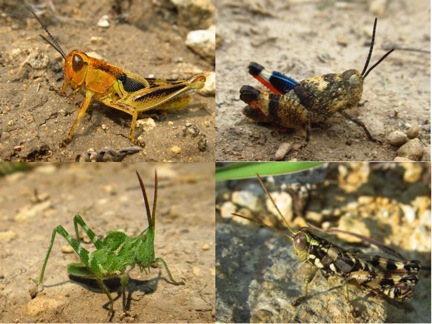
Examples of grasshopper diversity. Clockwise from the top left: Melanoplus packardii, Hadrotettix trifasciatus, Acrolophitus hirtipes, Phaulotettix eurycercus.


Prior to 2011, one of our sampling seasons (2009) was slightly drier and we found a decrease in grasshopper density and abundance. This went against many previously published observations of grasshoppers and other insect herbivores having larger populations in drier years. The proposed mechanism in the literature is that plant nutrient content actually increases with water stress. However, studies that measure the effect of water stress on plant nutrients typically use greenhouse-reared plants or crop species, and generally measure plant quality as simply a function of nitrogen content. We now know that plant dietary quality is much more complex, and in particular that herbivores actively regulate their protein and carbohydrate intake. Therefore, we decided to change course from our originally planed competition experiment. Instead, we took advantage of the coming drought to conduct a manipulative study in order to gain insights into what happens to native plants, and herbivore behavior, when the rains do not come

            We started our experiment early enough in the season to quantify, over time, the effect of water stress on the native grassland plant’s quality, quantity, and diversity. We marked off small open plots distributed across the grasslands of the Balcones Canyonlands National Wildlife Refuge. Half of these plants were left alone to suffer through the drought and we watered the other half [laboriously] by hand to mimic average summer rainfall. We did this through the growing season and took plant samples and visual grasshopper surveys monthly; in each plot individual grasshoppers were identified to species by sight. After completing each grasshopper survey, we measured grass and forb species richness, and took samples back to the lab to assess biomass and macronutrient content. Specifically, we quantified both digestible protein and nonstructural carbohydrate content in bulk samples of grass and forb tissues using biochemical assays.


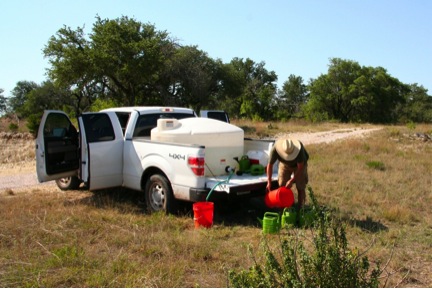
Behind the scenes of watering plots by hand in the field.

Behind the scenes of watering plots by hand in the field.


            At the end of the summer we found that drought reduced grasshopper abundance and diversity, relative to our water supplemented plots. Using our knowledge of different grasshopper species diets, we grouped species into functional feeding groups and found that functional groups responded differently to our watering treatments. Forb specialists seemed unaffected by the drought while grass-feeders and mixed-feeders (grass+forbs) were significantly less numerous in the unwatered plots. These different grasshopper responses were due to their particular feeding biology and the fact that grass and forbs responded differently to water stress. We go into more detail in the manuscript, but in short, forbs decreased in diversity and experienced a significant shift in their macronutrient profile over time, becoming less protein biased. In contrast, grass biomass was reduced by water stress, but grass protein-carbohydrate content was similar between our two water treatments.


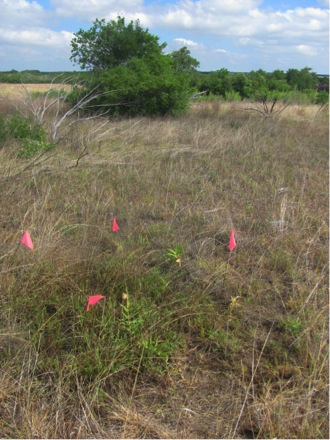
A freshly watered plot in a parched grassland.

A freshly watered plot in a parched grassland.


Our results are significant because we used naturally-growing, drought acclimated plants, and quantified protein-carbohydrate content – which are the two most important nutrients that affect insect herbivore feeding behavior and performance. Our research provides valuable data on how plant macronutrient content, biomass, and diversity co-vary in the field, and such data can be used to parameterize models that can help us better understand how generalist herbivores forage and perform under drought conditions, which are predicted to become more common as climate change intensifies. Although more work is required, we envision the use of remote sensing technology, measuring plant quality, biomass, and diversity, to better manage insect pests in rangeland ecosystems.


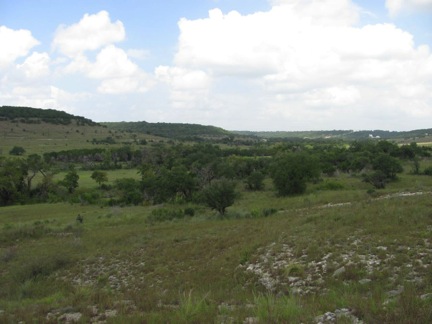
Mixed-grass oak savannah on the Balcones Canyonlands National Wildlife Refuge during a wet summer.

Mixed-grass oak savannah on the Balcones Canyonlands National Wildlife Refuge during a wet summer.

Resisting drought: conventional plant breeding outperforms GM Updated for 2026


Since its launch in 2010, the Improved Maize for African Soils Project (IMAS) has developed 21 conventionally bred varieties which have increased yield by up to 1 tonne per hectare.

The plan is to commercialise these varieties and introduce them in eight countries.

In contrast, the project’s researchers say that they are at least 10 years away from developing a comparable GM variety.

In another programme – The Drought Tolerant Maize for Africa project – 153 new, conventionally bred varieties have improved yields in 13 countries.

In field trials, these varieties increase yields by up to 30% under drought conditions.

It is estimated that by 2016 the extra yields from these conventionally bred, drought-tolerant maize varieties could help reduce the number of people living in poverty in these 13 countries by up to 9%.

Conventional breeding proving “far more successful” than GM

According to the leading science journal Nature, these successes are based on access to the large seed bank managed by the International Maize and Wheat Improvement Center (CIMMYT) in Mexico City.

Breeders from CIMMYT and the International Institute for Tropical Agriculture (IITA) in Nigeria identified maize varieties that thrive in water-scarce regions.

They cross bred these var­ieties and mated the most drought-tolerant of their offspring. The result – after several breeding cycles – is seed that is even better adapted to drought conditions.

Finally these plants were crossed with varieties that had been successfully grown in Africa.

According to Kevin Pixley, director of CIMMYT’s genetic resources programme, it is a “painstaking process”, but it is proving far more successful than genetic engineering approaches.

Drought tolerance is a complex trait that involves multiple genes and genetic engineering techniques which target one gene is taking longer and is significantly less effective.

Understanding ecology led to breakthrough

The CIMMYT researchers established that a key characteristic in the plants ability to withstand drought is the number of days between when the plant’s male organs shed pollen and when the female silks emerge.

When water is scarce, the silks emerge late. If the delay is long enough, they emerge after the plants have released their pollen and are not fertilized.

“Finding out this relationship was very important to be able to select for drought tolerance”, says Pixley.

By favouring plants with shorter intervals between pollen release and silk emergence, breeders were able to produce maize that was more resistant to drought.

GMO crops – and the food system – is not fit for purpose

CIMMYT and six other research organizations are collaborating with Monsanto on genetically engineered drought resistant maize varieties but admit they are several years away from any success.

Of course this is not the story we usually hear from the research establishment and the media.

Unusually the journal Nature has broken ranks and highlighted that far from being essential in ‘feeding the world’ – and especially the drought prone areas such as Africa – genetic engineering is less useful than conventional breeding.

The evidence that GMO crops are not fit for purpose in Africa has been apparent for some time.

Yet we are still being force fed the line that a genetic engineering techno fix is essential to combat climate change and nourish the world’s growing population.

The complex ecological relationships and part played by; e.g. soilmicro-organisms and fungi, is largely ignored. So are agro-ecological methods such as Sustainable Rice Intensification (SRI).

And so is the most crucial fact of all: the world already produces enough calories to feed 14 billion people and the problem is not production; it is waste, inequitable distribution and lack of access to land, water and supply chains for small farmers and communities.

But that is dismissed as irrelevant or skated over in the interests of maintaining a corporate dominated, commodity trade focussed agriculture and food system where the overwhelming goal is the generation of short term profit.


Lawrence Woodward is founder and director of GM Education, where this article was originally published. 

Source:Cross-bred crops get fit faster‘, Nature.


384909

Drought hits São Paulo – what drought? Updated for 2026


Outside the semi-arid area of the north-east, Brazilians have never had to worry about conserving water. Year in, year out, the summer has always brought rain.

But that has changed dramatically. São Paulo, the biggest metropolis in South America, with a population of almost 20 million, is now in the grip of its worst drought in more than a century – a water crisis of such proportions that reports on the daily level of the main reservoir arefollowed as closely as the football results.

The lack of rain is also affecting the dams that produce most of Brazil’s energy, highlighting the urgent need to diversify power sources.

And yet the state governor, wary of the effects on his prospects in forthcoming elections, has refused to introduce measures to ration, or even conserve, water.

Mighty rivers are running dry

Brazil is blessed not only with the mighty Amazon and all its huge tributaries, but also with dozens of other lengthy, broad rivers – once the highways for trade and slaving expeditions, but now providing waterways for cargo, power for dams, and water for reservoirs. It has at least 12% of the world’s fresh water supply.

But five of the principal rivers – the Tiete, Grande, Piracicaba, Mogi-Guaçu and Paraiba do Sul – that cross or border São Paulo, Brazil’s wealthiest state, have less than 30% of the water they should have at this time of year, according to data from the regional Hydrographic Basin Committee and from the National Electric System Operator (ONS).

Other major water sources – such as the Paraná, South America’s second biggest river, and the Paranapanema – are also suffering from the long dry period. The ruins of towns flooded for dam reservoirs have reappeared, fishermen’s boats are beached because the fish have disappeared, and navigation is at a standstill.

The transport of grain and other cargos to the port of Santos, via the river network, had to be suspended after the water level fell by up to eight metres. The equivalent of 10,000 lorryloads of cargo have been transferred by road so far.

Many industries have suspended their activities because of lack of water, and the drought has resulted in the loss of part of the coffee, sugar cane and wheat crops in one of Brazil’s most important agricultural states.

The hydrological period lasting from October 2013 to March 2014 was the driest for 123 years, according to the Agronomic Institute of Campinas, the oldest institute of its kind in Latin America.

Lowest water volumes since the 1930s

The federal government’s energy research company, EPE, found that in the first three months of 2014 the volume of rain was the third lowest since the 1930s.

It was the third consecutive year of reduction for the reservoirs of the hydroelectric dams that make up the South-east / Centre-West System, where many of Brazil’s biggest cities are located. From 88% in 2011, the volume of water in them had fallen to 38% by April 2014 – the month in which the dry season begins in this region.

By mid-August, the reservoirs of the Cantareira system, which supplies the water for almost 8.5 million of São Paulo’s inhabitants, had fallen to just 13.5% of capacity.

Yet the state government of São Paulo has so far refused even to admit that there is a crisis. The problem is the October elections, when Governor Geraldo Alkmim is running for re-election. Like most politicians, he does not want to be associated with a crisis. The word ‘rationing’ is taboo.

Instead, unofficial rationing – what might be called rationing by stealth – is in operation. At night, the São Paulo Water Company, Sabesp, is reducing the pressure in the water system by 75%, leaving residents in higher areas of the city with dry taps.

People before power? Electricity generation under threat

Over 80% of the country’s energy comes from hydroelectric power, and dozens more giant dams are under construction or planned, mostly in the Amazon basin. The government has been strangely reluctant to invest in, or even encourage, other sources of abundant renewable energy, such as wind, solar and biomass.

The over-reliance on hydropower has already led to a distortion. The back-up system of thermo-electric plants, run on gas and diesel, and designed for emergencies, has had to increase production from 8% in 2012 to cover 25% of energy demand this year – thus contributing to higher carbon emissions.

Politics have also interfered with the special crisis committee set up to monitor the drought situation, with representatives from local and federal agencies unable to agree on what to do.

The Sao Paulo energy company, CESP, unilaterally decided this month to reduce the volume of water released from the shared Jaguari reservoir to the neighbouring state of Rio de Janeiro for electricity generation, in order to keep more for its own water needs.

Dangerous precedent

For Marcio Zimmerman, executive secretary of the Ministry of Mines and Energy, CESP’s action creates a dangerous precedent. “There will be chaos if everyone decides to rebel against the ONS”, he said.

The realisation that climate change is already leading to major changes in weather patterns has sounded alarm bells among the business community about the need to diversify energy sources and conserve water.

Early this month, at a seminar organised by the Brazilian Business Council for Sustainable Development, the chief executives of more than 20 top companies drew up a list of 22 crisis-related proposals to be put to the presidential candidates in October’s election.

Newspaper editorials are now urging the politicians to take their heads out of the sand and involve the population in a serious discussion on the crisis and its effects on the water supply, energy generation, and food production .

The Rio newspaper O Globo declared: “They belittle the potential for efficiency available in a society accustomed to waste. When they act, it might be too late.”


Jan Rocha is a journalist living in São Paulo. She writes for Climate News Network, where this article originates.


383359