Tag Archives: herbivore

Herbivory effects of climate change Updated for 2026

Herbivory may be changed by climate change and how does that affect the host plants? Find out in the Early View paper “Colonization of a host tree by herbivorous insects under a changing climate” by Kaisa Heimonen and co-workers. Below is their summary of the paper: Climate warming is predicted to increase the abundance of herbivorous insects due to increased survival, growth and multivoltinism. In addition, due to warming climate many insect species are predicted to shift their ranges to higher latitudes. Host plants are adapted to the present day herbivore pressure and insect communities but in the future the abundance of insects and the composition of herbivorous insect communities might change which can lead to more intense herbivore damage. We wanted to study the susceptibility of silver birch (Betula pendula Roth) populations from different latitudes to the insect herbivores that are expected to spread northwards in the future. To do this we established three common gardens with 26 genotypes of silver birch from six latitudinal populations in Finland ranging from 60°N to 67°N. The common gardens were located at three different latitudes 60°N, 62°N and 67°N. At each study site 260 silver birches were growing. This experimental setup is being used also for several other studies (see the project homepage: http://www.uef.fi/fi/birchadaption).
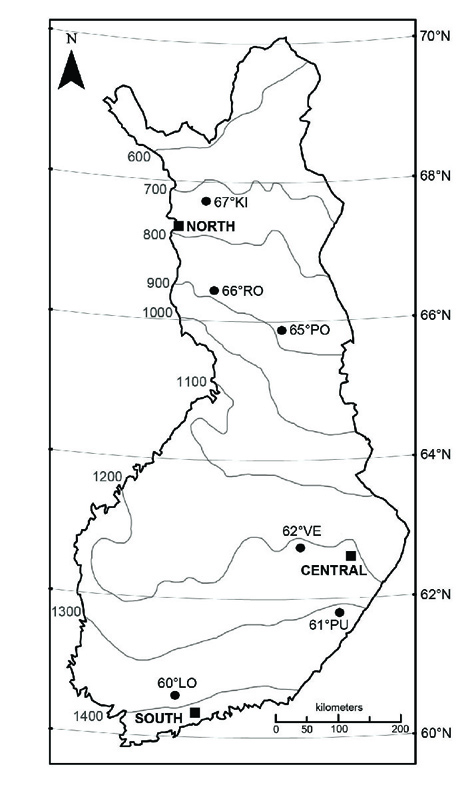
Figure 1. Map showing the three common garden sites (filled squares) and the six source populations (filled circles). Mean annual temperature isoclines are shown in grey.
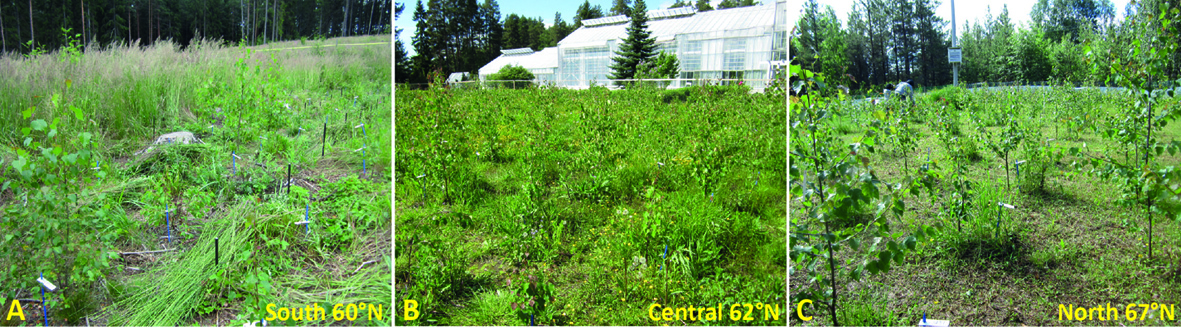
Figure 1. Map showing the three common garden sites (filled squares) and the six source populations (filled circles). Mean annual temperature isoclines are shown in grey.

Figure 2. The three common garden sites in Finland where the study was conducted. A) Southern study site is located in Tuusula 60°N, B) Central study site is located in Joensuu 62°N and C) Northern study site is located in Kolari 67°N. Photo credits: Kaisa Heimonen.

Figure 2. The three common garden sites in Finland where the study was conducted. A) Southern study site is located in Tuusula 60°N, B) Central study site is located in Joensuu 62°N and C) Northern study site is located in Kolari 67°N. Photo credits: Kaisa Heimonen.

We wanted to study how the local insects at each of the common garden sites colonized the translocated birch genotypes. We asked if the insect herbivore density, species richness or community composition could be explained by the source population of the birch or by the direction or distance of the latitudinal translocation. The herbivore community on the study birches was examined during two growing seasons in 2011 and in 2012.
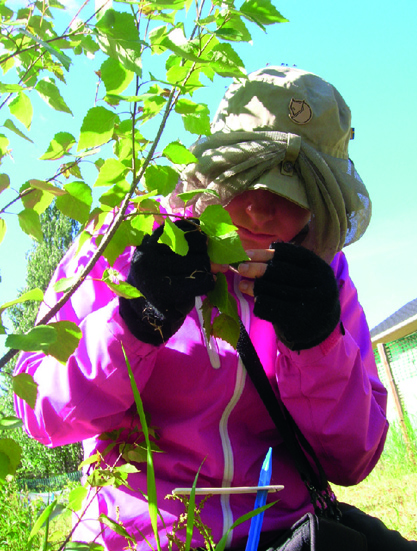
Figure 3. Kaisa Heimonen (lead author) observing the herbivorous insects on silver birch at the northern study site in 2012. Photo credits: Sari Kontunen-Soppela.

Figure 3. Kaisa Heimonen (lead author) observing the herbivorous insects on silver birch at the northern study site in 2012. Photo credits: Sari Kontunen-Soppela.

Herbivore density among the source populations differed in 2012 but not in 2011 and species richness was not affected by the source population. Latitudinal translocation could not explain the variation in the herbivore density or in the species richness. Community composition of the herbivores differed among the source populations at two of the three study sites and the similarity of the herbivore communities decreased with increasing latitudinal distance of the source populations.
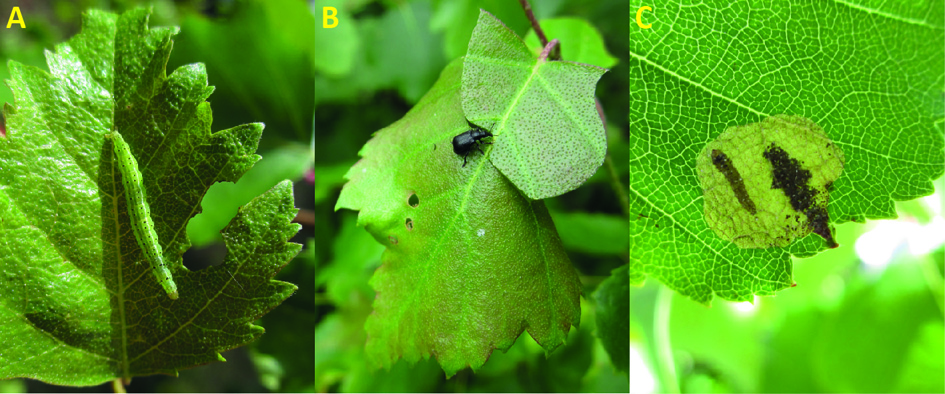
Figure 4. Common insect species on silver birch belonging to the orders Lepidoptera, Coleoptera and Hymenoptera. A) White-shouldered smudge (Ypsolopha parenthesella), B) Birch leaf roller (Deporaus betulae) and C) Early birch leaf edgeminer (Fenusella nana). Photo credits: Kaisa Heimonen.

Figure 4. Common insect species on silver birch belonging to the orders Lepidoptera, Coleoptera and Hymenoptera. A) White-shouldered smudge (Ypsolopha parenthesella), B) Birch leaf roller (Deporaus betulae) and C) Early birch leaf edgeminer (Fenusella nana). Photo credits: Kaisa Heimonen.

Silver birch genotypes from source populations originating from closer geographical distance had more similar herbivore community composition at our experimental sites possibly because they are genetically more similar than the geographically more distant birch genotypes. All birch genotypes were colonized by some of the local herbivores at all three study sites suggesting that in the future herbivorous insects are able to colonize novel host plant genotypes. The results of this study show that compositional changes in the insect communities on their host plants are expected in the future. Newly structured herbivore communities might affect the herbivore damage and thereby also the plant growth.
Drought – increase or decrease herbivore abundance? Updated for 2026

Grasshoppers tend to increase in abundance during drought, no decree, or increase…Find out which and when in the Earl View Oikos paper “Water stress in grasslands: dynamic responses of plants and insect herbivores” by Paul A. Lenhart and co-workers. Below is their summary of the study:

When I first saw the climate projections from NOAA in 2011 that there would be a severe La Niña-fueled drought I was worried that my fieldwork season would be a bust. In 2011, Texas, as well as much of the south central United States of America, suffered through the worst seasonal drought since modern record keeping began in 1895. The drought had severe economic and ecological impacts across the region, but I was focused on my main study organism: grasshoppers. These insects are a very important component of grassland ecosystems, and for the past two years I, together with my co-supervisors (Micky Eubanks and Spencer Behmer), had worked in the grasslands and savannah of central Texas studying a vibrant grasshopper community, consisting of over 56 species. I was working to understand the diet breadth of some of the key species, including their macronutrient regulation behavior, while also quantifying competitive dynamics between these species.

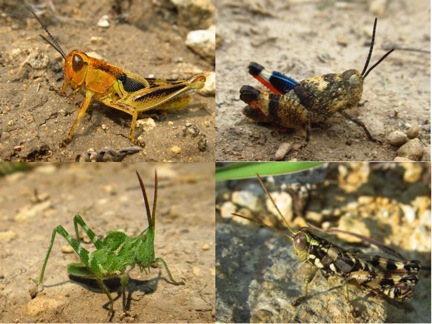
 Grasshoppers1

Examples of grasshopper diversity. Clockwise from the top left: Melanoplus packardii, Hadrotettix trifasciatus, Acrolophitus hirtipes, Phaulotettix eurycercus.


Prior to 2011, one of our sampling seasons (2009) was slightly drier and we found a decrease in grasshopper density and abundance. This went against many previously published observations of grasshoppers and other insect herbivores having larger populations in drier years. The proposed mechanism in the literature is that plant nutrient content actually increases with water stress. However, studies that measure the effect of water stress on plant nutrients typically use greenhouse-reared plants or crop species, and generally measure plant quality as simply a function of nitrogen content. We now know that plant dietary quality is much more complex, and in particular that herbivores actively regulate their protein and carbohydrate intake. Therefore, we decided to change course from our originally planed competition experiment. Instead, we took advantage of the coming drought to conduct a manipulative study in order to gain insights into what happens to native plants, and herbivore behavior, when the rains do not come

            We started our experiment early enough in the season to quantify, over time, the effect of water stress on the native grassland plant’s quality, quantity, and diversity. We marked off small open plots distributed across the grasslands of the Balcones Canyonlands National Wildlife Refuge. Half of these plants were left alone to suffer through the drought and we watered the other half [laboriously] by hand to mimic average summer rainfall. We did this through the growing season and took plant samples and visual grasshopper surveys monthly; in each plot individual grasshoppers were identified to species by sight. After completing each grasshopper survey, we measured grass and forb species richness, and took samples back to the lab to assess biomass and macronutrient content. Specifically, we quantified both digestible protein and nonstructural carbohydrate content in bulk samples of grass and forb tissues using biochemical assays.


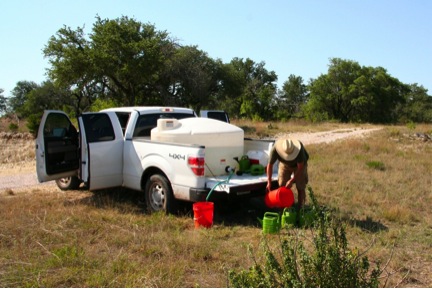
Behind the scenes of watering plots by hand in the field.

Behind the scenes of watering plots by hand in the field.


            At the end of the summer we found that drought reduced grasshopper abundance and diversity, relative to our water supplemented plots. Using our knowledge of different grasshopper species diets, we grouped species into functional feeding groups and found that functional groups responded differently to our watering treatments. Forb specialists seemed unaffected by the drought while grass-feeders and mixed-feeders (grass+forbs) were significantly less numerous in the unwatered plots. These different grasshopper responses were due to their particular feeding biology and the fact that grass and forbs responded differently to water stress. We go into more detail in the manuscript, but in short, forbs decreased in diversity and experienced a significant shift in their macronutrient profile over time, becoming less protein biased. In contrast, grass biomass was reduced by water stress, but grass protein-carbohydrate content was similar between our two water treatments.


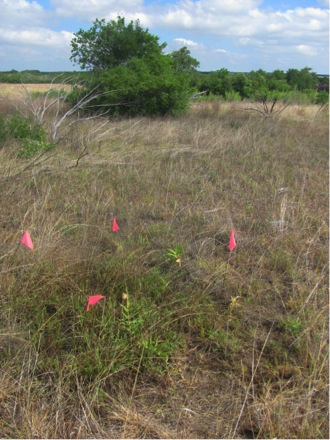
A freshly watered plot in a parched grassland.

A freshly watered plot in a parched grassland.


Our results are significant because we used naturally-growing, drought acclimated plants, and quantified protein-carbohydrate content – which are the two most important nutrients that affect insect herbivore feeding behavior and performance. Our research provides valuable data on how plant macronutrient content, biomass, and diversity co-vary in the field, and such data can be used to parameterize models that can help us better understand how generalist herbivores forage and perform under drought conditions, which are predicted to become more common as climate change intensifies. Although more work is required, we envision the use of remote sensing technology, measuring plant quality, biomass, and diversity, to better manage insect pests in rangeland ecosystems.


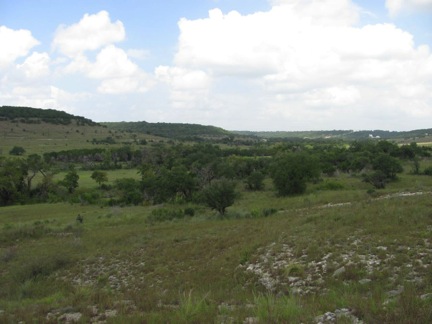
Mixed-grass oak savannah on the Balcones Canyonlands National Wildlife Refuge during a wet summer.

Mixed-grass oak savannah on the Balcones Canyonlands National Wildlife Refuge during a wet summer.