Tag Archives: breeding

Stay or go for next clutch? Updated for 2026

Moving to a new site for next brood? Good or bad? And why? These questions are answered in the Early View paper “Mechanisms and reproductive consequences of breeding dispersal in a specialist predator under temporally varying food conditions” by Julien Terraube and co-workers.

In this study, we explored the factors linked to variations in breeding dispersal behaviour and their consequences in terms of reproductive parameters in a raptor species. Which factors influence individual dispersal decisions? Are Eurasian kestrels Falco tinnunculus able to increase their own reproductive success after moving from one site to the other between two consecutive breeding seasons? Is this relationship mediated by environmental factors like food abundance or individual traits like gender or age? All these fascinating questions are hard to answer particularly in avian predators because of methodological limitations associated to size of the study area and even more in species like Eurasian kestrels breeding in boreal ecosystems, which have high breeding dispersal propensity and in which movements are driven by cyclic fluctuations in abundance of main foods (voles) (see Vasko et al. 2011).

In spring 1977, a long-term study of a local kestrel population breeding in western Finland (the Kauhava region) was initiated along with the monitoring of Tengmalm’s owl populations (see Korpimäki and Hakkarainen 2012). Hard work in the field has generated a fantastic long-term, large-scale dataset combining data from breeding success and individual traits of breeding kestrel parents captured at their nest sites over the last 25 years (1983-2013).


A +1-year old male kestrel on hand after trapping. Photo: Erkki Korpimäki.

A +1-year old male kestrel on hand after trapping. Photo: Erkki Korpimäki.

Given the increasing demand for long-term population studies in order to understand current impact of environmental changes, the authors would like to stress the importance of long-term studies on demographic parameters in long-lived vertebrate populations. In this study, the assessment of breeding dispersal distances was made possible through systematic capture of most kestrel parents breeding in the main study areas, ringing and recovery of previous rings. We would like to focus here on the capture procedure that allowed collecting breeding dispersal data and share the experience acquired during the hours spent in “Wild-West” of Finland when checking traps.
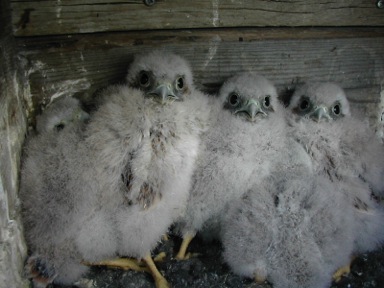
 

Three-week old nestlings in the nest-box. Photo: Erkki Korpimäki

Three-week old nestlings in the nest-box. Photo: Erkki Korpimäki

Capture occurs during the brood-rearing period when chicks are two-to-three weeks old, in order to avoid unnecessary disturbance of young nestlings during the most vulnerable phase. Virtually all the breeding population monitored breeds in nest-boxes that were set up on barns from early 1980s onwards. The total number of nest-boxes has varied from 350 to 450 throughout the study period in agricultural fields of the study area. We have used swing-door traps attached to the front of the nest box for trapping parents. The “trapping routine” starts by erecting the traps early in the morning from 5-6 am on a group of 5 to 10 breeding sites selected according to nestling age. Then trap-checking rounds are performed every two-to-three hours to check if any individual is trapped. The aim is to capture both female and male from each breeding site within 12 hours. Adults are ringed, measured and weighed near the breeding site and released as soon as possible. A capture day ends by giving newly-hatched rooster chickens to the kestrel nestlings to compensate for the decrease in prey delivery rates experienced during the trapping of their parents.

We have been lucky in the sense that voluntary birdwatchers and ringers have set up many large nest-box networks for kestrels in surrounding areas in western Finland. In addition, many voluntary ringers, particularly Erkki Rautiainen and Jussi Ryssy, have also made huge efforts to trap and ring kestrel parents and to ring fledglings at these nest-boxes.
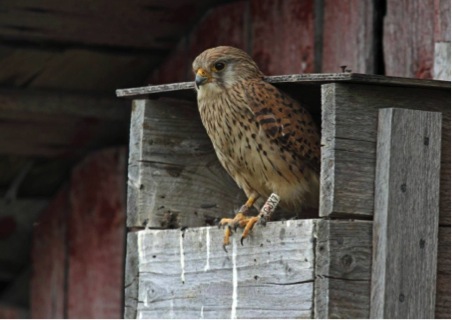
A female kestrel with metal and colour rings in the front of the nest-box. Photo: Benjam Pöntinen.

A female kestrel with metal and colour rings in the front of the nest-box. Photo: Benjam Pöntinen.

A total of 2089 males and 2544 females were trapped at nests during 1985 to 2011 in our study areas. Trapping success remained relatively constant over the period: of all the nesting attempts on average 70% of the male and 80% of the female parents were successfully captured yearly. This large-scale trapping and ringing program allowed us to collect 631 dispersal events from 1985 to 2011 that were analysed in this study.

Overall, we found that females dispersed further than males and older individuals dispersed further than yearlings. A noteworthy aspect of this study involved the evidence of body-condition dependent dispersal strategies in kestrels as the individual body condition index was positively correlated to breeding dispersal distances, particularly in females. Strikingly, our results also evidenced complex patterns of non-linear relationship between previous breeding success and dispersal distances. Finally, longer dispersal distances were associated with reproductive costs in males under increasing vole abundance, whereas those females dispersing further increased their breeding success under all conditions of food abundance.

These results call for further research as clearly there is more to learn about the link between potential pre- and post-breeding prospecting movements, optimal dispersal decisions and population dynamics in avian predators inhabiting fast changing boreal ecosystems.


References


Korpimäki, E. & Hakkarainen, H. 2012. The boreal owl: Ecology, Behaviour and Conservation of a Forest-Dwelling Predator. – Cambridge University Press, Cambridge. 372 pages.


Vasko, V., Laaksonen, T., Valkama, J. & Korpimäki, E. 2011. Breeding dispersal of Eurasian kestrels (Falco tinnunculus) under temporally fluctuating food abundance. – Journal of Avian Biology 42: 552-563. (doi: 10.1111/j.1600-048X.2011.05351.x)

Resisting drought: conventional plant breeding outperforms GM Updated for 2026


Since its launch in 2010, the Improved Maize for African Soils Project (IMAS) has developed 21 conventionally bred varieties which have increased yield by up to 1 tonne per hectare.

The plan is to commercialise these varieties and introduce them in eight countries.

In contrast, the project’s researchers say that they are at least 10 years away from developing a comparable GM variety.

In another programme – The Drought Tolerant Maize for Africa project – 153 new, conventionally bred varieties have improved yields in 13 countries.

In field trials, these varieties increase yields by up to 30% under drought conditions.

It is estimated that by 2016 the extra yields from these conventionally bred, drought-tolerant maize varieties could help reduce the number of people living in poverty in these 13 countries by up to 9%.

Conventional breeding proving “far more successful” than GM

According to the leading science journal Nature, these successes are based on access to the large seed bank managed by the International Maize and Wheat Improvement Center (CIMMYT) in Mexico City.

Breeders from CIMMYT and the International Institute for Tropical Agriculture (IITA) in Nigeria identified maize varieties that thrive in water-scarce regions.

They cross bred these var­ieties and mated the most drought-tolerant of their offspring. The result – after several breeding cycles – is seed that is even better adapted to drought conditions.

Finally these plants were crossed with varieties that had been successfully grown in Africa.

According to Kevin Pixley, director of CIMMYT’s genetic resources programme, it is a “painstaking process”, but it is proving far more successful than genetic engineering approaches.

Drought tolerance is a complex trait that involves multiple genes and genetic engineering techniques which target one gene is taking longer and is significantly less effective.

Understanding ecology led to breakthrough

The CIMMYT researchers established that a key characteristic in the plants ability to withstand drought is the number of days between when the plant’s male organs shed pollen and when the female silks emerge.

When water is scarce, the silks emerge late. If the delay is long enough, they emerge after the plants have released their pollen and are not fertilized.

“Finding out this relationship was very important to be able to select for drought tolerance”, says Pixley.

By favouring plants with shorter intervals between pollen release and silk emergence, breeders were able to produce maize that was more resistant to drought.

GMO crops – and the food system – is not fit for purpose

CIMMYT and six other research organizations are collaborating with Monsanto on genetically engineered drought resistant maize varieties but admit they are several years away from any success.

Of course this is not the story we usually hear from the research establishment and the media.

Unusually the journal Nature has broken ranks and highlighted that far from being essential in ‘feeding the world’ – and especially the drought prone areas such as Africa – genetic engineering is less useful than conventional breeding.

The evidence that GMO crops are not fit for purpose in Africa has been apparent for some time.

Yet we are still being force fed the line that a genetic engineering techno fix is essential to combat climate change and nourish the world’s growing population.

The complex ecological relationships and part played by; e.g. soilmicro-organisms and fungi, is largely ignored. So are agro-ecological methods such as Sustainable Rice Intensification (SRI).

And so is the most crucial fact of all: the world already produces enough calories to feed 14 billion people and the problem is not production; it is waste, inequitable distribution and lack of access to land, water and supply chains for small farmers and communities.

But that is dismissed as irrelevant or skated over in the interests of maintaining a corporate dominated, commodity trade focussed agriculture and food system where the overwhelming goal is the generation of short term profit.


Lawrence Woodward is founder and director of GM Education, where this article was originally published. 

Source:Cross-bred crops get fit faster‘, Nature.


384909

Save the free beavers of England! Updated for 2026


After an absence of more than two centuries, wild beavers have returned to Britain. For me that is an exciting thing to say.

At first they reappeared in Scotland – through escapees in Perthshire and an official reintroduction programme in Argyll. Now they are in England too, living and breeding on the River Otter in Devon.

Like most people I was thrilled when I heard the news. An iconic species was returning, enhancing biodiversity and enriching our environment. And it was happening with minimal fuss. or trouble.

Sadly, not everyone has seen it that way. The response from the government and some special interest groups has been depressingly familiar.

The animals they say, are a threat. They will harm fish stocks, they could carry disease. And, just to make it final, they have been gone too long. The landscape has changed too much. We cannot live together.

Across Europe, people and beavers mix

None of this is true. In virtually every country in Europe people and beavers manage to live side by side. These are not animals which require true wilderness but a species which live happily in modern agricultural landscapes.

They bring many benefits – enhancing fish stocks, increasing biodiversity and helping with flood prevention. There is a reason there have been 157 beaver reintroductions across the continent.

Despite this DEFRA, egged on by a few lobbyists, announced in early summer that it was planning to capture the beavers and “rehome” them. That could mean only one thing, a life in captivity and no more beavers in the wild. The uproar that followed was predictable. Columns were written, petitions were signed and local action groups came together.

In the weeks since, everything has gone quiet. Yet behind the scenes it seems preparations are still continuing to catch the animals.

There are rumours that traps have been ordered and moved into the area. Locals fear that the capturing could begin as soon as October.

Removing the population from the wild may be illegal

Friends of the Earth does not work much with beavers, and we do not run nature reserves in the UK, but we do know about the law, and in this case it seems to be very much on the beaver’s side.

The European Habitat Directive, a piece of law the UK agreed to, sets out clear rules for the protection of native species. The beaver is listed in Annex IV, and for these species Article 12 prohibits

  • all forms of deliberate capture or killing of specimens of these species in the wild;
  • deliberate disturbance of these species, particularly during the period of breeding, rearing, hibernation and migration;
  • deliberate destruction or taking of eggs from the wild;
    deterioration or destruction of breeding sites or resting places.its capture or killing in the wild.

It also obliges the government to establish a system of strict protection for all Annex IV animals.

The fact that the animals are not listed in the UK’s domestic regulations, due to the fact that they have been absent for some time, does not matter provided that the beavers are within their natural range.

And they are.

European beavers (Castor fiber) were once common throughout the continent and were found in almost every region, including Great Britain, where they were widespread, occurring right across the island.

Archaeological remains have been discovered from Cornwall to the North of Scotland. There are towns named after them. They are a recognised component our river systems. Natural England, the body that will no doubt be tasked with overseeing their removal, recognises this.

Netherlands, France, Belgium – so why not England?

Just as importantly, the modern British landscape is a perfect example of the kind of modern habitats they thrive in. In its 2009 feasibility study on reintroducing beavers to England, Natural England stated that it was ‘evident that many if not most of England’s rivers would provide suitable habitat to support beavers’.

The physical characteristics of the River Otter match the criteria they laid out. That there are beavers living and breeding there proves it.

The fact too that the beavers have just recently arrived is likely to be irrelevant. The concept of natural range outlined in the Directive is not static, and the guidance makes it clear that where the animals spread to a new area, that area must be considered part of its natural range.

Even if the beavers on the River Otter are escapees, this is no reason to consider them as being beyond their natural range. Indeed, the return of the beavers to England is just the latest stage in a process that has seen them rebound all over their territories.

From a population of just over a thousand a hundred years ago, they are now found in over 30 countries, including some of the UK’s nearest neighbours in the Netherlands, France and Belgium. Beavers have been seen swimming in the sea off Kent, and of course there are already populations in Scotland.

Little threat of disease

The Habitats Convention’s Article 16 does provide a let out that could, in specified circumstances, allow trapping. ‘Derogations’ from Article 12 may be permitted, for example:

  • in the interest of protecting wild fauna and flora and conserving natural habitats;
  • to prevent serious damage, in particular to crops, livestock, forests, fisheries and water and other types of property;
  • in the interests of public health and public safety, or for other imperative reasons of overriding public interest;
  • for the purpose of research and education, of repopulating and re-introducing these species and for the breedings operations necessary for these purposes.

Perhaps that’s what Lord de Mauley had in mind when he wrote a letter to the Angling Trust, raising the spectre that the animal might be carrying disease as a reason to catch them.

But this is a red herring. The disease in question, Echinococcus multilocularis, cannot be transmitted simply from beaver to beaver. In any case it can be easily tested for.

If the beavers living on the river were found to be free from disease, as they almost certainly are, it would be unjustifiable, disproportionate and potentially unlawful not to re-release them back onto the Otter, precisely because they are protected by the Directive.

As for the other circumstances provided in Article 16, DEFRA would be hard to argue that trapping the beavers was a matter of public health and safety, overriding public interest, or preventing serious damage.

None of the let outs appear to apply in this case where the beavers are causing no problems to anyone, and can only enhance the quality of wildlife habitat.

Community support

When the Scottish government tried to get rid of the wild beavers the community rallied round, eventually creating enough fuss for the issue to be dropped.

In Devon too everyone from farmers to shopkeepers to local councillors has spoken out in favour of the continued presence of the beavers.

It is still not too late. It is not clear how much the government really wants to catch these animals. By raising our concerns, we hope that DEFRA will realise that its actions will not just be unpopular, but potentially illegal.

We are not saying that our countryside should become a free-for all, but rather that we should take this opportunity to stop and think and work out the best way forward.

In the future beavers may need to be controlled, and the Habitats Directive allows this where genuinely necessary. We fully accept that and there are people who know how to do this.

At a time when so many species are under threat, and where the loss of biodiversity has become so constant that it almost loses its meaning, the ability to see a native species re-establish itself is a privilege, and one we should not give up lightly.


Alasdair Cameron is a wildlife campaigner with Friends of the Earth.

Action


370112