Tag Archives: environmentalists

Environmentalists’ oil price panic reflects their own existential crisis Updated for 2026


“Collapsing oil prices should give everyone in the ‘green movement’ cause for reflection.”

Say what! Really? Why is that?

I see the introduction to Steve Melia’s recent article for The Ecologist as indicative of a more general problem of how the environmental debate handles complex issues. Simplistic statements, such as that above, don’t necessarily reflect the complexity of the available evidence.

The article continued in the same vein: “With lower prices forecast to last for the next couple of years … “

Really? Yet again there’s little evidence to support those rosy projections, and many would state the contrary. Even environmentalism’s detractors question such assumptions these days.

For me, recent articles such as this expose the environmental movement’s quiet existential crisis. It’s a movement whose outlook has become narrowed by external forces as it has become skewed towards a media-led agenda – and which has shifted towards popularity rather than objectivity in addressing our ecological position as a species.

If we were to rely solely on what we see in the mass media, environmentalism is no longer a search to reconcile human needs to the limitations of their ecological circumstances.

It has become a debate over competing consumer choices which reflect, unquestioningly, the dominant consumer debate over affluence and growth, albeit of a green’ hue; and dominated by the single metric of carbon … and pandas!

The fact that we only significantly cut emissions and consumption during recessions, or that we’re running out of the resources needed to manufacture green technologies – oh, that’s so 1970s!

It’s not environmentalists’ fault, but it requires their participation.

As outlined recently by Adam Curtis, the purpose of the modern, engineered media debate is not to inform, it is to confuse. Doubt is their product.

The purpose of this approach is not advance a specific debate over change, instead it deflects criticism from existing practices. This happens because statements and events are not based upon evidence, but rather popularly acceptable and often contradictory assumptions – all of which engenders a widespread cognitive dissonance over precisely what ‘reality’ is.

That’s also a problem for major players in the environmental movement today, whose raison d’etre is to chase the media agenda to advance their cause.

Especially with on-line and 24-hour rolling news, the herd mentality governing the media melee overrides the ‘deep green’ fundamental questions about lifestyle which ‘traditional’ environmentalism raises. This is especially true in relation to evidence which contradicts the media’s dominant political message of growth and affluence.

For example, one of the ground-breaking – but little discussed – recent climate documentaries is Cowspiracy. It examines at the range of available evidence on one of the single biggest practices harming the global environment today: meat-eating.

One startling part of the film is when they interview campaign groups, who largely ignore or side-step the issue, or failed to acknowledge it altogether. Greenpeace refused to appear.

Why do media-led campaign groups feel the need to follow ‘the script’ the modern managed media assigns to them? Rather than, for example, standing apart and seeking to define their own agenda outside of the ‘usual channels’.

This is what the movement did during the 1970s and 1980s – and, thirty or forty years later, contrary to its anti-consumerist ‘hair shirt’ depiction, the weight evidence today shows that stance to have been correct.

So what is happening with oil prices?

The recent environmental debate on oil prices is an exemplar for how a failure of analysis is leading to a wholly mistaken assumptions about present trends.

And again, it’s because people are following a simplistic mass media agenda, rather than seeking to understand the range of evidence available – and use that understanding to their advantage.

Oil prices are falling because many the world’s strategic investors think the global economy is knackered. To understand why we need to look across all commodities, not just oil.

It if was just fracking, or a glut of conventional oil driving prices down, oil prices would be falling relative to other commodities. That would be a boon the the global economy and global growth – and yes, people would consume more oil.

But that’s not what we see.

Instead, nearly all commodity futures – from copper to cotton to tin – have been trending down over the last year. That’s due to the global economy stalling, cutting consumption generally, reducing demand, and thus driving all commodity prices down.

In fact, economists are now worried about deflation. As prices fall, people put off buying stuff in the hope they can get it cheaper in the near future – which depresses the economy even more.

Objectively though this is brilliant for the environment. Far more so than the paltry measures governments are using to address ecological issues – as the Australian finance minister recently admitted.

Whether you ‘believe’ in economics or not, the markets are reflecting the belief that, irrespective of the contradictory hogwash that lobbyists push into the media, there’s potentially another global crash coming. Remember, the problems of 2007/8 were never solved – they were just bailed out.

This is about economic power, not prices

The recent fall in oil prices has little to do with fracking. It arguably does have a link to the ‘ecological limits’ outlined by the peak oil debate, due to the changing the balance of power between OPEC and non-OPEC producers it creates. But the greatest factor here is geopolitics.

For the last fifty years OPEC has been what’s called the ‘swing producer‘. Whether OPEC opens or closes the taps largely determines the global supply oil – allowing them to manipulate the price. That power can be used for the benefit of the industry, raising prices to encourage investment, or for more nefarious political purposes.

Of course the Middle East, by cutting production, potentially takes a hit on their income. To make matters worse, all their economic loss does is to prop-up the more expensive production in the non-OPEC regions of the world – especially off-shore, in the Arctic, and unconventional production.

With a possible climate deal looming in December, and with the issue of ‘stranded assets‘ beginning to sink-in to the thinking of market investors, does being the ‘swing producer’ role benefit OPEC any more? That is perhaps what this current ‘crisis’ is really about.

The Middle East produces almost half the world’s crude oil, and it does so relatively cheaply. However, the idea that OPEC’s ‘cheap oil’ will guarantee low prices ignores the near $50 trillion cost which the IEA consider essential to maintain global energy production – which requires a near $100 to $115/barrel price to be economically viable.

Over the last decade, the fossil fuel industry had never invested so much money for such a small return; and that lower productivity is worsening the ecological footprint of their product. Somewhere between 60% and 75% of current production might be considered ‘conventional’ or ‘easy’ oil.

The remainder – the more extreme ‘conventional’ and unconventional sources, from the Niger Delta, to the Arctic, to the deep waters of the Gulf of Mexico, to fracking – is causing some of the highest ecological damage per unit of fuel produced.

If a climate deal, or acceptance of stranded assets, preserves the global balance of production in 2015/16, then it’s in OPEC’s interest to make sure they are the only oil producing group in the room.

By driving down prices – making all that marginal production in Europe, the Americas, Africa and Australia uneconomic – they may well be the last guys standing, if/when we have to ration future production to meet the needs of a realistic climate deal.

That turns Melia’s argument on its head

Far from weakening the environmental argument, as production limits begin to bite, the tussles within the industry are actually benefiting (at least in the short term) the objectives of the environment movement. Obviously OPEC are not doing this to help the environment, but we have to recognise this as a potential short-term outcome of their actions.

And on the far side of the present economic downturn? If OPEC get their way there will be less oil and gas capacity available in a year or two. If demand rises energy prices will spike once more, holding-down demand – again, a benefit for the environment (and OPEC).

Of course this is all geopolitics; and all these geopolitical power plays are incredibly short-term. It does absolutely nothing to address the fundamental ecological trends defining peak oil, nor the greater ‘limits to growth‘ which may collapse the global economy well before dangerous climate change does. But that’s another – and far more complex – debate!

Environmentalists should be cheering on OPEC! They’re bankrupting the companies environmentalists love to hate!

From the North Slope of Alaska, to tar sands and the Keystone pipeline in Canada, to the fracking patch of the Dakotas, they’re curtailing the development of some of the most damaging sources of petroleum operating today.

We don’t have to like OPEC, but we have to recognise the ‘unintended consequences’ their actions may have for the global environment.


Paul Mobbs is an independent environmental consultant, investigator, author and lecturer.

See a fully referenced version of this article on the Free Range Activism Website.


388736

Environmentalists’ oil price panic reflects their own existential crisis Updated for 2026


“Collapsing oil prices should give everyone in the ‘green movement’ cause for reflection.”

Say what! Really? Why is that?

I see the introduction to Steve Melia’s recent article for The Ecologist as indicative of a more general problem of how the environmental debate handles complex issues. Simplistic statements, such as that above, don’t necessarily reflect the complexity of the available evidence.

The article continued in the same vein: “With lower prices forecast to last for the next couple of years … “

Really? Yet again there’s little evidence to support those rosy projections, and many would state the contrary. Even environmentalism’s detractors question such assumptions these days.

For me, recent articles such as this expose the environmental movement’s quiet existential crisis. It’s a movement whose outlook has become narrowed by external forces as it has become skewed towards a media-led agenda – and which has shifted towards popularity rather than objectivity in addressing our ecological position as a species.

If we were to rely solely on what we see in the mass media, environmentalism is no longer a search to reconcile human needs to the limitations of their ecological circumstances.

It has become a debate over competing consumer choices which reflect, unquestioningly, the dominant consumer debate over affluence and growth, albeit of a green’ hue; and dominated by the single metric of carbon … and pandas!

The fact that we only significantly cut emissions and consumption during recessions, or that we’re running out of the resources needed to manufacture green technologies – oh, that’s so 1970s!

It’s not environmentalists’ fault, but it requires their participation.

As outlined recently by Adam Curtis, the purpose of the modern, engineered media debate is not to inform, it is to confuse. Doubt is their product.

The purpose of this approach is not advance a specific debate over change, instead it deflects criticism from existing practices. This happens because statements and events are not based upon evidence, but rather popularly acceptable and often contradictory assumptions – all of which engenders a widespread cognitive dissonance over precisely what ‘reality’ is.

That’s also a problem for major players in the environmental movement today, whose raison d’etre is to chase the media agenda to advance their cause.

Especially with on-line and 24-hour rolling news, the herd mentality governing the media melee overrides the ‘deep green’ fundamental questions about lifestyle which ‘traditional’ environmentalism raises. This is especially true in relation to evidence which contradicts the media’s dominant political message of growth and affluence.

For example, one of the ground-breaking – but little discussed – recent climate documentaries is Cowspiracy. It examines at the range of available evidence on one of the single biggest practices harming the global environment today: meat-eating.

One startling part of the film is when they interview campaign groups, who largely ignore or side-step the issue, or failed to acknowledge it altogether. Greenpeace refused to appear.

Why do media-led campaign groups feel the need to follow ‘the script’ the modern managed media assigns to them? Rather than, for example, standing apart and seeking to define their own agenda outside of the ‘usual channels’.

This is what the movement did during the 1970s and 1980s – and, thirty or forty years later, contrary to its anti-consumerist ‘hair shirt’ depiction, the weight evidence today shows that stance to have been correct.

So what is happening with oil prices?

The recent environmental debate on oil prices is an exemplar for how a failure of analysis is leading to a wholly mistaken assumptions about present trends.

And again, it’s because people are following a simplistic mass media agenda, rather than seeking to understand the range of evidence available – and use that understanding to their advantage.

Oil prices are falling because many the world’s strategic investors think the global economy is knackered. To understand why we need to look across all commodities, not just oil.

It if was just fracking, or a glut of conventional oil driving prices down, oil prices would be falling relative to other commodities. That would be a boon the the global economy and global growth – and yes, people would consume more oil.

But that’s not what we see.

Instead, nearly all commodity futures – from copper to cotton to tin – have been trending down over the last year. That’s due to the global economy stalling, cutting consumption generally, reducing demand, and thus driving all commodity prices down.

In fact, economists are now worried about deflation. As prices fall, people put off buying stuff in the hope they can get it cheaper in the near future – which depresses the economy even more.

Objectively though this is brilliant for the environment. Far more so than the paltry measures governments are using to address ecological issues – as the Australian finance minister recently admitted.

Whether you ‘believe’ in economics or not, the markets are reflecting the belief that, irrespective of the contradictory hogwash that lobbyists push into the media, there’s potentially another global crash coming. Remember, the problems of 2007/8 were never solved – they were just bailed out.

This is about economic power, not prices

The recent fall in oil prices has little to do with fracking. It arguably does have a link to the ‘ecological limits’ outlined by the peak oil debate, due to the changing the balance of power between OPEC and non-OPEC producers it creates. But the greatest factor here is geopolitics.

For the last fifty years OPEC has been what’s called the ‘swing producer‘. Whether OPEC opens or closes the taps largely determines the global supply oil – allowing them to manipulate the price. That power can be used for the benefit of the industry, raising prices to encourage investment, or for more nefarious political purposes.

Of course the Middle East, by cutting production, potentially takes a hit on their income. To make matters worse, all their economic loss does is to prop-up the more expensive production in the non-OPEC regions of the world – especially off-shore, in the Arctic, and unconventional production.

With a possible climate deal looming in December, and with the issue of ‘stranded assets‘ beginning to sink-in to the thinking of market investors, does being the ‘swing producer’ role benefit OPEC any more? That is perhaps what this current ‘crisis’ is really about.

The Middle East produces almost half the world’s crude oil, and it does so relatively cheaply. However, the idea that OPEC’s ‘cheap oil’ will guarantee low prices ignores the near $50 trillion cost which the IEA consider essential to maintain global energy production – which requires a near $100 to $115/barrel price to be economically viable.

Over the last decade, the fossil fuel industry had never invested so much money for such a small return; and that lower productivity is worsening the ecological footprint of their product. Somewhere between 60% and 75% of current production might be considered ‘conventional’ or ‘easy’ oil.

The remainder – the more extreme ‘conventional’ and unconventional sources, from the Niger Delta, to the Arctic, to the deep waters of the Gulf of Mexico, to fracking – is causing some of the highest ecological damage per unit of fuel produced.

If a climate deal, or acceptance of stranded assets, preserves the global balance of production in 2015/16, then it’s in OPEC’s interest to make sure they are the only oil producing group in the room.

By driving down prices – making all that marginal production in Europe, the Americas, Africa and Australia uneconomic – they may well be the last guys standing, if/when we have to ration future production to meet the needs of a realistic climate deal.

That turns Melia’s argument on its head

Far from weakening the environmental argument, as production limits begin to bite, the tussles within the industry are actually benefiting (at least in the short term) the objectives of the environment movement. Obviously OPEC are not doing this to help the environment, but we have to recognise this as a potential short-term outcome of their actions.

And on the far side of the present economic downturn? If OPEC get their way there will be less oil and gas capacity available in a year or two. If demand rises energy prices will spike once more, holding-down demand – again, a benefit for the environment (and OPEC).

Of course this is all geopolitics; and all these geopolitical power plays are incredibly short-term. It does absolutely nothing to address the fundamental ecological trends defining peak oil, nor the greater ‘limits to growth‘ which may collapse the global economy well before dangerous climate change does. But that’s another – and far more complex – debate!

Environmentalists should be cheering on OPEC! They’re bankrupting the companies environmentalists love to hate!

From the North Slope of Alaska, to tar sands and the Keystone pipeline in Canada, to the fracking patch of the Dakotas, they’re curtailing the development of some of the most damaging sources of petroleum operating today.

We don’t have to like OPEC, but we have to recognise the ‘unintended consequences’ their actions may have for the global environment.


Paul Mobbs is an independent environmental consultant, investigator, author and lecturer.

See a fully referenced version of this article on the Free Range Activism Website.


388736

‘Fake environmentalists’ battle for Istanbul’s last forest Updated for 2026


Zekiye Ozdemir and Gulseren Caliskan, both 70, sit staidly in their wicker chairs directly in front of a large iron police barrier, undeterred by the cold mist wafting down from the grey sky above.

On one side of the fence lies a parking lot, now a forbidden zone. It’s guarded by a hulking water cannon truck and a detachment of heavily armoured riot police, many of their faces concealed by black scarves.

On the other side is a group of some 100 activists and concerned citizens protesting what they call an attack on one of the few large green spaces left in Istanbul. They’re handing out tea and snacks from under their makeshift tents and umbrellas, to stave off the inclement weather.

The matronly pensioners blithely chirp away, paying no attention to the dozens of police looming nearby. “We came here to say no to skyscrapers, to protect nature, and to support the youth.”, Ozdemir explains enthusiastically.

Validebag Grove – ‘it’s turning upper-middle class housewives into activists’

In early October, activists collected 80,000 signatures of people opposed to the Uskudar Municipality’s construction project that will include a small mosque, wedding halls, open-air theaters and artificial pools.

The construction site is in a parking lot on the very edge of Validebag Grove – home to some 7,000 trees and several historical buildings. The grove is in Uskudar, a hilly, mostly conservative district on Istanbul’s Asian side.

Hilmi Turkmen, mayor of Uskudar Municipality and member of Turkey’s ruling Justice and Development Party (AKP), has called the activists “fake environmentalists” and said that “Unfortunately too much tolerance and goodwill drives people wild and makes them believe that they are right.”

Activists accuse the government of politicizing their citizens. “They are turning upper-middle class housewives into activists”, says Cigdem Cidamli, an environmentalist with Istanbul City Defense.

Police violence – ‘they’re like an army!’

At the crack of dawn on 21 October, a police-escorted bulldozer crept into the parking lot and starting ripping up concrete. Furious activists called the excavation unlawful because the legal process was still pending, and started a 24-hour vigil that still continues.

Later that afternoon, an administrative court suspended the construction, saying the Uskudar Municipality didn’t have a license for the mosque. When activists announced the stay of execution, police attacked them with teargas.

“They’re like an army”, environmentalist Onur Akgul says, noting there are almost as many cops as activists. Akgul is a member of Northern Forests’ Defence, an environmental group formed after the Gezi protests of 2013, which were also sparked by commercial development of a central green space.

On 23 October, construction resumed despite the court order. “They’re not listening to the law”, Akgul says. “What’s happening now is purely illegal.”

Several prominent activists and a journalist have been detained and beaten by police, to the surprise of no one. Cidamli was amongst those detained. “They beat us”, she says. “They threatened me, [saying] ‘I will fuck you, and kill you, [and] shoot you.'”

On the weekend of 25 – 26 October, activists organized a march and a picnic, and police responded by erecting the iron barricade and bringing in the riot squad. The following Monday, protesters filled the road with their cards to block excavation equipment, and tow trucks came to remove them, some with the drivers still inside.

A couple of weeks later, a group of women tried to enter the construction site. One of them promised the riot police “we will just enter the grove, look around, and then leave”, adding “you are also our children.” When they tried to make their way past the police, they were immediately pepper sprayed.

Asian Istanbul  – the new target for ‘urban transformation’

The Validebag Grove is a protected natural site, and a designated meeting spot during a natural disaster such as an earthquake.

The Uskudar Municipality is trying to annul the grove’s protected status, and activists say that because of Validebag’s location in an attractive residential neighbourhood, the Municipality wants to tear out trees and build more housing and commercial centres.

The ruling AK Party has been rapidly transforming Istanbul with a number of ‘urban transformation’ projects. Critics argue the changes are implemented from the top down with very little public consultation or regard for environmental effects, and that pro-AKP construction firms get the most lucrative bids.

They say laws have been altered to facilitate hasty construction and decrease the role of professional organizations responsible for ensuring high standards.

“Istanbul has become a city that is continuously under the assault of this urban transformation and privatization of public areas”, Cidanli says. Most of these projects have been undertaken on the European side of Istanbul, but according to Cidanli, “the Anatolian part of Istanbul is now under attack.”

Despite a dismal environmental record, Istanbul recently entered a competition to be the European Green Capital of 2017.

But according to British consulting agency World Cities Culture Forum, green spaces in Istanbul account for only 1.5% of the city – much smaller than other Europeans capitals such as London (38%), Berlin (14.4%), or Paris (9.40%).

Mosque a Trojan horse for commercial development

Cidanli fears this construction project is the first step in terminating Validebag’s protected status and opening the grove to commercial development. “This is a very profit-oriented project under the guise of a mosque”, she says. “They will go step by step”, slowly nibbling at the edges of the green space.

She says the municipality tried a month earlier to appropriate land in Validebag from the north with a project to build parking lots, but were unable to proceed due to opposition. Now, she says, they’re trying from the south.

Cidanli says these projects often start with a mosque because if anyone raises concerns, they’re accused of being Islamophobic in a very religious country. “Maybe they thought that if they say this will be a mosque, nobody would dare to oppose it”, she says.

President Erdogan, who has a private residence in Uskudar and has voiced support for the construction project, often attempts to stoke religious sentiment against his critics.

“Maybe some were uncomfortable because it is a masjid [small mosque]”, he told journalists on 25 October, accusing critics of the Validebag construction of being intolerant of Islam.

The opposition Republican People’s Party (CHP), whose members have visited and voiced support for demonstrators in Validebag, immediately shot back: “They are trying to use the mosque card to claim that people are against places of worship”, CHP deputy Mahmut Tanal told local news. “This is completely false.”

“We don’t have any problem with mosques”, Akgul, the environmentalist with Northern Forests’ Defence says, pointing out that many of the activists themselves are devout Muslims.

‘We don’t need any more mosques. We need oxygen!’

The issue has now been taken up by the main opposition Republican People’s Party (CHP). Its Deputy Chairman Sezgin Tanrikulu submitted a parliamentary question for Prime Minister Ahmet Davutoglu earlier this month about allegations that the Uskudar Municipality had agreed to turn parts of Validebag Grove into a car park. (The link has mysteriously been taken down but I accessed a cached version.)

According to Tanrikulu the construction of the mosque is “only for show” and the land will actually be allocated to a company linked to the ruling AK Party company. “What is the name of the company that signed an agreement with Üsküdar’s mayor for a car park on Validebag Grove?” he asked.

Religious or not, many of the demonstrators are staunch secularists, and have put up banners bearing the portrait of modern Turkey’s fiercely secular founder Mustafa Kemal Ataturk.

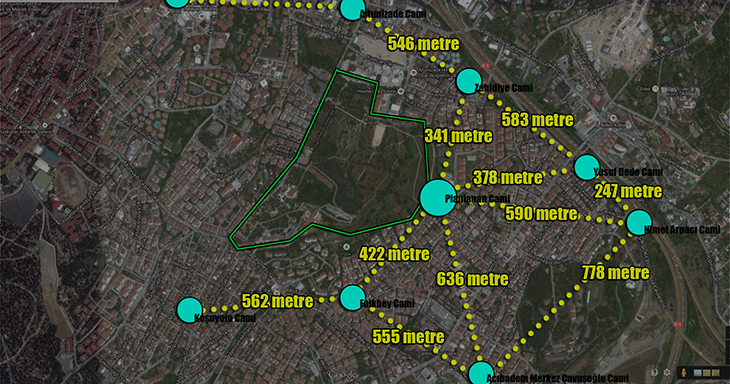
Some wonder why another mosque needs to be built in an area that already has 26, four of which are less than 600 metres away. “We don’t need any more mosques, says 70 year-old demonstrator Ozdemir. “We need oxygen!”

On October 31 the court’s stay of execution was reversed after an appeal, saying the project site lies outside of the protected grove. Some local papers and opposition politicians accused the Uskudar Municipality of interfering with the legal process, and lawyers representing the activists vowed to appeal the court’s reversal.

Among them was Tanrikulu – who claimed, in his parliamentary question, that the Municipality had tried to bypass the decision of the Istanbul 7th Administrative Court – which ordered a stop on construction at the site – by altering the sheet and parcel numbers of the car park.

Despite the unfavourable ruling, and the rising atmosphere of threat and initimidation from both government and police, the protestors are holding firm. And Ozdemir remains confident of ultimate victory, insisting: “The people will prevail!”


Nick Ashdown is a Canadian freelance journalist based in Istanbul, Turkey. You can follow him on Twitter @Nick_Ashdown


387355