Tag Archives: battle

Bees victory in pesticide battle – Bayer libel action dismissed Updated for 2026


German chemical giant Bayer has failed in its attempt to sue Friends of the Earth Germany (BUND) over its claims that two of its pesitcide formulations harm bees.

A judge in Dusseldorf has ruled that BUND had a right to voice its concerns about Bayer’s ‘Calypso‘ and ‘Lizetan’ pesticide formulations, sold to consumers as “not toxic to bees”. Both contain the neonicotinoid Thiacloprid which is associated with harm to bees.

“We are delighted with this achievement”, said BUND’s pesticide expert Tomas Brückmann. “This is a victory for the bees and freedom.”

Just before last Christmas Bayer took out a restraining order against BUND at the District Court in Dusseldorf, preventing the group from publishing its view that the product was harmful to bees, under threat of a €250,000 fine or a detention of up to two years. Now that order has been overturned.

A spokesman for Bayer said the company “regrets the decision”, adding that the products “had officially been classified as ‘not harmful for bees’ and were labeled as such in accordance with binding legal regulations” after thorough testing both by Bayer and Federal Office of Consumer Protection and Food Safety (BVL)

Scientific evidence shows Thiaclopid harms bees

But according to BUND, there is “scientific evidence of impaired learning ability” to bees from Thiacloprid, as well as to “the ability to communicate and pollen foraging activity of bees”.

It also believes that by printing a “not toxic to bees” logo on products containing Thiacloprid, following the emergence of contrary evidence, there arose “the suspicion of a deliberate deception of the consumer by Bayer.”

A scientific paper by Professor Randolf Menzel used in evidence by BUND, says: “Sublethal doses of neonicotinoids interfere selectively with the homing flight component based on this cognitive map memory, reducing the probability of successful returns to the hive. Chronic exposure to the neonicotinoid Thiacloprid reduces the attractiveness of a feeding site and the rate of recruitment.”

Following its legal defeat, says Brückmann, Bayer Crop Sciences should immediately withdraw the offending bee-hazardous pesticides from the market.

“We call on all markets to stop the sale of Thiacloprid pesticides”, he continued. “In addition, the EU should withdraw the authorization of the Thiacloprid and the Federal Office of Consumer Protection and Food Safety (BVL) withdraw product approvals for all Thiacloprid products.”

A paper published in the Journal PLOS ONE confirms that Thiacloprid, along with the neonicotinoids Imidacloprid and Clothianidin, affects bees’ navigational ability and behaviour, making it harder for them to find their way back to their hives.

It also shows that exposure to Thiacloprid can increase the likelihood of honeybees dying if they are already infected with diseases. A further study found that the toxicity of Thiacloprid to honey bees is increased over 1,000 fold when mixed with fungicides.

These bee-toxic pesticides must also be banned in the UK!

Back in London, Friends of the Earth bees campaigner Dave Timms said: “Bayer has been shown up as a corporate bully, trying to silence campaigners who are standing up for bees. 

“The ruling is a victory for Friends of the Earth Germany, freedom of speech and for the many thousands of people who have taken action to protect bees across Europe. 

Thiacloprid is used on various crops in the UK including oil seed rape (canola) and apples, and it is sold direct to the public in garden bug-killing products. Friends of the Earth is now asking the European Commission to take a precautionary approach by suspending all uses of Thiacloprid and to review its safety.

As in Germany, Bayer’s Thiacloprid products sold in the UK are described as “Bee Safe” or having “no risk to bees”. These include Calypso and Biscaya.

“Now we want to see action from the European Commission to ensure that any pesticides with evidence of harm to bees are taken off our shelves and out of our fields for good”, said Timms. In addition FoE will be contacting retailers asking them to stop selling products containing Thiacloprid.

In 2013 three other neonicotinoid pesticides (imidacloprid, thiamethoxam and clothianidin) were subject to a temporary ban in the EU. This followed a review of evidence by the European Food Safety Authority (EFSA) which found they each posed a “high acute risk” to honey bees.

“Although Thiacloprid is not subject to that ban there is evidence that it can make bees more likely to die from common diseases and can impair their navigational abilities, making it harder for them to return to their hives”, Timms added.

Not just bees – the entire food chain is at risk!

Last year a group of 29 independent scientists on the Global Taskforce on Systemic Pesticides concluded that the widespread use of neonicotinoid pesticides is affecting earthworms, birds and bees and the quality of water and soils.

They examined over 1,000 peer reviewed papers before reaching this conclusion. They also found that the compounds which neonicotinoids break down into are often as, or more, toxic than the active ingredients.

In another legal action, Bayer and Sygenta are suing the European Commission to lift its temporary ban on the three neonicotinoids. “The Commission must stand form against these bully-buy tactics”, said Timms.

And Bayer is not ruling out an appeal against BUND’s legal victory. A spokesman said: “The court considered the allegations of BUND to be a free expression of opinion, which deserved special protection. Bayer CropScience will wait for the written grounds for the judgment and subsequently consider potential further steps.”


Oliver Tickell edits The Ecologist.


391197

‘Fake environmentalists’ battle for Istanbul’s last forest Updated for 2026


Zekiye Ozdemir and Gulseren Caliskan, both 70, sit staidly in their wicker chairs directly in front of a large iron police barrier, undeterred by the cold mist wafting down from the grey sky above.

On one side of the fence lies a parking lot, now a forbidden zone. It’s guarded by a hulking water cannon truck and a detachment of heavily armoured riot police, many of their faces concealed by black scarves.

On the other side is a group of some 100 activists and concerned citizens protesting what they call an attack on one of the few large green spaces left in Istanbul. They’re handing out tea and snacks from under their makeshift tents and umbrellas, to stave off the inclement weather.

The matronly pensioners blithely chirp away, paying no attention to the dozens of police looming nearby. “We came here to say no to skyscrapers, to protect nature, and to support the youth.”, Ozdemir explains enthusiastically.

Validebag Grove – ‘it’s turning upper-middle class housewives into activists’

In early October, activists collected 80,000 signatures of people opposed to the Uskudar Municipality’s construction project that will include a small mosque, wedding halls, open-air theaters and artificial pools.

The construction site is in a parking lot on the very edge of Validebag Grove – home to some 7,000 trees and several historical buildings. The grove is in Uskudar, a hilly, mostly conservative district on Istanbul’s Asian side.

Hilmi Turkmen, mayor of Uskudar Municipality and member of Turkey’s ruling Justice and Development Party (AKP), has called the activists “fake environmentalists” and said that “Unfortunately too much tolerance and goodwill drives people wild and makes them believe that they are right.”

Activists accuse the government of politicizing their citizens. “They are turning upper-middle class housewives into activists”, says Cigdem Cidamli, an environmentalist with Istanbul City Defense.

Police violence – ‘they’re like an army!’

At the crack of dawn on 21 October, a police-escorted bulldozer crept into the parking lot and starting ripping up concrete. Furious activists called the excavation unlawful because the legal process was still pending, and started a 24-hour vigil that still continues.

Later that afternoon, an administrative court suspended the construction, saying the Uskudar Municipality didn’t have a license for the mosque. When activists announced the stay of execution, police attacked them with teargas.

“They’re like an army”, environmentalist Onur Akgul says, noting there are almost as many cops as activists. Akgul is a member of Northern Forests’ Defence, an environmental group formed after the Gezi protests of 2013, which were also sparked by commercial development of a central green space.

On 23 October, construction resumed despite the court order. “They’re not listening to the law”, Akgul says. “What’s happening now is purely illegal.”

Several prominent activists and a journalist have been detained and beaten by police, to the surprise of no one. Cidamli was amongst those detained. “They beat us”, she says. “They threatened me, [saying] ‘I will fuck you, and kill you, [and] shoot you.'”

On the weekend of 25 – 26 October, activists organized a march and a picnic, and police responded by erecting the iron barricade and bringing in the riot squad. The following Monday, protesters filled the road with their cards to block excavation equipment, and tow trucks came to remove them, some with the drivers still inside.

A couple of weeks later, a group of women tried to enter the construction site. One of them promised the riot police “we will just enter the grove, look around, and then leave”, adding “you are also our children.” When they tried to make their way past the police, they were immediately pepper sprayed.

Asian Istanbul  – the new target for ‘urban transformation’

The Validebag Grove is a protected natural site, and a designated meeting spot during a natural disaster such as an earthquake.

The Uskudar Municipality is trying to annul the grove’s protected status, and activists say that because of Validebag’s location in an attractive residential neighbourhood, the Municipality wants to tear out trees and build more housing and commercial centres.

The ruling AK Party has been rapidly transforming Istanbul with a number of ‘urban transformation’ projects. Critics argue the changes are implemented from the top down with very little public consultation or regard for environmental effects, and that pro-AKP construction firms get the most lucrative bids.

They say laws have been altered to facilitate hasty construction and decrease the role of professional organizations responsible for ensuring high standards.

“Istanbul has become a city that is continuously under the assault of this urban transformation and privatization of public areas”, Cidanli says. Most of these projects have been undertaken on the European side of Istanbul, but according to Cidanli, “the Anatolian part of Istanbul is now under attack.”

Despite a dismal environmental record, Istanbul recently entered a competition to be the European Green Capital of 2017.

But according to British consulting agency World Cities Culture Forum, green spaces in Istanbul account for only 1.5% of the city – much smaller than other Europeans capitals such as London (38%), Berlin (14.4%), or Paris (9.40%).

Mosque a Trojan horse for commercial development

Cidanli fears this construction project is the first step in terminating Validebag’s protected status and opening the grove to commercial development. “This is a very profit-oriented project under the guise of a mosque”, she says. “They will go step by step”, slowly nibbling at the edges of the green space.

She says the municipality tried a month earlier to appropriate land in Validebag from the north with a project to build parking lots, but were unable to proceed due to opposition. Now, she says, they’re trying from the south.

Cidanli says these projects often start with a mosque because if anyone raises concerns, they’re accused of being Islamophobic in a very religious country. “Maybe they thought that if they say this will be a mosque, nobody would dare to oppose it”, she says.

President Erdogan, who has a private residence in Uskudar and has voiced support for the construction project, often attempts to stoke religious sentiment against his critics.

“Maybe some were uncomfortable because it is a masjid [small mosque]”, he told journalists on 25 October, accusing critics of the Validebag construction of being intolerant of Islam.

The opposition Republican People’s Party (CHP), whose members have visited and voiced support for demonstrators in Validebag, immediately shot back: “They are trying to use the mosque card to claim that people are against places of worship”, CHP deputy Mahmut Tanal told local news. “This is completely false.”

“We don’t have any problem with mosques”, Akgul, the environmentalist with Northern Forests’ Defence says, pointing out that many of the activists themselves are devout Muslims.

‘We don’t need any more mosques. We need oxygen!’

The issue has now been taken up by the main opposition Republican People’s Party (CHP). Its Deputy Chairman Sezgin Tanrikulu submitted a parliamentary question for Prime Minister Ahmet Davutoglu earlier this month about allegations that the Uskudar Municipality had agreed to turn parts of Validebag Grove into a car park. (The link has mysteriously been taken down but I accessed a cached version.)

According to Tanrikulu the construction of the mosque is “only for show” and the land will actually be allocated to a company linked to the ruling AK Party company. “What is the name of the company that signed an agreement with Üsküdar’s mayor for a car park on Validebag Grove?” he asked.

Religious or not, many of the demonstrators are staunch secularists, and have put up banners bearing the portrait of modern Turkey’s fiercely secular founder Mustafa Kemal Ataturk.

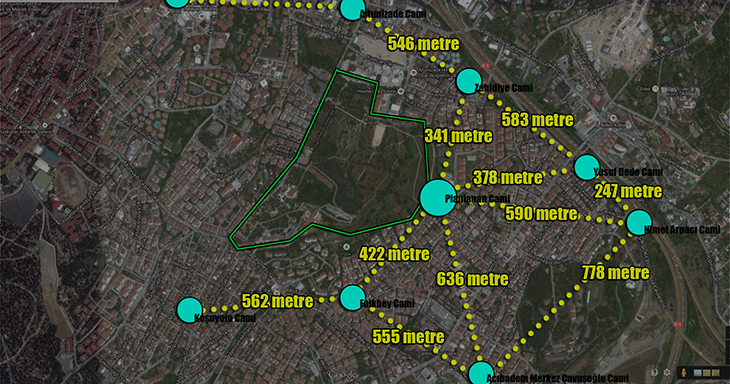
Some wonder why another mosque needs to be built in an area that already has 26, four of which are less than 600 metres away. “We don’t need any more mosques, says 70 year-old demonstrator Ozdemir. “We need oxygen!”

On October 31 the court’s stay of execution was reversed after an appeal, saying the project site lies outside of the protected grove. Some local papers and opposition politicians accused the Uskudar Municipality of interfering with the legal process, and lawyers representing the activists vowed to appeal the court’s reversal.

Among them was Tanrikulu – who claimed, in his parliamentary question, that the Municipality had tried to bypass the decision of the Istanbul 7th Administrative Court – which ordered a stop on construction at the site – by altering the sheet and parcel numbers of the car park.

Despite the unfavourable ruling, and the rising atmosphere of threat and initimidation from both government and police, the protestors are holding firm. And Ozdemir remains confident of ultimate victory, insisting: “The people will prevail!”


Nick Ashdown is a Canadian freelance journalist based in Istanbul, Turkey. You can follow him on Twitter @Nick_Ashdown


387355

Keystone XL – we won! But the real battle lies ahead Updated for 2026


So the Keystone XL bill failed to pass Congress. The Big Fail marks a huge success for groups who have been struggling to expose the KXL for the dirty policy it represents.

The actions taken on the day of the vote, including disrupting the Senate vote in the chamber and blocking Senators Bennet (D-Col.) and Carper (D-Del.) from leaving their offices, speak to the dedication and tirelessness of the movement to stop the pipeline.

So we can all go home now, right? We won!

The problem is that the bill will be back in January, and the congress we’re dealing with right now is very different from the one we’ll see ushered into office at the beginning of 2015.

Just because the lame-duck Congress voted against the bill (barely) with its Democratic Party majority does not mean that the Republicans will have any problem sweeping it through when they take the majority.

The Democratic Party’s vote does give Obama a mandate to veto the bill next year if and when it goes through, but the question remains as to whether or not he will use it.

In short, the Big Fail and ensuing celebrations from the Environmental NGOs looks suspiciously like a setup. It’s definitely not time to demobilize.

‘Claim no easy victories’

Rising Tide North America released a statement on their Facebook page going so far as to call the bill’s failure a “hollow victory”. While the Big Fail is vital, activists must stay vigilant, they stress.

“We’ve made the climate argument on this pipeline and won. We’ve made the environmental impact argument and won. We’ve even made the jobs argument on Keystone XL and won”, the group insists.

“The grassroots climate and environmental movements are obviously mobilized. Hopefully, next January becomes more about fighting Keystone XL in the streets, along the pipeline route and corporate offices than asking a political system rigged against us to smile upon our cause once more.”

As RTNA intimates, the KXL must be met through sincere and dedicated efforts at Indigenous solidarity with the Rosebud Sioux, who have called the KXL’s passage through the House an “act of war”, and others who are resisting not only the pipeline, but the tar sands as well.

This is not just a struggle to stop one pipeline; it is a struggle for the future of the Earth, and that means that the tar sands – the Earth’s largest and most toxic industrial project – must be shut down, and all pipelines extending from it thwarted.

What if the bill fails in January, through some miracle, and Canada exports the oil through Canada’s Atlantic coast? Would the NGOs declare victory, or would they stand with us in the streets?

As Amilcar Cabral wrote, “Claim no easy victories.”

Pipelines are not the end

The day of the vote, the New York Times gave the world a striking image of what pipelines and the future of what is called North America look like with a map of major oil spills from pipelines over just the last 20 years.

The grey silhouette of the US is splashed with dark circles along the Midwest and Gulf Coast. Of course these grey splashes look ominous, but do they give us an actual picture of the horror?

If we extend our view to catch a glimpse of Canada, contemplation on the horrors of the energy industry becomes totally unfathomable. The continued exploitation of tar sands in Alberta, Canada, is driving not only the worsening of climate change, but also the further destruction of the landbase.

No matter how many carbon credits are given out and swapped, no matter what techno-fixes are developed, when the land and water systems are destroyed, biodiversity is exterminated, and the web of life breaks down.

Yes, targeting the KXL pipeline is both functional and symbolic, and it has merit. But no, today’s decision in Washington does not signal the beginning of a new era-only an increment in the initial, legislative phase.

The Washington Post ran an article four days ago throwing into question whether or not this federal vote even matters, since the states maintain some degree of autonomy, and industry may find routes around politics.

In a telling incident, a Vice President of a major energy company got into a scuffle with the editor of EnviroNews on Monday while trying to take the latter’s camera, snorting out lines like, “I do whatever I want” and “fuck you!” This is the mentality not just of a person, but of a pampered industry used to getting its way.

While popular action has brought the pipeline to a screeching halt, the climate movement is far from packing up its gear and heading to Disneyland.

There is likely a long struggle ahead, and we need to prepare ourselves for what that’s going to look like-including the struggle not only against KXL, but also the numerous fossil fuel infrastructure routes moving out to the Pacific through the Cascadia bioregion, as well as the new gas infrastructure at Cove Point.

Mobilizing against climate change

At this point, the Peoples Climate March and its 300,000 participants appears to be a good start towards the kind of mass mobilization that we need. Earth Day of 1970 saw some 20 million people in the streets.

What if those are the paradigm-shifting numbers we need to see if we are going to take the future into our own hands and lead ourselves away from a more catastrophic failure than the Earth could ever manage?

Such movements are happening all over the world. Burkina Faso, Hong Kong, Guerrero – these are just a few places where populations are rising up, because capitalism will never be able to accomplish the goals that are necessary to secure the overcoming of exploitation and genocide.

Real victory would mean transforming the basis of society from fossil fuels and corporations to local, horizontal networks of community empowerment, recognizing treaty rights of Indigenous peoples, ending environmental racism.

This means abandoning the big money approach of the Gang Green – Sierra Club, World Wildlife Fund, and yes, even the ‘dynamic duo’ of Avaaz and 350.org.

It means building power on community level and spreading resources to those in dire need.

Cynical clickbait activism breeds cynical participation, while accumulating resources for dubious means generally focused around brand marketing and advertising makes the movement into its own worst enemy: a self-destructive and superficial PR complex mired in a corporate governance model.

Real victory will never come from Washington, it will come from Washington’s ultimate disarmament and disempowerment through the self-activity of people rising up together.


Alexander Reid Ross is a contributing moderator of the Earth First! Newswire, where this article was first published. He is the editor of Grabbing Back: Essays Against the Global Land Grab (AK Press 2014) and a contributor to Life During Wartime (AK Press 2013).


386961

The battle for Mosul Dam: a new age of water wars beckons Updated for 2026


Exactly a year ago, the world was wrestling with the possibility of another US-led military assault on an Arab state, following the horrific gas attacks in Damascus, Syria.

When US military action did come in early August this year, it was in northern Iraq against the Islamic State (IS) which evolved out of the Syrian civil war.

In the context of the spiralling humanitarian crisis, swift and co-ordinated IS advances, and single acts of astonishing barbarity, ongoing US attacks have become focused on control of a dam.

It’s the latest and most visible chapter in the world’s growing water crisis and confirmation of water’s central role in conflicts.

11 cubic kilometres of water

The Mosul Dam blocks the Tigris River south of the Turkish border, forming a reservoir 11 billion cubic metres in volume – the fourth largest in the Middle East.

Much of the military rhetoric has focused on the potential for deliberate destruction of the structure, releasing catastrophic flood waves reaching 4.6m high as far downstream as Baghdad, 350km away. But politically and economically it is the control of the dam’s hydroelectricity which gives it priority.

Engineers, meanwhile, noting the reservoir’s unorthodox setting (on water-soluble karstic geology ) fear an accidental breach of the dam if vital geotechnical work, including continuous injection of impermeable grout, is not properly maintained.

Water as political and military power

Strategically, the use of the dam to determine water levels and supplies to large parts of the country makes it the largest prize in what security analysts describe as a battle for control of water which many observers see as defining IS’s aims in Iraq.

This plan was evident as early as June this year, following extensive flooding caused by the deliberate closure of the captured Nuaimiyah Dam west of Baghdad.

But this is not the first time water has been used as a weapon in the ‘Fertile Crescent’ at the confluence of the Tigris and Euphrates rivers.

Saddam Hussein targeted water resources during the Iran-Iraq War and his oppression of the Marsh Arabs in southern Iraq during the 1990s centred on the drainage of 6,000 km2 of wetlands, destroying a subsistence economy perhaps 10,000 years old.

This was a “war by other means”, according to engineer Azzam Alwash, who won the 2013 Goldman Environmental prize for his post-2003 work to re-establish the marshlands.

The tactical use of water supplies in war dates back almost as far as civilisation itself. Limiting and depleting water supplies has been used as a siege weapon throughout history. The ‘Dambusters’ are even part of the UK’s popular cultural memory of World War Two.

Conflicting opinions

But is the current zeitgeist – that this century will be marked by wars dominated by water – representative of a real or imagined threat?

The UN was widely seen to endorsed this thesis in its 2009 World Water Development Report.

Shortly after, an opinion article in the journal Nature roundly rejected it, claiming instead that “inequitable access to water resources is a result of…broader conflict and power dynamics: it does not itself cause war”, and concluding that wars over water are a myth which distract from a globally progressive approach to co-operation in water management.

So which position is correct? Mark Zeitoun, an expert on Middle East water politics, has developed a theory of “hydro-hegemony” in which control over water supplies is an intrinsic component of unequal power relationships.

This is perhaps nowhere better illustrated than in relations between Israel and its neighbours which shift constantly and all-too-visibly from armed to unarmed conflicts, encompassing unilateral annexation of both land and water resources as well as uneasy bilateral agreements.

In this view, water is an integral component of all kinds of conflict, from cultural antagonism to military aggression. It follows that as global demand for water grows and areas already experiencing water stress suffer further under predicted climate change, then the importance of water in tensions at all scales will grow proportionally.

A fundamental human need

Water is at the heart of many conflicts worldwide, whether between nations such as Egypt and Ethiopia, where diplomatic tensions are high regarding the construction of the massive Grand Renaissance Dam on the Nile; between developing world communities and multinational corporations, for example Coca-Cola in India; or between regions within countries, such as in the western US where various states are in legal battles over the Rio Grande.

We should remain confident that the strong frameworks of national and international law will continue to confine many of these conflicts to council chambers and diplomatic conferences.

However, where these mechanisms break down then a shift on the spectrum of conflict towards violent confrontations, shaped by our fundamental human need for water, does seem possible if not inevitable.

In the past months in northern Iraq, from an escalating Syrian crisis in which water stress likely played a destabilising part, we may have seen the first shots fired.


Jonathan Bridge is Lecturer in Environmental Engineering at the University of Liverpool. He does not work for, consult to, own shares in or receive funding from any company or organisation that would benefit from this article, and has no relevant affiliations.

This article was originally published on The Conversation. Read the original article.

The Conversation


383505

Dams versus rivers – the global battle Updated for 2026


International Rivers has launched ‘The State of the World’s Rivers‘, an interactive online database that illustrates the role that dams have played in impoverishing the health of the world’s river basins.

The database shows how river fragmentation due to decades of dam-building is highly correlated with poor water quality and low biodiversity. Many of the world’s great river basins have been dammed to the point of serious decline, including the Mississippi, Yangtze, Paraná and Danube.

“The evidence we’ve compiled of planetary-scale impacts from river change is strong enough to warrant a major international focus on understanding the thresholds for ‘river change’ in the world’s major basins, and for the planet as a whole system”, said Jason Rainey, Executive Director of International Rivers.

For example, in the Middle East, decades of dam building in the Tigris-Euphrates basin have made it one of the most fragmented basins in the world.

As a result, the basin’s flooded grassland marshes have significantly decreased, leading to the disappearance of salt-tolerant vegetation that helped protect coastal areas, and a reduction in the plankton-rich waters that fertilize surrounding soils.

Habitat has decreased for 52 native fish species, migratory bird species, and mammals such as the water buffalo, antelopes and gazelles, and the jerboa.

Largely intact river basins now at risk

Meanwhile, some of the lesser-dammed basins, which are still relatively healthy at this point, are being targeted for major damming.

For example, the most biodiverse basin in the world, the Amazon, still provides habitat for roughly 14,000 species of mammals, 2,200 fish species, 1,500 bird species, and more than 1,000 amphibian species, like the Amazon River Dolphin, the Amazonian Manatee, and the Giant Otter. 

When all dam sizes are counted, Brazil plans to build an astonishing 412 dams in the Paraná and 254 in the Amazon basins. In Asia, China plans to continue to dam the Yangtze basin with at least another 94 planned large dams. At least 153 more dams are planned for the Mekong basin. 

Other basins that are high in biodiversity and water quality which are also targets for dam-building include the Tocantins, the Irrawaddy, the Congo, and the Zambezi.

Zachary Hurwitz, the coordinator of the project, said: “Basins that have been highly fragmented by dams provide important lessons for managing the relatively un-dammed basins that remain. Governments should turn their attention to river preservation to protect these basins’ valuable ecosystem services.”

Make damming ‘an option of last resort’

In addition to calling for an inter-governmental panel of experts to assess the State of the World’s Rivers, International Rivers recommends that no more dams be built on the mainstems of rivers, and that damming rivers becomes an option of last resort.

Created using Google Earth, the State of the World’s Rivers website maps nearly 6,000 dams in the world’s 50 major river basins, and ranks their ecological health according to indicators of river fragmentation, water quality and biodiversity.

The dams mapped are a small percentage of the more than 50,000 large dams that clog the arteries of our planet.

Users of the site can compare how each individual basin ranks in fragmentation, biodiversity, and water quality, and explore ten of the most significant river basins in more depth.

Each focus basin describes the threats from dam building, and allows users to see how dams can impact Ramsar Sites of Wetlands of International Importance and UNESCO World Heritage Sites.


Visit the State of the World’s Rivers database.

Watch video to learn how to navigate the site.

New York Times opinion piece ‘Large Dams Just Aren’t Worth the Cost’.


383174