Tag Archives: activists

Occupy Amazonia? Indigenous activists are taking direct action – and it’s working Updated for 2026


The native peoples of Loreto, in Peru’s Amazon basin, have just ended a month long occupation of 14 oil wells belonging to the Argentine company Pluspetrol.

Negotiations are still underway between the oil company and various other communities, represented by the indigenous association Feconaco.

This is not the first time Feconaco has occupied Pluspetrol’s operations. Such actions on the part of indigenous groups are relatively common.

Amazonian people don’t appear to have learned direct action from the Occupy Movement or from Euro-American protest traditions, despite the similar tactics. In the absence of functioning state protection, native people have always had to stand up for themselves.

Last September, for instance, Ka’apor people of northeastern Maranhão in Brazil published photographs of illegal loggers whom they had captured and tied up. They had taken matters into their own hands because the state was not protecting their territory.

The pioneers of indigenous direct action were the Kayapó of southern Pará in Brazil, who began monitoring goldmining and later logging in their territory, which senior leaders tolerated and indeed profited from.

In the early 1990s, environmental destruction and mercury poisoning led many Kayapó people to support a younger generation of leaders who expelled the miners and loggers from their territory. Images of the Kayapó have since become synonymous with indigenous environmentalism.

A history of exploitation

The relative success of direct action in recent decades contrasts with the often bloody encounters that went before, from which poorly-armed Indians invariably emerged badly.

Indigenous people in the Amazon have been the victims of the mining and energy industries for hundreds of years. The earliest colonists were motivated by greed for gold, and successive waves of exploitation have followed. The violent and coercive labour relations of the rubber boom (which ended a century ago) continue to affect how local people view trade and outsiders.

Fur hunters would shoot native people on sight throughout much of the 20th century. A good friend of mine, one of my principal informants in the field, fled Brazil as a child after his family were killed by fur hunters, and came to live with another tribe in the border area between French Guiana and Suriname.

Here, and across the Guiana region (the vast area of northeastern Amazonia bordered by the rivers Negro, Orinoco and the lower Amazon), mining for gold, diamonds and other minerals has led to significant social conflicts.

The region’s small communities are held together by personal ties of kinship and are highly dependent upon local ecosystems for their livelihoods. This makes them particularly vulnerable to the side-effects of extractive industries such as environmental destruction and pollution of rivers and lakes. But there are also social and medical effects: prostitution, alcoholism, drug addiction and the introduction of new diseases such as HIV.

Mining and oil companies generally earn a bad reputation for their Amazon activities, but projects devised in the name of ‘sustainability’ can have a negative impact too. Think in particular of the programme of hydroelectric dams being rolled out across Brazil.

Belo Monte, the world’s fourth largest hydroelectric dam, is being built across a southern tributary of the Amazon, for instance. It has already caused the influx of tens of thousands of workers, with severe strain on local social relations. Its impact on a vast ecosystem – a major hydrological basin – will be monumental.

Protests against the Belo Monte dam have failed, as a Brazilian government focused on development ploughed on with its project which is, after all, consistent with the political rhetoric of the ‘green economy’. Indigenous people are a small section of the electorate, and their voice cuts little sway in the national political scene.

Companies in the crosshairs

Protests against international private companies can arguably be more effective, in so far as the directors of these companies consider a poor public image to significantly affect their profits.

A legal battle raging for nearly two decades between indigenous peoples in Ecuador and the energy giant Chevron, contributed to the corporation earning the title of a Lifetime Award for Shameful Corporate Behaviour by grassroots satirists in Davos earlier this year. Yet the corporate social responsibility activities which result from such pressures all too often seem to be largely cosmetic.

Where direct action has succeeded it is largely thanks to the construction of new kinds of alliances between indigenous leaders, progressive and socially oriented NGOs, and independent activists, including some academics.

Indigenous people in the Amazon basin have gradually, over the centuries, become more adept at getting organised and speaking the language of power. They’re now a key part of a global indigenous peoples’ movement which can call on an increasing number of activists with training in international law, documentary film making, or indeed anthropology, to assist campaigning efforts.

On a smaller scale, communities regularly engage with different projects brought by outsiders, including the ‘partnerships’ proposed by extractive industries. However, they just as often come to regret their entrance into the relationship.

Indigenous people come to realise that their understandings of fair exchanges are not the same, and sometimes not even compatible with those of their interlocutors, whether they be loggers, miners, or people looking for more intangible wealth such as traditional designs, music or ecological knowledge.

These experiences show that the conflicts that sometimes arise between native people and outsiders seeking to extract natural resources are not merely conflicts of material interests, and are not structured merely by an imbalance of power. They are on a more fundamental level conflicts of worldviews, of cosmovisiones, as Afro-Colombians sometimes call them.

Indigenous people have made vast efforts to speak across the gap between themselves and others who live and move in the capitalist world. The onus is now on outsiders, including postcolonial states and transnational organisations, to make a corresponding effort.


Marc Brightman is Lecturer in Social and Environmental Sustainability in the Department of Anthropology at University College London. Together with Jerome Lewis, he is co-founder and co-director of the Centre for the Anthropology of Sustainability.

This article was originally published on The Conversation. Read the original article.

The Conversation


391337

Occupy Amazonia? Indigenous activists are taking direct action – and it’s working Updated for 2026


The native peoples of Loreto, in Peru’s Amazon basin, have just ended a month long occupation of 14 oil wells belonging to the Argentine company Pluspetrol.

Negotiations are still underway between the oil company and various other communities, represented by the indigenous association Feconaco.

This is not the first time Feconaco has occupied Pluspetrol’s operations. Such actions on the part of indigenous groups are relatively common.

Amazonian people don’t appear to have learned direct action from the Occupy Movement or from Euro-American protest traditions, despite the similar tactics. In the absence of functioning state protection, native people have always had to stand up for themselves.

Last September, for instance, Ka’apor people of northeastern Maranhão in Brazil published photographs of illegal loggers whom they had captured and tied up. They had taken matters into their own hands because the state was not protecting their territory.

The pioneers of indigenous direct action were the Kayapó of southern Pará in Brazil, who began monitoring goldmining and later logging in their territory, which senior leaders tolerated and indeed profited from.

In the early 1990s, environmental destruction and mercury poisoning led many Kayapó people to support a younger generation of leaders who expelled the miners and loggers from their territory. Images of the Kayapó have since become synonymous with indigenous environmentalism.

A history of exploitation

The relative success of direct action in recent decades contrasts with the often bloody encounters that went before, from which poorly-armed Indians invariably emerged badly.

Indigenous people in the Amazon have been the victims of the mining and energy industries for hundreds of years. The earliest colonists were motivated by greed for gold, and successive waves of exploitation have followed. The violent and coercive labour relations of the rubber boom (which ended a century ago) continue to affect how local people view trade and outsiders.

Fur hunters would shoot native people on sight throughout much of the 20th century. A good friend of mine, one of my principal informants in the field, fled Brazil as a child after his family were killed by fur hunters, and came to live with another tribe in the border area between French Guiana and Suriname.

Here, and across the Guiana region (the vast area of northeastern Amazonia bordered by the rivers Negro, Orinoco and the lower Amazon), mining for gold, diamonds and other minerals has led to significant social conflicts.

The region’s small communities are held together by personal ties of kinship and are highly dependent upon local ecosystems for their livelihoods. This makes them particularly vulnerable to the side-effects of extractive industries such as environmental destruction and pollution of rivers and lakes. But there are also social and medical effects: prostitution, alcoholism, drug addiction and the introduction of new diseases such as HIV.

Mining and oil companies generally earn a bad reputation for their Amazon activities, but projects devised in the name of ‘sustainability’ can have a negative impact too. Think in particular of the programme of hydroelectric dams being rolled out across Brazil.

Belo Monte, the world’s fourth largest hydroelectric dam, is being built across a southern tributary of the Amazon, for instance. It has already caused the influx of tens of thousands of workers, with severe strain on local social relations. Its impact on a vast ecosystem – a major hydrological basin – will be monumental.

Protests against the Belo Monte dam have failed, as a Brazilian government focused on development ploughed on with its project which is, after all, consistent with the political rhetoric of the ‘green economy’. Indigenous people are a small section of the electorate, and their voice cuts little sway in the national political scene.

Companies in the crosshairs

Protests against international private companies can arguably be more effective, in so far as the directors of these companies consider a poor public image to significantly affect their profits.

A legal battle raging for nearly two decades between indigenous peoples in Ecuador and the energy giant Chevron, contributed to the corporation earning the title of a Lifetime Award for Shameful Corporate Behaviour by grassroots satirists in Davos earlier this year. Yet the corporate social responsibility activities which result from such pressures all too often seem to be largely cosmetic.

Where direct action has succeeded it is largely thanks to the construction of new kinds of alliances between indigenous leaders, progressive and socially oriented NGOs, and independent activists, including some academics.

Indigenous people in the Amazon basin have gradually, over the centuries, become more adept at getting organised and speaking the language of power. They’re now a key part of a global indigenous peoples’ movement which can call on an increasing number of activists with training in international law, documentary film making, or indeed anthropology, to assist campaigning efforts.

On a smaller scale, communities regularly engage with different projects brought by outsiders, including the ‘partnerships’ proposed by extractive industries. However, they just as often come to regret their entrance into the relationship.

Indigenous people come to realise that their understandings of fair exchanges are not the same, and sometimes not even compatible with those of their interlocutors, whether they be loggers, miners, or people looking for more intangible wealth such as traditional designs, music or ecological knowledge.

These experiences show that the conflicts that sometimes arise between native people and outsiders seeking to extract natural resources are not merely conflicts of material interests, and are not structured merely by an imbalance of power. They are on a more fundamental level conflicts of worldviews, of cosmovisiones, as Afro-Colombians sometimes call them.

Indigenous people have made vast efforts to speak across the gap between themselves and others who live and move in the capitalist world. The onus is now on outsiders, including postcolonial states and transnational organisations, to make a corresponding effort.


Marc Brightman is Lecturer in Social and Environmental Sustainability in the Department of Anthropology at University College London. Together with Jerome Lewis, he is co-founder and co-director of the Centre for the Anthropology of Sustainability.

This article was originally published on The Conversation. Read the original article.

The Conversation


391337

Occupy Amazonia? Indigenous activists are taking direct action – and it’s working Updated for 2026


The native peoples of Loreto, in Peru’s Amazon basin, have just ended a month long occupation of 14 oil wells belonging to the Argentine company Pluspetrol.

Negotiations are still underway between the oil company and various other communities, represented by the indigenous association Feconaco.

This is not the first time Feconaco has occupied Pluspetrol’s operations. Such actions on the part of indigenous groups are relatively common.

Amazonian people don’t appear to have learned direct action from the Occupy Movement or from Euro-American protest traditions, despite the similar tactics. In the absence of functioning state protection, native people have always had to stand up for themselves.

Last September, for instance, Ka’apor people of northeastern Maranhão in Brazil published photographs of illegal loggers whom they had captured and tied up. They had taken matters into their own hands because the state was not protecting their territory.

The pioneers of indigenous direct action were the Kayapó of southern Pará in Brazil, who began monitoring goldmining and later logging in their territory, which senior leaders tolerated and indeed profited from.

In the early 1990s, environmental destruction and mercury poisoning led many Kayapó people to support a younger generation of leaders who expelled the miners and loggers from their territory. Images of the Kayapó have since become synonymous with indigenous environmentalism.

A history of exploitation

The relative success of direct action in recent decades contrasts with the often bloody encounters that went before, from which poorly-armed Indians invariably emerged badly.

Indigenous people in the Amazon have been the victims of the mining and energy industries for hundreds of years. The earliest colonists were motivated by greed for gold, and successive waves of exploitation have followed. The violent and coercive labour relations of the rubber boom (which ended a century ago) continue to affect how local people view trade and outsiders.

Fur hunters would shoot native people on sight throughout much of the 20th century. A good friend of mine, one of my principal informants in the field, fled Brazil as a child after his family were killed by fur hunters, and came to live with another tribe in the border area between French Guiana and Suriname.

Here, and across the Guiana region (the vast area of northeastern Amazonia bordered by the rivers Negro, Orinoco and the lower Amazon), mining for gold, diamonds and other minerals has led to significant social conflicts.

The region’s small communities are held together by personal ties of kinship and are highly dependent upon local ecosystems for their livelihoods. This makes them particularly vulnerable to the side-effects of extractive industries such as environmental destruction and pollution of rivers and lakes. But there are also social and medical effects: prostitution, alcoholism, drug addiction and the introduction of new diseases such as HIV.

Mining and oil companies generally earn a bad reputation for their Amazon activities, but projects devised in the name of ‘sustainability’ can have a negative impact too. Think in particular of the programme of hydroelectric dams being rolled out across Brazil.

Belo Monte, the world’s fourth largest hydroelectric dam, is being built across a southern tributary of the Amazon, for instance. It has already caused the influx of tens of thousands of workers, with severe strain on local social relations. Its impact on a vast ecosystem – a major hydrological basin – will be monumental.

Protests against the Belo Monte dam have failed, as a Brazilian government focused on development ploughed on with its project which is, after all, consistent with the political rhetoric of the ‘green economy’. Indigenous people are a small section of the electorate, and their voice cuts little sway in the national political scene.

Companies in the crosshairs

Protests against international private companies can arguably be more effective, in so far as the directors of these companies consider a poor public image to significantly affect their profits.

A legal battle raging for nearly two decades between indigenous peoples in Ecuador and the energy giant Chevron, contributed to the corporation earning the title of a Lifetime Award for Shameful Corporate Behaviour by grassroots satirists in Davos earlier this year. Yet the corporate social responsibility activities which result from such pressures all too often seem to be largely cosmetic.

Where direct action has succeeded it is largely thanks to the construction of new kinds of alliances between indigenous leaders, progressive and socially oriented NGOs, and independent activists, including some academics.

Indigenous people in the Amazon basin have gradually, over the centuries, become more adept at getting organised and speaking the language of power. They’re now a key part of a global indigenous peoples’ movement which can call on an increasing number of activists with training in international law, documentary film making, or indeed anthropology, to assist campaigning efforts.

On a smaller scale, communities regularly engage with different projects brought by outsiders, including the ‘partnerships’ proposed by extractive industries. However, they just as often come to regret their entrance into the relationship.

Indigenous people come to realise that their understandings of fair exchanges are not the same, and sometimes not even compatible with those of their interlocutors, whether they be loggers, miners, or people looking for more intangible wealth such as traditional designs, music or ecological knowledge.

These experiences show that the conflicts that sometimes arise between native people and outsiders seeking to extract natural resources are not merely conflicts of material interests, and are not structured merely by an imbalance of power. They are on a more fundamental level conflicts of worldviews, of cosmovisiones, as Afro-Colombians sometimes call them.

Indigenous people have made vast efforts to speak across the gap between themselves and others who live and move in the capitalist world. The onus is now on outsiders, including postcolonial states and transnational organisations, to make a corresponding effort.


Marc Brightman is Lecturer in Social and Environmental Sustainability in the Department of Anthropology at University College London. Together with Jerome Lewis, he is co-founder and co-director of the Centre for the Anthropology of Sustainability.

This article was originally published on The Conversation. Read the original article.

The Conversation


391337

FBI harassing fossil fuel activists in the Pacific northwest Updated for 2026


In August 2014, two activists with the environmentalist group Rising Tide spent a week riding the backwoods highways of Idaho monitoring a megaload.

That’s big rig hauling equipment for processing tar sands oil that’s wide enough to take up two lanes of road, too high to fit under a freeway overpass, can be longer than a football field, and can weigh up to 1,000,000 pounds.

They had no idea that they would soon be wrapped up in a Federal Bureau of Investigation probe that encompassed three states and several environmentalist groups.

Helen Yost of Moscow, Idaho, and Herb Goodwin of Bellingham, Washington, have spent years travelling through area the bioregion of Cascadia to halt megaloads, from Washington and Oregon to Idaho and up through Montana.

They are used to harassment from law enforcement. That week, Goodwin said, the two were stopped on average twice a night, by law-enforcement agencies ranging from state troopers to local police in Sandpoint and Moscow.

Usually carrying equipment to upgrade and expand tar sands mining in Alberta, Canada, megaloads make a tortuous crawl along rural roads at night to avoid traffic, questions, and complaints.

Organizing resistance – too successful to ignore

But activists like Goodwin and Yost have been remarkably successful at organizing the people in mountain country. In August 2013, more than a hundred people in Idaho participated in a four-day mobile blockade of a megaload on US 12 headed for the Nez Perce reservation.

The Nez Perce Nation said the megaloads threatened treaty-reserved resources, historic and cultural resources, and “tribal member health and welfare.” Tribal chair Silas Whitman was one of the blockaders arrested, while activists from Wild Idaho Rising Tide (WIRT), the group Yost helped form, played important support roles.

Rising Tide North America’s network, spun out of the Earth First! grassroots environmentalist movement in 2005, now spans the Cascadia bioregion, with chapters in Seattle, Spokane, Olympia, Bellingham, and Vancouver, Washington; Portland, Oregon; Moscow, Idaho; Missoula, Montana; and Vancouver, B.C.

In the last six months, they have collaborated on an average of a blockade per month, and have helped to spearhead the movement against fossil fuel exports through the Pacific Northwest.

The network has worked in solidarity with indigenous peoples to halt megaloads, has marched in pickets with unions to shut down ports, and has aided community groups to stop permits for coal, oil, and gas terminals on the Pacific Coast.

The FBI steps in

On Oct. 9, Herb Goodwin was approached at his home in Bellingham by two FBI agents asking about a group called Deep Green Resistance (DGR).

The FBI and Joint Terrorism Taskforce had previously contacted several members of DGR and their families both by phone and through home visits in places as dispersed as Georgia, New York and Seattle.

Goodwin was alarmed but not surprised when the lead agent “flashed a badge and claimed to be from the FBI.” Refusing to tell him anything beyond her first name, ‘Brenda’, she provided a sloppy excuse for not presenting a business card.

The other person identified himself as ‘Al Jensen’, and his card identified him as a member of the Criminal Intelligence Unit of the Bellingham Police Department.

“Jensen jocularly mentioned that we knew each other from the Occupy movement / camp and train blockade, attempting to coax up conversation”, Goodwin said in an e-mail. “I did not take the bait.”

The Occupy encampment in Bellingham lasted for two months in the winter of 2011-12. Goodwin was one of four people arrested during the eviction, which came about two weeks after the mass blockade of a coal train Jensen mentioned. He says he recognized the detective’s face, but didn’t know his name:

“I think he was one of the undercover guys who was shifting in and out of our camp for the couple of months we had the camp up. I got a lot more surveillance after the Bellingham coal train blockade. I had people scoping out my apartment off and on for a couple months after that … I could see people scoping me from cars with binoculars.”

Goodwin says he is not a member of DGR, but suggests that it has drawn the interest of the FBI for advocating an ‘underground’ strategy to dismantle industrial civilization. At the same time, he adds,

“all the people remotely connected with DGR call themselves ‘aboveground,’ and they say that they’re going to be involved in the same kind of aboveground actions that other activist groups are, but as far as I know they haven’t really done anything.”

There is no love lost between DGR and Rising Tide. In February 2014, Rising Tide North America signed a letter along with some 40 other groups, such as Greenpeace, the National Lawyers Guild, and Tar Sands Blockade, petitioning the University of Oregon to cancel a keynote address by one of DGR’s leaders at an environmental-law conference on the grounds that the group’s transphobic beliefs promote “exclusionary hate that breeds an environment of hostility and violence.”

Questioning a Rising Tide activist about DGR seemed to blur some important differences between the groups, but activists still saw between the lines. The FBI inquisition was an obvious campaign to silence dissent, Yost says: “When Herb got visited we knew it wouldn’t be long before they came around to someone from Idaho.”

Habeas corpus battle in rural Idaho

On 9th October, the same day Goodwin was visited by the FBI, an activist named Alma Hasse attended a public meeting of the Payette County Planning and Zoning Commission to testify against the expansion of a gas-processing facility in the area, along the Oregon border northwest of Boise.

She recommended that the five Commission members recuse themselves from the permitting process on the grounds that they had signed oil and gas leases with Alta Mesa, the company seeking approval. (All three of the county commissioners have signed oil and gas leases as well.)

An associate of Yost and Goodwin, Hasse has worked in rural Idaho for years, agitating and organizing against fracking and oil trains. Cofounder of Idaho Residents Against Gas Extraction (IRAGE), which works with WIRT, she regularly attends Payette County government public meetings and brings up problems with their processes.

This time, something was different. The Commission members closed the meeting to the public, brusquely challenging Hasse’s testimony, and ordering her to leave or face arrest. After insisting on her right to participate in the public meeting, she was arrested and kept in jail for a week without being charged or even processed.

In protest against her mistreatment by the Commission, Hasse refused to give her name. Though the police knew her, and called her ‘Alma’ when they talked about her, they refused her requests for a telephone call until she obtained a PIN number, which she could only get after being processed.

Police refused to process Hasse until she volunteered her name. Instead of booking her as ‘Jane Doe’ (a formality, since they already knew her name), they kept her in a cell by herself.

“I felt like it was a game”, Hasse says. “They had my name. I had to sign in to testify at the public hearing, so both my name and my address were on the sign-in sheet.” She also had been granted a permit to carry a concealed weapon by the county sheriff’s office, so they had her Social Security number, date of birth, and fingerprints.

When police asked for her name, Hasse would tell them that they already knew her name, and that she wanted to talk to her attorney. They refused, which she insists was a violation of her civil rights and right of habeas corpus.

Only after she drew attention to her incarceration by going on a hunger strike, supported by a media campaign led by her husband and civil disobedience spearheaded by her daughter and WIRT, was she allowed to go free.

“I felt like I had to stand on principle”, Hasse says. “At some point, we as citizens have to stand up and assert our rights, because if we don’t, we’re just going to be steamrolled.”

When the FBI sends texts

On 10th December, Helen Yost of WIRT received three phone calls from an unfamiliar number in Coeur d’Alene, Idaho. Thinking they were from a telemarketer, she did not answer them. But nine days later, she awoke to another call from the same number. She had anticipated the text message that followed for years.

“Helen, I am trying to get a hold of you to speak with you. An issue has come up, and I need to speak with you. Please give me a call. I am an FBI agent. SA Travis Thiede.”

Yost responded within ten minutes: “NO!”

Agent Thiede’s reply came four minutes later: “OK, I understand, just wanted to have a conversation with you. Thanks.”

According to his LinkedIn profile, Thiede joined the FBI in 1997 after serving in the Army and as a police officer in Colorado Springs, Colorado. He was involved in the providing security at the 2002 Winter Olympics in Salt Lake City and the investigation of a power-station bombing on the games’ last day.

Yost believes that the agent’s calls were related to her role as an organizer with WIRT. On 10th December, the day the first ones were placed, she had just returned to Moscow from a road trip organizing for the third annual Stand Up! Fight Back! Against Fossil Fuels in the Northwest!

She’d been in Sandpoint on 8th December and in Spokane, about 35 miles from the FBI office in Coeur d’Alene, on 9th December.

Continuing harassment

After years of dedicated activism, Hasse and Yost were not surprised. Groups like IRAGE and Rising Tide have felt the presence of the FBI for years.

The intensity of repression depends on the success of their campaigns, and not since the late 1990s has the Pacific Northwest seen so much mass action for environmental causes. During that period, the FBI inaugurated a broad strategy of repression, known by activists as the Green Scare, to track down suspects implicated in actions deemed ‘eco-terrorist’.

According to leaked documents, its surveillance net was so large that officers even tailed random Subaru-driving patrons of a farmers’ market. Earth Liberation Front spokesperson Craig Rosebraugh was subpoenaed eight times to testify before grand juries.

The FBI’s Operation Backfire led to 13 people being indicted and nine convicted on various charges, including arson. Of the other four, one committed suicide in jail, two are still fugitives, and one escaped prison time by turning snitch, but was later jailed on heroin charges.

That era is said to have ended in 2006, but the bureau is still using agent provocateurs to infiltrate environmental and social-justice movements. (One was recently arrested for failing to register as a sex offender and for credit-card fraud.)

In 2008, a young man named Eric McDavid was sentenced to more than 19 years in prison, after an agent provocateur who called herself ‘Anna’ seduced him into talking about committing acts of sabotage at a cabin in Northern California the FBI had rented and wired for her.

Repressive ‘ag-gag’ laws against fossil fuel activists

Legislation such as the 2006 federal Animal Enterprise Terrorism Act, largely drafted by the far-right corporate American Legislative Exchange Council, has expanded the criminalization of advocacy for the environment and animal rights.

Because of Idaho’s new ‘ag-gag’ law – enacted in February after animal rights activists released videos of dairy workers abusing cows, it outlaws filming or recording agricultural operations without permission – activists in Payette County are afraid to take photographs of new fossil fuel wells and processing plants.

The surveillance has continued apace, as well. In 2011, activists with WIRT heard from an arrested megaload blockader that the local police were communicating with the FBI. They wrangled two meetings with the police and sheriff, but did not get any substantial information regarding the extent of federal involvement.

That fall, minutes after Yost received a call from an activist telling her that a protest was about to begin, police showed up and shined flashlights into people’s cars. She believes they learned the protest’s location by tapping her phone.

The local sheriff also approached associates of a professor at a university in Spokane and asked them about why he ‘Liked’ WIRT’s Facebook page.

In June 2013, the FBI called the parents of an activist with Portland Rising Tide, and six other activists who have worked with Rising Tide Seattle were visited by FBI terrorism expert Matthew Acker and forensics leader Kera O’Reilly. There was also a third agent, who did not give his information.

The agents asked about the movement against tar-sands and fossil-fuel shipments. It was apparent immediately that the target was the Summer Heat action scheduled for that July 27, a joint effort with 350.org that would send a hundred or more kayaks and boats into the Columbia River for a symbolic blockade on to protest coal barges, oil-by-rail, and gas pipelines.

“My [attorney] was not able to find out what or why they were bothering my sweet folks, but I will tell you why”, one activist whose parents were visited wrote.

“Its because Portland Rising Tide is outreaching, training, and organizing hundreds of Pacific NWers of all age groups to engage in a level of civil disobedience not seen in decades. We are going to do it to save our neighborhoods, our communities, our salmon, and our climate. And that scares the shit out of the powers that be.”


Alexander Reid Ross is a contributing moderator of the Earth First! Newswire and works for Bark. He is the editor of Grabbing Back: Essays Against the Global Land Grab (AK Press 2014) and a contributor to Life During Wartime (AK Press 2013).

This article originally appeared at DefendingDissent.org.


388642

‘Fake environmentalists’ battle for Istanbul’s last forest Updated for 2026


Zekiye Ozdemir and Gulseren Caliskan, both 70, sit staidly in their wicker chairs directly in front of a large iron police barrier, undeterred by the cold mist wafting down from the grey sky above.

On one side of the fence lies a parking lot, now a forbidden zone. It’s guarded by a hulking water cannon truck and a detachment of heavily armoured riot police, many of their faces concealed by black scarves.

On the other side is a group of some 100 activists and concerned citizens protesting what they call an attack on one of the few large green spaces left in Istanbul. They’re handing out tea and snacks from under their makeshift tents and umbrellas, to stave off the inclement weather.

The matronly pensioners blithely chirp away, paying no attention to the dozens of police looming nearby. “We came here to say no to skyscrapers, to protect nature, and to support the youth.”, Ozdemir explains enthusiastically.

Validebag Grove – ‘it’s turning upper-middle class housewives into activists’

In early October, activists collected 80,000 signatures of people opposed to the Uskudar Municipality’s construction project that will include a small mosque, wedding halls, open-air theaters and artificial pools.

The construction site is in a parking lot on the very edge of Validebag Grove – home to some 7,000 trees and several historical buildings. The grove is in Uskudar, a hilly, mostly conservative district on Istanbul’s Asian side.

Hilmi Turkmen, mayor of Uskudar Municipality and member of Turkey’s ruling Justice and Development Party (AKP), has called the activists “fake environmentalists” and said that “Unfortunately too much tolerance and goodwill drives people wild and makes them believe that they are right.”

Activists accuse the government of politicizing their citizens. “They are turning upper-middle class housewives into activists”, says Cigdem Cidamli, an environmentalist with Istanbul City Defense.

Police violence – ‘they’re like an army!’

At the crack of dawn on 21 October, a police-escorted bulldozer crept into the parking lot and starting ripping up concrete. Furious activists called the excavation unlawful because the legal process was still pending, and started a 24-hour vigil that still continues.

Later that afternoon, an administrative court suspended the construction, saying the Uskudar Municipality didn’t have a license for the mosque. When activists announced the stay of execution, police attacked them with teargas.

“They’re like an army”, environmentalist Onur Akgul says, noting there are almost as many cops as activists. Akgul is a member of Northern Forests’ Defence, an environmental group formed after the Gezi protests of 2013, which were also sparked by commercial development of a central green space.

On 23 October, construction resumed despite the court order. “They’re not listening to the law”, Akgul says. “What’s happening now is purely illegal.”

Several prominent activists and a journalist have been detained and beaten by police, to the surprise of no one. Cidamli was amongst those detained. “They beat us”, she says. “They threatened me, [saying] ‘I will fuck you, and kill you, [and] shoot you.'”

On the weekend of 25 – 26 October, activists organized a march and a picnic, and police responded by erecting the iron barricade and bringing in the riot squad. The following Monday, protesters filled the road with their cards to block excavation equipment, and tow trucks came to remove them, some with the drivers still inside.

A couple of weeks later, a group of women tried to enter the construction site. One of them promised the riot police “we will just enter the grove, look around, and then leave”, adding “you are also our children.” When they tried to make their way past the police, they were immediately pepper sprayed.

Asian Istanbul  – the new target for ‘urban transformation’

The Validebag Grove is a protected natural site, and a designated meeting spot during a natural disaster such as an earthquake.

The Uskudar Municipality is trying to annul the grove’s protected status, and activists say that because of Validebag’s location in an attractive residential neighbourhood, the Municipality wants to tear out trees and build more housing and commercial centres.

The ruling AK Party has been rapidly transforming Istanbul with a number of ‘urban transformation’ projects. Critics argue the changes are implemented from the top down with very little public consultation or regard for environmental effects, and that pro-AKP construction firms get the most lucrative bids.

They say laws have been altered to facilitate hasty construction and decrease the role of professional organizations responsible for ensuring high standards.

“Istanbul has become a city that is continuously under the assault of this urban transformation and privatization of public areas”, Cidanli says. Most of these projects have been undertaken on the European side of Istanbul, but according to Cidanli, “the Anatolian part of Istanbul is now under attack.”

Despite a dismal environmental record, Istanbul recently entered a competition to be the European Green Capital of 2017.

But according to British consulting agency World Cities Culture Forum, green spaces in Istanbul account for only 1.5% of the city – much smaller than other Europeans capitals such as London (38%), Berlin (14.4%), or Paris (9.40%).

Mosque a Trojan horse for commercial development

Cidanli fears this construction project is the first step in terminating Validebag’s protected status and opening the grove to commercial development. “This is a very profit-oriented project under the guise of a mosque”, she says. “They will go step by step”, slowly nibbling at the edges of the green space.

She says the municipality tried a month earlier to appropriate land in Validebag from the north with a project to build parking lots, but were unable to proceed due to opposition. Now, she says, they’re trying from the south.

Cidanli says these projects often start with a mosque because if anyone raises concerns, they’re accused of being Islamophobic in a very religious country. “Maybe they thought that if they say this will be a mosque, nobody would dare to oppose it”, she says.

President Erdogan, who has a private residence in Uskudar and has voiced support for the construction project, often attempts to stoke religious sentiment against his critics.

“Maybe some were uncomfortable because it is a masjid [small mosque]”, he told journalists on 25 October, accusing critics of the Validebag construction of being intolerant of Islam.

The opposition Republican People’s Party (CHP), whose members have visited and voiced support for demonstrators in Validebag, immediately shot back: “They are trying to use the mosque card to claim that people are against places of worship”, CHP deputy Mahmut Tanal told local news. “This is completely false.”

“We don’t have any problem with mosques”, Akgul, the environmentalist with Northern Forests’ Defence says, pointing out that many of the activists themselves are devout Muslims.

‘We don’t need any more mosques. We need oxygen!’

The issue has now been taken up by the main opposition Republican People’s Party (CHP). Its Deputy Chairman Sezgin Tanrikulu submitted a parliamentary question for Prime Minister Ahmet Davutoglu earlier this month about allegations that the Uskudar Municipality had agreed to turn parts of Validebag Grove into a car park. (The link has mysteriously been taken down but I accessed a cached version.)

According to Tanrikulu the construction of the mosque is “only for show” and the land will actually be allocated to a company linked to the ruling AK Party company. “What is the name of the company that signed an agreement with Üsküdar’s mayor for a car park on Validebag Grove?” he asked.

Religious or not, many of the demonstrators are staunch secularists, and have put up banners bearing the portrait of modern Turkey’s fiercely secular founder Mustafa Kemal Ataturk.

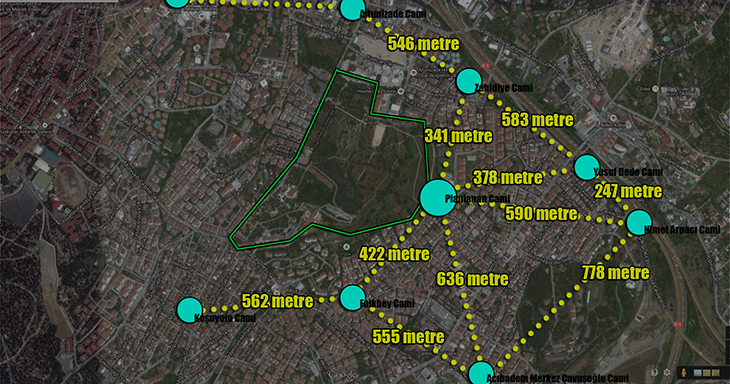
Some wonder why another mosque needs to be built in an area that already has 26, four of which are less than 600 metres away. “We don’t need any more mosques, says 70 year-old demonstrator Ozdemir. “We need oxygen!”

On October 31 the court’s stay of execution was reversed after an appeal, saying the project site lies outside of the protected grove. Some local papers and opposition politicians accused the Uskudar Municipality of interfering with the legal process, and lawyers representing the activists vowed to appeal the court’s reversal.

Among them was Tanrikulu – who claimed, in his parliamentary question, that the Municipality had tried to bypass the decision of the Istanbul 7th Administrative Court – which ordered a stop on construction at the site – by altering the sheet and parcel numbers of the car park.

Despite the unfavourable ruling, and the rising atmosphere of threat and initimidation from both government and police, the protestors are holding firm. And Ozdemir remains confident of ultimate victory, insisting: “The people will prevail!”


Nick Ashdown is a Canadian freelance journalist based in Istanbul, Turkey. You can follow him on Twitter @Nick_Ashdown


387355

Malaysia: eco-activists combat judicial repression Updated for 2026


Thirty years ago the Malaysian government suppressed environmental and human rights protests using arbitrary detentions and sedition law.

Today, we are again faced with the same challenge.

In 1987 I was arrested under the Internal Security Act (ISA) 1960 – which allows detention without trial.

I was held in solitary confinement for 47 days without the right to a lawyer or to be heard in court. No charges were ever filed against me.

I still do not know the real reasons for my arrest, but the authorities use the ISA against those they regard as “subversive”.

During that time, I was involved in many public interest cases which we brought on behalf of communities. One of them was a case involving a community in Bukit Merah affected by Asian Rare Earth – a company whose majority shareholder was Japanese giant Mitsubishi Chemicals.

Laws change, repression remains

The ISA 1960 was repealed on September 15, 2011 but has been replaced by a new law called the Security Offences (Special Measures) Act 2012.

I have also been barred from entering the East Malaysian state of Sarawak because of my involvement in the movement agains the Bakun Dam in the 1990s, and a case that was filed on behalf of indigenous communities affected by the Bakun Hydro-electric Dam.

This dam caused the relocation of about 10,000 indigenous people from their original settlement sites. They were asked to move to a resettlement site with poor amenities and infrastructure.

Even now, in 2014, the complaints from those who live at the resettlement site have not been adequately addressed by the Malaysian government.

Development versus environment and the poor

Wherever environmental crises take place, it is the poor who are the main victims.

Farmers, fishermen, plantation and industrial workers, indigenous peoples who live in the forest, and people living near polluting factories are among those who pay the biggest price when ‘development’ projects cause environmental problems.

Not only is their health and safety jeopardized by pollution and environmental contamination, but their very survival is often at stake.

Again and again I have seen natural resources destroyed by chemicals, forests and land taken away because of ‘development projects’, water resources polluted by industrial waste, indigenous skills rendered useless, and indigenous peoples’ livelihoods destroyed.

Such projects usually involve powerful parties who often want nothing more than to remove or silence opposition as quickly and conveniently as possible. Environmental concerns, groups and defenders are increasingly subject to criminalisation, persecution and slander.

However, with growing awareness of environmental issues, communities are increasingly standing up to defend their rights – often using the law to do so, with many key environmental legal cases being filed.

As in the 1980s, Friends of the Earth Malaysia is playing its part in this – helping communities to file legal cases to defend their health and environment in the local courts.

Environmental activism

In the last ten years, two particular cases have raised the level of environmental awareness in Malaysia. The first involves a community in Bukit Koman in Pahang where many people began to suffer various skin, eye and respiratory problems after a gold mining company began operations.

A civil case brought by the community against the Malaysian Department of the Environment (DoE) and the gold mining company, Raub Australian Gold Mining Sdn Bhd (RAGM) requesting a new Environmental Impact Assessment (EIA) was met with defeat at all stages from the High Court to the Federal Court (the highest court).

In 2013 RAGM brought defamation suits against three community leaders in reaction to statements made to the press.

One of the defamation suits has since been withdrawn, as an apology was tendered in court and no damages or costs had to be paid to the company. The apology was given in the interest of resolving the matter amicably.

In 2012, RAGM also sued two internet news portals, Malaysiakini and Free Malaysia Today (FMT) for publishing allegedly defamatory articles relating to the Bukit Koman issues. RAGM withdrew the defamation suit against FMT after it tendered a full apology in court this year.

The second case relates to the opposition of 1.2 million people to the operations of a rare earths factory in Gebeng, Kuantan, Pahang. The plant, Lynas Advance Materials Plant (LAMP), belongs to the Australian Lynas Corporation Ltd.

There is an ongoing campaign on the ground to get Lynas out of Malaysia because the company will be producing radioactive waste and has yet to find a permanent solution to where this waste will be stored.

Both these cases, along with numerous other environment and human rights related issues, have been the subject of many heated debates, media coverage and street demonstrations.

Repressive laws

The Malaysian government has recently been invoking many of its repressive laws, such as the Sedition Act 1984, against political activists, one notable academic and a journalist.

The government has charged a number of environmental activists under the newly enacted Peaceful Assembly Act 2012 for taking part in street demonstrations without giving prior notice to the police. Prior to this, many were also charged under the Police Act 1967, which stipulates that permits are needed for any public gathering.

In fact in August 2013, four people were charged under the Peaceful Assembly Act 2012 for organising and taking part in a solidarity rally to seek answers from the government for the health problems suffered by the Bukit Koman community. All four have since been discharged by court and no further charges have been brought against them.

In July this year, 15 people were charged in court under the Penal Code for rioting, taking part in an unlawful assembly and obstructing the police following a street demonstration that took place in June for opposing the activities of Lynas Corporation.

A New Zealand activist and a member of the Stop Lynas Coalition, Natalie Lowrey, who was also present during the demonstration to lend solidarity to the people of Gebeng, Pahang, was arrested and kept in detention for six days.

She was released without charge after a popular international appeal, and told she was free to leave the country. On 31st August, when Natalie attempted to enter Malaysia again, she was deported. Immigration officials informed her that she was on the police blacklist and was unable to enter Malaysia.

These actions show the government’s suppression of the constitutional rights to assemble and speak freely without fear or favour.

Corporations are also threatening legal action and have filed legal suits against activists and the media following interviews, statements given and news reports. Millions of Malaysian Ringgits are being asked in damages for these legal suits.

Rights of Citizens

Despite the legal assaults, environmental activism in Malaysia is still strong and environmental defenders are keeping up their spirits.

Friends of the Earth Malaysia has always championed the rights of the marginalised and has advocated for freedom of speech, freedom to assemble, access to information and public participation in decision making processes as well as environmental justice. And we are not about to stop.

For any country to develop in an ecologically and socially just way, it is vital that local communities, especially the poor, are consulted, heard and their interests given priority over the interests of big corporations and other vested interests.

If development does not bring real benefits to the poor and the marginalised, it is mal-development, where the rich benefit over the poor. This cannot be countenanced in any society which is premised on being just and democratic.

This week, from 22nd to 26th September, a solidarity mission coordinated by Friends of the Earth International has been visiting Malaysia to express solidarity with affected communities.

Friends of the Earth International believes that for the Malaysian government to contribute to a better future for all its citizens it must support the struggle of environmental rights defenders and protect and respect them, instead of criminalising environmental activism.

In addition, the government must ensure that any corporations responsible for environmental or human rights violations are held accountable for their actions.


Meena Raman is the Friends of the Earth Malaysia Honorary Secretary and a member of the Friends of the Earth International executive committee.


384600