Tag Archives: last

Engineering consent for fracking: Chris Smith and the ‘astroturf’ consultancy Updated for 2026


Unless George Osborne gets new orders about his budget this week, it looks like, despite the bluster of the last year, the Government will not be announcing the results of the 14th On-shore Oil and Gas Licensing Round this side of the election (perhaps they’re worried about legal action).

Despite this the Conservative’s token ‘green’, Tim Yeo MP, has been trumpeting the benefits of shale gas, based upon some spurious data produced by DECC which – as I outline in a new report for Talk Fracking this week – is based upon questionable results.

Arguably Tim Yeo’s trust in those results, expressed during the Parliamentary debate on the moratorium proposed by the Commons Environmental Audit Committee, has been very much abused by DECC and shale gas’s supporters in government.

In fact, with less than two months to go before the election, and despite ‘fracking’ having been the major grassroots environmental issue of the last Parliament, all is quiet on the shale gas front.

In reality though this is just the calm before the post-election PR storm.

Coming our way – the fracking spin machine

Irrespective of who wins (or perhaps in the circumstances, who loses the least), after the election the UK public will face an onslaught of PR-orchestrated ‘spin’ to promote shale gas, coalbed methane and underground coal gasification (UCG) as the best thing since … well, anything!

In Scotland, a moratorium on ‘fracking’ was imposed days after the failure of the moratorium in Parliament (although, as I highlighted in my last Ecologist article, the wording of the moratorium doesn’t cover UCG).

As a result the pro-fracking company INEOS, recently heavily invested into unconventional gas, is planning to “love bomb” the Scottish public back into supporting fracking. And though in Scotland that campaign is just getting under-way, in England it’s already begun …

What?, hadn’t you noticed? – that’s because you weren’t meant to.

In the final case study of my recent report for Talk Fracking I examine the use of academics within the Task Force on Shale Gas – a body set up last September under the auspices of former New Labour minister, and more recently former head of the Environment Agency, Lord Chris Smith.

The Task Force claims to “provide a transparent, trusted, independent and impartial platform for public scrutiny, discussion and information about shale gas exploration and production in the UK.”

Behold the Prince of Darkness … Edel who?

This is where the public relations ‘shadow play’ comes into its own. Not in the guise of Lord Chris Smith – who while head of the Environment Agency had behind the scenes meetings to thrash out how environmental regulations would be watered-down.

Not even the Task Force’s ‘expert panel’ members – many of whom have previously expressed support for shale gas and even outright hostility to the anti-fracking movement. And not even the oil and gas industry companies – who are funding the work of the Task Force.

The real players here – the people behind the scenes pulling the strings of the shadow play puppets – are Edelman, which acts as the Task Force’s secretariat.

Who are Edelman? That’s the really important question here – and the most prescient question to ask in relation to the Task Force’s future work on behalf of the public.

All modern businesses tend to specialise in certain fields. Edelman’s specialism is ‘grassroots engagement’ – creating industry-friendly front – or ‘astroturf’-groups to represent the benefits of controversial developments. Edelman has developed this technique in the US for its large American extractive and industrial clients over the last decade or so.

Their purpose is not to convince the public. They are there – as outlined in the recent US study Merchants of Doubt – to confuse the public so that they don’t know who to believe. Their aim is to create, as the original strategies developed by the tobacco industry in the 1960s outlined, an apparent controversy so they can get their point across.

They do not create unity or agreement on an issue, but instead seek to polarise the community to prevent the grassroots opposition holding sway over political decision-makers.

Neutralizing risk, pressurizing opponents

If you want to see how Edelman works, take a look at TransCanada’s alternative proposal for the stalled Keystone Pipeline – the East Energy Pipeline.

Even before the route was announced, TransCanada employed Edelman to carry out an assessment of how they could “drive an active public discussion about Energy East that gives Canadians reasons to affirmatively support the project in the face of organized opposition.”

The way this would be enacted is outlined in another study prepared a few months later by Edelman:

“The most effective way to counter any external challenge is to ready a robust campaign that comprises proactive and reactive communication activities. This approach strives to neutralize risk before it is levelled, respond directly to issues or attacks as they arise, and apply pressure – intelligently – on opponents, as appropriate.”

Their strategy also included a specific digital ‘grassroots advocacy’ proposal which – from Edelman’s US-based offices where they maintain a large interactive intelligence database – would organise an on-line campaign, using 35,000 recruited ‘activists’, to target conventional and social media with positive messages about TransCanada’s pipeline.

There was even a separate proposal for Francophone Québec – perhaps because Edelman’s research showed that French speaking Canadians were politically disposed to be “green” or “super-green”.

The difficulty for Edelman and their clients was that someone leaked these documents to Greenpeace Canada last November.

Edelman changes trains

Which brings us back to the Task Force on Shale Gas.

Up until the Task Force was created, Edelman had been running the secretariat for the All Party Parliamentary Group (APPG) on Unconventional Gas and Oil. The APPGs expenses were funded, like many other APPGs, by the industry – a similar group in fact to those who now support the new Task Force.

Trouble was, being comprised of politicians, the public paid little attention to any of the industry propaganda’ which the APPG circulated.

Then last Autumn, roughly coincident with the formation of the Task Force, Edelman dropped the APPG – handing the secretariat role to another agency with a track record of astroturfing on behalf of industrial causes, Hill and Knowlton.

Was the APPG a failing cause? Were politicians the wrong conduit to influence the public?

After all, in 2013 someone at one of the funders of the Task Force, Centrica, had written an email to the Department for Energy and Climate (DECC) office promoting shale gas stating that

“Our polling shows that academics are the most trusted sources of information to the public so we are looking at ways to work with the academic community to present the scientific facts around shale.”

Just few months before the dropping the APPG, Edelman employed Katie Waring, energy secretary Ed Davey’s former special adviser at DECC – perhaps indicating that a change of strategy was being planned.

With Edelman, has the Task Force lost all credibility?

The problem for the ambitions of Chris Smith is that the model of the Task Force – comprising experts doing research for the public, funded by industry and managed by PR agencies – has already been used in the USA. For example, the Center for Sustainable Shale Development.

It too was modelled as a ‘stakeholder group’ where academics, industry and the public could come together and research the impacts of shale gas – but which was shown to be a front group for the industry, and whose fossil fuel industry support increased when some non-industry members left.

Even with the panel of experts many of whom are pre-disposed to shale gas, and the industry financing, the involvement of Edelman is toxic to the future work of the Task Force.

Chris Smith has to come clean. Who thought up the concept of the Task Force? Who co-ordinated the early meetings and identified the key figures who would take part? And what has been the role of Edelman in that process?

If the Task Force exists “to provide a transparent, trusted, independent and impartial platform for public scrutiny”, then a key part of that has to be accounting for the previous manipulative role of Edelman in controversial public issues – and whether that contaminates the Task Force’s role to serve the public interest.

A ‘fair and impartial platform’? Hardly!

In the USA almost 60 years ago the father of PR, Edward Bernays, stated in his influential book, The Engineering of Consent:

“Today it is impossible to overestimate the importance of engineering consent; it affects almost every aspect of our daily lives. When used for social purposes, it is among our most valuable contributions to the efficient functioning of modern society …

“The responsible leader … must apply his energies to mastering the operational know-how of consent engineering, and to out-maneuvering his opponents in the public interest.”

The Task Force on Shale Gas, in its composition, the background to its formation, and those who organise its work, has the appearance of an industry front group; organised by the company who specialise in such tactics to ‘engineer consent’Edelman.

Unless and until the process by which the Task Force was created is fully revealed, including who employed or commissioned Edelman in that role, then the Task Force cannot be considered – irrespective of its academic credentials – to be a fair and impartial platform to discuss unconventional gas and oil in Britain.


Paul Mobbs is an independent environmental consultant, investigator, author and lecturer, and maintains the Free Range Activism Website (FRAW).

A fully referenced version of this article is located on FRAW.


391381

Engineering consent for fracking: Chris Smith and the ‘astroturf’ consultancy Updated for 2026


Unless George Osborne gets new orders about his budget this week, it looks like, despite the bluster of the last year, the Government will not be announcing the results of the 14th On-shore Oil and Gas Licensing Round this side of the election (perhaps they’re worried about legal action).

Despite this the Conservative’s token ‘green’, Tim Yeo MP, has been trumpeting the benefits of shale gas, based upon some spurious data produced by DECC which – as I outline in a new report for Talk Fracking this week – is based upon questionable results.

Arguably Tim Yeo’s trust in those results, expressed during the Parliamentary debate on the moratorium proposed by the Commons Environmental Audit Committee, has been very much abused by DECC and shale gas’s supporters in government.

In fact, with less than two months to go before the election, and despite ‘fracking’ having been the major grassroots environmental issue of the last Parliament, all is quiet on the shale gas front.

In reality though this is just the calm before the post-election PR storm.

Coming our way – the fracking spin machine

Irrespective of who wins (or perhaps in the circumstances, who loses the least), after the election the UK public will face an onslaught of PR-orchestrated ‘spin’ to promote shale gas, coalbed methane and underground coal gasification (UCG) as the best thing since … well, anything!

In Scotland, a moratorium on ‘fracking’ was imposed days after the failure of the moratorium in Parliament (although, as I highlighted in my last Ecologist article, the wording of the moratorium doesn’t cover UCG).

As a result the pro-fracking company INEOS, recently heavily invested into unconventional gas, is planning to “love bomb” the Scottish public back into supporting fracking. And though in Scotland that campaign is just getting under-way, in England it’s already begun …

What?, hadn’t you noticed? – that’s because you weren’t meant to.

In the final case study of my recent report for Talk Fracking I examine the use of academics within the Task Force on Shale Gas – a body set up last September under the auspices of former New Labour minister, and more recently former head of the Environment Agency, Lord Chris Smith.

The Task Force claims to “provide a transparent, trusted, independent and impartial platform for public scrutiny, discussion and information about shale gas exploration and production in the UK.”

Behold the Prince of Darkness … Edel who?

This is where the public relations ‘shadow play’ comes into its own. Not in the guise of Lord Chris Smith – who while head of the Environment Agency had behind the scenes meetings to thrash out how environmental regulations would be watered-down.

Not even the Task Force’s ‘expert panel’ members – many of whom have previously expressed support for shale gas and even outright hostility to the anti-fracking movement. And not even the oil and gas industry companies – who are funding the work of the Task Force.

The real players here – the people behind the scenes pulling the strings of the shadow play puppets – are Edelman, which acts as the Task Force’s secretariat.

Who are Edelman? That’s the really important question here – and the most prescient question to ask in relation to the Task Force’s future work on behalf of the public.

All modern businesses tend to specialise in certain fields. Edelman’s specialism is ‘grassroots engagement’ – creating industry-friendly front – or ‘astroturf’-groups to represent the benefits of controversial developments. Edelman has developed this technique in the US for its large American extractive and industrial clients over the last decade or so.

Their purpose is not to convince the public. They are there – as outlined in the recent US study Merchants of Doubt – to confuse the public so that they don’t know who to believe. Their aim is to create, as the original strategies developed by the tobacco industry in the 1960s outlined, an apparent controversy so they can get their point across.

They do not create unity or agreement on an issue, but instead seek to polarise the community to prevent the grassroots opposition holding sway over political decision-makers.

Neutralizing risk, pressurizing opponents

If you want to see how Edelman works, take a look at TransCanada’s alternative proposal for the stalled Keystone Pipeline – the East Energy Pipeline.

Even before the route was announced, TransCanada employed Edelman to carry out an assessment of how they could “drive an active public discussion about Energy East that gives Canadians reasons to affirmatively support the project in the face of organized opposition.”

The way this would be enacted is outlined in another study prepared a few months later by Edelman:

“The most effective way to counter any external challenge is to ready a robust campaign that comprises proactive and reactive communication activities. This approach strives to neutralize risk before it is levelled, respond directly to issues or attacks as they arise, and apply pressure – intelligently – on opponents, as appropriate.”

Their strategy also included a specific digital ‘grassroots advocacy’ proposal which – from Edelman’s US-based offices where they maintain a large interactive intelligence database – would organise an on-line campaign, using 35,000 recruited ‘activists’, to target conventional and social media with positive messages about TransCanada’s pipeline.

There was even a separate proposal for Francophone Québec – perhaps because Edelman’s research showed that French speaking Canadians were politically disposed to be “green” or “super-green”.

The difficulty for Edelman and their clients was that someone leaked these documents to Greenpeace Canada last November.

Edelman changes trains

Which brings us back to the Task Force on Shale Gas.

Up until the Task Force was created, Edelman had been running the secretariat for the All Party Parliamentary Group (APPG) on Unconventional Gas and Oil. The APPGs expenses were funded, like many other APPGs, by the industry – a similar group in fact to those who now support the new Task Force.

Trouble was, being comprised of politicians, the public paid little attention to any of the industry propaganda’ which the APPG circulated.

Then last Autumn, roughly coincident with the formation of the Task Force, Edelman dropped the APPG – handing the secretariat role to another agency with a track record of astroturfing on behalf of industrial causes, Hill and Knowlton.

Was the APPG a failing cause? Were politicians the wrong conduit to influence the public?

After all, in 2013 someone at one of the funders of the Task Force, Centrica, had written an email to the Department for Energy and Climate (DECC) office promoting shale gas stating that

“Our polling shows that academics are the most trusted sources of information to the public so we are looking at ways to work with the academic community to present the scientific facts around shale.”

Just few months before the dropping the APPG, Edelman employed Katie Waring, energy secretary Ed Davey’s former special adviser at DECC – perhaps indicating that a change of strategy was being planned.

With Edelman, has the Task Force lost all credibility?

The problem for the ambitions of Chris Smith is that the model of the Task Force – comprising experts doing research for the public, funded by industry and managed by PR agencies – has already been used in the USA. For example, the Center for Sustainable Shale Development.

It too was modelled as a ‘stakeholder group’ where academics, industry and the public could come together and research the impacts of shale gas – but which was shown to be a front group for the industry, and whose fossil fuel industry support increased when some non-industry members left.

Even with the panel of experts many of whom are pre-disposed to shale gas, and the industry financing, the involvement of Edelman is toxic to the future work of the Task Force.

Chris Smith has to come clean. Who thought up the concept of the Task Force? Who co-ordinated the early meetings and identified the key figures who would take part? And what has been the role of Edelman in that process?

If the Task Force exists “to provide a transparent, trusted, independent and impartial platform for public scrutiny”, then a key part of that has to be accounting for the previous manipulative role of Edelman in controversial public issues – and whether that contaminates the Task Force’s role to serve the public interest.

A ‘fair and impartial platform’? Hardly!

In the USA almost 60 years ago the father of PR, Edward Bernays, stated in his influential book, The Engineering of Consent:

“Today it is impossible to overestimate the importance of engineering consent; it affects almost every aspect of our daily lives. When used for social purposes, it is among our most valuable contributions to the efficient functioning of modern society …

“The responsible leader … must apply his energies to mastering the operational know-how of consent engineering, and to out-maneuvering his opponents in the public interest.”

The Task Force on Shale Gas, in its composition, the background to its formation, and those who organise its work, has the appearance of an industry front group; organised by the company who specialise in such tactics to ‘engineer consent’Edelman.

Unless and until the process by which the Task Force was created is fully revealed, including who employed or commissioned Edelman in that role, then the Task Force cannot be considered – irrespective of its academic credentials – to be a fair and impartial platform to discuss unconventional gas and oil in Britain.


Paul Mobbs is an independent environmental consultant, investigator, author and lecturer, and maintains the Free Range Activism Website (FRAW).

A fully referenced version of this article is located on FRAW.


391381

The end is nigh: last rites for Hinkley C Updated for 2026


I’ve always said that the two proposed new reactors at Hinkley Point would never get built. Now I’m not just saying it: I’m absolutely convinced that they’ll never get built.

A couple of weeks ago, EdF formally confirmed that no decision would be taken on Hinkley Point before the General Election, and probably not before the end of the year.

The reason it gave was that: “We are in the final phase of negotiations, but that phase can take a considerable amount of time, depending on the number of problems left to resolve.”

And that list of problems is daunting. First, it needs to be able to sign final deals with co-investors, including the Chinese, who are beginning to cut up rough. Then it needs final confirmation from the European Commission and the UK Government for a whole load of issues regarding the waste transfer contract.

It also needs to finalise a £10bn loan guarantee from the Treasury. And, despite months of discussions, it needs to conclude negotiations with the UK Government regarding the subsidy contract.

Legal challenges loom large

You’ll notice that this list does not include any delays that may be caused by the Austrian Government challenging the EU’s decision to approve as ‘legal’ (within the EU’s state aid rules) the billions of pounds of subsidy that the UK Government will pump into the project.

EdF doesn’t talk about that, as it still hopes that the Austrians will be ‘persuaded’ by the UK Government to withdraw its challenge. And the UK Government is certainly intent on doing exactly that!

Over the last few months, details have been trickling out about the retaliatory measures UK Ministers are now threatening in a demonstration of state bullying that beggars belief. A leaked memo showed UK ministers asserting that “the UK will take every opportunity to sue or damage Austria in the future.”

Which shows just how desperate the Coalition Government has become, having put all its notionally ‘low carbon’ eggs in the nuclear basket – a decision that has forced ministers to go to extraordinary lengths to get the Hinkley Point project over the line.

UK Government bending over backwards … to no avail

Influential commentator Dr Philip Johnstone, Research Fellow at the Science Policy Research Unit, put it as follows: “Every wish of the nuclear industry has been granted by the UK Government. The British planning system has been ‘streamlined’, with nuclear a key inspiration of the need to speed things up.

“The Government has created one of the best institutional contexts in the world for developing nuclear, with a new Office for Nuclear Regulation and the Office for Nuclear Development, and has ensured that nuclear regulators are equipped to pre-license designs for new build.

“As well as this, a strategic siting assessment and environmental assessment were carried out, further ‘streamlining’ the process of new nuclear construction. Electricity Market Reform has been brought in, where, despite being a mature technology, nuclear was granted Contracts for Difference at double the current market rate for the next 35 years.”

But none of that cuts much ice with the Austrians, and if their challenge proceeds, nobody quite knows how long a delay that might entail. It will certainly be years, not months.

And it just got worse for the Coalition Government. We heard last week that EdF is now going to have to deal with another legal challenge – this one from a German energy Co-operative (a very successful enterprise, founded by Greenpeace 15 years ago) on the grounds that the EU’s decision self-evidently distorts competition.

Greenpeace Energy is also calling on the German Government to join Austria in its formal complaint, but that’s still unlikely.

The nuclear dream crashes into harsh realities

But you know what – regardless of what happens with those legal challenges, it looks like the beginning of the end for Hinkley anyway. And here’s why:

  • The cost of the Hinkley Point project has gone up and up over the last two years, and shows little indication of stabilising where it now is;
  • The calamitous failure of EdF (and its partner Areva) to deliver the first two EPR projects at Olkiluoto in Finland and Flamanville in France has dragged on and on;
    – The two Chinese co-investors (the China National Nuclear Corporation and China General Nuclear Power) have got more and more leery about the EPR reactor design;
  • The French Government has become more and more outspoken about its reluctance to go on bailing out either EdF or Areva, as their balance sheets go from bad to worse;
  • Areva is now in such a bad state (with a €4.8bn loss in 2014) that it looks as if it might have to withdraw as a co-investor in the Hinkley project – a state of affairs pretty much confirmed by EdF’s CEO last week;
  • Worse yet, Areva has announced that it wants to suspend indefinitely any further work on the approval process for its EPR (the same reactor design as Hinkley) in the USA, which sends a pretty strong signal that the EPR in the USA is as good as dead and buried;
  • To cap it all, the UK Government has itself further muddied the waters by seeking approval from the EU to hold a ‘golden share’ in the Hinkley project. This would give them special voting rights, and could theoretically allow Ministers to block the transfer of ownership of Hinkley if EdF decided that it wanted to get out. (Worried about the Chinese taking total control, perhaps?!) Experts believe this may completely undo the case that the UK Government made to the Commission last year for approval of those huge subsidies.

And in the meantime, it has to be said that the world looks very different from the point of view of renewable energy. The costs of solar and wind continue to fall, year on year, with every indication that there’s a further 40% reduction to come over the next few years.

Hinkley has become toxic

So perhaps it’s not so surprising that the Coalition Government has been a lot quieter on its Hinkley hopes and dreams than it was last year. Not a peep, for instance, from the disgracefully compromised Liberal Democrat Secretary of State for Energy, Ed Davey. And not a peep from George Osborne, who must be looking at the finances of Hinkley Point with increasing hostility.

Interestingly, nor have we heard anything like as much from today’s pro-nuclear greenies as we did before – including George Monbiot, Stephen Tindale, Mark Lynas and even Jim Lovelock.

From what I’ve heard (by way of reliable gossip, it has to be said, rather than hard-and-fast evidence!), they’ve all realised that their ability to enthuse people with their pro-nuclear illusions is being severely (if not entirely) undermined by the Hinkley Point fiasco.

The combination of EdF and Areva (both realistically bankrupt, were it not for funding from the French Government), Chinese investors (demanding copper-bottomed guarantees that they will be bailed out when Hinkley Point turns into another Olkiluoto or Flamanville), a reactor design (the EPR) that even the keenest of nuclear engineers have started to describe as “unbuildable”, and the threat of further, even more costly delays (there’s now no chance at all that any reactor at Hinkley Point will be generating any electricity before 2025), is quite simply toxic.

My best bet is that these pro-nuclear greenies now desperately need Hinkley Point to fail, so that their reputations will be sort-of salvaged – even as they start hyping the next instalment of their nuclear nonsense.

We got a very strong sense of that through the speech of another pro-nuclear, former greenie, Baroness Worthington, Shadow Spokesperson for Energy and Climate Change in the House of Lords. In her words, the Hinkley Point deal has caused “a crisis of confidence” in the future of energy policy in the UK:

“policies which Conservatives brought in have resulted in a massive destabilisation of the energy market. Intervention in the market has dented confidence for a contract which has yet to be signed. We have become over-obsessed with the delivery of one project.”

And this from one of the keenest advocates of nuclear power in the Labour Party! No doubt her voice has been influential in the current Labour Party position on Hinkley, which is to argue that it needs a completely new financial appraisal, effectively giving the Labour Party a ‘get-out-of-Hinkley Point’ post-Election option.

When in a hole, stop digging. Tom Greatrex, take note!

Which is by no means the same thing, sadly, as Labour developing a ‘get-out-of-nuclear-altogether’ option. The Labour Party’s deeply unimpressive Energy Spokesman, Tom Greatrex, recently told voters in Scotland that a future Labour Government would force Scotland to be part of a new UK-wide nuclear programme – regardless of the SNP’s very clear anti-nuclear stance. (Go for it, Tom: what better way of winning back Labour voters in Scotland!)

All this chaos and confusion must surely mean that, post Election, we might at last be able to get back to a serious debate about energy policy here in the UK, without Hinkley Point distorting every single aspect of today’s Electricity Market Reform, shadowing out every single policy alternative, and holding back the mindset and behavioural revolutions amongst both business and the general public on which our energy future really depends.

We’ve already paid a very significant price for Labour’s sad surrender to the seductive lies of the nuclear industry, and for this Coalition Government’s near-incomprehensible decision to pursue the EPR reactor design for Hinkley Point. Between them, they’ve dug a hole already so deep that they have no idea what to do other than to keep on digging.

So let’s just hope that those Austrians stick to their guns with their legal challenge, for this is by far the longest and by far the most robust rope-ladder up which those benighted politicians – and ever-more benighted pro-nuclear greenies – will soon – ever so thankfully – be able to climb.


Jonathon Porritt is Founder Director of Forum for the Future www.forumforthefuture.org. His latest book, ‘The World We Madeis available from www.phaidon.com/store.

This article was originally published on Jonathon Porritt’s blog.


391149

No more cetacean extinctions! It’s our last chance to save the vaquita Updated for 2026


The ‘vaquita’ is a beastie with some remarkable claims to fame. It’s one of the two smallest cetaceans in the world, just managing to nudge about 1.5 metres (5ft) long on a good day.

Its name means ‘little cow’, though it is also called the ‘desert porpoise’ or ‘Gulf of California porpoise’ as it lives near arid Baja California. They are the only porpoises found in warm waters.

It was only described by science in 1958, and has a tiny geographic range at the north end of the Gulf of California, also known as the Sea of Cortez. At about 4,000 km2 (about the size of Cornwall) it’s among the smallest ranges of any marine mammal.

It’s possibly one of the cutest sea mammals around (with dark eye patches giving it a passable panda look), although very few people have ever gotten a good look at a live vaquita…

    Oh yes. And it’s likely to become extinct in just a few years.

    Fishery bycatch – what a way to go …

    There are fewer than a hundred vaquitas left on the planet, and we humans are reducing that number by a staggering 17% each year!

    The truth is – we should be able to save the vaquita. We know where it lives, and we know that we humans are its biggest threat. Vaquitas are caught and killed as bycatch in a fishery targeting fish called totoaba.

    The swim bladders of the totoaba are prized as a delicacy for soup in China so there’s lucrative financial incentive for illicit fishing. It just so happens that totoaba are about the same size as a vaquita, which is really bad news for the porpoises when indiscriminate gillnets are used that catch them, too!

    By stopping fishing entirely, or moving fully to fishing methods that can’t catch porpoises ‘by accident’, and protecting the vaquita’s habitat, this could and should be one of the easiest marine animals to conserve.

    Many of the recognisable marine critters at greatest risk of extinction, such as hammerhead sharks, whale sharks, sea turtles & manta rays have vast ranges, and are much trickier to protect fully from human impacts.

    That doesn’t mean we shouldn’t try, of course, but it does surely make it all the more ridiculous if we can’t get our act together to save the vaquita.

    They have a ‘marine protected area’ – but it’s too small

    In fact, in 2005 a ‘marine protected area’ was designated specifically to protect this tiny porpoise, covering the central part of its range (see map, right). But it’s surrounded by heavily-fished areas, and ongoing fishing – both legal and illegal – is killing more and more porpoises.

    A much larger protected area has now been proposed (see map) in which fishing would still take place, but the gill nets in which the vaquitas are so often fatally entangled would be banned.

    As Nampan, the North Americas Marine Protected Areas Network reports: “Experts worldwide are in agreement that the surest way to prevent the extinction of the vaquita is to eliminate the use of entangling nets in the areas where vaquitas occur.

    “The immediate removal of such nets must be accompanied by one or more financial mechanisms to compensate the fishermen who can no longer pursue their livelihoods in the same way. This means that economic alternatives and vaquita-safe fishing methods must be developed and made available in the fishing communities of the northern Gulf.

    “It is crucial for the CEC to support Mexico’s pursuit of these objectives. Without immediate, decisive action, the vaquita could become the second cetacean species to have been rendered extinct as a direct consequence of human activity in the present century.”

    We owe it to the vaquitas to try to save them.

    Is that enough cetacean extinction now?

    This generation has already seen the extinction of the Baiji, a Chinese river dolphin. Other species are declining fast thanks to humanity, with ship strikes, pollution, habitat destruction, and irresponsible fishing taking an increasingly heavy toll.

    The vaquita is top of the list, but the future is also bleak for the Maui’s dolphin, the North Atlantic right whale, the Ganges river dolphin, the Western Pacific gray whale, the Irrawaddy dolphin and many more.

    Then there are the ice whales – narwhals, beluga & bowheads – whose habitat is being destroyed and plundered as it melts away.

    We should be able to save the vaquita. But do we collectively care enough to do it? The President of Mexico, Enrique Peña Nieto, is considering introducing a new law that could protect the vaquita’s home.

    Our encouragement will surely help him to reach the right decision.


    Action: Sign the petition to send a message to Enrique Peña Nieto and make sure he knows we want to save the vaquita.

    Find out more about vaquitas and how to save them: vaquita.tv.

    Willie Mackenzie is part of the Greenpeace UK biodiversity team. He works mostly on oceans and fishy issues. Twitter: @williemackenzie

    This article was originally published on the Greenpeace blog.


    387445

No more cetacean extinctions! It’s our last chance to save the vaquita Updated for 2026


The ‘vaquita’ is a beastie with some remarkable claims to fame. It’s one of the two smallest cetaceans in the world, just managing to nudge about 1.5 metres (5ft) long on a good day.

Its name means ‘little cow’, though it is also called the ‘desert porpoise’ or ‘Gulf of California porpoise’ as it lives near arid Baja California. They are the only porpoises found in warm waters.

It was only described by science in 1958, and has a tiny geographic range at the north end of the Gulf of California, also known as the Sea of Cortez. At about 4,000 km2 (about the size of Cornwall) it’s among the smallest ranges of any marine mammal.

It’s possibly one of the cutest sea mammals around (with dark eye patches giving it a passable panda look), although very few people have ever gotten a good look at a live vaquita…

    Oh yes. And it’s likely to become extinct in just a few years.

    Fishery bycatch – what a way to go …

    There are fewer than a hundred vaquitas left on the planet, and we humans are reducing that number by a staggering 17% each year!

    The truth is – we should be able to save the vaquita. We know where it lives, and we know that we humans are its biggest threat. Vaquitas are caught and killed as bycatch in a fishery targeting fish called totoaba.

    The swim bladders of the totoaba are prized as a delicacy for soup in China so there’s lucrative financial incentive for illicit fishing. It just so happens that totoaba are about the same size as a vaquita, which is really bad news for the porpoises when indiscriminate gillnets are used that catch them, too!

    By stopping fishing entirely, or moving fully to fishing methods that can’t catch porpoises ‘by accident’, and protecting the vaquita’s habitat, this could and should be one of the easiest marine animals to conserve.

    Many of the recognisable marine critters at greatest risk of extinction, such as hammerhead sharks, whale sharks, sea turtles & manta rays have vast ranges, and are much trickier to protect fully from human impacts.

    That doesn’t mean we shouldn’t try, of course, but it does surely make it all the more ridiculous if we can’t get our act together to save the vaquita.

    They have a ‘marine protected area’ – but it’s too small

    In fact, in 2005 a ‘marine protected area’ was designated specifically to protect this tiny porpoise, covering the central part of its range (see map, right). But it’s surrounded by heavily-fished areas, and ongoing fishing – both legal and illegal – is killing more and more porpoises.

    A much larger protected area has now been proposed (see map) in which fishing would still take place, but the gill nets in which the vaquitas are so often fatally entangled would be banned.

    As Nampan, the North Americas Marine Protected Areas Network reports: “Experts worldwide are in agreement that the surest way to prevent the extinction of the vaquita is to eliminate the use of entangling nets in the areas where vaquitas occur.

    “The immediate removal of such nets must be accompanied by one or more financial mechanisms to compensate the fishermen who can no longer pursue their livelihoods in the same way. This means that economic alternatives and vaquita-safe fishing methods must be developed and made available in the fishing communities of the northern Gulf.

    “It is crucial for the CEC to support Mexico’s pursuit of these objectives. Without immediate, decisive action, the vaquita could become the second cetacean species to have been rendered extinct as a direct consequence of human activity in the present century.”

    We owe it to the vaquitas to try to save them.

    Is that enough cetacean extinction now?

    This generation has already seen the extinction of the Baiji, a Chinese river dolphin. Other species are declining fast thanks to humanity, with ship strikes, pollution, habitat destruction, and irresponsible fishing taking an increasingly heavy toll.

    The vaquita is top of the list, but the future is also bleak for the Maui’s dolphin, the North Atlantic right whale, the Ganges river dolphin, the Western Pacific gray whale, the Irrawaddy dolphin and many more.

    Then there are the ice whales – narwhals, beluga & bowheads – whose habitat is being destroyed and plundered as it melts away.

    We should be able to save the vaquita. But do we collectively care enough to do it? The President of Mexico, Enrique Peña Nieto, is considering introducing a new law that could protect the vaquita’s home.

    Our encouragement will surely help him to reach the right decision.


    Action: Sign the petition to send a message to Enrique Peña Nieto and make sure he knows we want to save the vaquita.

    Find out more about vaquitas and how to save them: vaquita.tv.

    Willie Mackenzie is part of the Greenpeace UK biodiversity team. He works mostly on oceans and fishy issues. Twitter: @williemackenzie

    This article was originally published on the Greenpeace blog.


    387445

No more cetacean extinctions! It’s our last chance to save the vaquita Updated for 2026


The ‘vaquita’ is a beastie with some remarkable claims to fame. It’s one of the two smallest cetaceans in the world, just managing to nudge about 1.5 metres (5ft) long on a good day.

Its name means ‘little cow’, though it is also called the ‘desert porpoise’ or ‘Gulf of California porpoise’ as it lives near arid Baja California. They are the only porpoises found in warm waters.

It was only described by science in 1958, and has a tiny geographic range at the north end of the Gulf of California, also known as the Sea of Cortez. At about 4,000 km2 (about the size of Cornwall) it’s among the smallest ranges of any marine mammal.

It’s possibly one of the cutest sea mammals around (with dark eye patches giving it a passable panda look), although very few people have ever gotten a good look at a live vaquita…

    Oh yes. And it’s likely to become extinct in just a few years.

    Fishery bycatch – what a way to go …

    There are fewer than a hundred vaquitas left on the planet, and we humans are reducing that number by a staggering 17% each year!

    The truth is – we should be able to save the vaquita. We know where it lives, and we know that we humans are its biggest threat. Vaquitas are caught and killed as bycatch in a fishery targeting fish called totoaba.

    The swim bladders of the totoaba are prized as a delicacy for soup in China so there’s lucrative financial incentive for illicit fishing. It just so happens that totoaba are about the same size as a vaquita, which is really bad news for the porpoises when indiscriminate gillnets are used that catch them, too!

    By stopping fishing entirely, or moving fully to fishing methods that can’t catch porpoises ‘by accident’, and protecting the vaquita’s habitat, this could and should be one of the easiest marine animals to conserve.

    Many of the recognisable marine critters at greatest risk of extinction, such as hammerhead sharks, whale sharks, sea turtles & manta rays have vast ranges, and are much trickier to protect fully from human impacts.

    That doesn’t mean we shouldn’t try, of course, but it does surely make it all the more ridiculous if we can’t get our act together to save the vaquita.

    They have a ‘marine protected area’ – but it’s too small

    In fact, in 2005 a ‘marine protected area’ was designated specifically to protect this tiny porpoise, covering the central part of its range (see map, right). But it’s surrounded by heavily-fished areas, and ongoing fishing – both legal and illegal – is killing more and more porpoises.

    A much larger protected area has now been proposed (see map) in which fishing would still take place, but the gill nets in which the vaquitas are so often fatally entangled would be banned.

    As Nampan, the North Americas Marine Protected Areas Network reports: “Experts worldwide are in agreement that the surest way to prevent the extinction of the vaquita is to eliminate the use of entangling nets in the areas where vaquitas occur.

    “The immediate removal of such nets must be accompanied by one or more financial mechanisms to compensate the fishermen who can no longer pursue their livelihoods in the same way. This means that economic alternatives and vaquita-safe fishing methods must be developed and made available in the fishing communities of the northern Gulf.

    “It is crucial for the CEC to support Mexico’s pursuit of these objectives. Without immediate, decisive action, the vaquita could become the second cetacean species to have been rendered extinct as a direct consequence of human activity in the present century.”

    We owe it to the vaquitas to try to save them.

    Is that enough cetacean extinction now?

    This generation has already seen the extinction of the Baiji, a Chinese river dolphin. Other species are declining fast thanks to humanity, with ship strikes, pollution, habitat destruction, and irresponsible fishing taking an increasingly heavy toll.

    The vaquita is top of the list, but the future is also bleak for the Maui’s dolphin, the North Atlantic right whale, the Ganges river dolphin, the Western Pacific gray whale, the Irrawaddy dolphin and many more.

    Then there are the ice whales – narwhals, beluga & bowheads – whose habitat is being destroyed and plundered as it melts away.

    We should be able to save the vaquita. But do we collectively care enough to do it? The President of Mexico, Enrique Peña Nieto, is considering introducing a new law that could protect the vaquita’s home.

    Our encouragement will surely help him to reach the right decision.


    Action: Sign the petition to send a message to Enrique Peña Nieto and make sure he knows we want to save the vaquita.

    Find out more about vaquitas and how to save them: vaquita.tv.

    Willie Mackenzie is part of the Greenpeace UK biodiversity team. He works mostly on oceans and fishy issues. Twitter: @williemackenzie

    This article was originally published on the Greenpeace blog.


    387445

No more cetacean extinctions! It’s our last chance to save the vaquita Updated for 2026


The ‘vaquita’ is a beastie with some remarkable claims to fame. It’s one of the two smallest cetaceans in the world, just managing to nudge about 1.5 metres (5ft) long on a good day.

Its name means ‘little cow’, though it is also called the ‘desert porpoise’ or ‘Gulf of California porpoise’ as it lives near arid Baja California. They are the only porpoises found in warm waters.

It was only described by science in 1958, and has a tiny geographic range at the north end of the Gulf of California, also known as the Sea of Cortez. At about 4,000 km2 (about the size of Cornwall) it’s among the smallest ranges of any marine mammal.

It’s possibly one of the cutest sea mammals around (with dark eye patches giving it a passable panda look), although very few people have ever gotten a good look at a live vaquita…

    Oh yes. And it’s likely to become extinct in just a few years.

    Fishery bycatch – what a way to go …

    There are fewer than a hundred vaquitas left on the planet, and we humans are reducing that number by a staggering 17% each year!

    The truth is – we should be able to save the vaquita. We know where it lives, and we know that we humans are its biggest threat. Vaquitas are caught and killed as bycatch in a fishery targeting fish called totoaba.

    The swim bladders of the totoaba are prized as a delicacy for soup in China so there’s lucrative financial incentive for illicit fishing. It just so happens that totoaba are about the same size as a vaquita, which is really bad news for the porpoises when indiscriminate gillnets are used that catch them, too!

    By stopping fishing entirely, or moving fully to fishing methods that can’t catch porpoises ‘by accident’, and protecting the vaquita’s habitat, this could and should be one of the easiest marine animals to conserve.

    Many of the recognisable marine critters at greatest risk of extinction, such as hammerhead sharks, whale sharks, sea turtles & manta rays have vast ranges, and are much trickier to protect fully from human impacts.

    That doesn’t mean we shouldn’t try, of course, but it does surely make it all the more ridiculous if we can’t get our act together to save the vaquita.

    They have a ‘marine protected area’ – but it’s too small

    In fact, in 2005 a ‘marine protected area’ was designated specifically to protect this tiny porpoise, covering the central part of its range (see map, right). But it’s surrounded by heavily-fished areas, and ongoing fishing – both legal and illegal – is killing more and more porpoises.

    A much larger protected area has now been proposed (see map) in which fishing would still take place, but the gill nets in which the vaquitas are so often fatally entangled would be banned.

    As Nampan, the North Americas Marine Protected Areas Network reports: “Experts worldwide are in agreement that the surest way to prevent the extinction of the vaquita is to eliminate the use of entangling nets in the areas where vaquitas occur.

    “The immediate removal of such nets must be accompanied by one or more financial mechanisms to compensate the fishermen who can no longer pursue their livelihoods in the same way. This means that economic alternatives and vaquita-safe fishing methods must be developed and made available in the fishing communities of the northern Gulf.

    “It is crucial for the CEC to support Mexico’s pursuit of these objectives. Without immediate, decisive action, the vaquita could become the second cetacean species to have been rendered extinct as a direct consequence of human activity in the present century.”

    We owe it to the vaquitas to try to save them.

    Is that enough cetacean extinction now?

    This generation has already seen the extinction of the Baiji, a Chinese river dolphin. Other species are declining fast thanks to humanity, with ship strikes, pollution, habitat destruction, and irresponsible fishing taking an increasingly heavy toll.

    The vaquita is top of the list, but the future is also bleak for the Maui’s dolphin, the North Atlantic right whale, the Ganges river dolphin, the Western Pacific gray whale, the Irrawaddy dolphin and many more.

    Then there are the ice whales – narwhals, beluga & bowheads – whose habitat is being destroyed and plundered as it melts away.

    We should be able to save the vaquita. But do we collectively care enough to do it? The President of Mexico, Enrique Peña Nieto, is considering introducing a new law that could protect the vaquita’s home.

    Our encouragement will surely help him to reach the right decision.


    Action: Sign the petition to send a message to Enrique Peña Nieto and make sure he knows we want to save the vaquita.

    Find out more about vaquitas and how to save them: vaquita.tv.

    Willie Mackenzie is part of the Greenpeace UK biodiversity team. He works mostly on oceans and fishy issues. Twitter: @williemackenzie

    This article was originally published on the Greenpeace blog.


    387445

No more cetacean extinctions! It’s our last chance to save the vaquita Updated for 2026


The ‘vaquita’ is a beastie with some remarkable claims to fame. It’s one of the two smallest cetaceans in the world, just managing to nudge about 1.5 metres (5ft) long on a good day.

Its name means ‘little cow’, though it is also called the ‘desert porpoise’ or ‘Gulf of California porpoise’ as it lives near arid Baja California. They are the only porpoises found in warm waters.

It was only described by science in 1958, and has a tiny geographic range at the north end of the Gulf of California, also known as the Sea of Cortez. At about 4,000 km2 (about the size of Cornwall) it’s among the smallest ranges of any marine mammal.

It’s possibly one of the cutest sea mammals around (with dark eye patches giving it a passable panda look), although very few people have ever gotten a good look at a live vaquita…

    Oh yes. And it’s likely to become extinct in just a few years.

    Fishery bycatch – what a way to go …

    There are fewer than a hundred vaquitas left on the planet, and we humans are reducing that number by a staggering 17% each year!

    The truth is – we should be able to save the vaquita. We know where it lives, and we know that we humans are its biggest threat. Vaquitas are caught and killed as bycatch in a fishery targeting fish called totoaba.

    The swim bladders of the totoaba are prized as a delicacy for soup in China so there’s lucrative financial incentive for illicit fishing. It just so happens that totoaba are about the same size as a vaquita, which is really bad news for the porpoises when indiscriminate gillnets are used that catch them, too!

    By stopping fishing entirely, or moving fully to fishing methods that can’t catch porpoises ‘by accident’, and protecting the vaquita’s habitat, this could and should be one of the easiest marine animals to conserve.

    Many of the recognisable marine critters at greatest risk of extinction, such as hammerhead sharks, whale sharks, sea turtles & manta rays have vast ranges, and are much trickier to protect fully from human impacts.

    That doesn’t mean we shouldn’t try, of course, but it does surely make it all the more ridiculous if we can’t get our act together to save the vaquita.

    They have a ‘marine protected area’ – but it’s too small

    In fact, in 2005 a ‘marine protected area’ was designated specifically to protect this tiny porpoise, covering the central part of its range (see map, right). But it’s surrounded by heavily-fished areas, and ongoing fishing – both legal and illegal – is killing more and more porpoises.

    A much larger protected area has now been proposed (see map) in which fishing would still take place, but the gill nets in which the vaquitas are so often fatally entangled would be banned.

    As Nampan, the North Americas Marine Protected Areas Network reports: “Experts worldwide are in agreement that the surest way to prevent the extinction of the vaquita is to eliminate the use of entangling nets in the areas where vaquitas occur.

    “The immediate removal of such nets must be accompanied by one or more financial mechanisms to compensate the fishermen who can no longer pursue their livelihoods in the same way. This means that economic alternatives and vaquita-safe fishing methods must be developed and made available in the fishing communities of the northern Gulf.

    “It is crucial for the CEC to support Mexico’s pursuit of these objectives. Without immediate, decisive action, the vaquita could become the second cetacean species to have been rendered extinct as a direct consequence of human activity in the present century.”

    We owe it to the vaquitas to try to save them.

    Is that enough cetacean extinction now?

    This generation has already seen the extinction of the Baiji, a Chinese river dolphin. Other species are declining fast thanks to humanity, with ship strikes, pollution, habitat destruction, and irresponsible fishing taking an increasingly heavy toll.

    The vaquita is top of the list, but the future is also bleak for the Maui’s dolphin, the North Atlantic right whale, the Ganges river dolphin, the Western Pacific gray whale, the Irrawaddy dolphin and many more.

    Then there are the ice whales – narwhals, beluga & bowheads – whose habitat is being destroyed and plundered as it melts away.

    We should be able to save the vaquita. But do we collectively care enough to do it? The President of Mexico, Enrique Peña Nieto, is considering introducing a new law that could protect the vaquita’s home.

    Our encouragement will surely help him to reach the right decision.


    Action: Sign the petition to send a message to Enrique Peña Nieto and make sure he knows we want to save the vaquita.

    Find out more about vaquitas and how to save them: vaquita.tv.

    Willie Mackenzie is part of the Greenpeace UK biodiversity team. He works mostly on oceans and fishy issues. Twitter: @williemackenzie

    This article was originally published on the Greenpeace blog.


    387445

No more cetacean extinctions! It’s our last chance to save the vaquita Updated for 2026


The ‘vaquita’ is a beastie with some remarkable claims to fame. It’s one of the two smallest cetaceans in the world, just managing to nudge about 1.5 metres (5ft) long on a good day.

Its name means ‘little cow’, though it is also called the ‘desert porpoise’ or ‘Gulf of California porpoise’ as it lives near arid Baja California. They are the only porpoises found in warm waters.

It was only described by science in 1958, and has a tiny geographic range at the north end of the Gulf of California, also known as the Sea of Cortez. At about 4,000 km2 (about the size of Cornwall) it’s among the smallest ranges of any marine mammal.

It’s possibly one of the cutest sea mammals around (with dark eye patches giving it a passable panda look), although very few people have ever gotten a good look at a live vaquita…

    Oh yes. And it’s likely to become extinct in just a few years.

    Fishery bycatch – what a way to go …

    There are fewer than a hundred vaquitas left on the planet, and we humans are reducing that number by a staggering 17% each year!

    The truth is – we should be able to save the vaquita. We know where it lives, and we know that we humans are its biggest threat. Vaquitas are caught and killed as bycatch in a fishery targeting fish called totoaba.

    The swim bladders of the totoaba are prized as a delicacy for soup in China so there’s lucrative financial incentive for illicit fishing. It just so happens that totoaba are about the same size as a vaquita, which is really bad news for the porpoises when indiscriminate gillnets are used that catch them, too!

    By stopping fishing entirely, or moving fully to fishing methods that can’t catch porpoises ‘by accident’, and protecting the vaquita’s habitat, this could and should be one of the easiest marine animals to conserve.

    Many of the recognisable marine critters at greatest risk of extinction, such as hammerhead sharks, whale sharks, sea turtles & manta rays have vast ranges, and are much trickier to protect fully from human impacts.

    That doesn’t mean we shouldn’t try, of course, but it does surely make it all the more ridiculous if we can’t get our act together to save the vaquita.

    They have a ‘marine protected area’ – but it’s too small

    In fact, in 2005 a ‘marine protected area’ was designated specifically to protect this tiny porpoise, covering the central part of its range (see map, right). But it’s surrounded by heavily-fished areas, and ongoing fishing – both legal and illegal – is killing more and more porpoises.

    A much larger protected area has now been proposed (see map) in which fishing would still take place, but the gill nets in which the vaquitas are so often fatally entangled would be banned.

    As Nampan, the North Americas Marine Protected Areas Network reports: “Experts worldwide are in agreement that the surest way to prevent the extinction of the vaquita is to eliminate the use of entangling nets in the areas where vaquitas occur.

    “The immediate removal of such nets must be accompanied by one or more financial mechanisms to compensate the fishermen who can no longer pursue their livelihoods in the same way. This means that economic alternatives and vaquita-safe fishing methods must be developed and made available in the fishing communities of the northern Gulf.

    “It is crucial for the CEC to support Mexico’s pursuit of these objectives. Without immediate, decisive action, the vaquita could become the second cetacean species to have been rendered extinct as a direct consequence of human activity in the present century.”

    We owe it to the vaquitas to try to save them.

    Is that enough cetacean extinction now?

    This generation has already seen the extinction of the Baiji, a Chinese river dolphin. Other species are declining fast thanks to humanity, with ship strikes, pollution, habitat destruction, and irresponsible fishing taking an increasingly heavy toll.

    The vaquita is top of the list, but the future is also bleak for the Maui’s dolphin, the North Atlantic right whale, the Ganges river dolphin, the Western Pacific gray whale, the Irrawaddy dolphin and many more.

    Then there are the ice whales – narwhals, beluga & bowheads – whose habitat is being destroyed and plundered as it melts away.

    We should be able to save the vaquita. But do we collectively care enough to do it? The President of Mexico, Enrique Peña Nieto, is considering introducing a new law that could protect the vaquita’s home.

    Our encouragement will surely help him to reach the right decision.


    Action: Sign the petition to send a message to Enrique Peña Nieto and make sure he knows we want to save the vaquita.

    Find out more about vaquitas and how to save them: vaquita.tv.

    Willie Mackenzie is part of the Greenpeace UK biodiversity team. He works mostly on oceans and fishy issues. Twitter: @williemackenzie

    This article was originally published on the Greenpeace blog.


    387445

‘Fake environmentalists’ battle for Istanbul’s last forest Updated for 2026


Zekiye Ozdemir and Gulseren Caliskan, both 70, sit staidly in their wicker chairs directly in front of a large iron police barrier, undeterred by the cold mist wafting down from the grey sky above.

On one side of the fence lies a parking lot, now a forbidden zone. It’s guarded by a hulking water cannon truck and a detachment of heavily armoured riot police, many of their faces concealed by black scarves.

On the other side is a group of some 100 activists and concerned citizens protesting what they call an attack on one of the few large green spaces left in Istanbul. They’re handing out tea and snacks from under their makeshift tents and umbrellas, to stave off the inclement weather.

The matronly pensioners blithely chirp away, paying no attention to the dozens of police looming nearby. “We came here to say no to skyscrapers, to protect nature, and to support the youth.”, Ozdemir explains enthusiastically.

Validebag Grove – ‘it’s turning upper-middle class housewives into activists’

In early October, activists collected 80,000 signatures of people opposed to the Uskudar Municipality’s construction project that will include a small mosque, wedding halls, open-air theaters and artificial pools.

The construction site is in a parking lot on the very edge of Validebag Grove – home to some 7,000 trees and several historical buildings. The grove is in Uskudar, a hilly, mostly conservative district on Istanbul’s Asian side.

Hilmi Turkmen, mayor of Uskudar Municipality and member of Turkey’s ruling Justice and Development Party (AKP), has called the activists “fake environmentalists” and said that “Unfortunately too much tolerance and goodwill drives people wild and makes them believe that they are right.”

Activists accuse the government of politicizing their citizens. “They are turning upper-middle class housewives into activists”, says Cigdem Cidamli, an environmentalist with Istanbul City Defense.

Police violence – ‘they’re like an army!’

At the crack of dawn on 21 October, a police-escorted bulldozer crept into the parking lot and starting ripping up concrete. Furious activists called the excavation unlawful because the legal process was still pending, and started a 24-hour vigil that still continues.

Later that afternoon, an administrative court suspended the construction, saying the Uskudar Municipality didn’t have a license for the mosque. When activists announced the stay of execution, police attacked them with teargas.

“They’re like an army”, environmentalist Onur Akgul says, noting there are almost as many cops as activists. Akgul is a member of Northern Forests’ Defence, an environmental group formed after the Gezi protests of 2013, which were also sparked by commercial development of a central green space.

On 23 October, construction resumed despite the court order. “They’re not listening to the law”, Akgul says. “What’s happening now is purely illegal.”

Several prominent activists and a journalist have been detained and beaten by police, to the surprise of no one. Cidamli was amongst those detained. “They beat us”, she says. “They threatened me, [saying] ‘I will fuck you, and kill you, [and] shoot you.'”

On the weekend of 25 – 26 October, activists organized a march and a picnic, and police responded by erecting the iron barricade and bringing in the riot squad. The following Monday, protesters filled the road with their cards to block excavation equipment, and tow trucks came to remove them, some with the drivers still inside.

A couple of weeks later, a group of women tried to enter the construction site. One of them promised the riot police “we will just enter the grove, look around, and then leave”, adding “you are also our children.” When they tried to make their way past the police, they were immediately pepper sprayed.

Asian Istanbul  – the new target for ‘urban transformation’

The Validebag Grove is a protected natural site, and a designated meeting spot during a natural disaster such as an earthquake.

The Uskudar Municipality is trying to annul the grove’s protected status, and activists say that because of Validebag’s location in an attractive residential neighbourhood, the Municipality wants to tear out trees and build more housing and commercial centres.

The ruling AK Party has been rapidly transforming Istanbul with a number of ‘urban transformation’ projects. Critics argue the changes are implemented from the top down with very little public consultation or regard for environmental effects, and that pro-AKP construction firms get the most lucrative bids.

They say laws have been altered to facilitate hasty construction and decrease the role of professional organizations responsible for ensuring high standards.

“Istanbul has become a city that is continuously under the assault of this urban transformation and privatization of public areas”, Cidanli says. Most of these projects have been undertaken on the European side of Istanbul, but according to Cidanli, “the Anatolian part of Istanbul is now under attack.”

Despite a dismal environmental record, Istanbul recently entered a competition to be the European Green Capital of 2017.

But according to British consulting agency World Cities Culture Forum, green spaces in Istanbul account for only 1.5% of the city – much smaller than other Europeans capitals such as London (38%), Berlin (14.4%), or Paris (9.40%).

Mosque a Trojan horse for commercial development

Cidanli fears this construction project is the first step in terminating Validebag’s protected status and opening the grove to commercial development. “This is a very profit-oriented project under the guise of a mosque”, she says. “They will go step by step”, slowly nibbling at the edges of the green space.

She says the municipality tried a month earlier to appropriate land in Validebag from the north with a project to build parking lots, but were unable to proceed due to opposition. Now, she says, they’re trying from the south.

Cidanli says these projects often start with a mosque because if anyone raises concerns, they’re accused of being Islamophobic in a very religious country. “Maybe they thought that if they say this will be a mosque, nobody would dare to oppose it”, she says.

President Erdogan, who has a private residence in Uskudar and has voiced support for the construction project, often attempts to stoke religious sentiment against his critics.

“Maybe some were uncomfortable because it is a masjid [small mosque]”, he told journalists on 25 October, accusing critics of the Validebag construction of being intolerant of Islam.

The opposition Republican People’s Party (CHP), whose members have visited and voiced support for demonstrators in Validebag, immediately shot back: “They are trying to use the mosque card to claim that people are against places of worship”, CHP deputy Mahmut Tanal told local news. “This is completely false.”

“We don’t have any problem with mosques”, Akgul, the environmentalist with Northern Forests’ Defence says, pointing out that many of the activists themselves are devout Muslims.

‘We don’t need any more mosques. We need oxygen!’

The issue has now been taken up by the main opposition Republican People’s Party (CHP). Its Deputy Chairman Sezgin Tanrikulu submitted a parliamentary question for Prime Minister Ahmet Davutoglu earlier this month about allegations that the Uskudar Municipality had agreed to turn parts of Validebag Grove into a car park. (The link has mysteriously been taken down but I accessed a cached version.)

According to Tanrikulu the construction of the mosque is “only for show” and the land will actually be allocated to a company linked to the ruling AK Party company. “What is the name of the company that signed an agreement with Üsküdar’s mayor for a car park on Validebag Grove?” he asked.

Religious or not, many of the demonstrators are staunch secularists, and have put up banners bearing the portrait of modern Turkey’s fiercely secular founder Mustafa Kemal Ataturk.

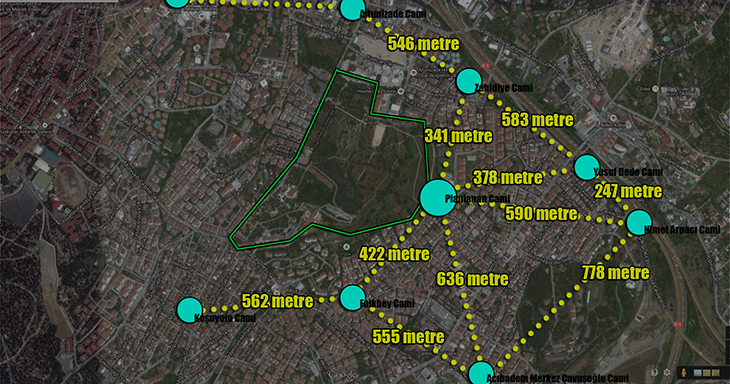
Some wonder why another mosque needs to be built in an area that already has 26, four of which are less than 600 metres away. “We don’t need any more mosques, says 70 year-old demonstrator Ozdemir. “We need oxygen!”

On October 31 the court’s stay of execution was reversed after an appeal, saying the project site lies outside of the protected grove. Some local papers and opposition politicians accused the Uskudar Municipality of interfering with the legal process, and lawyers representing the activists vowed to appeal the court’s reversal.

Among them was Tanrikulu – who claimed, in his parliamentary question, that the Municipality had tried to bypass the decision of the Istanbul 7th Administrative Court – which ordered a stop on construction at the site – by altering the sheet and parcel numbers of the car park.

Despite the unfavourable ruling, and the rising atmosphere of threat and initimidation from both government and police, the protestors are holding firm. And Ozdemir remains confident of ultimate victory, insisting: “The people will prevail!”


Nick Ashdown is a Canadian freelance journalist based in Istanbul, Turkey. You can follow him on Twitter @Nick_Ashdown


387355