Tag Archives: from

Toxic landfills, fracking and the lethal threat of Environment Agency neglect Updated for 2026


Zane, a beautiful bright 7-year-old boy who had just won his green stripe belt at martial arts class, and who was described by his headmaster as a “larger than life” figure, died on the nmight of 8th February 2014. Both his parents were taken ill, and his father, Kye, remains paralysed from the waist down.

The cause of death and harm remains officially unknown nearly a year later. Initial reports suggesting carbon monoxide poisoning from water pumps were later discounted. But firemen at the scene detected hydrogen cyanide, later confirmed by Public Health England.

In fact, the house is a rare all electric house with no gas supply and no capability of generating carbon monoxide. No carbon monoxide was found in the family home. Also, it took Public Health England 14 weeks to confirm to the family that hydrogen cyanide was indeed found in their flooded house.

Was it a cover-up?

And amazingly, despite the immediate finding of hydrogen cyanide in the home, the pathologist was never told to test Zane’s blood for hydrogen cyanide.

As early as March, the family sent a report to the coroner suggesting important lines of enquiry including testing for hydrogen cyanide. But there is still no official confirmation of what actually killed Zane.

The family’s own investigations into the surrounding area have since revealed that a field 6 metres from their home that contains a lake and looks so idyllic, is actually contaminated land – but this did not show in environmental searches.

Zane’s parents bought the house in 2004, when an environmental report showed no land contamination. However, subsequent reports for a neighbouring property in 2011, and for their own home, ordered by Zane’s parents last month, indicate contamination due to an old landfill site behind their home, now an infilled lake.

They also discovered that the Environment Agency knew about the toxic hazard from the landfill, ordering gas-proof membranes to protect their own staff when they built cabins nearby. This week, the family told Talk Fracking that the authorities, including the Environment Agency, have been “walls of silence”.

In response to questions about climate change, the Met Office confirmed that the flooding was consistent with what is expected from the fundamental physics of a warming world, thus increasing the potential dangers that flooding could compromise more landfill sites.

Fracking may need countless new landfills to dump its waste

In a recent submission to the Environmental Audit Committee, researcher and consultant Paul Mobbs analyses the water treatment and waste management associated with fracking. He forecasts a 50% increase in hazardous waste landfill, a staggering quarter of a million tonnes.

In December, Talk Fracking gave the Government some Christmas reading in the form of scientific reports on the health dangers of fracking. They included the Government’s own scientific advisor warning that fracking could join historic scandals such as asbestos, thalidomide, and lead in petrol.

Energy Minister, Matthew Hancock replied to Talk Fracking this week, citing two reports, one a three-year old study by the Royal Academy of Engineering (RAE), and the other by Public Health England. In his reply he concedes that both reports call for effective regulation and strong enforcement to bring the health, safety and environmental risks to a low level.

With the proposed massive expansion of this new industry across the country, and the many known and accepted risks, including the landfill issues highlighted by Paul Mobbs, you would expect a responsible Government to increase Environment Agency staff accordingly.

And now the Environment Agency cuts its regulatory capacity

In one of the reports Matthew Hancock used in his defence, the RAE stated that regulatory capacity must be maintained. But just two days after Zane’s sad death, news of 25% staff cuts hit the headlines.

Frontline services, according to Chris Smith, the then head of the EA, wouldn’t be affected by cuts, even while the agency was already struggling, calling nearly a fifth of frontline staff in from other teams in order to cope with the flooding.

Chris Smith now heads the ‘independent’ Shale Gas Task Force, where he earns around £1,500 a day, funded by fracking companies.

The new head of the Agency is Sir Phillip Dilley, earning £100k for three days a week work. He used to head the engineering firm, Arup, and is still listed as a trustee. Arup was employed by the leading fracking company, Cuadrilla – whose chairman Lord Browne sat as an advisor in the Cabinet.

It’s also been recently revealed that the EA pension fund invests in the very fracking companies it is supposed to regulate. The Environment Agency has just issued Cuadrilla with a brand new permit for drilling in Lancashire.

What Zane’s tragic story tells us is that regulators are less concerned about public safety, than about avoiding public awareness of the risks posed by contaminated, unregulated landfill sites throughout the UK. How many are there? Could you be living by one?

And if the Environment Agency cannot even monitor and ensure the safely of our existing industrial and domestic waste dumps, how wise is it to encourage a fracking boom that will cause a 50% increase the landfilling of hazardous waste, creating a massive new toxic legacy for the future?


Petition:Call for a public debate into the death of 7 year old Zane‘ (38 degrees).

This article is based on one originally published by Talk Fracking, a campaign group committed to highlighting the issues surrounding fracking in the UK, holding the policy makers and industry to account and providing a forum for debate.

Also on The Ecologist:Death by landfill – cutting ‘green tape’ costs lives‘.


389167

Stay or go for next clutch? Updated for 2026

Moving to a new site for next brood? Good or bad? And why? These questions are answered in the Early View paper “Mechanisms and reproductive consequences of breeding dispersal in a specialist predator under temporally varying food conditions” by Julien Terraube and co-workers.

In this study, we explored the factors linked to variations in breeding dispersal behaviour and their consequences in terms of reproductive parameters in a raptor species. Which factors influence individual dispersal decisions? Are Eurasian kestrels Falco tinnunculus able to increase their own reproductive success after moving from one site to the other between two consecutive breeding seasons? Is this relationship mediated by environmental factors like food abundance or individual traits like gender or age? All these fascinating questions are hard to answer particularly in avian predators because of methodological limitations associated to size of the study area and even more in species like Eurasian kestrels breeding in boreal ecosystems, which have high breeding dispersal propensity and in which movements are driven by cyclic fluctuations in abundance of main foods (voles) (see Vasko et al. 2011).

In spring 1977, a long-term study of a local kestrel population breeding in western Finland (the Kauhava region) was initiated along with the monitoring of Tengmalm’s owl populations (see Korpimäki and Hakkarainen 2012). Hard work in the field has generated a fantastic long-term, large-scale dataset combining data from breeding success and individual traits of breeding kestrel parents captured at their nest sites over the last 25 years (1983-2013).


A +1-year old male kestrel on hand after trapping. Photo: Erkki Korpimäki.

A +1-year old male kestrel on hand after trapping. Photo: Erkki Korpimäki.

Given the increasing demand for long-term population studies in order to understand current impact of environmental changes, the authors would like to stress the importance of long-term studies on demographic parameters in long-lived vertebrate populations. In this study, the assessment of breeding dispersal distances was made possible through systematic capture of most kestrel parents breeding in the main study areas, ringing and recovery of previous rings. We would like to focus here on the capture procedure that allowed collecting breeding dispersal data and share the experience acquired during the hours spent in “Wild-West” of Finland when checking traps.


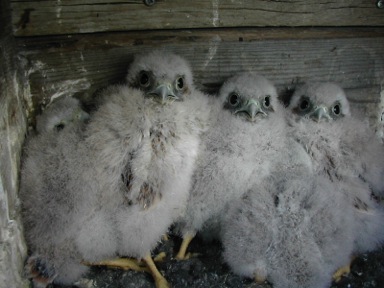
Three-week old nestlings in the nest-box. Photo: Erkki Korpimäki

Three-week old nestlings in the nest-box. Photo: Erkki Korpimäki

Capture occurs during the brood-rearing period when chicks are two-to-three weeks old, in order to avoid unnecessary disturbance of young nestlings during the most vulnerable phase. Virtually all the breeding population monitored breeds in nest-boxes that were set up on barns from early 1980s onwards. The total number of nest-boxes has varied from 350 to 450 throughout the study period in agricultural fields of the study area. We have used swing-door traps attached to the front of the nest box for trapping parents. The “trapping routine” starts by erecting the traps early in the morning from 5-6 am on a group of 5 to 10 breeding sites selected according to nestling age. Then trap-checking rounds are performed every two-to-three hours to check if any individual is trapped. The aim is to capture both female and male from each breeding site within 12 hours. Adults are ringed, measured and weighed near the breeding site and released as soon as possible. A capture day ends by giving newly-hatched rooster chickens to the kestrel nestlings to compensate for the decrease in prey delivery rates experienced during the trapping of their parents.

We have been lucky in the sense that voluntary birdwatchers and ringers have set up many large nest-box networks for kestrels in surrounding areas in western Finland. In addition, many voluntary ringers, particularly Erkki Rautiainen and Jussi Ryssy, have also made huge efforts to trap and ring kestrel parents and to ring fledglings at these nest-boxes.

A female kestrel with metal and colour rings in the front of the nest-box. Photo: Benjam Pöntinen.

A female kestrel with metal and colour rings in the front of the nest-box. Photo: Benjam Pöntinen.

A total of 2089 males and 2544 females were trapped at nests during 1985 to 2011 in our study areas. Trapping success remained relatively constant over the period: of all the nesting attempts on average 70% of the male and 80% of the female parents were successfully captured yearly. This large-scale trapping and ringing program allowed us to collect 631 dispersal events from 1985 to 2011 that were analysed in this study.

Overall, we found that females dispersed further than males and older individuals dispersed further than yearlings. A noteworthy aspect of this study involved the evidence of body-condition dependent dispersal strategies in kestrels as the individual body condition index was positively correlated to breeding dispersal distances, particularly in females. Strikingly, our results also evidenced complex patterns of non-linear relationship between previous breeding success and dispersal distances. Finally, longer dispersal distances were associated with reproductive costs in males under increasing vole abundance, whereas those females dispersing further increased their breeding success under all conditions of food abundance.

These results call for further research as clearly there is more to learn about the link between potential pre- and post-breeding prospecting movements, optimal dispersal decisions and population dynamics in avian predators inhabiting fast changing boreal ecosystems.


References


Korpimäki, E. & Hakkarainen, H. 2012. The boreal owl: Ecology, Behaviour and Conservation of a Forest-Dwelling Predator. – Cambridge University Press, Cambridge. 372 pages.


Vasko, V., Laaksonen, T., Valkama, J. & Korpimäki, E. 2011. Breeding dispersal of Eurasian kestrels (Falco tinnunculus) under temporally fluctuating food abundance. – Journal of Avian Biology 42: 552-563. (doi: 10.1111/j.1600-048X.2011.05351.x)

Climate sceptic Lord Ridley – Britain’s biggest carbon footprint? Updated for 2026


Lord Ridley is a powerhouse of climate denial in Britain – and a leading contender for the title of Britain’s biggest individual carbon polluter.

The self-styled Rational Optimist is an advisor to Lord Lawson’s secretly funded charity, the Global Warming Policy Foundation (GWPF), and acts as a one-man think tank to his brother-in-law, the sacked environment secretary Owen Paterson.

At the same time, the landed aristocrat will mine more than 10 million tonnes of coal from open cast mines scattered around his expansive Blagdon Estate in Northumberland during the next five years.

Miles King, a conservationist with almost 30 years of professional experience, has used publicly available information to estimate that the coal mined from Ridley’s estate will produce 28.6 million tonnes of CO2.

The government has estimated that the UK emitted a total of 570 million tonnes of CO2 or equivalent greenhouse gasses during 2013. This means Ridley’s mines will contribute an estimated 1% of the total annual emissions of a country of 60 million people.

Massive profit, in praise of coal

“I don’t know how much profit Ridley is making from his coal but it must be massive”, King writes on A New Nature Blog. “As the modern day King Coal, one might suggest Matt Ridley has an extremely large vested interest in stoking climate denial.”

Ridley declares an interest in coal when speaking in the House of Lords. He denies being a climate denier, and denies the charge of promoting the coal industry. He claims his arguments support gas rather than coal interests.

However, as King points out, Ridley has been known to defend coal. “It’s the fashion these days to vilify coal as the root of all environmental evil, but I think that’s mistaken”, Ridley writes on his own blog.

“Coal and the technologies it spawned made it possible to double human lifespan, end famine, provide electric light and spare forests for nature.

“Because we get coal out of the ground, we do not have to cut down forests; because we use petroleum we don’t have to kill whales for their oil; because we use gas to make fertilizer we don’t have to cultivate so much land to feed the world.

“This country can compete with China on the basis of either cheap labour or cheap energy. I know which I’d prefer.”

Matt Ridley was also the chairman of the Northern Rock bank from 2004 until its collapse in 2007, after which it was nationalised. In 2013 he was elected as hereditary peer in the House of Lords as a member of the Conservative Party.

Financial benefit unknown – estimated at £13m / year

King’s investigation into Ridley’s carbon footprint was inspired by reports launched by DeSmog UK just before the New Year where we claimed that the mines around the aristocrat’s estate would yield a further £13m a year due to recent planning approvals.

Ridley has so far refused to confirm the exact amount of money he is making from the coal under his family’s land, citing commercial confidentiality. “I receive no financial benefit other than a wayleave in exchange for providing access to the land”, he told DeSmog UK.

The Ridley mines are operated by family firm Banks Mining. The coal under the ground is still owned by the British government following nationalisation in 1947, although the Coal Authority charges very little for the extraction and sale of our most valuable and dangerous resource.

Yet, soon Ridley, his miners and the government could be mandated to reveal exactly how much in profits is being made by the Blagdon mines, how much is paid in taxation, and the amount in fees going to the Coal Authority.

The controversial Infrastructure Bill currently going through Parliament will, if passed, make the Extractive Industries Transparency Initiative (EITI) legally binding.

According to the government, “EITI is a global standard ensuring openness and accountability in the management of revenue from natural resources including coal, oil, natural gas, quarrying and mining.”

Unburnable coal

The transparency initiative was launched by campaigners concerned about the relationship between major oil companies and corrupt governments around the world.

They believe transparency will allow citizens to fully appreciate how national resources are being sold cheaply by their political elites.

But Britain’s support for this initiative could have serious implications for Ridley, when local residents find out exactly how much is being made in profits from the coal on his estate and can test the veracity of his claim to only receive a negligible amount in fees.

A study by academics at University College London (UCL) published in Nature confirms that 80% of the world’s coal is ‘unburnable’ if there is to be any hope of keeping climate change to less than two degrees – and averting catastrophe.

Dr Christophe McGlade, from the UCL Institute for Sustainable Resources, said: “Policymakers must realise that their instincts to completely use the fossil fuels within their countries are wholly incompatible with their commitments to the 2C goal.”


Brendan Montague writes for DeSmogUK. Follow him on Twitter @Brendanmontague.

This article was originally published on DeSmogUK.


388952

FBI harassing fossil fuel activists in the Pacific northwest Updated for 2026


In August 2014, two activists with the environmentalist group Rising Tide spent a week riding the backwoods highways of Idaho monitoring a megaload.

That’s big rig hauling equipment for processing tar sands oil that’s wide enough to take up two lanes of road, too high to fit under a freeway overpass, can be longer than a football field, and can weigh up to 1,000,000 pounds.

They had no idea that they would soon be wrapped up in a Federal Bureau of Investigation probe that encompassed three states and several environmentalist groups.

Helen Yost of Moscow, Idaho, and Herb Goodwin of Bellingham, Washington, have spent years travelling through area the bioregion of Cascadia to halt megaloads, from Washington and Oregon to Idaho and up through Montana.

They are used to harassment from law enforcement. That week, Goodwin said, the two were stopped on average twice a night, by law-enforcement agencies ranging from state troopers to local police in Sandpoint and Moscow.

Usually carrying equipment to upgrade and expand tar sands mining in Alberta, Canada, megaloads make a tortuous crawl along rural roads at night to avoid traffic, questions, and complaints.

Organizing resistance – too successful to ignore

But activists like Goodwin and Yost have been remarkably successful at organizing the people in mountain country. In August 2013, more than a hundred people in Idaho participated in a four-day mobile blockade of a megaload on US 12 headed for the Nez Perce reservation.

The Nez Perce Nation said the megaloads threatened treaty-reserved resources, historic and cultural resources, and “tribal member health and welfare.” Tribal chair Silas Whitman was one of the blockaders arrested, while activists from Wild Idaho Rising Tide (WIRT), the group Yost helped form, played important support roles.

Rising Tide North America’s network, spun out of the Earth First! grassroots environmentalist movement in 2005, now spans the Cascadia bioregion, with chapters in Seattle, Spokane, Olympia, Bellingham, and Vancouver, Washington; Portland, Oregon; Moscow, Idaho; Missoula, Montana; and Vancouver, B.C.

In the last six months, they have collaborated on an average of a blockade per month, and have helped to spearhead the movement against fossil fuel exports through the Pacific Northwest.

The network has worked in solidarity with indigenous peoples to halt megaloads, has marched in pickets with unions to shut down ports, and has aided community groups to stop permits for coal, oil, and gas terminals on the Pacific Coast.

The FBI steps in

On Oct. 9, Herb Goodwin was approached at his home in Bellingham by two FBI agents asking about a group called Deep Green Resistance (DGR).

The FBI and Joint Terrorism Taskforce had previously contacted several members of DGR and their families both by phone and through home visits in places as dispersed as Georgia, New York and Seattle.

Goodwin was alarmed but not surprised when the lead agent “flashed a badge and claimed to be from the FBI.” Refusing to tell him anything beyond her first name, ‘Brenda’, she provided a sloppy excuse for not presenting a business card.

The other person identified himself as ‘Al Jensen’, and his card identified him as a member of the Criminal Intelligence Unit of the Bellingham Police Department.

“Jensen jocularly mentioned that we knew each other from the Occupy movement / camp and train blockade, attempting to coax up conversation”, Goodwin said in an e-mail. “I did not take the bait.”

The Occupy encampment in Bellingham lasted for two months in the winter of 2011-12. Goodwin was one of four people arrested during the eviction, which came about two weeks after the mass blockade of a coal train Jensen mentioned. He says he recognized the detective’s face, but didn’t know his name:

“I think he was one of the undercover guys who was shifting in and out of our camp for the couple of months we had the camp up. I got a lot more surveillance after the Bellingham coal train blockade. I had people scoping out my apartment off and on for a couple months after that … I could see people scoping me from cars with binoculars.”

Goodwin says he is not a member of DGR, but suggests that it has drawn the interest of the FBI for advocating an ‘underground’ strategy to dismantle industrial civilization. At the same time, he adds,

“all the people remotely connected with DGR call themselves ‘aboveground,’ and they say that they’re going to be involved in the same kind of aboveground actions that other activist groups are, but as far as I know they haven’t really done anything.”

There is no love lost between DGR and Rising Tide. In February 2014, Rising Tide North America signed a letter along with some 40 other groups, such as Greenpeace, the National Lawyers Guild, and Tar Sands Blockade, petitioning the University of Oregon to cancel a keynote address by one of DGR’s leaders at an environmental-law conference on the grounds that the group’s transphobic beliefs promote “exclusionary hate that breeds an environment of hostility and violence.”

Questioning a Rising Tide activist about DGR seemed to blur some important differences between the groups, but activists still saw between the lines. The FBI inquisition was an obvious campaign to silence dissent, Yost says: “When Herb got visited we knew it wouldn’t be long before they came around to someone from Idaho.”

Habeas corpus battle in rural Idaho

On 9th October, the same day Goodwin was visited by the FBI, an activist named Alma Hasse attended a public meeting of the Payette County Planning and Zoning Commission to testify against the expansion of a gas-processing facility in the area, along the Oregon border northwest of Boise.

She recommended that the five Commission members recuse themselves from the permitting process on the grounds that they had signed oil and gas leases with Alta Mesa, the company seeking approval. (All three of the county commissioners have signed oil and gas leases as well.)

An associate of Yost and Goodwin, Hasse has worked in rural Idaho for years, agitating and organizing against fracking and oil trains. Cofounder of Idaho Residents Against Gas Extraction (IRAGE), which works with WIRT, she regularly attends Payette County government public meetings and brings up problems with their processes.

This time, something was different. The Commission members closed the meeting to the public, brusquely challenging Hasse’s testimony, and ordering her to leave or face arrest. After insisting on her right to participate in the public meeting, she was arrested and kept in jail for a week without being charged or even processed.

In protest against her mistreatment by the Commission, Hasse refused to give her name. Though the police knew her, and called her ‘Alma’ when they talked about her, they refused her requests for a telephone call until she obtained a PIN number, which she could only get after being processed.

Police refused to process Hasse until she volunteered her name. Instead of booking her as ‘Jane Doe’ (a formality, since they already knew her name), they kept her in a cell by herself.

“I felt like it was a game”, Hasse says. “They had my name. I had to sign in to testify at the public hearing, so both my name and my address were on the sign-in sheet.” She also had been granted a permit to carry a concealed weapon by the county sheriff’s office, so they had her Social Security number, date of birth, and fingerprints.

When police asked for her name, Hasse would tell them that they already knew her name, and that she wanted to talk to her attorney. They refused, which she insists was a violation of her civil rights and right of habeas corpus.

Only after she drew attention to her incarceration by going on a hunger strike, supported by a media campaign led by her husband and civil disobedience spearheaded by her daughter and WIRT, was she allowed to go free.

“I felt like I had to stand on principle”, Hasse says. “At some point, we as citizens have to stand up and assert our rights, because if we don’t, we’re just going to be steamrolled.”

When the FBI sends texts

On 10th December, Helen Yost of WIRT received three phone calls from an unfamiliar number in Coeur d’Alene, Idaho. Thinking they were from a telemarketer, she did not answer them. But nine days later, she awoke to another call from the same number. She had anticipated the text message that followed for years.

“Helen, I am trying to get a hold of you to speak with you. An issue has come up, and I need to speak with you. Please give me a call. I am an FBI agent. SA Travis Thiede.”

Yost responded within ten minutes: “NO!”

Agent Thiede’s reply came four minutes later: “OK, I understand, just wanted to have a conversation with you. Thanks.”

According to his LinkedIn profile, Thiede joined the FBI in 1997 after serving in the Army and as a police officer in Colorado Springs, Colorado. He was involved in the providing security at the 2002 Winter Olympics in Salt Lake City and the investigation of a power-station bombing on the games’ last day.

Yost believes that the agent’s calls were related to her role as an organizer with WIRT. On 10th December, the day the first ones were placed, she had just returned to Moscow from a road trip organizing for the third annual Stand Up! Fight Back! Against Fossil Fuels in the Northwest!

She’d been in Sandpoint on 8th December and in Spokane, about 35 miles from the FBI office in Coeur d’Alene, on 9th December.

Continuing harassment

After years of dedicated activism, Hasse and Yost were not surprised. Groups like IRAGE and Rising Tide have felt the presence of the FBI for years.

The intensity of repression depends on the success of their campaigns, and not since the late 1990s has the Pacific Northwest seen so much mass action for environmental causes. During that period, the FBI inaugurated a broad strategy of repression, known by activists as the Green Scare, to track down suspects implicated in actions deemed ‘eco-terrorist’.

According to leaked documents, its surveillance net was so large that officers even tailed random Subaru-driving patrons of a farmers’ market. Earth Liberation Front spokesperson Craig Rosebraugh was subpoenaed eight times to testify before grand juries.

The FBI’s Operation Backfire led to 13 people being indicted and nine convicted on various charges, including arson. Of the other four, one committed suicide in jail, two are still fugitives, and one escaped prison time by turning snitch, but was later jailed on heroin charges.

That era is said to have ended in 2006, but the bureau is still using agent provocateurs to infiltrate environmental and social-justice movements. (One was recently arrested for failing to register as a sex offender and for credit-card fraud.)

In 2008, a young man named Eric McDavid was sentenced to more than 19 years in prison, after an agent provocateur who called herself ‘Anna’ seduced him into talking about committing acts of sabotage at a cabin in Northern California the FBI had rented and wired for her.

Repressive ‘ag-gag’ laws against fossil fuel activists

Legislation such as the 2006 federal Animal Enterprise Terrorism Act, largely drafted by the far-right corporate American Legislative Exchange Council, has expanded the criminalization of advocacy for the environment and animal rights.

Because of Idaho’s new ‘ag-gag’ law – enacted in February after animal rights activists released videos of dairy workers abusing cows, it outlaws filming or recording agricultural operations without permission – activists in Payette County are afraid to take photographs of new fossil fuel wells and processing plants.

The surveillance has continued apace, as well. In 2011, activists with WIRT heard from an arrested megaload blockader that the local police were communicating with the FBI. They wrangled two meetings with the police and sheriff, but did not get any substantial information regarding the extent of federal involvement.

That fall, minutes after Yost received a call from an activist telling her that a protest was about to begin, police showed up and shined flashlights into people’s cars. She believes they learned the protest’s location by tapping her phone.

The local sheriff also approached associates of a professor at a university in Spokane and asked them about why he ‘Liked’ WIRT’s Facebook page.

In June 2013, the FBI called the parents of an activist with Portland Rising Tide, and six other activists who have worked with Rising Tide Seattle were visited by FBI terrorism expert Matthew Acker and forensics leader Kera O’Reilly. There was also a third agent, who did not give his information.

The agents asked about the movement against tar-sands and fossil-fuel shipments. It was apparent immediately that the target was the Summer Heat action scheduled for that July 27, a joint effort with 350.org that would send a hundred or more kayaks and boats into the Columbia River for a symbolic blockade on to protest coal barges, oil-by-rail, and gas pipelines.

“My [attorney] was not able to find out what or why they were bothering my sweet folks, but I will tell you why”, one activist whose parents were visited wrote.

“Its because Portland Rising Tide is outreaching, training, and organizing hundreds of Pacific NWers of all age groups to engage in a level of civil disobedience not seen in decades. We are going to do it to save our neighborhoods, our communities, our salmon, and our climate. And that scares the shit out of the powers that be.”


Alexander Reid Ross is a contributing moderator of the Earth First! Newswire and works for Bark. He is the editor of Grabbing Back: Essays Against the Global Land Grab (AK Press 2014) and a contributor to Life During Wartime (AK Press 2013).

This article originally appeared at DefendingDissent.org.


388642

MH17 investigation – geopolitics triumphs over truth and justice Updated for 2026


On 17 July 2014 Malaysian Airlines Flight MH17 en route from Amsterdam to Kuala Lumpur was shot down over the Eastern Ukraine.

Although the precise circumstances were at that point unknown the western media were quick to blame Ukrainian ‘rebels’. The means by which MH17 was destroyed, the media alleged, was a surface to air BUK missile supplied to the ‘rebels’ by Russia.

For a host of reasons it was almost certainly not a BUK missile that caused the crash. The stage was set however, for a demonization of Russia in general as the alleged supplier of the missile, and President Vladimir Putin in particular.

The relentless propaganda enforcing this view has continued unabated to this day, although the evidential foundation for the allegations remains at best remote.

First the verdict … and hide the evidence

The Russians produced an initial denial of involvement. Four days after the tragedy however, as anti-Russian hysteria was escalating to extreme levels, the Russian military held a press presentation. The fact of this presentation was barely reported in the western media. The content, more importantly, was either ignored or misrepresented.

The Russians disclosed, inter alia, their radar and satellite data. These data showed that MH17 had been diverted from its scheduled route so that it flew directly over the war zone in eastern Ukraine. They asked for an explanation but one has never been forthcoming.

These data also showed that MH17 had been shadowed during its last minutes by two SU25 fighter jets, a model flown by the Ukrainian air force. Again the Russians asked why this had happened.

The main response was a claim that the SU25 could not fly above 10,000 metres. Not only is this untrue, as an examination of military resources readily demonstrates, but the Wikipedia entry on the SU25 had been altered days before the shoot down to claim that the SU25’s operating ceiling was only 7,000 metres. Again the western media ignored this obvious alarm bell.

The Russians further disclosed that at the precise time of the shoot down an American spy satellite was directly overhead the scene and would have recorded the sequence of events.

The Russians invited the Americans to share these data with the official investigation that had been launched, but to date the Americans have failed to do so. Again, the western media are singularly incurious as to the reason for this lack of cooperation.

IATA rules misapplied to excldue Malaysia

Under IATA Rules, the parties responsible for the investigation would be the Malaysians, as owners of the plane and home country of the airline, and the Ukrainians over whose territory the atrocity occurred.

It was the Dutch however, who took the lead role, citing two facts: the plane had departed from Amsterdam; and they had suffered the largest number of their nationals as victims.

The Malaysians were initially excluded from the inquiry for reasons that have never been satisfactorily explained. They were finally invited to join the Joint Inquiry on 2 December 2014.

Instead, the initial inquiry group consisted of Ukraine, the Netherlands, Australia and Belgium. The Australians suffered the third largest loss of life but had no standing to be one of the investigatory nations, and certainly less of a claim than the Malaysians.

The Australian Prime Minister and some other politicians had been at the forefront of making extreme allegations against Russia and President Putin. Why Belgium was included remains a mystery.

Secret agreement gives Ukraine a veto on the findings

On 8 August 2014 these four investigating nations signed an agreement that the results of the investigation would not be published unless all four countries agreed.

This gave one of the prime suspects in the atrocity, Ukraine, an effective veto over any investigations result that attributed blame to them. This is an astonishing situation and probably without precedent in modern air crash investigations.

More significantly however, is that the existence of this secret agreement was not announced by the Australian government, nor to the best of my knowledge has any report about the existence of the agreement or its extraordinary terms, been published in any mainstream publication.

The Dutch magazine Elsevier, under Dutch Freedom of Information laws, sought a copy of the agreement. On 19 November they announced that the request had been refused on the grounds that it “could endanger the relations with other countries involved.”

An Australian citizen (name redacted) wrote to the Minister for Infrastructure and Regional Development (Deputy Prime Minister Warren Truss) seeking a copy of the agreement. By letter dated 15 October 2014 the Department of Foreign Affairs and Trade (DFAT) replied on behalf of the Minister, refusing the requester a copy of the agreement as its contents were “classified”.

The present writer wrote to DFAT on 21 August 2014 seeking a copy of the agreement of 8 August 2014 under the Freedom of Information Act. The department declaimed responsibility and said that they had passed my request on to the Attorney-General’s Department.

Australia’s federal police refuse FOI request

This was odd, but even odder was advice from the Attorney General that my request had been passed in turn to the Australian Federal Police who were the responsible body.

This must be the first time in Australian history since 1901 that negotiations and agreements between sovereign nations had been conducted on Australia’s behalf by the Federal Police.

On 2 December 2014 the Australian Federal Police finally gave their decision on the FOI request. It was declined on the basis that disclosure of the document (which they acknowledged existed) under section 33 would, or could reasonably be expected to, cause damage to:

  • (i) the security of the Commonwealth; or
  • (ii) the defence of the Commonwealth; or
  • (iii) the international relations of the Commonwealth

The refusal also relied upon section 37(1)(a) of the Act which exempts a document if it could reasonably be said to prejudice the conduct of an investigation.

Thirdly, the Federal Police relied upon section 37(1) (c) where disclosure could reasonably be expected to endanger the life or physical safety of a person.

The fourth ground of refusal was under section 37(2)(b) which exempts disclosure where it might reasonably be expected to prejudice an investigation by disclosing methods of investigation or detection of unlawful activity.

In the circumstances of this case it is very difficult to see how any of those provisions would apply. The agreement, it should be remembered, is to give any one of the four investigating countries a veto over publication of the results. A final report would be entitled to withhold details of the investigation that would truly prejudice matters of national security.

An investigation of a crash of an aeroplane is however, carried out under IATA Rules and its procedures are well established and well documented. Whose life or safety might be endangered by releasing the agreement is unspecified.

Geopolitics trumps justice

One is left with the conclusion that 33 (iii) is the real ground and the ‘international relations’ referred to are the difficulty Australia and other nations have got themselves into by prematurely blaming Russia when all of the emerging evidence points squarely at Ukraine.

Given the existence of this agreement it is difficult to see how anyone can have any confidence in whatever final report is published by the Dutch. The preliminary report was careful not to apportion blame or even state the cause of the crash other than to say that the plane was hit a by a large number of “high velocity objects” which were undefined.

Another major question is why have the mainstream media kept up a barrage of misinformation up to and including the recent G20 debacle, when they know, or ought to know that the investigation is a sham?

It is also difficult to see how the continued demonization of Russia and Mr Putin for manifestly geo-political reasons (and the probable reasons for the shoot down in the first place) represents any form of justice for the families of the 298 victims and in particular the 37 who were Australian citizens or residents.

It is clear that the Government’s professed support for Security Council Resolution 2116 (2014) for a “full, thorough, and independent international investigation into the incident in accordance with international civil aviation guidelines” is no more than window dressing for a much wider geopolitical agenda.


James O’Neill is a former academic who has practiced as a barrister for the past 30 years. He has a special interest in international human rights issues. He may be contacted at j.oneill@bigpond.net.au


388399

Carbon dioxide threat to mussels’ shells Updated for 2026


In a new paper published today in the Royal Society’s journal Interface, researchers from the University of Glasgow describe how mussels’ shells become more brittle when they are formed in more acidic water.

The world’s oceans are becoming increasingly acidic as they absorb some of the atmospheric carbon dioxide which contributes to climate change.

The water reacts with the carbon dioxide to form carbonic acid, which is gradually lowering the pH of the oceans (indicating an increase in acidity). Scientists expect the pH of the world’s oceans to have dropped from 8 today to 7.7 by the end of the 21st century.

“What we’ve found in the lab is that increased levels of acidification in their habitats have a negative impact on mussels’ ability to create their shells”, said research team leader Susan Fitzer of the University’s School of Geographical and Earth Sciences.

As oceans get more acid, less bicarbonate for shell-making

Mussels’ shells are composites of calcium carbonate and organic material created by the mussels through a process known as biomineralisation.

Mussels draw bicarbonate ions from seawater and use proteins in their bodies to make crystals of calcium carbonate to form their two-layer shells. In more acidic water, there are less bicarbonate ions available for the mussels to make their shells.

“This could mean that mussels growing in the wild in the future could be more vulnerable to attack from predators, as well as from the effect of ocean forces”, explained Dr Fitzer.

“As blue mussels are commonly used for human consumption, it could also have an effect on the yields of mussels available for the fishing industry.”

The mussels do have way to resist the more acidic water once their shells have formed. Their shells’ outer later is composed of calcite, a form of calcium carbonate that is more resistant to acid decay. Only the inner layer is made of the more soluble aragonite.

But even that mechanism is under threat, says Dr Fitzer: “What we found was that the calcite outer shells of the mussels past a certain threshold of acidity was stiffer and harder, making it more brittle and prone to fracture under pressure, and the aragonite inner shell became softer.

Ocean conditions replicated in the lab

The research, carried out with colleagues in our School of Engineering, was designed to examine the toughness of the shells of the mussels in the more acidic water against those in control conditions.

Common blue mussels, Mytilus edulis, were housed in laboratory tanks. The researchers controlled and altered the temperature and CO2 levels of the water in the tanks to simulate four different types of ocean waters at CO2 levels projected to occur in the coming decades (380, 550, 750, 1000 ppm).

Ocean conditions were also simulated as closely as possible by changing light levels over time to mimic the changing of the seasons.

Another finding was that the impact of the increased acidity reduced as temperatures increased: “The effect on the mussels’ shells was reduced when the temperature of the water was increased by 2°C. This might suggest that the mussels are reverting to ancestral evolutionary mechanisms to mitigate the effects of increased acidity.”

Now the team is planning to extend its research to include other marine organisms, says Dr Fitzer: “We’re planning to continue our research in this area in the future and expand its scope to look at the effects of more acidic water on the shells of other marine organisms including oysters and abalone.”


The paper:Ocean acidification alters the material properties of Mytilus edulis shells‘, is published in Interface.

The research was funded by the Leverhulme Trust awarded to the research team including Professor Maggie Cusack, Dr Nick Kamenos and Dr Vernon Phoenix.


388396

Carbon dioxide threat to mussels’ shells Updated for 2026


In a new paper published today in the Royal Society’s journal Interface, researchers from the University of Glasgow describe how mussels’ shells become more brittle when they are formed in more acidic water.

The world’s oceans are becoming increasingly acidic as they absorb some of the atmospheric carbon dioxide which contributes to climate change.

The water reacts with the carbon dioxide to form carbonic acid, which is gradually lowering the pH of the oceans (indicating an increase in acidity). Scientists expect the pH of the world’s oceans to have dropped from 8 today to 7.7 by the end of the 21st century.

“What we’ve found in the lab is that increased levels of acidification in their habitats have a negative impact on mussels’ ability to create their shells”, said research team leader Susan Fitzer of the University’s School of Geographical and Earth Sciences.

As oceans get more acid, less bicarbonate for shell-making

Mussels’ shells are composites of calcium carbonate and organic material created by the mussels through a process known as biomineralisation.

Mussels draw bicarbonate ions from seawater and use proteins in their bodies to make crystals of calcium carbonate to form their two-layer shells. In more acidic water, there are less bicarbonate ions available for the mussels to make their shells.

“This could mean that mussels growing in the wild in the future could be more vulnerable to attack from predators, as well as from the effect of ocean forces”, explained Dr Fitzer.

“As blue mussels are commonly used for human consumption, it could also have an effect on the yields of mussels available for the fishing industry.”

The mussels do have way to resist the more acidic water once their shells have formed. Their shells’ outer later is composed of calcite, a form of calcium carbonate that is more resistant to acid decay. Only the inner layer is made of the more soluble aragonite.

But even that mechanism is under threat, says Dr Fitzer: “What we found was that the calcite outer shells of the mussels past a certain threshold of acidity was stiffer and harder, making it more brittle and prone to fracture under pressure, and the aragonite inner shell became softer.

Ocean conditions replicated in the lab

The research, carried out with colleagues in our School of Engineering, was designed to examine the toughness of the shells of the mussels in the more acidic water against those in control conditions.

Common blue mussels, Mytilus edulis, were housed in laboratory tanks. The researchers controlled and altered the temperature and CO2 levels of the water in the tanks to simulate four different types of ocean waters at CO2 levels projected to occur in the coming decades (380, 550, 750, 1000 ppm).

Ocean conditions were also simulated as closely as possible by changing light levels over time to mimic the changing of the seasons.

Another finding was that the impact of the increased acidity reduced as temperatures increased: “The effect on the mussels’ shells was reduced when the temperature of the water was increased by 2°C. This might suggest that the mussels are reverting to ancestral evolutionary mechanisms to mitigate the effects of increased acidity.”

Now the team is planning to extend its research to include other marine organisms, says Dr Fitzer: “We’re planning to continue our research in this area in the future and expand its scope to look at the effects of more acidic water on the shells of other marine organisms including oysters and abalone.”


The paper:Ocean acidification alters the material properties of Mytilus edulis shells‘, is published in Interface.

The research was funded by the Leverhulme Trust awarded to the research team including Professor Maggie Cusack, Dr Nick Kamenos and Dr Vernon Phoenix.


388396

Carbon dioxide threat to mussels’ shells Updated for 2026


In a new paper published today in the Royal Society’s journal Interface, researchers from the University of Glasgow describe how mussels’ shells become more brittle when they are formed in more acidic water.

The world’s oceans are becoming increasingly acidic as they absorb some of the atmospheric carbon dioxide which contributes to climate change.

The water reacts with the carbon dioxide to form carbonic acid, which is gradually lowering the pH of the oceans (indicating an increase in acidity). Scientists expect the pH of the world’s oceans to have dropped from 8 today to 7.7 by the end of the 21st century.

“What we’ve found in the lab is that increased levels of acidification in their habitats have a negative impact on mussels’ ability to create their shells”, said research team leader Susan Fitzer of the University’s School of Geographical and Earth Sciences.

As oceans get more acid, less bicarbonate for shell-making

Mussels’ shells are composites of calcium carbonate and organic material created by the mussels through a process known as biomineralisation.

Mussels draw bicarbonate ions from seawater and use proteins in their bodies to make crystals of calcium carbonate to form their two-layer shells. In more acidic water, there are less bicarbonate ions available for the mussels to make their shells.

“This could mean that mussels growing in the wild in the future could be more vulnerable to attack from predators, as well as from the effect of ocean forces”, explained Dr Fitzer.

“As blue mussels are commonly used for human consumption, it could also have an effect on the yields of mussels available for the fishing industry.”

The mussels do have way to resist the more acidic water once their shells have formed. Their shells’ outer later is composed of calcite, a form of calcium carbonate that is more resistant to acid decay. Only the inner layer is made of the more soluble aragonite.

But even that mechanism is under threat, says Dr Fitzer: “What we found was that the calcite outer shells of the mussels past a certain threshold of acidity was stiffer and harder, making it more brittle and prone to fracture under pressure, and the aragonite inner shell became softer.

Ocean conditions replicated in the lab

The research, carried out with colleagues in our School of Engineering, was designed to examine the toughness of the shells of the mussels in the more acidic water against those in control conditions.

Common blue mussels, Mytilus edulis, were housed in laboratory tanks. The researchers controlled and altered the temperature and CO2 levels of the water in the tanks to simulate four different types of ocean waters at CO2 levels projected to occur in the coming decades (380, 550, 750, 1000 ppm).

Ocean conditions were also simulated as closely as possible by changing light levels over time to mimic the changing of the seasons.

Another finding was that the impact of the increased acidity reduced as temperatures increased: “The effect on the mussels’ shells was reduced when the temperature of the water was increased by 2°C. This might suggest that the mussels are reverting to ancestral evolutionary mechanisms to mitigate the effects of increased acidity.”

Now the team is planning to extend its research to include other marine organisms, says Dr Fitzer: “We’re planning to continue our research in this area in the future and expand its scope to look at the effects of more acidic water on the shells of other marine organisms including oysters and abalone.”


The paper:Ocean acidification alters the material properties of Mytilus edulis shells‘, is published in Interface.

The research was funded by the Leverhulme Trust awarded to the research team including Professor Maggie Cusack, Dr Nick Kamenos and Dr Vernon Phoenix.


388396

Carbon dioxide threat to mussels’ shells Updated for 2026


In a new paper published today in the Royal Society’s journal Interface, researchers from the University of Glasgow describe how mussels’ shells become more brittle when they are formed in more acidic water.

The world’s oceans are becoming increasingly acidic as they absorb some of the atmospheric carbon dioxide which contributes to climate change.

The water reacts with the carbon dioxide to form carbonic acid, which is gradually lowering the pH of the oceans (indicating an increase in acidity). Scientists expect the pH of the world’s oceans to have dropped from 8 today to 7.7 by the end of the 21st century.

“What we’ve found in the lab is that increased levels of acidification in their habitats have a negative impact on mussels’ ability to create their shells”, said research team leader Susan Fitzer of the University’s School of Geographical and Earth Sciences.

As oceans get more acid, less bicarbonate for shell-making

Mussels’ shells are composites of calcium carbonate and organic material created by the mussels through a process known as biomineralisation.

Mussels draw bicarbonate ions from seawater and use proteins in their bodies to make crystals of calcium carbonate to form their two-layer shells. In more acidic water, there are less bicarbonate ions available for the mussels to make their shells.

“This could mean that mussels growing in the wild in the future could be more vulnerable to attack from predators, as well as from the effect of ocean forces”, explained Dr Fitzer.

“As blue mussels are commonly used for human consumption, it could also have an effect on the yields of mussels available for the fishing industry.”

The mussels do have way to resist the more acidic water once their shells have formed. Their shells’ outer later is composed of calcite, a form of calcium carbonate that is more resistant to acid decay. Only the inner layer is made of the more soluble aragonite.

But even that mechanism is under threat, says Dr Fitzer: “What we found was that the calcite outer shells of the mussels past a certain threshold of acidity was stiffer and harder, making it more brittle and prone to fracture under pressure, and the aragonite inner shell became softer.

Ocean conditions replicated in the lab

The research, carried out with colleagues in our School of Engineering, was designed to examine the toughness of the shells of the mussels in the more acidic water against those in control conditions.

Common blue mussels, Mytilus edulis, were housed in laboratory tanks. The researchers controlled and altered the temperature and CO2 levels of the water in the tanks to simulate four different types of ocean waters at CO2 levels projected to occur in the coming decades (380, 550, 750, 1000 ppm).

Ocean conditions were also simulated as closely as possible by changing light levels over time to mimic the changing of the seasons.

Another finding was that the impact of the increased acidity reduced as temperatures increased: “The effect on the mussels’ shells was reduced when the temperature of the water was increased by 2°C. This might suggest that the mussels are reverting to ancestral evolutionary mechanisms to mitigate the effects of increased acidity.”

Now the team is planning to extend its research to include other marine organisms, says Dr Fitzer: “We’re planning to continue our research in this area in the future and expand its scope to look at the effects of more acidic water on the shells of other marine organisms including oysters and abalone.”


The paper:Ocean acidification alters the material properties of Mytilus edulis shells‘, is published in Interface.

The research was funded by the Leverhulme Trust awarded to the research team including Professor Maggie Cusack, Dr Nick Kamenos and Dr Vernon Phoenix.


388396

Carbon dioxide threat to mussels’ shells Updated for 2026


In a new paper published today in the Royal Society’s journal Interface, researchers from the University of Glasgow describe how mussels’ shells become more brittle when they are formed in more acidic water.

The world’s oceans are becoming increasingly acidic as they absorb some of the atmospheric carbon dioxide which contributes to climate change.

The water reacts with the carbon dioxide to form carbonic acid, which is gradually lowering the pH of the oceans (indicating an increase in acidity). Scientists expect the pH of the world’s oceans to have dropped from 8 today to 7.7 by the end of the 21st century.

“What we’ve found in the lab is that increased levels of acidification in their habitats have a negative impact on mussels’ ability to create their shells”, said research team leader Susan Fitzer of the University’s School of Geographical and Earth Sciences.

As oceans get more acid, less bicarbonate for shell-making

Mussels’ shells are composites of calcium carbonate and organic material created by the mussels through a process known as biomineralisation.

Mussels draw bicarbonate ions from seawater and use proteins in their bodies to make crystals of calcium carbonate to form their two-layer shells. In more acidic water, there are less bicarbonate ions available for the mussels to make their shells.

“This could mean that mussels growing in the wild in the future could be more vulnerable to attack from predators, as well as from the effect of ocean forces”, explained Dr Fitzer.

“As blue mussels are commonly used for human consumption, it could also have an effect on the yields of mussels available for the fishing industry.”

The mussels do have way to resist the more acidic water once their shells have formed. Their shells’ outer later is composed of calcite, a form of calcium carbonate that is more resistant to acid decay. Only the inner layer is made of the more soluble aragonite.

But even that mechanism is under threat, says Dr Fitzer: “What we found was that the calcite outer shells of the mussels past a certain threshold of acidity was stiffer and harder, making it more brittle and prone to fracture under pressure, and the aragonite inner shell became softer.

Ocean conditions replicated in the lab

The research, carried out with colleagues in our School of Engineering, was designed to examine the toughness of the shells of the mussels in the more acidic water against those in control conditions.

Common blue mussels, Mytilus edulis, were housed in laboratory tanks. The researchers controlled and altered the temperature and CO2 levels of the water in the tanks to simulate four different types of ocean waters at CO2 levels projected to occur in the coming decades (380, 550, 750, 1000 ppm).

Ocean conditions were also simulated as closely as possible by changing light levels over time to mimic the changing of the seasons.

Another finding was that the impact of the increased acidity reduced as temperatures increased: “The effect on the mussels’ shells was reduced when the temperature of the water was increased by 2°C. This might suggest that the mussels are reverting to ancestral evolutionary mechanisms to mitigate the effects of increased acidity.”

Now the team is planning to extend its research to include other marine organisms, says Dr Fitzer: “We’re planning to continue our research in this area in the future and expand its scope to look at the effects of more acidic water on the shells of other marine organisms including oysters and abalone.”


The paper:Ocean acidification alters the material properties of Mytilus edulis shells‘, is published in Interface.

The research was funded by the Leverhulme Trust awarded to the research team including Professor Maggie Cusack, Dr Nick Kamenos and Dr Vernon Phoenix.


388396