Tag Archives: more

Climate ‘uncertainty’ is no excuse for climate inaction Updated for 2026


Former environment minister Owen Paterson has called for the UK to scrap its climate change targets.

In a speech to the Global Warming Policy Foundation, he cited “considerable uncertainty” over the impact of carbon emissions on global warming – a line that was displayed prominently in coverage by the Telegraph and the Daily Mail.

Paterson is far from alone: climate change debate has been suffused with appeals to ‘uncertainty’ to delay policy action. Who hasn’t heard politicians or media personalities use uncertainty associated with some aspects of climate change to claim that the science is ‘not settled‘?

Over in the US, this sort of thinking pops up quite often in the opinion pages of The Wall Street Journal. Its most recent article, by Professor Judith Curry, concludes that the ostensibly slowed rate of recent warming gives us “more time to find ways to decarbonise the economy affordably.”

What we do know – inspite of ‘uncertainty’

At first glance, avoiding interference with the global economy may seem advisable when there is uncertainty about the future rate of warming or the severity of its consequences.

But delaying action because the facts are presumed to be unreliable reflects a misunderstanding of the science of uncertainty.

Simply because a crucial parameter such as the climate system’s sensitivity to greenhouse gas emissions is expressed as a range – for example, that under some emissions scenarios we will experience 2.6°C to 4.8ºC of global warming or 0.3 to 1.7 m of sea level rise by 2100 – does not mean that the underlying science is poorly understood. We are very confident that temperatures and sea levels will rise by a considerable amount.

Perhaps more importantly, just because some aspects of climate change are difficult to predict (will your county experience more intense floods in a warmer world, or will the floods occur down the road?) does not negate our wider understanding of the climate.

We can’t yet predict the floods of the future but we do know that precipitation will be more intense because more water will be stored in the atmosphere on a warmer planet.

This idea of uncertainty might be embedded deeply within science but is no one’s friend and it should be minimised to the greatest extent possible. It is an impetus to mitigative action rather than a reason for complacency.

Uncertainty means more risk – not less

There are three key aspects of scientific uncertainty surrounding climate change projections that exacerbate rather than ameliorate the risks to our future.

First, uncertainty has an asymmetrical effect on many climatic quantities. For example, a quantity known as Earth system sensitivity, which tells us how much the planet warms for each doubling of atmospheric carbon dioxide concentration, has been estimated to be between 1.5°C to 4.5ºC.

However, it is highly unlikely, given the well-established understanding of how carbon dioxide absorbs long-wave radiation, that this value can be below 1ºC. There is a possibility, however, that sensitivity could be higher than 4.5ºC.

For fundamental mathematical reasons, the uncertainty favours greater, rather than smaller, climate impacts than a simple range suggests.

Uncertainty also makes adaptation harder

Second, the uncertainty in our projections makes adaptation to climate change more expensive and challenging. Suppose we need to build flood defences for a coastal English town.

If we could forecast a 1m sea level rise by 2100 without any uncertainty, the town could confidently build flood barriers 1m higher than they are today. However, although sea levels are most likely to rise by about 1m, we’re really looking at a range between 0.3m and 1.7m.

Therefore, flood defences must be at least 1.7m higher than today – 70cm higher than they could be in the absence of uncertainty. And as uncertainty increases, so does the required height of flood defences for non-negotiable mathematical reasons.

And the problem doesn’t end there, as there is further uncertainty in forecasts of rainfall occurrence, intensity and storm surges. This could ultimately mandate a 2 to 3m-high flood defence to stay on the safe side, even if the most likely prediction is for only a 1m sea-level rise.

Even then, as most uncertainty ranges are for 95% confidence, there is a 5% chance that those walls would still be too low. Maybe a town is willing to accept a 5% chance of a breach, but a nuclear power station cannot to take such risks.

Systemic uncertainties may be hiding the gravest of risks

Finally, some global warming consequences are associated with deep, so-called systemic uncertainty. For example, the combined impact on coral reefs of warmer oceans, more acidic waters and coastal run-off that becomes more silt-choked from more intense rainfalls is very difficult to predict.

But we do know, from decades of study of complex systems, that those deep uncertainties may camouflage particularly grave risks. This is particularly concerning given that more than 2.6 billion people depend on the oceans as their primary source of protein.

Similarly, warming of Arctic permafrost could promote the growth of CO2-sequestering plants, the release of warming-accelerating methane, or both.

Warm worlds with very high levels of carbon dioxide did exist in the very distant past and these earlier worlds provide some insight into the response of the Earth system; however, we are accelerating into this new world at a rate that is unprecedented in Earth history, creating additional layers of complexity and uncertainty.

Uncertainty is not the same as ignorance

Increasingly, arguments against climate mitigation are phrased as “I accept that humans are increasing CO2 levels and that this will cause some warming but climate is so complicated we cannot understand what the impacts of that warming will be.”

This argument is incorrect – uncertainty does not imply ignorance. Indeed, whatever we don’t know mandates caution. No parent would argue:

“I accept that if my child kicks lions, this will irritate them, but a range of factors will dictate how the lions respond; therefore I will not stop my child from kicking lions.”

The deeper the uncertainty, the more greenhouse gas emissions should be perceived as a wild and poorly understood gamble.

By extension, the only unequivocal tool for minimising climate change uncertainty is to decrease our greenhouse gas emissions.


Richard Pancost is Professor of Biogeochemistry, Director of the Cabot Institute at the University of Bristol. He receives funding from the NERC, the EU and the Leverhulme Trust.

Stephan Lewandowsky is Chair of Cognitive Psychology at the University of Bristol. He receives funding from the Australian Research Council, the World University Network, and the Royal Society.

This article was originally published on The Conversation. Read the original article.

The Conversation


385583

Climate ‘uncertainty’ is no excuse for climate inaction Updated for 2026


Former environment minister Owen Paterson has called for the UK to scrap its climate change targets.

In a speech to the Global Warming Policy Foundation, he cited “considerable uncertainty” over the impact of carbon emissions on global warming – a line that was displayed prominently in coverage by the Telegraph and the Daily Mail.

Paterson is far from alone: climate change debate has been suffused with appeals to ‘uncertainty’ to delay policy action. Who hasn’t heard politicians or media personalities use uncertainty associated with some aspects of climate change to claim that the science is ‘not settled‘?

Over in the US, this sort of thinking pops up quite often in the opinion pages of The Wall Street Journal. Its most recent article, by Professor Judith Curry, concludes that the ostensibly slowed rate of recent warming gives us “more time to find ways to decarbonise the economy affordably.”

What we do know – inspite of ‘uncertainty’

At first glance, avoiding interference with the global economy may seem advisable when there is uncertainty about the future rate of warming or the severity of its consequences.

But delaying action because the facts are presumed to be unreliable reflects a misunderstanding of the science of uncertainty.

Simply because a crucial parameter such as the climate system’s sensitivity to greenhouse gas emissions is expressed as a range – for example, that under some emissions scenarios we will experience 2.6°C to 4.8ºC of global warming or 0.3 to 1.7 m of sea level rise by 2100 – does not mean that the underlying science is poorly understood. We are very confident that temperatures and sea levels will rise by a considerable amount.

Perhaps more importantly, just because some aspects of climate change are difficult to predict (will your county experience more intense floods in a warmer world, or will the floods occur down the road?) does not negate our wider understanding of the climate.

We can’t yet predict the floods of the future but we do know that precipitation will be more intense because more water will be stored in the atmosphere on a warmer planet.

This idea of uncertainty might be embedded deeply within science but is no one’s friend and it should be minimised to the greatest extent possible. It is an impetus to mitigative action rather than a reason for complacency.

Uncertainty means more risk – not less

There are three key aspects of scientific uncertainty surrounding climate change projections that exacerbate rather than ameliorate the risks to our future.

First, uncertainty has an asymmetrical effect on many climatic quantities. For example, a quantity known as Earth system sensitivity, which tells us how much the planet warms for each doubling of atmospheric carbon dioxide concentration, has been estimated to be between 1.5°C to 4.5ºC.

However, it is highly unlikely, given the well-established understanding of how carbon dioxide absorbs long-wave radiation, that this value can be below 1ºC. There is a possibility, however, that sensitivity could be higher than 4.5ºC.

For fundamental mathematical reasons, the uncertainty favours greater, rather than smaller, climate impacts than a simple range suggests.

Uncertainty also makes adaptation harder

Second, the uncertainty in our projections makes adaptation to climate change more expensive and challenging. Suppose we need to build flood defences for a coastal English town.

If we could forecast a 1m sea level rise by 2100 without any uncertainty, the town could confidently build flood barriers 1m higher than they are today. However, although sea levels are most likely to rise by about 1m, we’re really looking at a range between 0.3m and 1.7m.

Therefore, flood defences must be at least 1.7m higher than today – 70cm higher than they could be in the absence of uncertainty. And as uncertainty increases, so does the required height of flood defences for non-negotiable mathematical reasons.

And the problem doesn’t end there, as there is further uncertainty in forecasts of rainfall occurrence, intensity and storm surges. This could ultimately mandate a 2 to 3m-high flood defence to stay on the safe side, even if the most likely prediction is for only a 1m sea-level rise.

Even then, as most uncertainty ranges are for 95% confidence, there is a 5% chance that those walls would still be too low. Maybe a town is willing to accept a 5% chance of a breach, but a nuclear power station cannot to take such risks.

Systemic uncertainties may be hiding the gravest of risks

Finally, some global warming consequences are associated with deep, so-called systemic uncertainty. For example, the combined impact on coral reefs of warmer oceans, more acidic waters and coastal run-off that becomes more silt-choked from more intense rainfalls is very difficult to predict.

But we do know, from decades of study of complex systems, that those deep uncertainties may camouflage particularly grave risks. This is particularly concerning given that more than 2.6 billion people depend on the oceans as their primary source of protein.

Similarly, warming of Arctic permafrost could promote the growth of CO2-sequestering plants, the release of warming-accelerating methane, or both.

Warm worlds with very high levels of carbon dioxide did exist in the very distant past and these earlier worlds provide some insight into the response of the Earth system; however, we are accelerating into this new world at a rate that is unprecedented in Earth history, creating additional layers of complexity and uncertainty.

Uncertainty is not the same as ignorance

Increasingly, arguments against climate mitigation are phrased as “I accept that humans are increasing CO2 levels and that this will cause some warming but climate is so complicated we cannot understand what the impacts of that warming will be.”

This argument is incorrect – uncertainty does not imply ignorance. Indeed, whatever we don’t know mandates caution. No parent would argue:

“I accept that if my child kicks lions, this will irritate them, but a range of factors will dictate how the lions respond; therefore I will not stop my child from kicking lions.”

The deeper the uncertainty, the more greenhouse gas emissions should be perceived as a wild and poorly understood gamble.

By extension, the only unequivocal tool for minimising climate change uncertainty is to decrease our greenhouse gas emissions.


Richard Pancost is Professor of Biogeochemistry, Director of the Cabot Institute at the University of Bristol. He receives funding from the NERC, the EU and the Leverhulme Trust.

Stephan Lewandowsky is Chair of Cognitive Psychology at the University of Bristol. He receives funding from the Australian Research Council, the World University Network, and the Royal Society.

This article was originally published on The Conversation. Read the original article.

The Conversation


385583

Climate ‘uncertainty’ is no excuse for climate inaction Updated for 2026


Former environment minister Owen Paterson has called for the UK to scrap its climate change targets.

In a speech to the Global Warming Policy Foundation, he cited “considerable uncertainty” over the impact of carbon emissions on global warming – a line that was displayed prominently in coverage by the Telegraph and the Daily Mail.

Paterson is far from alone: climate change debate has been suffused with appeals to ‘uncertainty’ to delay policy action. Who hasn’t heard politicians or media personalities use uncertainty associated with some aspects of climate change to claim that the science is ‘not settled‘?

Over in the US, this sort of thinking pops up quite often in the opinion pages of The Wall Street Journal. Its most recent article, by Professor Judith Curry, concludes that the ostensibly slowed rate of recent warming gives us “more time to find ways to decarbonise the economy affordably.”

What we do know – inspite of ‘uncertainty’

At first glance, avoiding interference with the global economy may seem advisable when there is uncertainty about the future rate of warming or the severity of its consequences.

But delaying action because the facts are presumed to be unreliable reflects a misunderstanding of the science of uncertainty.

Simply because a crucial parameter such as the climate system’s sensitivity to greenhouse gas emissions is expressed as a range – for example, that under some emissions scenarios we will experience 2.6°C to 4.8ºC of global warming or 0.3 to 1.7 m of sea level rise by 2100 – does not mean that the underlying science is poorly understood. We are very confident that temperatures and sea levels will rise by a considerable amount.

Perhaps more importantly, just because some aspects of climate change are difficult to predict (will your county experience more intense floods in a warmer world, or will the floods occur down the road?) does not negate our wider understanding of the climate.

We can’t yet predict the floods of the future but we do know that precipitation will be more intense because more water will be stored in the atmosphere on a warmer planet.

This idea of uncertainty might be embedded deeply within science but is no one’s friend and it should be minimised to the greatest extent possible. It is an impetus to mitigative action rather than a reason for complacency.

Uncertainty means more risk – not less

There are three key aspects of scientific uncertainty surrounding climate change projections that exacerbate rather than ameliorate the risks to our future.

First, uncertainty has an asymmetrical effect on many climatic quantities. For example, a quantity known as Earth system sensitivity, which tells us how much the planet warms for each doubling of atmospheric carbon dioxide concentration, has been estimated to be between 1.5°C to 4.5ºC.

However, it is highly unlikely, given the well-established understanding of how carbon dioxide absorbs long-wave radiation, that this value can be below 1ºC. There is a possibility, however, that sensitivity could be higher than 4.5ºC.

For fundamental mathematical reasons, the uncertainty favours greater, rather than smaller, climate impacts than a simple range suggests.

Uncertainty also makes adaptation harder

Second, the uncertainty in our projections makes adaptation to climate change more expensive and challenging. Suppose we need to build flood defences for a coastal English town.

If we could forecast a 1m sea level rise by 2100 without any uncertainty, the town could confidently build flood barriers 1m higher than they are today. However, although sea levels are most likely to rise by about 1m, we’re really looking at a range between 0.3m and 1.7m.

Therefore, flood defences must be at least 1.7m higher than today – 70cm higher than they could be in the absence of uncertainty. And as uncertainty increases, so does the required height of flood defences for non-negotiable mathematical reasons.

And the problem doesn’t end there, as there is further uncertainty in forecasts of rainfall occurrence, intensity and storm surges. This could ultimately mandate a 2 to 3m-high flood defence to stay on the safe side, even if the most likely prediction is for only a 1m sea-level rise.

Even then, as most uncertainty ranges are for 95% confidence, there is a 5% chance that those walls would still be too low. Maybe a town is willing to accept a 5% chance of a breach, but a nuclear power station cannot to take such risks.

Systemic uncertainties may be hiding the gravest of risks

Finally, some global warming consequences are associated with deep, so-called systemic uncertainty. For example, the combined impact on coral reefs of warmer oceans, more acidic waters and coastal run-off that becomes more silt-choked from more intense rainfalls is very difficult to predict.

But we do know, from decades of study of complex systems, that those deep uncertainties may camouflage particularly grave risks. This is particularly concerning given that more than 2.6 billion people depend on the oceans as their primary source of protein.

Similarly, warming of Arctic permafrost could promote the growth of CO2-sequestering plants, the release of warming-accelerating methane, or both.

Warm worlds with very high levels of carbon dioxide did exist in the very distant past and these earlier worlds provide some insight into the response of the Earth system; however, we are accelerating into this new world at a rate that is unprecedented in Earth history, creating additional layers of complexity and uncertainty.

Uncertainty is not the same as ignorance

Increasingly, arguments against climate mitigation are phrased as “I accept that humans are increasing CO2 levels and that this will cause some warming but climate is so complicated we cannot understand what the impacts of that warming will be.”

This argument is incorrect – uncertainty does not imply ignorance. Indeed, whatever we don’t know mandates caution. No parent would argue:

“I accept that if my child kicks lions, this will irritate them, but a range of factors will dictate how the lions respond; therefore I will not stop my child from kicking lions.”

The deeper the uncertainty, the more greenhouse gas emissions should be perceived as a wild and poorly understood gamble.

By extension, the only unequivocal tool for minimising climate change uncertainty is to decrease our greenhouse gas emissions.


Richard Pancost is Professor of Biogeochemistry, Director of the Cabot Institute at the University of Bristol. He receives funding from the NERC, the EU and the Leverhulme Trust.

Stephan Lewandowsky is Chair of Cognitive Psychology at the University of Bristol. He receives funding from the Australian Research Council, the World University Network, and the Royal Society.

This article was originally published on The Conversation. Read the original article.
The Conversation


385583

Climate ‘uncertainty’ is no excuse for climate inaction Updated for 2026


Former environment minister Owen Paterson has called for the UK to scrap its climate change targets.

In a speech to the Global Warming Policy Foundation, he cited “considerable uncertainty” over the impact of carbon emissions on global warming – a line that was displayed prominently in coverage by the Telegraph and the Daily Mail.

Paterson is far from alone: climate change debate has been suffused with appeals to ‘uncertainty’ to delay policy action. Who hasn’t heard politicians or media personalities use uncertainty associated with some aspects of climate change to claim that the science is ‘not settled‘?

Over in the US, this sort of thinking pops up quite often in the opinion pages of The Wall Street Journal. Its most recent article, by Professor Judith Curry, concludes that the ostensibly slowed rate of recent warming gives us “more time to find ways to decarbonise the economy affordably.”

What we do know – inspite of ‘uncertainty’

At first glance, avoiding interference with the global economy may seem advisable when there is uncertainty about the future rate of warming or the severity of its consequences.

But delaying action because the facts are presumed to be unreliable reflects a misunderstanding of the science of uncertainty.

Simply because a crucial parameter such as the climate system’s sensitivity to greenhouse gas emissions is expressed as a range – for example, that under some emissions scenarios we will experience 2.6°C to 4.8ºC of global warming or 0.3 to 1.7 m of sea level rise by 2100 – does not mean that the underlying science is poorly understood. We are very confident that temperatures and sea levels will rise by a considerable amount.

Perhaps more importantly, just because some aspects of climate change are difficult to predict (will your county experience more intense floods in a warmer world, or will the floods occur down the road?) does not negate our wider understanding of the climate.

We can’t yet predict the floods of the future but we do know that precipitation will be more intense because more water will be stored in the atmosphere on a warmer planet.

This idea of uncertainty might be embedded deeply within science but is no one’s friend and it should be minimised to the greatest extent possible. It is an impetus to mitigative action rather than a reason for complacency.

Uncertainty means more risk – not less

There are three key aspects of scientific uncertainty surrounding climate change projections that exacerbate rather than ameliorate the risks to our future.

First, uncertainty has an asymmetrical effect on many climatic quantities. For example, a quantity known as Earth system sensitivity, which tells us how much the planet warms for each doubling of atmospheric carbon dioxide concentration, has been estimated to be between 1.5°C to 4.5ºC.

However, it is highly unlikely, given the well-established understanding of how carbon dioxide absorbs long-wave radiation, that this value can be below 1ºC. There is a possibility, however, that sensitivity could be higher than 4.5ºC.

For fundamental mathematical reasons, the uncertainty favours greater, rather than smaller, climate impacts than a simple range suggests.

Uncertainty also makes adaptation harder

Second, the uncertainty in our projections makes adaptation to climate change more expensive and challenging. Suppose we need to build flood defences for a coastal English town.

If we could forecast a 1m sea level rise by 2100 without any uncertainty, the town could confidently build flood barriers 1m higher than they are today. However, although sea levels are most likely to rise by about 1m, we’re really looking at a range between 0.3m and 1.7m.

Therefore, flood defences must be at least 1.7m higher than today – 70cm higher than they could be in the absence of uncertainty. And as uncertainty increases, so does the required height of flood defences for non-negotiable mathematical reasons.

And the problem doesn’t end there, as there is further uncertainty in forecasts of rainfall occurrence, intensity and storm surges. This could ultimately mandate a 2 to 3m-high flood defence to stay on the safe side, even if the most likely prediction is for only a 1m sea-level rise.

Even then, as most uncertainty ranges are for 95% confidence, there is a 5% chance that those walls would still be too low. Maybe a town is willing to accept a 5% chance of a breach, but a nuclear power station cannot to take such risks.

Systemic uncertainties may be hiding the gravest of risks

Finally, some global warming consequences are associated with deep, so-called systemic uncertainty. For example, the combined impact on coral reefs of warmer oceans, more acidic waters and coastal run-off that becomes more silt-choked from more intense rainfalls is very difficult to predict.

But we do know, from decades of study of complex systems, that those deep uncertainties may camouflage particularly grave risks. This is particularly concerning given that more than 2.6 billion people depend on the oceans as their primary source of protein.

Similarly, warming of Arctic permafrost could promote the growth of CO2-sequestering plants, the release of warming-accelerating methane, or both.

Warm worlds with very high levels of carbon dioxide did exist in the very distant past and these earlier worlds provide some insight into the response of the Earth system; however, we are accelerating into this new world at a rate that is unprecedented in Earth history, creating additional layers of complexity and uncertainty.

Uncertainty is not the same as ignorance

Increasingly, arguments against climate mitigation are phrased as “I accept that humans are increasing CO2 levels and that this will cause some warming but climate is so complicated we cannot understand what the impacts of that warming will be.”

This argument is incorrect – uncertainty does not imply ignorance. Indeed, whatever we don’t know mandates caution. No parent would argue:

“I accept that if my child kicks lions, this will irritate them, but a range of factors will dictate how the lions respond; therefore I will not stop my child from kicking lions.”

The deeper the uncertainty, the more greenhouse gas emissions should be perceived as a wild and poorly understood gamble.

By extension, the only unequivocal tool for minimising climate change uncertainty is to decrease our greenhouse gas emissions.


Richard Pancost is Professor of Biogeochemistry, Director of the Cabot Institute at the University of Bristol. He receives funding from the NERC, the EU and the Leverhulme Trust.

Stephan Lewandowsky is Chair of Cognitive Psychology at the University of Bristol. He receives funding from the Australian Research Council, the World University Network, and the Royal Society.

This article was originally published on The Conversation. Read the original article.
The Conversation


385583

Climate ‘uncertainty’ is no excuse for climate inaction Updated for 2026


Former environment minister Owen Paterson has called for the UK to scrap its climate change targets.

In a speech to the Global Warming Policy Foundation, he cited “considerable uncertainty” over the impact of carbon emissions on global warming – a line that was displayed prominently in coverage by the Telegraph and the Daily Mail.

Paterson is far from alone: climate change debate has been suffused with appeals to ‘uncertainty’ to delay policy action. Who hasn’t heard politicians or media personalities use uncertainty associated with some aspects of climate change to claim that the science is ‘not settled‘?

Over in the US, this sort of thinking pops up quite often in the opinion pages of The Wall Street Journal. Its most recent article, by Professor Judith Curry, concludes that the ostensibly slowed rate of recent warming gives us “more time to find ways to decarbonise the economy affordably.”

What we do know – inspite of ‘uncertainty’

At first glance, avoiding interference with the global economy may seem advisable when there is uncertainty about the future rate of warming or the severity of its consequences.

But delaying action because the facts are presumed to be unreliable reflects a misunderstanding of the science of uncertainty.

Simply because a crucial parameter such as the climate system’s sensitivity to greenhouse gas emissions is expressed as a range – for example, that under some emissions scenarios we will experience 2.6°C to 4.8ºC of global warming or 0.3 to 1.7 m of sea level rise by 2100 – does not mean that the underlying science is poorly understood. We are very confident that temperatures and sea levels will rise by a considerable amount.

Perhaps more importantly, just because some aspects of climate change are difficult to predict (will your county experience more intense floods in a warmer world, or will the floods occur down the road?) does not negate our wider understanding of the climate.

We can’t yet predict the floods of the future but we do know that precipitation will be more intense because more water will be stored in the atmosphere on a warmer planet.

This idea of uncertainty might be embedded deeply within science but is no one’s friend and it should be minimised to the greatest extent possible. It is an impetus to mitigative action rather than a reason for complacency.

Uncertainty means more risk – not less

There are three key aspects of scientific uncertainty surrounding climate change projections that exacerbate rather than ameliorate the risks to our future.

First, uncertainty has an asymmetrical effect on many climatic quantities. For example, a quantity known as Earth system sensitivity, which tells us how much the planet warms for each doubling of atmospheric carbon dioxide concentration, has been estimated to be between 1.5°C to 4.5ºC.

However, it is highly unlikely, given the well-established understanding of how carbon dioxide absorbs long-wave radiation, that this value can be below 1ºC. There is a possibility, however, that sensitivity could be higher than 4.5ºC.

For fundamental mathematical reasons, the uncertainty favours greater, rather than smaller, climate impacts than a simple range suggests.

Uncertainty also makes adaptation harder

Second, the uncertainty in our projections makes adaptation to climate change more expensive and challenging. Suppose we need to build flood defences for a coastal English town.

If we could forecast a 1m sea level rise by 2100 without any uncertainty, the town could confidently build flood barriers 1m higher than they are today. However, although sea levels are most likely to rise by about 1m, we’re really looking at a range between 0.3m and 1.7m.

Therefore, flood defences must be at least 1.7m higher than today – 70cm higher than they could be in the absence of uncertainty. And as uncertainty increases, so does the required height of flood defences for non-negotiable mathematical reasons.

And the problem doesn’t end there, as there is further uncertainty in forecasts of rainfall occurrence, intensity and storm surges. This could ultimately mandate a 2 to 3m-high flood defence to stay on the safe side, even if the most likely prediction is for only a 1m sea-level rise.

Even then, as most uncertainty ranges are for 95% confidence, there is a 5% chance that those walls would still be too low. Maybe a town is willing to accept a 5% chance of a breach, but a nuclear power station cannot to take such risks.

Systemic uncertainties may be hiding the gravest of risks

Finally, some global warming consequences are associated with deep, so-called systemic uncertainty. For example, the combined impact on coral reefs of warmer oceans, more acidic waters and coastal run-off that becomes more silt-choked from more intense rainfalls is very difficult to predict.

But we do know, from decades of study of complex systems, that those deep uncertainties may camouflage particularly grave risks. This is particularly concerning given that more than 2.6 billion people depend on the oceans as their primary source of protein.

Similarly, warming of Arctic permafrost could promote the growth of CO2-sequestering plants, the release of warming-accelerating methane, or both.

Warm worlds with very high levels of carbon dioxide did exist in the very distant past and these earlier worlds provide some insight into the response of the Earth system; however, we are accelerating into this new world at a rate that is unprecedented in Earth history, creating additional layers of complexity and uncertainty.

Uncertainty is not the same as ignorance

Increasingly, arguments against climate mitigation are phrased as “I accept that humans are increasing CO2 levels and that this will cause some warming but climate is so complicated we cannot understand what the impacts of that warming will be.”

This argument is incorrect – uncertainty does not imply ignorance. Indeed, whatever we don’t know mandates caution. No parent would argue:

“I accept that if my child kicks lions, this will irritate them, but a range of factors will dictate how the lions respond; therefore I will not stop my child from kicking lions.”

The deeper the uncertainty, the more greenhouse gas emissions should be perceived as a wild and poorly understood gamble.

By extension, the only unequivocal tool for minimising climate change uncertainty is to decrease our greenhouse gas emissions.


Richard Pancost is Professor of Biogeochemistry, Director of the Cabot Institute at the University of Bristol. He receives funding from the NERC, the EU and the Leverhulme Trust.

Stephan Lewandowsky is Chair of Cognitive Psychology at the University of Bristol. He receives funding from the Australian Research Council, the World University Network, and the Royal Society.

This article was originally published on The Conversation. Read the original article.

The Conversation


385583

Climate ‘uncertainty’ is no excuse for climate inaction Updated for 2026


Former environment minister Owen Paterson has called for the UK to scrap its climate change targets.

In a speech to the Global Warming Policy Foundation, he cited “considerable uncertainty” over the impact of carbon emissions on global warming – a line that was displayed prominently in coverage by the Telegraph and the Daily Mail.

Paterson is far from alone: climate change debate has been suffused with appeals to ‘uncertainty’ to delay policy action. Who hasn’t heard politicians or media personalities use uncertainty associated with some aspects of climate change to claim that the science is ‘not settled‘?

Over in the US, this sort of thinking pops up quite often in the opinion pages of The Wall Street Journal. Its most recent article, by Professor Judith Curry, concludes that the ostensibly slowed rate of recent warming gives us “more time to find ways to decarbonise the economy affordably.”

What we do know – inspite of ‘uncertainty’

At first glance, avoiding interference with the global economy may seem advisable when there is uncertainty about the future rate of warming or the severity of its consequences.

But delaying action because the facts are presumed to be unreliable reflects a misunderstanding of the science of uncertainty.

Simply because a crucial parameter such as the climate system’s sensitivity to greenhouse gas emissions is expressed as a range – for example, that under some emissions scenarios we will experience 2.6°C to 4.8ºC of global warming or 0.3 to 1.7 m of sea level rise by 2100 – does not mean that the underlying science is poorly understood. We are very confident that temperatures and sea levels will rise by a considerable amount.

Perhaps more importantly, just because some aspects of climate change are difficult to predict (will your county experience more intense floods in a warmer world, or will the floods occur down the road?) does not negate our wider understanding of the climate.

We can’t yet predict the floods of the future but we do know that precipitation will be more intense because more water will be stored in the atmosphere on a warmer planet.

This idea of uncertainty might be embedded deeply within science but is no one’s friend and it should be minimised to the greatest extent possible. It is an impetus to mitigative action rather than a reason for complacency.

Uncertainty means more risk – not less

There are three key aspects of scientific uncertainty surrounding climate change projections that exacerbate rather than ameliorate the risks to our future.

First, uncertainty has an asymmetrical effect on many climatic quantities. For example, a quantity known as Earth system sensitivity, which tells us how much the planet warms for each doubling of atmospheric carbon dioxide concentration, has been estimated to be between 1.5°C to 4.5ºC.

However, it is highly unlikely, given the well-established understanding of how carbon dioxide absorbs long-wave radiation, that this value can be below 1ºC. There is a possibility, however, that sensitivity could be higher than 4.5ºC.

For fundamental mathematical reasons, the uncertainty favours greater, rather than smaller, climate impacts than a simple range suggests.

Uncertainty also makes adaptation harder

Second, the uncertainty in our projections makes adaptation to climate change more expensive and challenging. Suppose we need to build flood defences for a coastal English town.

If we could forecast a 1m sea level rise by 2100 without any uncertainty, the town could confidently build flood barriers 1m higher than they are today. However, although sea levels are most likely to rise by about 1m, we’re really looking at a range between 0.3m and 1.7m.

Therefore, flood defences must be at least 1.7m higher than today – 70cm higher than they could be in the absence of uncertainty. And as uncertainty increases, so does the required height of flood defences for non-negotiable mathematical reasons.

And the problem doesn’t end there, as there is further uncertainty in forecasts of rainfall occurrence, intensity and storm surges. This could ultimately mandate a 2 to 3m-high flood defence to stay on the safe side, even if the most likely prediction is for only a 1m sea-level rise.

Even then, as most uncertainty ranges are for 95% confidence, there is a 5% chance that those walls would still be too low. Maybe a town is willing to accept a 5% chance of a breach, but a nuclear power station cannot to take such risks.

Systemic uncertainties may be hiding the gravest of risks

Finally, some global warming consequences are associated with deep, so-called systemic uncertainty. For example, the combined impact on coral reefs of warmer oceans, more acidic waters and coastal run-off that becomes more silt-choked from more intense rainfalls is very difficult to predict.

But we do know, from decades of study of complex systems, that those deep uncertainties may camouflage particularly grave risks. This is particularly concerning given that more than 2.6 billion people depend on the oceans as their primary source of protein.

Similarly, warming of Arctic permafrost could promote the growth of CO2-sequestering plants, the release of warming-accelerating methane, or both.

Warm worlds with very high levels of carbon dioxide did exist in the very distant past and these earlier worlds provide some insight into the response of the Earth system; however, we are accelerating into this new world at a rate that is unprecedented in Earth history, creating additional layers of complexity and uncertainty.

Uncertainty is not the same as ignorance

Increasingly, arguments against climate mitigation are phrased as “I accept that humans are increasing CO2 levels and that this will cause some warming but climate is so complicated we cannot understand what the impacts of that warming will be.”

This argument is incorrect – uncertainty does not imply ignorance. Indeed, whatever we don’t know mandates caution. No parent would argue:

“I accept that if my child kicks lions, this will irritate them, but a range of factors will dictate how the lions respond; therefore I will not stop my child from kicking lions.”

The deeper the uncertainty, the more greenhouse gas emissions should be perceived as a wild and poorly understood gamble.

By extension, the only unequivocal tool for minimising climate change uncertainty is to decrease our greenhouse gas emissions.


Richard Pancost is Professor of Biogeochemistry, Director of the Cabot Institute at the University of Bristol. He receives funding from the NERC, the EU and the Leverhulme Trust.

Stephan Lewandowsky is Chair of Cognitive Psychology at the University of Bristol. He receives funding from the Australian Research Council, the World University Network, and the Royal Society.

This article was originally published on The Conversation. Read the original article.

The Conversation


385583

Climate ‘uncertainty’ is no excuse for climate inaction Updated for 2026


Former environment minister Owen Paterson has called for the UK to scrap its climate change targets.

In a speech to the Global Warming Policy Foundation, he cited “considerable uncertainty” over the impact of carbon emissions on global warming – a line that was displayed prominently in coverage by the Telegraph and the Daily Mail.

Paterson is far from alone: climate change debate has been suffused with appeals to ‘uncertainty’ to delay policy action. Who hasn’t heard politicians or media personalities use uncertainty associated with some aspects of climate change to claim that the science is ‘not settled‘?

Over in the US, this sort of thinking pops up quite often in the opinion pages of The Wall Street Journal. Its most recent article, by Professor Judith Curry, concludes that the ostensibly slowed rate of recent warming gives us “more time to find ways to decarbonise the economy affordably.”

What we do know – inspite of ‘uncertainty’

At first glance, avoiding interference with the global economy may seem advisable when there is uncertainty about the future rate of warming or the severity of its consequences.

But delaying action because the facts are presumed to be unreliable reflects a misunderstanding of the science of uncertainty.

Simply because a crucial parameter such as the climate system’s sensitivity to greenhouse gas emissions is expressed as a range – for example, that under some emissions scenarios we will experience 2.6°C to 4.8ºC of global warming or 0.3 to 1.7 m of sea level rise by 2100 – does not mean that the underlying science is poorly understood. We are very confident that temperatures and sea levels will rise by a considerable amount.

Perhaps more importantly, just because some aspects of climate change are difficult to predict (will your county experience more intense floods in a warmer world, or will the floods occur down the road?) does not negate our wider understanding of the climate.

We can’t yet predict the floods of the future but we do know that precipitation will be more intense because more water will be stored in the atmosphere on a warmer planet.

This idea of uncertainty might be embedded deeply within science but is no one’s friend and it should be minimised to the greatest extent possible. It is an impetus to mitigative action rather than a reason for complacency.

Uncertainty means more risk – not less

There are three key aspects of scientific uncertainty surrounding climate change projections that exacerbate rather than ameliorate the risks to our future.

First, uncertainty has an asymmetrical effect on many climatic quantities. For example, a quantity known as Earth system sensitivity, which tells us how much the planet warms for each doubling of atmospheric carbon dioxide concentration, has been estimated to be between 1.5°C to 4.5ºC.

However, it is highly unlikely, given the well-established understanding of how carbon dioxide absorbs long-wave radiation, that this value can be below 1ºC. There is a possibility, however, that sensitivity could be higher than 4.5ºC.

For fundamental mathematical reasons, the uncertainty favours greater, rather than smaller, climate impacts than a simple range suggests.

Uncertainty also makes adaptation harder

Second, the uncertainty in our projections makes adaptation to climate change more expensive and challenging. Suppose we need to build flood defences for a coastal English town.

If we could forecast a 1m sea level rise by 2100 without any uncertainty, the town could confidently build flood barriers 1m higher than they are today. However, although sea levels are most likely to rise by about 1m, we’re really looking at a range between 0.3m and 1.7m.

Therefore, flood defences must be at least 1.7m higher than today – 70cm higher than they could be in the absence of uncertainty. And as uncertainty increases, so does the required height of flood defences for non-negotiable mathematical reasons.

And the problem doesn’t end there, as there is further uncertainty in forecasts of rainfall occurrence, intensity and storm surges. This could ultimately mandate a 2 to 3m-high flood defence to stay on the safe side, even if the most likely prediction is for only a 1m sea-level rise.

Even then, as most uncertainty ranges are for 95% confidence, there is a 5% chance that those walls would still be too low. Maybe a town is willing to accept a 5% chance of a breach, but a nuclear power station cannot to take such risks.

Systemic uncertainties may be hiding the gravest of risks

Finally, some global warming consequences are associated with deep, so-called systemic uncertainty. For example, the combined impact on coral reefs of warmer oceans, more acidic waters and coastal run-off that becomes more silt-choked from more intense rainfalls is very difficult to predict.

But we do know, from decades of study of complex systems, that those deep uncertainties may camouflage particularly grave risks. This is particularly concerning given that more than 2.6 billion people depend on the oceans as their primary source of protein.

Similarly, warming of Arctic permafrost could promote the growth of CO2-sequestering plants, the release of warming-accelerating methane, or both.

Warm worlds with very high levels of carbon dioxide did exist in the very distant past and these earlier worlds provide some insight into the response of the Earth system; however, we are accelerating into this new world at a rate that is unprecedented in Earth history, creating additional layers of complexity and uncertainty.

Uncertainty is not the same as ignorance

Increasingly, arguments against climate mitigation are phrased as “I accept that humans are increasing CO2 levels and that this will cause some warming but climate is so complicated we cannot understand what the impacts of that warming will be.”

This argument is incorrect – uncertainty does not imply ignorance. Indeed, whatever we don’t know mandates caution. No parent would argue:

“I accept that if my child kicks lions, this will irritate them, but a range of factors will dictate how the lions respond; therefore I will not stop my child from kicking lions.”

The deeper the uncertainty, the more greenhouse gas emissions should be perceived as a wild and poorly understood gamble.

By extension, the only unequivocal tool for minimising climate change uncertainty is to decrease our greenhouse gas emissions.


Richard Pancost is Professor of Biogeochemistry, Director of the Cabot Institute at the University of Bristol. He receives funding from the NERC, the EU and the Leverhulme Trust.

Stephan Lewandowsky is Chair of Cognitive Psychology at the University of Bristol. He receives funding from the Australian Research Council, the World University Network, and the Royal Society.

This article was originally published on The Conversation. Read the original article.

The Conversation


385583

Climate ‘uncertainty’ is no excuse for climate inaction Updated for 2026


Former environment minister Owen Paterson has called for the UK to scrap its climate change targets.

In a speech to the Global Warming Policy Foundation, he cited “considerable uncertainty” over the impact of carbon emissions on global warming – a line that was displayed prominently in coverage by the Telegraph and the Daily Mail.

Paterson is far from alone: climate change debate has been suffused with appeals to ‘uncertainty’ to delay policy action. Who hasn’t heard politicians or media personalities use uncertainty associated with some aspects of climate change to claim that the science is ‘not settled‘?

Over in the US, this sort of thinking pops up quite often in the opinion pages of The Wall Street Journal. Its most recent article, by Professor Judith Curry, concludes that the ostensibly slowed rate of recent warming gives us “more time to find ways to decarbonise the economy affordably.”

What we do know – inspite of ‘uncertainty’

At first glance, avoiding interference with the global economy may seem advisable when there is uncertainty about the future rate of warming or the severity of its consequences.

But delaying action because the facts are presumed to be unreliable reflects a misunderstanding of the science of uncertainty.

Simply because a crucial parameter such as the climate system’s sensitivity to greenhouse gas emissions is expressed as a range – for example, that under some emissions scenarios we will experience 2.6°C to 4.8ºC of global warming or 0.3 to 1.7 m of sea level rise by 2100 – does not mean that the underlying science is poorly understood. We are very confident that temperatures and sea levels will rise by a considerable amount.

Perhaps more importantly, just because some aspects of climate change are difficult to predict (will your county experience more intense floods in a warmer world, or will the floods occur down the road?) does not negate our wider understanding of the climate.

We can’t yet predict the floods of the future but we do know that precipitation will be more intense because more water will be stored in the atmosphere on a warmer planet.

This idea of uncertainty might be embedded deeply within science but is no one’s friend and it should be minimised to the greatest extent possible. It is an impetus to mitigative action rather than a reason for complacency.

Uncertainty means more risk – not less

There are three key aspects of scientific uncertainty surrounding climate change projections that exacerbate rather than ameliorate the risks to our future.

First, uncertainty has an asymmetrical effect on many climatic quantities. For example, a quantity known as Earth system sensitivity, which tells us how much the planet warms for each doubling of atmospheric carbon dioxide concentration, has been estimated to be between 1.5°C to 4.5ºC.

However, it is highly unlikely, given the well-established understanding of how carbon dioxide absorbs long-wave radiation, that this value can be below 1ºC. There is a possibility, however, that sensitivity could be higher than 4.5ºC.

For fundamental mathematical reasons, the uncertainty favours greater, rather than smaller, climate impacts than a simple range suggests.

Uncertainty also makes adaptation harder

Second, the uncertainty in our projections makes adaptation to climate change more expensive and challenging. Suppose we need to build flood defences for a coastal English town.

If we could forecast a 1m sea level rise by 2100 without any uncertainty, the town could confidently build flood barriers 1m higher than they are today. However, although sea levels are most likely to rise by about 1m, we’re really looking at a range between 0.3m and 1.7m.

Therefore, flood defences must be at least 1.7m higher than today – 70cm higher than they could be in the absence of uncertainty. And as uncertainty increases, so does the required height of flood defences for non-negotiable mathematical reasons.

And the problem doesn’t end there, as there is further uncertainty in forecasts of rainfall occurrence, intensity and storm surges. This could ultimately mandate a 2 to 3m-high flood defence to stay on the safe side, even if the most likely prediction is for only a 1m sea-level rise.

Even then, as most uncertainty ranges are for 95% confidence, there is a 5% chance that those walls would still be too low. Maybe a town is willing to accept a 5% chance of a breach, but a nuclear power station cannot to take such risks.

Systemic uncertainties may be hiding the gravest of risks

Finally, some global warming consequences are associated with deep, so-called systemic uncertainty. For example, the combined impact on coral reefs of warmer oceans, more acidic waters and coastal run-off that becomes more silt-choked from more intense rainfalls is very difficult to predict.

But we do know, from decades of study of complex systems, that those deep uncertainties may camouflage particularly grave risks. This is particularly concerning given that more than 2.6 billion people depend on the oceans as their primary source of protein.

Similarly, warming of Arctic permafrost could promote the growth of CO2-sequestering plants, the release of warming-accelerating methane, or both.

Warm worlds with very high levels of carbon dioxide did exist in the very distant past and these earlier worlds provide some insight into the response of the Earth system; however, we are accelerating into this new world at a rate that is unprecedented in Earth history, creating additional layers of complexity and uncertainty.

Uncertainty is not the same as ignorance

Increasingly, arguments against climate mitigation are phrased as “I accept that humans are increasing CO2 levels and that this will cause some warming but climate is so complicated we cannot understand what the impacts of that warming will be.”

This argument is incorrect – uncertainty does not imply ignorance. Indeed, whatever we don’t know mandates caution. No parent would argue:

“I accept that if my child kicks lions, this will irritate them, but a range of factors will dictate how the lions respond; therefore I will not stop my child from kicking lions.”

The deeper the uncertainty, the more greenhouse gas emissions should be perceived as a wild and poorly understood gamble.

By extension, the only unequivocal tool for minimising climate change uncertainty is to decrease our greenhouse gas emissions.


Richard Pancost is Professor of Biogeochemistry, Director of the Cabot Institute at the University of Bristol. He receives funding from the NERC, the EU and the Leverhulme Trust.

Stephan Lewandowsky is Chair of Cognitive Psychology at the University of Bristol. He receives funding from the Australian Research Council, the World University Network, and the Royal Society.

This article was originally published on The Conversation. Read the original article.

The Conversation


385583

Caught in the middle: Plants get consumed more frequently at intermediately degraded sites Updated for 2026

Predicting herbivore intensity in disturbed habitats is not as easy as it might seem… Results were a bit surprising in “Land-use legacies and present fire regimes interact to mediate herbivory by altering the neighboring plant community” by Philip G. Hahn and John L. Orrock. Below is the author’s summary of the study:

The southeastern United States was once teaming with biodiversity in the sprawling, open pine savannas that stretched from Virginia to Texas. Post-settlement, these biodiversity hotspots were quickly reduced to less than 3% of their original extent, largely through conversion to agriculture and fire suppression. More recently, many agricultural fields have been abandoned and replanted with pine trees. Although these degraded woodlands harbor low levels of biodiversity, they offer tremendous potential to restore lost species. Particularly, ecologists know very little about interactions among plants and insects in these degraded ecosystems. Hypothetically, insect herbivores, such as grasshoppers, could be suppressing plant diversity in these post-agricultural woodlands by preferentially consuming more palatable remnant wildflowers that attempt to reestablish.

Hahn1

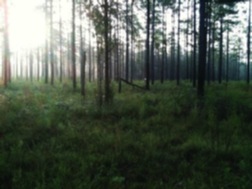
The sun rises over a rare remnant longleaf pine savanna, fueling a motley array of biological interactions.

We tested this idea by transplanting native plants into herbivore exclosures within longleaf pine stands on historic agricultural sites. In order to compare disturbed and undisturbed longleaf pine savannas, we also located several stands of remnant longleaf pine savanna. Because some of these stands experienced woody encroachment due to fire suppression, we crossed fire frequency with historical land use as a component of our experimental design. This created a gradient of degradation with either low or high fire frequency stands within post-agricultural or remnant woodlands.

After measuring herbivore density and herbivory rates on our experimental plants for a field season, we found that sites with low levels of plant cover supported small populations of herbivorous grasshoppers, which resulted in low herbivory rates on our experimental plants. These sites were usually degraded by historic agriculture and were extremely fire suppressed.

Hahn2

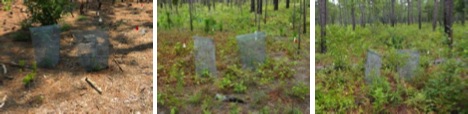
Sites representing the range of neighboring plant cover at our experimental sites. Insect exclosures or control cages (with holes) were placed over a set of experimental plants.


There were more grasshoppers at sites with extremely high levels of plant cover. Herbivory rates were expected to be higher at these sites because there were so many grasshoppers. As it turns out, herbivory rates were actually low because there were many more neighboring plants for grasshoppers to consume. In other words, high abundance of neighboring plants swamped out the negative effect of herbivory on the focal plants. These sites with low herbivory rates tended to be frequently burned remnant sites, meaning that remnant sites can support high populations of both plants and grasshoppers, while minimizing the negative effects that herbivores have on plants.

We found the greatest herbivory rates at intermediate levels of plant cover, where grasshoppers were also in intermediate abundance. These sites tended to historically be used for agricultural or were fire suppressed remnants. In other words, moderately degraded sites had the highest rates of herbivory.


Sites representing the range of neighboring plant cover at our experimental sites. Insect exclosures or control cages (with holes) were placed over a set of experimental plants.

Data being generated

By demonstrating that past and present human activities play a key role in present-day plant-herbivore interactions, our work has several important implications for basic and applied ecology. The findings provide a starting point to predict when and where herbivore density or neighboring plants will be important drivers of herbivory. The results also have implications for the recovery of biodiversity in post-agricultural lands and other systems affected by human disturbance by generating predictions about which habitat types will be more susceptible to herbivores.

Future NOW Updated for 2026


Featuring pioneering eco-spiritual presenters: Peter Owen Jones, Satish Kumar, Chloe Goodchild, Tim Freke and Joe Hoare.

The Future NOW conference and charity fundraiser brings leading eco and wellbeing thinkers, writers, performers and activists to Bristol’s Trinity Centre on Saturday 8th November (10am-5pm) to raise the debate about the future and explore urgent solutions and mindful steps for sustaining the Earth so we can secure bright, happy and sustainable future lives for our children and grandchildren on this planet.

Peter Owen Jones, maverick 21st Century priest, BBC TV explorer and keynote speaker for Future NOW, says:
Humanity is in the process of bequeathing a poisonous and broken planet to the next generation. The systems we have inherited from the past are simply unable to create a sustainable future. Whilst we are doubtless approaching an end of some sort we are also beginning at last to dream of what a new humanity and new Earth might contain.  Future NOW will explore all that we need to sustain a future for all the myriad of life on this beautiful planet.

Organised by leading edge speakers, communications and events agency Conscious Frontiers together with celebrated Laughter Yoga expert and author Joe Hoare, Future NOW was inspired by the burgeoning Spiritual Ecology movement which seeks a spiritual response to our current ecological crisis, urging us to reconnect with Mother Earth as a sacred living being to which we all belong, and to recognise the Earth as the source of all life, not a resource to be plundered.
 
Featuring groundbreaking presentations and powerful performances from ‘Extreme Pilgrim’ Peter Owen Jones, ‘Earth Pilgrim’ Satish Kumar, ‘Big Love Philosopher’ Tim Freke, ‘Sacred Voice Pioneer’ Chloe Goodchild and ‘Laughing Yogi’ Joe Hoare – as well as interactive breakout sessions exploring and reflecting on the question, “What can I do differently?” – Future NOW is a call to become more mindful, more peaceful, more connected and more loving to ourselves, to each other and to the Earth.

With our planet approaching tipping point, we are faced with potentially devastating climate change and environmental meltdown caused by our unsustainable, materialistic way of life, threatening us with natural disasters, famine, diseases, mass social upheaval and loss of life. World renowned Zen master Thich Nhat Hanh refers to these calamities as “Bells of Mindfulness” warning us to wake up and urgently consider our impact on the planet before it’s too late.

Will Gethin, Director of Conscious Frontiers says:
Future NOW is a response to this call of the Earth. it’s an invitation to take an active role in shaping a more sustainable and harmonious future – a future where our outmoded Western material dream is replaced by a new dream of mindfulness, kindness, interconnectedness and community.”

50% of the proceeds from Future NOW will be donated to the benevolent charities/causes of the keynote speakers: The Resurgence Trust, The Life Cairn Project, The Naked Voice and The Alliance for Lucid Living, all of which further the event’s aim to create a happier and more harmonious future for our planet (for further information visit the FutureNOW charity page).

Joe Hoare, co-organiser of Future NOW says:
“Throughout the conference, participants are invited to explore how we can each make a difference and take urgent action to be the change in our daily lives. Future NOW is an invitation to join the New Consciousness Revolution.”

Event details:
Date: Saturday 8th November, 10am-5pm
Venue: Trinity Centre, Trinity Road, Bristol, BS2 0NW

BOOKING INFORMATION:
Future NOW tickets cost £55 (£65 on the door). A limited number of Early Bird tickets are currently available. For further information and bookings visit FutureNow

Future NOW speakers and organisers are available for interview
For Media Enquiries please contact Will Gethin at Conscious Frontiers
07795 204 833 or email Will Gethin


385478