Tag Archives: warming

Coming soon: the ‘Big Heat’ Updated for 2026


Forget the so-called ‘pause’ in global warming-new research says we might be in for an era of deeply accelerated heating.

While the rate of atmospheric warming in recent years has, indeed, slowed due to various natural weather cycles – hence the skeptics’ droning on about ‘pauses’ – global warming, as a whole, has not stopped.

Far from it. It’s actually sped up, dramatically, as excess heat has absorbed into the oceans. We’ve only begun to realize the extent of this phenomenon in recent years, after scientists developed new technologies capable of measuring ocean temperatures with a depth and precision that was previously lacking.

In 2011, a paper in Geophysical Research Letters tallied up the total warming data from land, air, ice, and the oceans. In 2012, the lead author of that study, oceanographer John Church, updated his research. What Church found was shocking: in recent decades, climate change has been adding heat to the oceans at an average rate of 125 Terawatts (TW).

How to convey this extraordinary fact? His team came up with an analogy: it was roughly the same amount of energy that would be released by the detonation of two atomic bombs the size dropped on Hiroshima. In other words, these scientists found that anthropogenic climate is warming the oceans at a rate equivalent to around two Hiroshima bombs per second.

Or looked at another way, all the world’s coal fired power stations currently have a generation capacity a little under 2TW. As they are typically about one third efficient, working flat out they would collectively produce about 6TW of heat and power. Now multiply by 20.

Actually, it’s worse. Much worse …

But as new data came in, the situation has looked worse: over the last 17 years, the rate of warming has doubled to about four bombs per second. In 2013, the rate of warming tripled to become equivalent to 12 Hiroshima bombs every second.

So not only is warming intensifying, it is also accelerating. By burning fossil fuels, humans are effectively detonating 378 million atomic bombs in the oceans each year – this, along with the ocean’s over – absorption of carbon dioxide, has fuelled ocean acidification, and now threatens the entire marine food chain as well as animals who feed on marine species. Like, er, many humans.

According to a new paper in Science from a crack team of climate scientists, a key reason that the oceans are absorbing all this heat in recent decades so well (thus masking the extent of global warming by allowing atmospheric average temperatures to heat more slowly), is due to the Pacific Decadal Oscillation (PDO), an El Nino-like weather pattern that can last anywhere between 15-30 years.

In its previous positive phase, which ran from around 1977 to 1998, the PDO meant the oceans would absorb less heat, thus operating as an accelerator on atmospheric temperatures. Since 1998, the PDO has been in a largely negative phase, during which the oceans absorb more heat from the atmosphere.

Such decadal ocean cycles have broken down recently, and become more sporadic. The last, mostly negative phase, was punctuated by a brief positive phase that lasted 3 years between 2002 and 2005.

Where’s all the heat gone? Buried in the deep ocean

The authors of the new study, Penn State climatologist Michael Mann, University of Minnesota geologist Byron Steinman, and Penn State meteorologist Sonya Miller, point out that the PDO, as well as the Atlantic Multidecadal Oscillation (AMO), have thus played a major role in temporarily dampening atmospheric warming.

So what has happened? During this period, Mann and his team show, there has been increased “heat burial” in the Pacific ocean, that is, a greater absorption of all that heat equivalent to hundreds of millions of Hiroshimas.

For some, this has created the false impression, solely from looking at global average surface air temperatures, of a ‘pause’ in warming. But as Mann said, the combination of the AMO and PDO “likely offset anthropogenic warming over the past decade.”

Therefore, the ‘pause’ doesn’t really exist, and instead is an artifact of the limitations of our different measuring instruments.

“The ‘false pause’ is explained in part by cooling in the Pacific ocean over the past one-to-two decades”, Mann told me, “but that is likely to reverse soon: in other words, the ‘slowdown’ is fleeting and will likely soon disappear.”

The disappearance of the ‘slowdown’ will, in tangible terms, mean that the oceans will absorb less atmospheric heat. While all the accumulated ocean heat “is certainly not going to pop back out”, NASA’s chief climate scientist Dr. Gavin Schmidt told me, it is likely to mean that less atmospheric heat will end up being absorbed:

“Ocean cycles can modulate the uptake of anthropogenic heat, as some have speculated for the last decade or so, but … net flux is still going to be going into the ocean.”

Next, the heat will transfer to the atmosphere

According to Mann and his team, at some point, this will manifest as an acceleration in the rise of global average surface air temperatures. In their Science study, they observe:

“Given the pattern of past historical variation, this trend will likely reverse with internal variability, instead adding to anthropogenic warming in the coming decades.”

So at some point in the near future, the PDO will switch from its current negative phase back to positive, reducing the capacity of the oceans to accumulate heat from the atmosphere.

That positive phase of the PDO will therefore see a rapid rise in global surface air temperatures, as the oceans’ capacity to absorb all those Hiroshima bomb equivalents declines – and leaves it to accumulate in our skies. In other words, after years of slower-than-expected warming, we may suddenly feel the heat.

So when will that happen? No one knows for sure, but at the end of last year, signs emerged that the phase shift to a positive PDO could be happening right now. In the five months before November 2014, measures of surface temperature differences in the Pacific shifted to positive, according to the National Oceanic and Atmospheric Administration.

This is the longest such positive shift detected in about 12 years. Although too soon to determine for sure whether this is, indeed, the beginning of the PDO’s switch to a new positive phase, this interpretation is consistent with current temperature variations, which during a positive PDO phase should be relatively warm in the tropical Pacific and relatively cool in regions north of about 20 degrees latitude.

In January 2015, further signs emerged that the PDO is right now in transition to a new warm phase. “Global warming is about the get a boost”, ventured meteorologist Eric Holthaus. Recent data including California’s intensifying drought and sightings of tropical fish off the Alaskan coast “are further evidence of unusual ocean warming”, suggesting that a PDO transition “may already be underway a new warm phase.”

While it’s still not clear whether the PDO is really shifting into a new phase just yet, when it does, it won’t be good. Scientists from the UK Met Office’s Hadley Center led by Dr. Chris Roberts of the Oceans and Cryosphere Group estimate in a new paper in Nature that there is an 85% chance the faux ‘pause’ will end in the next five years, followed by a burst of warming likely to consist of a decade or so of warm ocean oscillations.

Arctic faces a double warming whammy

Roberts and his team found that a ‘slow down’ period is usually (60% of the time) followed by rapid warming at twice the background rate for at least five years, and potentially longer.

And mostly, this warming would be concentrated in the Arctic, a region where temperatures are already higher than the global average, and which is widely recognized to be a barometer of the health of the global climate due to how Arctic changes dramatically alter trends elsewhere.

Recent extreme weather events around the world have been attributed to the melting Arctic ice sheets and the impact on ocean circulations and jet streams.

What this means, if the UK Met Office is right, is that we probably have five years (likely less) before we witness the ‘Big Heat’ – a supercharged surge of rapid global warming that could last a decade, further destabilizing the climate system in deeply unpredictable ways.


Dr. Nafeez Ahmed is an investigative journalist, bestselling author, and international security scholar. He is a regular contributor to The Ecologist where he writes about the geopolitics of interconnected environmental, energy and economic crises. He has also written for the Guardian, The Independent, Sydney Morning Herald, The Age, The Scotsman, Foreign Policy, Prospect, New Statesman, Vice, Le Monde diplomatique, among many others. His new novel of the near future is ZERO POINT.

Follow him on Twitter @nafeezahmed and Facebook.

Website: www.nafeezahmed.com

This article was originally published on Vice magazine’s Motherboard.


390917

Coming soon: the ‘Big Heat’ Updated for 2026


Forget the so-called ‘pause’ in global warming-new research says we might be in for an era of deeply accelerated heating.

While the rate of atmospheric warming in recent years has, indeed, slowed due to various natural weather cycles – hence the skeptics’ droning on about ‘pauses’ – global warming, as a whole, has not stopped.

Far from it. It’s actually sped up, dramatically, as excess heat has absorbed into the oceans. We’ve only begun to realize the extent of this phenomenon in recent years, after scientists developed new technologies capable of measuring ocean temperatures with a depth and precision that was previously lacking.

In 2011, a paper in Geophysical Research Letters tallied up the total warming data from land, air, ice, and the oceans. In 2012, the lead author of that study, oceanographer John Church, updated his research. What Church found was shocking: in recent decades, climate change has been adding heat to the oceans at an average rate of 125 Terawatts (TW).

How to convey this extraordinary fact? His team came up with an analogy: it was roughly the same amount of energy that would be released by the detonation of two atomic bombs the size dropped on Hiroshima. In other words, these scientists found that anthropogenic climate is warming the oceans at a rate equivalent to around two Hiroshima bombs per second.

Or looked at another way, all the world’s coal fired power stations currently have a generation capacity a little under 2TW. As they are typically about one third efficient, working flat out they would collectively produce about 6TW of heat and power. Now multiply by 20.

Actually, it’s worse. Much worse …

But as new data came in, the situation has looked worse: over the last 17 years, the rate of warming has doubled to about four bombs per second. In 2013, the rate of warming tripled to become equivalent to 12 Hiroshima bombs every second.

So not only is warming intensifying, it is also accelerating. By burning fossil fuels, humans are effectively detonating 378 million atomic bombs in the oceans each year – this, along with the ocean’s over – absorption of carbon dioxide, has fuelled ocean acidification, and now threatens the entire marine food chain as well as animals who feed on marine species. Like, er, many humans.

According to a new paper in Science from a crack team of climate scientists, a key reason that the oceans are absorbing all this heat in recent decades so well (thus masking the extent of global warming by allowing atmospheric average temperatures to heat more slowly), is due to the Pacific Decadal Oscillation (PDO), an El Nino-like weather pattern that can last anywhere between 15-30 years.

In its previous positive phase, which ran from around 1977 to 1998, the PDO meant the oceans would absorb less heat, thus operating as an accelerator on atmospheric temperatures. Since 1998, the PDO has been in a largely negative phase, during which the oceans absorb more heat from the atmosphere.

Such decadal ocean cycles have broken down recently, and become more sporadic. The last, mostly negative phase, was punctuated by a brief positive phase that lasted 3 years between 2002 and 2005.

Where’s all the heat gone? Buried in the deep ocean

The authors of the new study, Penn State climatologist Michael Mann, University of Minnesota geologist Byron Steinman, and Penn State meteorologist Sonya Miller, point out that the PDO, as well as the Atlantic Multidecadal Oscillation (AMO), have thus played a major role in temporarily dampening atmospheric warming.

So what has happened? During this period, Mann and his team show, there has been increased “heat burial” in the Pacific ocean, that is, a greater absorption of all that heat equivalent to hundreds of millions of Hiroshimas.

For some, this has created the false impression, solely from looking at global average surface air temperatures, of a ‘pause’ in warming. But as Mann said, the combination of the AMO and PDO “likely offset anthropogenic warming over the past decade.”

Therefore, the ‘pause’ doesn’t really exist, and instead is an artifact of the limitations of our different measuring instruments.

“The ‘false pause’ is explained in part by cooling in the Pacific ocean over the past one-to-two decades”, Mann told me, “but that is likely to reverse soon: in other words, the ‘slowdown’ is fleeting and will likely soon disappear.”

The disappearance of the ‘slowdown’ will, in tangible terms, mean that the oceans will absorb less atmospheric heat. While all the accumulated ocean heat “is certainly not going to pop back out”, NASA’s chief climate scientist Dr. Gavin Schmidt told me, it is likely to mean that less atmospheric heat will end up being absorbed:

“Ocean cycles can modulate the uptake of anthropogenic heat, as some have speculated for the last decade or so, but … net flux is still going to be going into the ocean.”

Next, the heat will transfer to the atmosphere

According to Mann and his team, at some point, this will manifest as an acceleration in the rise of global average surface air temperatures. In their Science study, they observe:

“Given the pattern of past historical variation, this trend will likely reverse with internal variability, instead adding to anthropogenic warming in the coming decades.”

So at some point in the near future, the PDO will switch from its current negative phase back to positive, reducing the capacity of the oceans to accumulate heat from the atmosphere.

That positive phase of the PDO will therefore see a rapid rise in global surface air temperatures, as the oceans’ capacity to absorb all those Hiroshima bomb equivalents declines – and leaves it to accumulate in our skies. In other words, after years of slower-than-expected warming, we may suddenly feel the heat.

So when will that happen? No one knows for sure, but at the end of last year, signs emerged that the phase shift to a positive PDO could be happening right now. In the five months before November 2014, measures of surface temperature differences in the Pacific shifted to positive, according to the National Oceanic and Atmospheric Administration.

This is the longest such positive shift detected in about 12 years. Although too soon to determine for sure whether this is, indeed, the beginning of the PDO’s switch to a new positive phase, this interpretation is consistent with current temperature variations, which during a positive PDO phase should be relatively warm in the tropical Pacific and relatively cool in regions north of about 20 degrees latitude.

In January 2015, further signs emerged that the PDO is right now in transition to a new warm phase. “Global warming is about the get a boost”, ventured meteorologist Eric Holthaus. Recent data including California’s intensifying drought and sightings of tropical fish off the Alaskan coast “are further evidence of unusual ocean warming”, suggesting that a PDO transition “may already be underway a new warm phase.”

While it’s still not clear whether the PDO is really shifting into a new phase just yet, when it does, it won’t be good. Scientists from the UK Met Office’s Hadley Center led by Dr. Chris Roberts of the Oceans and Cryosphere Group estimate in a new paper in Nature that there is an 85% chance the faux ‘pause’ will end in the next five years, followed by a burst of warming likely to consist of a decade or so of warm ocean oscillations.

Arctic faces a double warming whammy

Roberts and his team found that a ‘slow down’ period is usually (60% of the time) followed by rapid warming at twice the background rate for at least five years, and potentially longer.

And mostly, this warming would be concentrated in the Arctic, a region where temperatures are already higher than the global average, and which is widely recognized to be a barometer of the health of the global climate due to how Arctic changes dramatically alter trends elsewhere.

Recent extreme weather events around the world have been attributed to the melting Arctic ice sheets and the impact on ocean circulations and jet streams.

What this means, if the UK Met Office is right, is that we probably have five years (likely less) before we witness the ‘Big Heat’ – a supercharged surge of rapid global warming that could last a decade, further destabilizing the climate system in deeply unpredictable ways.


Dr. Nafeez Ahmed is an investigative journalist, bestselling author, and international security scholar. He is a regular contributor to The Ecologist where he writes about the geopolitics of interconnected environmental, energy and economic crises. He has also written for the Guardian, The Independent, Sydney Morning Herald, The Age, The Scotsman, Foreign Policy, Prospect, New Statesman, Vice, Le Monde diplomatique, among many others. His new novel of the near future is ZERO POINT.

Follow him on Twitter @nafeezahmed and Facebook.

Website: www.nafeezahmed.com

This article was originally published on Vice magazine’s Motherboard.


390917

Coming soon: the ‘Big Heat’ Updated for 2026


Forget the so-called ‘pause’ in global warming-new research says we might be in for an era of deeply accelerated heating.

While the rate of atmospheric warming in recent years has, indeed, slowed due to various natural weather cycles – hence the skeptics’ droning on about ‘pauses’ – global warming, as a whole, has not stopped.

Far from it. It’s actually sped up, dramatically, as excess heat has absorbed into the oceans. We’ve only begun to realize the extent of this phenomenon in recent years, after scientists developed new technologies capable of measuring ocean temperatures with a depth and precision that was previously lacking.

In 2011, a paper in Geophysical Research Letters tallied up the total warming data from land, air, ice, and the oceans. In 2012, the lead author of that study, oceanographer John Church, updated his research. What Church found was shocking: in recent decades, climate change has been adding heat to the oceans at an average rate of 125 Terawatts (TW).

How to convey this extraordinary fact? His team came up with an analogy: it was roughly the same amount of energy that would be released by the detonation of two atomic bombs the size dropped on Hiroshima. In other words, these scientists found that anthropogenic climate is warming the oceans at a rate equivalent to around two Hiroshima bombs per second.

Or looked at another way, all the world’s coal fired power stations currently have a generation capacity a little under 2TW. As they are typically about one third efficient, working flat out they would collectively produce about 6TW of heat and power. Now multiply by 20.

Actually, it’s worse. Much worse …

But as new data came in, the situation has looked worse: over the last 17 years, the rate of warming has doubled to about four bombs per second. In 2013, the rate of warming tripled to become equivalent to 12 Hiroshima bombs every second.

So not only is warming intensifying, it is also accelerating. By burning fossil fuels, humans are effectively detonating 378 million atomic bombs in the oceans each year – this, along with the ocean’s over – absorption of carbon dioxide, has fuelled ocean acidification, and now threatens the entire marine food chain as well as animals who feed on marine species. Like, er, many humans.

According to a new paper in Science from a crack team of climate scientists, a key reason that the oceans are absorbing all this heat in recent decades so well (thus masking the extent of global warming by allowing atmospheric average temperatures to heat more slowly), is due to the Pacific Decadal Oscillation (PDO), an El Nino-like weather pattern that can last anywhere between 15-30 years.

In its previous positive phase, which ran from around 1977 to 1998, the PDO meant the oceans would absorb less heat, thus operating as an accelerator on atmospheric temperatures. Since 1998, the PDO has been in a largely negative phase, during which the oceans absorb more heat from the atmosphere.

Such decadal ocean cycles have broken down recently, and become more sporadic. The last, mostly negative phase, was punctuated by a brief positive phase that lasted 3 years between 2002 and 2005.

Where’s all the heat gone? Buried in the deep ocean

The authors of the new study, Penn State climatologist Michael Mann, University of Minnesota geologist Byron Steinman, and Penn State meteorologist Sonya Miller, point out that the PDO, as well as the Atlantic Multidecadal Oscillation (AMO), have thus played a major role in temporarily dampening atmospheric warming.

So what has happened? During this period, Mann and his team show, there has been increased “heat burial” in the Pacific ocean, that is, a greater absorption of all that heat equivalent to hundreds of millions of Hiroshimas.

For some, this has created the false impression, solely from looking at global average surface air temperatures, of a ‘pause’ in warming. But as Mann said, the combination of the AMO and PDO “likely offset anthropogenic warming over the past decade.”

Therefore, the ‘pause’ doesn’t really exist, and instead is an artifact of the limitations of our different measuring instruments.

“The ‘false pause’ is explained in part by cooling in the Pacific ocean over the past one-to-two decades”, Mann told me, “but that is likely to reverse soon: in other words, the ‘slowdown’ is fleeting and will likely soon disappear.”

The disappearance of the ‘slowdown’ will, in tangible terms, mean that the oceans will absorb less atmospheric heat. While all the accumulated ocean heat “is certainly not going to pop back out”, NASA’s chief climate scientist Dr. Gavin Schmidt told me, it is likely to mean that less atmospheric heat will end up being absorbed:

“Ocean cycles can modulate the uptake of anthropogenic heat, as some have speculated for the last decade or so, but … net flux is still going to be going into the ocean.”

Next, the heat will transfer to the atmosphere

According to Mann and his team, at some point, this will manifest as an acceleration in the rise of global average surface air temperatures. In their Science study, they observe:

“Given the pattern of past historical variation, this trend will likely reverse with internal variability, instead adding to anthropogenic warming in the coming decades.”

So at some point in the near future, the PDO will switch from its current negative phase back to positive, reducing the capacity of the oceans to accumulate heat from the atmosphere.

That positive phase of the PDO will therefore see a rapid rise in global surface air temperatures, as the oceans’ capacity to absorb all those Hiroshima bomb equivalents declines – and leaves it to accumulate in our skies. In other words, after years of slower-than-expected warming, we may suddenly feel the heat.

So when will that happen? No one knows for sure, but at the end of last year, signs emerged that the phase shift to a positive PDO could be happening right now. In the five months before November 2014, measures of surface temperature differences in the Pacific shifted to positive, according to the National Oceanic and Atmospheric Administration.

This is the longest such positive shift detected in about 12 years. Although too soon to determine for sure whether this is, indeed, the beginning of the PDO’s switch to a new positive phase, this interpretation is consistent with current temperature variations, which during a positive PDO phase should be relatively warm in the tropical Pacific and relatively cool in regions north of about 20 degrees latitude.

In January 2015, further signs emerged that the PDO is right now in transition to a new warm phase. “Global warming is about the get a boost”, ventured meteorologist Eric Holthaus. Recent data including California’s intensifying drought and sightings of tropical fish off the Alaskan coast “are further evidence of unusual ocean warming”, suggesting that a PDO transition “may already be underway a new warm phase.”

While it’s still not clear whether the PDO is really shifting into a new phase just yet, when it does, it won’t be good. Scientists from the UK Met Office’s Hadley Center led by Dr. Chris Roberts of the Oceans and Cryosphere Group estimate in a new paper in Nature that there is an 85% chance the faux ‘pause’ will end in the next five years, followed by a burst of warming likely to consist of a decade or so of warm ocean oscillations.

Arctic faces a double warming whammy

Roberts and his team found that a ‘slow down’ period is usually (60% of the time) followed by rapid warming at twice the background rate for at least five years, and potentially longer.

And mostly, this warming would be concentrated in the Arctic, a region where temperatures are already higher than the global average, and which is widely recognized to be a barometer of the health of the global climate due to how Arctic changes dramatically alter trends elsewhere.

Recent extreme weather events around the world have been attributed to the melting Arctic ice sheets and the impact on ocean circulations and jet streams.

What this means, if the UK Met Office is right, is that we probably have five years (likely less) before we witness the ‘Big Heat’ – a supercharged surge of rapid global warming that could last a decade, further destabilizing the climate system in deeply unpredictable ways.


Dr. Nafeez Ahmed is an investigative journalist, bestselling author, and international security scholar. He is a regular contributor to The Ecologist where he writes about the geopolitics of interconnected environmental, energy and economic crises. He has also written for the Guardian, The Independent, Sydney Morning Herald, The Age, The Scotsman, Foreign Policy, Prospect, New Statesman, Vice, Le Monde diplomatique, among many others. His new novel of the near future is ZERO POINT.

Follow him on Twitter @nafeezahmed and Facebook.

Website: www.nafeezahmed.com

This article was originally published on Vice magazine’s Motherboard.


390917

Coming soon: the ‘Big Heat’ Updated for 2026


Forget the so-called ‘pause’ in global warming-new research says we might be in for an era of deeply accelerated heating.

While the rate of atmospheric warming in recent years has, indeed, slowed due to various natural weather cycles – hence the skeptics’ droning on about ‘pauses’ – global warming, as a whole, has not stopped.

Far from it. It’s actually sped up, dramatically, as excess heat has absorbed into the oceans. We’ve only begun to realize the extent of this phenomenon in recent years, after scientists developed new technologies capable of measuring ocean temperatures with a depth and precision that was previously lacking.

In 2011, a paper in Geophysical Research Letters tallied up the total warming data from land, air, ice, and the oceans. In 2012, the lead author of that study, oceanographer John Church, updated his research. What Church found was shocking: in recent decades, climate change has been adding heat to the oceans at an average rate of 125 Terawatts (TW).

How to convey this extraordinary fact? His team came up with an analogy: it was roughly the same amount of energy that would be released by the detonation of two atomic bombs the size dropped on Hiroshima. In other words, these scientists found that anthropogenic climate is warming the oceans at a rate equivalent to around two Hiroshima bombs per second.

Or looked at another way, all the world’s coal fired power stations currently have a generation capacity a little under 2TW. As they are typically about one third efficient, working flat out they would collectively produce about 6TW of heat and power. Now multiply by 20.

Actually, it’s worse. Much worse …

But as new data came in, the situation has looked worse: over the last 17 years, the rate of warming has doubled to about four bombs per second. In 2013, the rate of warming tripled to become equivalent to 12 Hiroshima bombs every second.

So not only is warming intensifying, it is also accelerating. By burning fossil fuels, humans are effectively detonating 378 million atomic bombs in the oceans each year – this, along with the ocean’s over – absorption of carbon dioxide, has fuelled ocean acidification, and now threatens the entire marine food chain as well as animals who feed on marine species. Like, er, many humans.

According to a new paper in Science from a crack team of climate scientists, a key reason that the oceans are absorbing all this heat in recent decades so well (thus masking the extent of global warming by allowing atmospheric average temperatures to heat more slowly), is due to the Pacific Decadal Oscillation (PDO), an El Nino-like weather pattern that can last anywhere between 15-30 years.

In its previous positive phase, which ran from around 1977 to 1998, the PDO meant the oceans would absorb less heat, thus operating as an accelerator on atmospheric temperatures. Since 1998, the PDO has been in a largely negative phase, during which the oceans absorb more heat from the atmosphere.

Such decadal ocean cycles have broken down recently, and become more sporadic. The last, mostly negative phase, was punctuated by a brief positive phase that lasted 3 years between 2002 and 2005.

Where’s all the heat gone? Buried in the deep ocean

The authors of the new study, Penn State climatologist Michael Mann, University of Minnesota geologist Byron Steinman, and Penn State meteorologist Sonya Miller, point out that the PDO, as well as the Atlantic Multidecadal Oscillation (AMO), have thus played a major role in temporarily dampening atmospheric warming.

So what has happened? During this period, Mann and his team show, there has been increased “heat burial” in the Pacific ocean, that is, a greater absorption of all that heat equivalent to hundreds of millions of Hiroshimas.

For some, this has created the false impression, solely from looking at global average surface air temperatures, of a ‘pause’ in warming. But as Mann said, the combination of the AMO and PDO “likely offset anthropogenic warming over the past decade.”

Therefore, the ‘pause’ doesn’t really exist, and instead is an artifact of the limitations of our different measuring instruments.

“The ‘false pause’ is explained in part by cooling in the Pacific ocean over the past one-to-two decades”, Mann told me, “but that is likely to reverse soon: in other words, the ‘slowdown’ is fleeting and will likely soon disappear.”

The disappearance of the ‘slowdown’ will, in tangible terms, mean that the oceans will absorb less atmospheric heat. While all the accumulated ocean heat “is certainly not going to pop back out”, NASA’s chief climate scientist Dr. Gavin Schmidt told me, it is likely to mean that less atmospheric heat will end up being absorbed:

“Ocean cycles can modulate the uptake of anthropogenic heat, as some have speculated for the last decade or so, but … net flux is still going to be going into the ocean.”

Next, the heat will transfer to the atmosphere

According to Mann and his team, at some point, this will manifest as an acceleration in the rise of global average surface air temperatures. In their Science study, they observe:

“Given the pattern of past historical variation, this trend will likely reverse with internal variability, instead adding to anthropogenic warming in the coming decades.”

So at some point in the near future, the PDO will switch from its current negative phase back to positive, reducing the capacity of the oceans to accumulate heat from the atmosphere.

That positive phase of the PDO will therefore see a rapid rise in global surface air temperatures, as the oceans’ capacity to absorb all those Hiroshima bomb equivalents declines – and leaves it to accumulate in our skies. In other words, after years of slower-than-expected warming, we may suddenly feel the heat.

So when will that happen? No one knows for sure, but at the end of last year, signs emerged that the phase shift to a positive PDO could be happening right now. In the five months before November 2014, measures of surface temperature differences in the Pacific shifted to positive, according to the National Oceanic and Atmospheric Administration.

This is the longest such positive shift detected in about 12 years. Although too soon to determine for sure whether this is, indeed, the beginning of the PDO’s switch to a new positive phase, this interpretation is consistent with current temperature variations, which during a positive PDO phase should be relatively warm in the tropical Pacific and relatively cool in regions north of about 20 degrees latitude.

In January 2015, further signs emerged that the PDO is right now in transition to a new warm phase. “Global warming is about the get a boost”, ventured meteorologist Eric Holthaus. Recent data including California’s intensifying drought and sightings of tropical fish off the Alaskan coast “are further evidence of unusual ocean warming”, suggesting that a PDO transition “may already be underway a new warm phase.”

While it’s still not clear whether the PDO is really shifting into a new phase just yet, when it does, it won’t be good. Scientists from the UK Met Office’s Hadley Center led by Dr. Chris Roberts of the Oceans and Cryosphere Group estimate in a new paper in Nature that there is an 85% chance the faux ‘pause’ will end in the next five years, followed by a burst of warming likely to consist of a decade or so of warm ocean oscillations.

Arctic faces a double warming whammy

Roberts and his team found that a ‘slow down’ period is usually (60% of the time) followed by rapid warming at twice the background rate for at least five years, and potentially longer.

And mostly, this warming would be concentrated in the Arctic, a region where temperatures are already higher than the global average, and which is widely recognized to be a barometer of the health of the global climate due to how Arctic changes dramatically alter trends elsewhere.

Recent extreme weather events around the world have been attributed to the melting Arctic ice sheets and the impact on ocean circulations and jet streams.

What this means, if the UK Met Office is right, is that we probably have five years (likely less) before we witness the ‘Big Heat’ – a supercharged surge of rapid global warming that could last a decade, further destabilizing the climate system in deeply unpredictable ways.


Dr. Nafeez Ahmed is an investigative journalist, bestselling author, and international security scholar. He is a regular contributor to The Ecologist where he writes about the geopolitics of interconnected environmental, energy and economic crises. He has also written for the Guardian, The Independent, Sydney Morning Herald, The Age, The Scotsman, Foreign Policy, Prospect, New Statesman, Vice, Le Monde diplomatique, among many others. His new novel of the near future is ZERO POINT.

Follow him on Twitter @nafeezahmed and Facebook.

Website: www.nafeezahmed.com

This article was originally published on Vice magazine’s Motherboard.


390917

Coming soon: the ‘Big Heat’ Updated for 2026


Forget the so-called ‘pause’ in global warming-new research says we might be in for an era of deeply accelerated heating.

While the rate of atmospheric warming in recent years has, indeed, slowed due to various natural weather cycles – hence the skeptics’ droning on about ‘pauses’ – global warming, as a whole, has not stopped.

Far from it. It’s actually sped up, dramatically, as excess heat has absorbed into the oceans. We’ve only begun to realize the extent of this phenomenon in recent years, after scientists developed new technologies capable of measuring ocean temperatures with a depth and precision that was previously lacking.

In 2011, a paper in Geophysical Research Letters tallied up the total warming data from land, air, ice, and the oceans. In 2012, the lead author of that study, oceanographer John Church, updated his research. What Church found was shocking: in recent decades, climate change has been adding heat to the oceans at an average rate of 125 Terawatts (TW).

How to convey this extraordinary fact? His team came up with an analogy: it was roughly the same amount of energy that would be released by the detonation of two atomic bombs the size dropped on Hiroshima. In other words, these scientists found that anthropogenic climate is warming the oceans at a rate equivalent to around two Hiroshima bombs per second.

Or looked at another way, all the world’s coal fired power stations currently have a generation capacity a little under 2TW. As they are typically about one third efficient, working flat out they would collectively produce about 6TW of heat and power. Now multiply by 20.

Actually, it’s worse. Much worse …

But as new data came in, the situation has looked worse: over the last 17 years, the rate of warming has doubled to about four bombs per second. In 2013, the rate of warming tripled to become equivalent to 12 Hiroshima bombs every second.

So not only is warming intensifying, it is also accelerating. By burning fossil fuels, humans are effectively detonating 378 million atomic bombs in the oceans each year – this, along with the ocean’s over – absorption of carbon dioxide, has fuelled ocean acidification, and now threatens the entire marine food chain as well as animals who feed on marine species. Like, er, many humans.

According to a new paper in Science from a crack team of climate scientists, a key reason that the oceans are absorbing all this heat in recent decades so well (thus masking the extent of global warming by allowing atmospheric average temperatures to heat more slowly), is due to the Pacific Decadal Oscillation (PDO), an El Nino-like weather pattern that can last anywhere between 15-30 years.

In its previous positive phase, which ran from around 1977 to 1998, the PDO meant the oceans would absorb less heat, thus operating as an accelerator on atmospheric temperatures. Since 1998, the PDO has been in a largely negative phase, during which the oceans absorb more heat from the atmosphere.

Such decadal ocean cycles have broken down recently, and become more sporadic. The last, mostly negative phase, was punctuated by a brief positive phase that lasted 3 years between 2002 and 2005.

Where’s all the heat gone? Buried in the deep ocean

The authors of the new study, Penn State climatologist Michael Mann, University of Minnesota geologist Byron Steinman, and Penn State meteorologist Sonya Miller, point out that the PDO, as well as the Atlantic Multidecadal Oscillation (AMO), have thus played a major role in temporarily dampening atmospheric warming.

So what has happened? During this period, Mann and his team show, there has been increased “heat burial” in the Pacific ocean, that is, a greater absorption of all that heat equivalent to hundreds of millions of Hiroshimas.

For some, this has created the false impression, solely from looking at global average surface air temperatures, of a ‘pause’ in warming. But as Mann said, the combination of the AMO and PDO “likely offset anthropogenic warming over the past decade.”

Therefore, the ‘pause’ doesn’t really exist, and instead is an artifact of the limitations of our different measuring instruments.

“The ‘false pause’ is explained in part by cooling in the Pacific ocean over the past one-to-two decades”, Mann told me, “but that is likely to reverse soon: in other words, the ‘slowdown’ is fleeting and will likely soon disappear.”

The disappearance of the ‘slowdown’ will, in tangible terms, mean that the oceans will absorb less atmospheric heat. While all the accumulated ocean heat “is certainly not going to pop back out”, NASA’s chief climate scientist Dr. Gavin Schmidt told me, it is likely to mean that less atmospheric heat will end up being absorbed:

“Ocean cycles can modulate the uptake of anthropogenic heat, as some have speculated for the last decade or so, but … net flux is still going to be going into the ocean.”

Next, the heat will transfer to the atmosphere

According to Mann and his team, at some point, this will manifest as an acceleration in the rise of global average surface air temperatures. In their Science study, they observe:

“Given the pattern of past historical variation, this trend will likely reverse with internal variability, instead adding to anthropogenic warming in the coming decades.”

So at some point in the near future, the PDO will switch from its current negative phase back to positive, reducing the capacity of the oceans to accumulate heat from the atmosphere.

That positive phase of the PDO will therefore see a rapid rise in global surface air temperatures, as the oceans’ capacity to absorb all those Hiroshima bomb equivalents declines – and leaves it to accumulate in our skies. In other words, after years of slower-than-expected warming, we may suddenly feel the heat.

So when will that happen? No one knows for sure, but at the end of last year, signs emerged that the phase shift to a positive PDO could be happening right now. In the five months before November 2014, measures of surface temperature differences in the Pacific shifted to positive, according to the National Oceanic and Atmospheric Administration.

This is the longest such positive shift detected in about 12 years. Although too soon to determine for sure whether this is, indeed, the beginning of the PDO’s switch to a new positive phase, this interpretation is consistent with current temperature variations, which during a positive PDO phase should be relatively warm in the tropical Pacific and relatively cool in regions north of about 20 degrees latitude.

In January 2015, further signs emerged that the PDO is right now in transition to a new warm phase. “Global warming is about the get a boost”, ventured meteorologist Eric Holthaus. Recent data including California’s intensifying drought and sightings of tropical fish off the Alaskan coast “are further evidence of unusual ocean warming”, suggesting that a PDO transition “may already be underway a new warm phase.”

While it’s still not clear whether the PDO is really shifting into a new phase just yet, when it does, it won’t be good. Scientists from the UK Met Office’s Hadley Center led by Dr. Chris Roberts of the Oceans and Cryosphere Group estimate in a new paper in Nature that there is an 85% chance the faux ‘pause’ will end in the next five years, followed by a burst of warming likely to consist of a decade or so of warm ocean oscillations.

Arctic faces a double warming whammy

Roberts and his team found that a ‘slow down’ period is usually (60% of the time) followed by rapid warming at twice the background rate for at least five years, and potentially longer.

And mostly, this warming would be concentrated in the Arctic, a region where temperatures are already higher than the global average, and which is widely recognized to be a barometer of the health of the global climate due to how Arctic changes dramatically alter trends elsewhere.

Recent extreme weather events around the world have been attributed to the melting Arctic ice sheets and the impact on ocean circulations and jet streams.

What this means, if the UK Met Office is right, is that we probably have five years (likely less) before we witness the ‘Big Heat’ – a supercharged surge of rapid global warming that could last a decade, further destabilizing the climate system in deeply unpredictable ways.


Dr. Nafeez Ahmed is an investigative journalist, bestselling author, and international security scholar. He is a regular contributor to The Ecologist where he writes about the geopolitics of interconnected environmental, energy and economic crises. He has also written for the Guardian, The Independent, Sydney Morning Herald, The Age, The Scotsman, Foreign Policy, Prospect, New Statesman, Vice, Le Monde diplomatique, among many others. His new novel of the near future is ZERO POINT.

Follow him on Twitter @nafeezahmed and Facebook.

Website: www.nafeezahmed.com

This article was originally published on Vice magazine’s Motherboard.


390917

Coming soon: the ‘Big Heat’ Updated for 2026


Forget the so-called ‘pause’ in global warming-new research says we might be in for an era of deeply accelerated heating.

While the rate of atmospheric warming in recent years has, indeed, slowed due to various natural weather cycles – hence the skeptics’ droning on about ‘pauses’ – global warming, as a whole, has not stopped.

Far from it. It’s actually sped up, dramatically, as excess heat has absorbed into the oceans. We’ve only begun to realize the extent of this phenomenon in recent years, after scientists developed new technologies capable of measuring ocean temperatures with a depth and precision that was previously lacking.

In 2011, a paper in Geophysical Research Letters tallied up the total warming data from land, air, ice, and the oceans. In 2012, the lead author of that study, oceanographer John Church, updated his research. What Church found was shocking: in recent decades, climate change has been adding heat to the oceans at an average rate of 125 Terawatts (TW).

How to convey this extraordinary fact? His team came up with an analogy: it was roughly the same amount of energy that would be released by the detonation of two atomic bombs the size dropped on Hiroshima. In other words, these scientists found that anthropogenic climate is warming the oceans at a rate equivalent to around two Hiroshima bombs per second.

Or looked at another way, all the world’s coal fired power stations currently have a generation capacity a little under 2TW. As they are typically about one third efficient, working flat out they would collectively produce about 6TW of heat and power. Now multiply by 20.

Actually, it’s worse. Much worse …

But as new data came in, the situation has looked worse: over the last 17 years, the rate of warming has doubled to about four bombs per second. In 2013, the rate of warming tripled to become equivalent to 12 Hiroshima bombs every second.

So not only is warming intensifying, it is also accelerating. By burning fossil fuels, humans are effectively detonating 378 million atomic bombs in the oceans each year – this, along with the ocean’s over – absorption of carbon dioxide, has fuelled ocean acidification, and now threatens the entire marine food chain as well as animals who feed on marine species. Like, er, many humans.

According to a new paper in Science from a crack team of climate scientists, a key reason that the oceans are absorbing all this heat in recent decades so well (thus masking the extent of global warming by allowing atmospheric average temperatures to heat more slowly), is due to the Pacific Decadal Oscillation (PDO), an El Nino-like weather pattern that can last anywhere between 15-30 years.

In its previous positive phase, which ran from around 1977 to 1998, the PDO meant the oceans would absorb less heat, thus operating as an accelerator on atmospheric temperatures. Since 1998, the PDO has been in a largely negative phase, during which the oceans absorb more heat from the atmosphere.

Such decadal ocean cycles have broken down recently, and become more sporadic. The last, mostly negative phase, was punctuated by a brief positive phase that lasted 3 years between 2002 and 2005.

Where’s all the heat gone? Buried in the deep ocean

The authors of the new study, Penn State climatologist Michael Mann, University of Minnesota geologist Byron Steinman, and Penn State meteorologist Sonya Miller, point out that the PDO, as well as the Atlantic Multidecadal Oscillation (AMO), have thus played a major role in temporarily dampening atmospheric warming.

So what has happened? During this period, Mann and his team show, there has been increased “heat burial” in the Pacific ocean, that is, a greater absorption of all that heat equivalent to hundreds of millions of Hiroshimas.

For some, this has created the false impression, solely from looking at global average surface air temperatures, of a ‘pause’ in warming. But as Mann said, the combination of the AMO and PDO “likely offset anthropogenic warming over the past decade.”

Therefore, the ‘pause’ doesn’t really exist, and instead is an artifact of the limitations of our different measuring instruments.

“The ‘false pause’ is explained in part by cooling in the Pacific ocean over the past one-to-two decades”, Mann told me, “but that is likely to reverse soon: in other words, the ‘slowdown’ is fleeting and will likely soon disappear.”

The disappearance of the ‘slowdown’ will, in tangible terms, mean that the oceans will absorb less atmospheric heat. While all the accumulated ocean heat “is certainly not going to pop back out”, NASA’s chief climate scientist Dr. Gavin Schmidt told me, it is likely to mean that less atmospheric heat will end up being absorbed:

“Ocean cycles can modulate the uptake of anthropogenic heat, as some have speculated for the last decade or so, but … net flux is still going to be going into the ocean.”

Next, the heat will transfer to the atmosphere

According to Mann and his team, at some point, this will manifest as an acceleration in the rise of global average surface air temperatures. In their Science study, they observe:

“Given the pattern of past historical variation, this trend will likely reverse with internal variability, instead adding to anthropogenic warming in the coming decades.”

So at some point in the near future, the PDO will switch from its current negative phase back to positive, reducing the capacity of the oceans to accumulate heat from the atmosphere.

That positive phase of the PDO will therefore see a rapid rise in global surface air temperatures, as the oceans’ capacity to absorb all those Hiroshima bomb equivalents declines – and leaves it to accumulate in our skies. In other words, after years of slower-than-expected warming, we may suddenly feel the heat.

So when will that happen? No one knows for sure, but at the end of last year, signs emerged that the phase shift to a positive PDO could be happening right now. In the five months before November 2014, measures of surface temperature differences in the Pacific shifted to positive, according to the National Oceanic and Atmospheric Administration.

This is the longest such positive shift detected in about 12 years. Although too soon to determine for sure whether this is, indeed, the beginning of the PDO’s switch to a new positive phase, this interpretation is consistent with current temperature variations, which during a positive PDO phase should be relatively warm in the tropical Pacific and relatively cool in regions north of about 20 degrees latitude.

In January 2015, further signs emerged that the PDO is right now in transition to a new warm phase. “Global warming is about the get a boost”, ventured meteorologist Eric Holthaus. Recent data including California’s intensifying drought and sightings of tropical fish off the Alaskan coast “are further evidence of unusual ocean warming”, suggesting that a PDO transition “may already be underway a new warm phase.”

While it’s still not clear whether the PDO is really shifting into a new phase just yet, when it does, it won’t be good. Scientists from the UK Met Office’s Hadley Center led by Dr. Chris Roberts of the Oceans and Cryosphere Group estimate in a new paper in Nature that there is an 85% chance the faux ‘pause’ will end in the next five years, followed by a burst of warming likely to consist of a decade or so of warm ocean oscillations.

Arctic faces a double warming whammy

Roberts and his team found that a ‘slow down’ period is usually (60% of the time) followed by rapid warming at twice the background rate for at least five years, and potentially longer.

And mostly, this warming would be concentrated in the Arctic, a region where temperatures are already higher than the global average, and which is widely recognized to be a barometer of the health of the global climate due to how Arctic changes dramatically alter trends elsewhere.

Recent extreme weather events around the world have been attributed to the melting Arctic ice sheets and the impact on ocean circulations and jet streams.

What this means, if the UK Met Office is right, is that we probably have five years (likely less) before we witness the ‘Big Heat’ – a supercharged surge of rapid global warming that could last a decade, further destabilizing the climate system in deeply unpredictable ways.


Dr. Nafeez Ahmed is an investigative journalist, bestselling author, and international security scholar. He is a regular contributor to The Ecologist where he writes about the geopolitics of interconnected environmental, energy and economic crises. He has also written for the Guardian, The Independent, Sydney Morning Herald, The Age, The Scotsman, Foreign Policy, Prospect, New Statesman, Vice, Le Monde diplomatique, among many others. His new novel of the near future is ZERO POINT.

Follow him on Twitter @nafeezahmed and Facebook.

Website: www.nafeezahmed.com

This article was originally published on Vice magazine’s Motherboard.


390917

Coming soon: the ‘Big Heat’ Updated for 2026


Forget the so-called ‘pause’ in global warming-new research says we might be in for an era of deeply accelerated heating.

While the rate of atmospheric warming in recent years has, indeed, slowed due to various natural weather cycles – hence the skeptics’ droning on about ‘pauses’ – global warming, as a whole, has not stopped.

Far from it. It’s actually sped up, dramatically, as excess heat has absorbed into the oceans. We’ve only begun to realize the extent of this phenomenon in recent years, after scientists developed new technologies capable of measuring ocean temperatures with a depth and precision that was previously lacking.

In 2011, a paper in Geophysical Research Letters tallied up the total warming data from land, air, ice, and the oceans. In 2012, the lead author of that study, oceanographer John Church, updated his research. What Church found was shocking: in recent decades, climate change has been adding heat to the oceans at an average rate of 125 Terawatts (TW).

How to convey this extraordinary fact? His team came up with an analogy: it was roughly the same amount of energy that would be released by the detonation of two atomic bombs the size dropped on Hiroshima. In other words, these scientists found that anthropogenic climate is warming the oceans at a rate equivalent to around two Hiroshima bombs per second.

Or looked at another way, all the world’s coal fired power stations currently have a generation capacity a little under 2TW. As they are typically about one third efficient, working flat out they would collectively produce about 6TW of heat and power. Now multiply by 20.

Actually, it’s worse. Much worse …

But as new data came in, the situation has looked worse: over the last 17 years, the rate of warming has doubled to about four bombs per second. In 2013, the rate of warming tripled to become equivalent to 12 Hiroshima bombs every second.

So not only is warming intensifying, it is also accelerating. By burning fossil fuels, humans are effectively detonating 378 million atomic bombs in the oceans each year – this, along with the ocean’s over – absorption of carbon dioxide, has fuelled ocean acidification, and now threatens the entire marine food chain as well as animals who feed on marine species. Like, er, many humans.

According to a new paper in Science from a crack team of climate scientists, a key reason that the oceans are absorbing all this heat in recent decades so well (thus masking the extent of global warming by allowing atmospheric average temperatures to heat more slowly), is due to the Pacific Decadal Oscillation (PDO), an El Nino-like weather pattern that can last anywhere between 15-30 years.

In its previous positive phase, which ran from around 1977 to 1998, the PDO meant the oceans would absorb less heat, thus operating as an accelerator on atmospheric temperatures. Since 1998, the PDO has been in a largely negative phase, during which the oceans absorb more heat from the atmosphere.

Such decadal ocean cycles have broken down recently, and become more sporadic. The last, mostly negative phase, was punctuated by a brief positive phase that lasted 3 years between 2002 and 2005.

Where’s all the heat gone? Buried in the deep ocean

The authors of the new study, Penn State climatologist Michael Mann, University of Minnesota geologist Byron Steinman, and Penn State meteorologist Sonya Miller, point out that the PDO, as well as the Atlantic Multidecadal Oscillation (AMO), have thus played a major role in temporarily dampening atmospheric warming.

So what has happened? During this period, Mann and his team show, there has been increased “heat burial” in the Pacific ocean, that is, a greater absorption of all that heat equivalent to hundreds of millions of Hiroshimas.

For some, this has created the false impression, solely from looking at global average surface air temperatures, of a ‘pause’ in warming. But as Mann said, the combination of the AMO and PDO “likely offset anthropogenic warming over the past decade.”

Therefore, the ‘pause’ doesn’t really exist, and instead is an artifact of the limitations of our different measuring instruments.

“The ‘false pause’ is explained in part by cooling in the Pacific ocean over the past one-to-two decades”, Mann told me, “but that is likely to reverse soon: in other words, the ‘slowdown’ is fleeting and will likely soon disappear.”

The disappearance of the ‘slowdown’ will, in tangible terms, mean that the oceans will absorb less atmospheric heat. While all the accumulated ocean heat “is certainly not going to pop back out”, NASA’s chief climate scientist Dr. Gavin Schmidt told me, it is likely to mean that less atmospheric heat will end up being absorbed:

“Ocean cycles can modulate the uptake of anthropogenic heat, as some have speculated for the last decade or so, but … net flux is still going to be going into the ocean.”

Next, the heat will transfer to the atmosphere

According to Mann and his team, at some point, this will manifest as an acceleration in the rise of global average surface air temperatures. In their Science study, they observe:

“Given the pattern of past historical variation, this trend will likely reverse with internal variability, instead adding to anthropogenic warming in the coming decades.”

So at some point in the near future, the PDO will switch from its current negative phase back to positive, reducing the capacity of the oceans to accumulate heat from the atmosphere.

That positive phase of the PDO will therefore see a rapid rise in global surface air temperatures, as the oceans’ capacity to absorb all those Hiroshima bomb equivalents declines – and leaves it to accumulate in our skies. In other words, after years of slower-than-expected warming, we may suddenly feel the heat.

So when will that happen? No one knows for sure, but at the end of last year, signs emerged that the phase shift to a positive PDO could be happening right now. In the five months before November 2014, measures of surface temperature differences in the Pacific shifted to positive, according to the National Oceanic and Atmospheric Administration.

This is the longest such positive shift detected in about 12 years. Although too soon to determine for sure whether this is, indeed, the beginning of the PDO’s switch to a new positive phase, this interpretation is consistent with current temperature variations, which during a positive PDO phase should be relatively warm in the tropical Pacific and relatively cool in regions north of about 20 degrees latitude.

In January 2015, further signs emerged that the PDO is right now in transition to a new warm phase. “Global warming is about the get a boost”, ventured meteorologist Eric Holthaus. Recent data including California’s intensifying drought and sightings of tropical fish off the Alaskan coast “are further evidence of unusual ocean warming”, suggesting that a PDO transition “may already be underway a new warm phase.”

While it’s still not clear whether the PDO is really shifting into a new phase just yet, when it does, it won’t be good. Scientists from the UK Met Office’s Hadley Center led by Dr. Chris Roberts of the Oceans and Cryosphere Group estimate in a new paper in Nature that there is an 85% chance the faux ‘pause’ will end in the next five years, followed by a burst of warming likely to consist of a decade or so of warm ocean oscillations.

Arctic faces a double warming whammy

Roberts and his team found that a ‘slow down’ period is usually (60% of the time) followed by rapid warming at twice the background rate for at least five years, and potentially longer.

And mostly, this warming would be concentrated in the Arctic, a region where temperatures are already higher than the global average, and which is widely recognized to be a barometer of the health of the global climate due to how Arctic changes dramatically alter trends elsewhere.

Recent extreme weather events around the world have been attributed to the melting Arctic ice sheets and the impact on ocean circulations and jet streams.

What this means, if the UK Met Office is right, is that we probably have five years (likely less) before we witness the ‘Big Heat’ – a supercharged surge of rapid global warming that could last a decade, further destabilizing the climate system in deeply unpredictable ways.


Dr. Nafeez Ahmed is an investigative journalist, bestselling author, and international security scholar. He is a regular contributor to The Ecologist where he writes about the geopolitics of interconnected environmental, energy and economic crises. He has also written for the Guardian, The Independent, Sydney Morning Herald, The Age, The Scotsman, Foreign Policy, Prospect, New Statesman, Vice, Le Monde diplomatique, among many others. His new novel of the near future is ZERO POINT.

Follow him on Twitter @nafeezahmed and Facebook.

Website: www.nafeezahmed.com

This article was originally published on Vice magazine’s Motherboard.


390917

Survivable IPCC projections are based on science fiction – the reality is much worse Updated for 2026


The IPPC (Intergovernmental Panel on Climate Change) published in their latest report, AR5, a set of ‘Representative Concentration Pathways’ (RCP’s).

These RCP’s (see graph, right) consist of four scenarios that project global temperature rises based on different quantities of greenhouse gas concentrations.

The scenarios are assumed to all be linked directly to emissions scenarios. The more carbon we emit then the hotter it gets. Currently humanity is on the worst case scenario of RCP 8.5 which takes us to 2°C warming by mid century and 4°C warming by the end of the century.

As Professor Schellnhuber, from Potsdam Institute for Climate Research (PIK) said, the difference between two and four degrees is human civilisation.”

In 2009 the International Union of Forest Research Organisations delivered a report to the UN that stated that the natural carbon sink of trees could be lost at a 2.5°C temperature increase.

The ranges for RCP 4.5 and RCP 6 both take us over 2.5°C and any idea that we can survive when the tree sink flips from being a carbon sink to a carbon source is delusional.

Where does this leave us?

Of the four shown RCP’s only one keeps us within the range that climate scientists regard as survivable. This is RCP 2.6 that has a projected temperature range of 0.9°C and 2.3°C.

Considering we are currently at 0.85°C above the preindustrial level of greenhouse gas concentrations, we are already entering the range and as Professor Martin Rees says: “I honestly would bet, sad though it is, that the annual CO2 emissions are going to rise year by year for at least the next 20 years and that will build up accumulative levels close to 500 parts per million.”

The recent US / China agreement supports Rees’s contentions. But even if Rees is wrong and we do manage to curtail our carbon emissions, a closer look at RCP 2.6 shows something much more disturbing.

In his image (see graph, right), IPCC SMP Expert Reviewer David Tattershall has inserted vertical red lines to mark the decades between years 2000 and 2100. Within this 21st Century range he has also highlighted a steep decline in atmospheric concentrations of greenhouse gases (shown by the steep declining thick red line).

It is interesting that concerted action for emissions reductions is timed to occur just beyond the date for the implementation of a supposed legally binding international agreement.

Stopping emissions does not reduce atmospheric carbon. The emissions to date are colossal and the warming effect is delayed by around 40 years. Therefore, even if we halt emissions, we know there is much more warming to come. That will also set off other positive feedbacks along the way that will amplify the warming further, stretching over centuries.

So how does the IPCC achieve these vast reductions in greenhouse gases?

If we look at the vertical red lines, at around 2025 the steep decline in atmospheric greenhouse gases begins. Accumulated emissions not only are reduced to zero in 2070 but actually go negative.

This chart shows that carbon is removed from the atmosphere in quantities of hundreds of billions of tonnes, for as far ahead as 2300 to sustain a temperature beneath 2°C.

What makes this idea of projected large-scale Carbon Dioxide Removal (CDR) even more perverse is the talk by policymakers of a “carbon budget”. This refers to the amount of fossil fuel that can be burned before we are at risk of reaching a 2°C rise in global mean temperature.

It is quite clear that we have no carbon budget whatsoever. The account, far from being in surplus, is horrendously overdrawn. To claim we have a few decades of safely burning coal, oil and gas is an utter nonsense.

Sequestering billions of tonnes of carbon for centuries

If all of the above has not raised any alarm bells then perhaps it is time to consider the proposed methods for sucking the billions of tonnes of carbon out of the atmosphere.

In February 2015 the National Research Council in the United States launched their two reports on “climate interventions”. Dr Nutt concluded with this statement on CDR:

“Carbon Dioxide Removal strategies offer the potential to decrease carbon dioxide concentrations in the atmosphere but they are limited right now by their slow response, by their inability to scale up and their high cost.”

Dr Nutt’s conclusion points to very important factor that we can elaborate on with a rare case of certainty. There is no proposed CDR technology that can be scaled up to suck billions of tonnes out of the Earth’s atmosphere. It simply does not exist in the real world.

This is reiterated by Dr Hugh Hunt in the Department of Engineering, at the University of Cambridge, who points out:

“10 billion tonnes a year of carbon sequestration? We don’t do anything on this planet on that scale. We don’t manufacture food on that scale, we don’t mine iron ore on that scale. We don’t even produce coal, oil or gas on that scale. Iron ore is below a billion tonnes a year! How are we going to create a technology, from scratch, a highly complicated technology, to the tune of 10 billion tonnes a year in the next 10 years?”

Science fiction

It is not just that there are currently no ideas being researched to such a degree where they are likely to be able to bring down atmospheric carbon to a safe level of around 300 parts per million. It is also that the level of funding available to the scientists doing the research is woefully inadequate.

These RCP’s are used by policymakers to decide what actions are required to sustain a safe climate for our own and future generations. The information they are using, presented by the IPCC, is nothing more than science fiction.

It makes for sober thinking when glossy images of President Obama and the Chinese Premier, Wen Jiabao, are presented to the world shaking hands on global emissions reductions by 2030 that we know will commit us to catastrophe.


Nick Breeze is a film maker and writer on climate change and other environmental topics. He has been interviewing a range of experts relating to the field of climate change and science for over five years. These include interviews with Dr James Hansen, Professor Martin Rees, Professor James Lovelock, Dr Rowan Williams, Dr Natalia Shakhova, Dr Michael Mann, Dr Hugh Hunt, among others.

Additional articles can also be read on his blog Envisionation.


390807

Herbivory response to global warming Updated for 2026

Experimental warming is an effective approach to determine the effect of increasing temperature on ecological processes, with few confounding factors (e.g., other variables that covary spatially and temporally with temperature). Therefore, a number of field experiments have been initiated worldwide to study the effects of simulated global warming. A wide range of techniques (e.g., greenhouses, open-top chambers, and electric infrared heaters) have been developed to experimentally warm a variety of small plants, including those of the tundra, grasslands, and sapling trees. Within forests, most insect species diversity and plant-insect interactions are concentrated in the canopy of mature trees, rather than in the understory, because of higher plant productivity. However, few studies have examined the responses of mature trees to experimental warming in natural forests.

Bild1

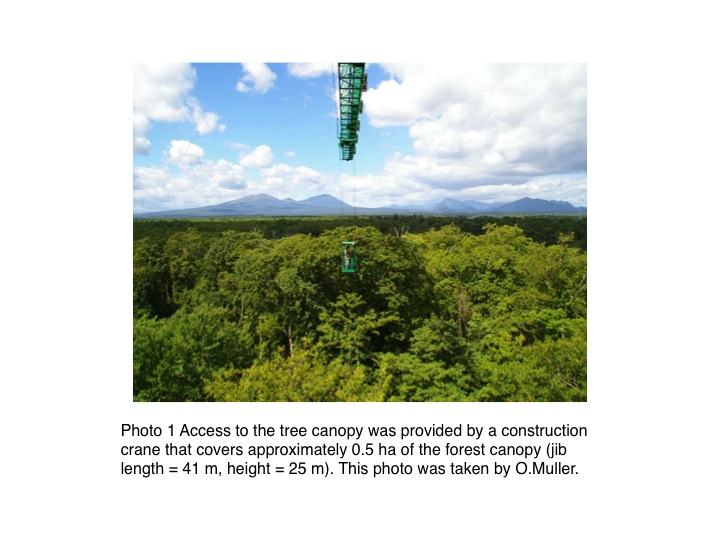
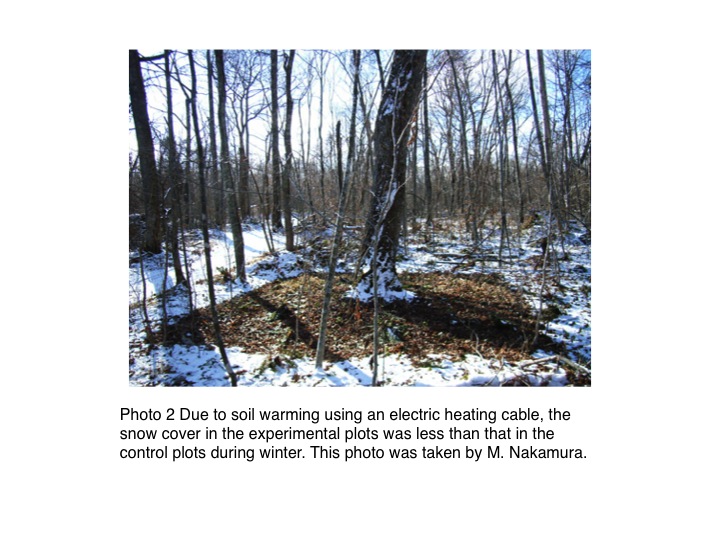
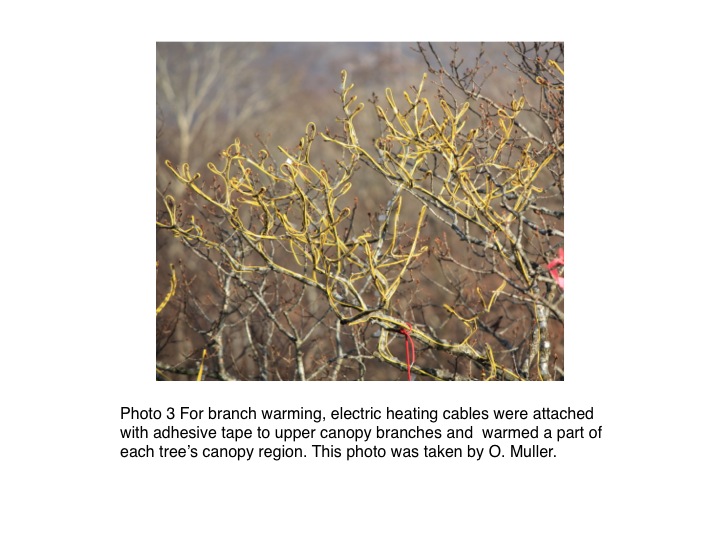
In the paper “Different initial responses of the canopy herbivory rate in mature oak trees to experimental soil and branch warming in a soil-freezing area”, we report the initial 3-year (2007–2009) results of an experimental warming of mature Quercus crispula (18–20 m in height), a late-successional tree species. Five mature Q. crispula trees whose canopy was accessible by a gondola hanging from a construction crane were selected (Photo1). To better understand the mechanism by which global warming affects plant-insect interactions in the canopy of mature oak trees, field experiments must warm aboveground and belowground regions separately. Thus, we experimentally increased the temperature of the surrounding soil and canopy branches of mature oak trees by approximately 5°C using electric heating cables (Photo 2 and 3).

Bild2

Our warming experiment clearly demonstrates that plant-insect interactions in the canopy responded differently to soil and branch warming of mature oak trees. Soil warming in a mature cool-temperate forest with a freeze-thaw cycle decreased the nutritional quality of leaves and the rate of herbivory in the canopy, whereas branch warming had no effect on canopy leaf traits or the herbivory rate. The magnitude of the indirect (plant-mediated) effects of belowground temperature elevation on canopy herbivory was gradually enhanced during the initial 3 years of the study. These results suggest that belowground temperature elevation due to global warming in a soil freezing area is an important driving force of plant-insect interactions in the canopy. For a better understanding of the mechanism by which global warming affects plant-insect interactions in mature cool-temperate forests, this warming experiment should be continued using mature oak trees because indirect effects of temperature are likely more pronounced in the long- than in the short-term.

Bild3

Masahiro Nakamura and co-workers

Rapid Arctic warming is spreading south Updated for 2026


Climate scientists are confident that the Arctic is warming more than twice as fast as any other part of the planet, but now comes evidence from researchers in Finland that the rising temperatures are being felt further south than the polar regions.

Most governments have agreed that the global temperature should not be allowed to rise more than 2°C above its pre-industrial level in order to prevent the onset of dangerous climate change. Finland’s experience shows how fast this threshold may be reached.

The marked rise is reported in a study by researchers from the University of Eastern Finland and the Finnish Meteorological Institute, published in the journal Stochastic Environmental Research and Risk Assessment. They say their study “exhibits a statistically significant trend, which is consistent with human-induced global warming.”

Winter months are warming fastest

Records show that, over the past 166 years, the average temperature in Finland has risen by more than two degrees Celsius.

The average increase observed was 0.14°C per decade, which is nearly twice the global average. Since the 1960s, the temperature has risen faster than ever before, with the rise varying between 0.2 and 0.4°C per decade.

One of the study’s co-authors, Professor Ari Laaksonen, said: “The biggest temperature rise has coincided with November, December and January. Temperatures have also risen faster than the annual average in March, April and May. In the summer months, however, the temperature rise has not been as significant.”

One consequence of the rising temperature is that Finnish lakes now freeze over later in the year than they used to, while the ice cover melts earlier each spring. Some of Finland’s trees are also beginning to blossom earlier than before.

No slowdown in temperature rise

The study found that the temperature has risen in two phases – the first lasting from the start of the observation period in 1847 to the late 1930s, and the second from the late 1960s until now. During the intervening 30 years or so, the temperature remained nearly steady.

Dr Santtu Mikkonen, the lead author, said: “The stop in the temperature rise can be explained by several factors, including long-term changes in solar activity and the post-World War II growth of human-derived aerosols in the atmosphere. When looking at recent years’ observations, it seems that the temperature rise is not slowing down.”

“Our study shows that the warming is taking place all over Finland. In addition to the results shown in the paper we made some tests with data only from southern Finland  and from individual stations in different parts of the country, and the trend was similar in all these analyses. The area of higher warming is reaching further south than it has been recorded before.”

The temperature time series was created by averaging the data produced by all Finnish weather stations across the country. Because the Finnish weather network did not cover the entire country in the early years, data obtained from weather stations in neighbouring countries was also used.

Finland, lying between the Atlantic and the Eurasian continent, is subject to very variable weather. The researchers say they used a method that made it possible for them to take into consideration the seasonal changes typical of Nordic conditions, as well as significant annual variation.


Alex Kirby writes for Climate News Network.


388400