Tag Archives: right

TTIP: MPs demand transparency and ‘right to regulate’ Updated for 2026


MPs in the House of Commons Business, Innovation and Skills (BIS) Committee have demanded that “a right to regulate” be enshrined in the controversial Transatlantic Trade and Investment Partnership (TTIP) between the European Union and the United States.

There are growing fears – highlighted in today’s Ecologist with reference to Canada’s salutary experience – that TTIP’s fiercely investor-state dispute settlement (ISDS) mechanism would allow foreign companies and private investors to sue governments for enacting ‘business unfriendly’ legislation.

Where countries legislate for environmental protection, labour standards or the state’s right to run public services – like the National Health Service – ISDS could allow corporations to sue governments for the loss of future profits in secret tribunals.

As the report highlights, ISDS could also allow “the possibility of US oil companies challenging environmental regulations on fracking.” Other examples include challenging regulations on chemicals in food and cosmetics as well as EU restrictions on genetically modified organisms.

The Committee therefore demands that “a statement ensuring the right to regulate by Sovereign Nations takes precedence over an investor’s right to invest is placed at the heart of the Government’s response on ISDS provisions”, also insisting on “the exclusion of any clauses which would require the State to pay in all outcomes.”

And – with specific reference to public concerns over NHS privatization – the MPs “urge the Government to ensure that an unequivocal statement guaranteeing the protection of public services at present – and the right to expand them in the future – is set out in any ISDS provisions.”

The demands are made in a new report just published by the (BIS) Committee which concludes: “We do not believe that the case has yet been made for ISDS clauses in TTIP.”

Government slammed for ISDS silence

The MPs also add a barb aimed squarely at the British government: “The European Commission is currently consulting Member States on the ISDS provisions. We are deeply concerned that the UK Government is not planning to submit a formal response to that consultation.

“We disagree with this approach. We argue that a formal response should be submitted and for that response to be made available for public scrutiny.”

The Committee argues that the Government’s secretive approach on the ISDS issue “does not give the impression that the Government is treating seriously the concerns that have been raised about the range or use of such clauses and serves only to fuel the existing scepticism held by opponents of TTIP.

“It also has the potential to leave the UK on the margins of any debate to better frame ISDS negotiations. We recommend that the Government produces a formal response to the consultation exercise and for it to be published at the same time it is submitted to the European Commission.”

This is not the first government report to question the need for ISDS clauses. On 10 March, the House of Commons Environmental Audit Committee (EAC) argued that the trade deal should not allow US companies to sue European nations when they pass environmental laws that hurt their profits.

The EAC also found that the trade deal could result in a “race to the bottom”, where attempts to align EU environmental safeguards to those in the US – which are generally seen to be weaker – could undermine or dilute environmental protections.

Secretive negotiations against the public interest

The Committee also takes aim at the secretive nature of the negotiations between the EU anmd the US on this major free trade deal, which it says has resulted in an “oversimplification and misrepresentation of arguments on both sides.”

“Everyone involved in the debate on TTIP-campaigners, lobbyists, the UK Government and the European Commission-must ensure that an evidence-based approach is at the heart of any TTIP debate.”

Adrian Bailey MP, Chair of the BIS Committee commented: “More detail needs to be made available to allow greater public scrutiny of this extensive trade agreement. Unfortunately, in the absence of that detail or undertakings that negotiating texts will be made public, the debate on the trade agreement has become polarised.”

The high degree of secrecy means it is impossible to monitor or evaluate what issues are being taken into account, the report explains. This echoes concerns previously raised by MPs about whether or not environmental risks are being taken into consideration.

However, because the negotiation process is ongoing, and much of the detail has yet to be agreed on or made public, it is “not possible to come to a definitive conclusion on the benefits or risks of an extensive trade agreement”, the BIS Committee states.

The Committee argues that the European Commission and the UK Government “must shoulder some of the blame” for the fact that only a minimal level of information has been made available about TTIP. Lord Livingston, Minister of State for Trade and Investment, agreed, telling the Committee that “a greater level of transparency was necessary and that this was now being addressed.”

The European Commission recently published some EU negotiating texts; however, it refuses to publish agendas or minutes of meetings held. It also argues that for data protection reasons, it cannot publish the names of meeting participants without their consent.


Action: an International Day of Action against all ‘free trade’ deals is planned for Saturday 18 April in association with Stop TTIP.

Sign an EU-wide petition against TTIP – it already has 1.6 million signatures and has a target of 2 million by October 2015.

Kyla Mandel is Deputy Editor of DeSmog UK. Follow her on Twitter
@kylamandel.

Oliver Tickell edits The Ecologist.

The report:Transatlantic Trade and Investment Partnership‘, House of Commons Business, Innovation and Skills Committee, Eleventh Report of Session 2014-15.

This article is an expanded and edited version of one originally published on DeSmog UK.


391624

TTIP: MPs demand transparency and ‘right to regulate’ Updated for 2026


MPs in the House of Commons Business, Innovation and Skills (BIS) Committee have demanded that “a right to regulate” be enshrined in the controversial Transatlantic Trade and Investment Partnership (TTIP) between the European Union and the United States.

There are growing fears – highlighted in today’s Ecologist with reference to Canada’s salutary experience – that TTIP’s fiercely investor-state dispute settlement (ISDS) mechanism would allow foreign companies and private investors to sue governments for enacting ‘business unfriendly’ legislation.

Where countries legislate for environmental protection, labour standards or the state’s right to run public services – like the National Health Service – ISDS could allow corporations to sue governments for the loss of future profits in secret tribunals.

As the report highlights, ISDS could also allow “the possibility of US oil companies challenging environmental regulations on fracking.” Other examples include challenging regulations on chemicals in food and cosmetics as well as EU restrictions on genetically modified organisms.

The Committee therefore demands that “a statement ensuring the right to regulate by Sovereign Nations takes precedence over an investor’s right to invest is placed at the heart of the Government’s response on ISDS provisions”, also insisting on “the exclusion of any clauses which would require the State to pay in all outcomes.”

And – with specific reference to public concerns over NHS privatization – the MPs “urge the Government to ensure that an unequivocal statement guaranteeing the protection of public services at present – and the right to expand them in the future – is set out in any ISDS provisions.”

The demands are made in a new report just published by the (BIS) Committee which concludes: “We do not believe that the case has yet been made for ISDS clauses in TTIP.”

Government slammed for ISDS silence

The MPs also add a barb aimed squarely at the British government: “The European Commission is currently consulting Member States on the ISDS provisions. We are deeply concerned that the UK Government is not planning to submit a formal response to that consultation.

“We disagree with this approach. We argue that a formal response should be submitted and for that response to be made available for public scrutiny.”

The Committee argues that the Government’s secretive approach on the ISDS issue “does not give the impression that the Government is treating seriously the concerns that have been raised about the range or use of such clauses and serves only to fuel the existing scepticism held by opponents of TTIP.

“It also has the potential to leave the UK on the margins of any debate to better frame ISDS negotiations. We recommend that the Government produces a formal response to the consultation exercise and for it to be published at the same time it is submitted to the European Commission.”

This is not the first government report to question the need for ISDS clauses. On 10 March, the House of Commons Environmental Audit Committee (EAC) argued that the trade deal should not allow US companies to sue European nations when they pass environmental laws that hurt their profits.

The EAC also found that the trade deal could result in a “race to the bottom”, where attempts to align EU environmental safeguards to those in the US – which are generally seen to be weaker – could undermine or dilute environmental protections.

Secretive negotiations against the public interest

The Committee also takes aim at the secretive nature of the negotiations between the EU anmd the US on this major free trade deal, which it says has resulted in an “oversimplification and misrepresentation of arguments on both sides.”

“Everyone involved in the debate on TTIP-campaigners, lobbyists, the UK Government and the European Commission-must ensure that an evidence-based approach is at the heart of any TTIP debate.”

Adrian Bailey MP, Chair of the BIS Committee commented: “More detail needs to be made available to allow greater public scrutiny of this extensive trade agreement. Unfortunately, in the absence of that detail or undertakings that negotiating texts will be made public, the debate on the trade agreement has become polarised.”

The high degree of secrecy means it is impossible to monitor or evaluate what issues are being taken into account, the report explains. This echoes concerns previously raised by MPs about whether or not environmental risks are being taken into consideration.

However, because the negotiation process is ongoing, and much of the detail has yet to be agreed on or made public, it is “not possible to come to a definitive conclusion on the benefits or risks of an extensive trade agreement”, the BIS Committee states.

The Committee argues that the European Commission and the UK Government “must shoulder some of the blame” for the fact that only a minimal level of information has been made available about TTIP. Lord Livingston, Minister of State for Trade and Investment, agreed, telling the Committee that “a greater level of transparency was necessary and that this was now being addressed.”

The European Commission recently published some EU negotiating texts; however, it refuses to publish agendas or minutes of meetings held. It also argues that for data protection reasons, it cannot publish the names of meeting participants without their consent.


Action: an International Day of Action against all ‘free trade’ deals is planned for Saturday 18 April in association with Stop TTIP.

Sign an EU-wide petition against TTIP – it already has 1.6 million signatures and has a target of 2 million by October 2015.

Kyla Mandel is Deputy Editor of DeSmog UK. Follow her on Twitter
@kylamandel.

Oliver Tickell edits The Ecologist.

The report:Transatlantic Trade and Investment Partnership‘, House of Commons Business, Innovation and Skills Committee, Eleventh Report of Session 2014-15.

This article is an expanded and edited version of one originally published on DeSmog UK.


391624

TTIP: MPs demand transparency and ‘right to regulate’ Updated for 2026


MPs in the House of Commons Business, Innovation and Skills (BIS) Committee have demanded that “a right to regulate” be enshrined in the controversial Transatlantic Trade and Investment Partnership (TTIP) between the European Union and the United States.

There are growing fears – highlighted in today’s Ecologist with reference to Canada’s salutary experience – that TTIP’s fiercely investor-state dispute settlement (ISDS) mechanism would allow foreign companies and private investors to sue governments for enacting ‘business unfriendly’ legislation.

Where countries legislate for environmental protection, labour standards or the state’s right to run public services – like the National Health Service – ISDS could allow corporations to sue governments for the loss of future profits in secret tribunals.

As the report highlights, ISDS could also allow “the possibility of US oil companies challenging environmental regulations on fracking.” Other examples include challenging regulations on chemicals in food and cosmetics as well as EU restrictions on genetically modified organisms.

The Committee therefore demands that “a statement ensuring the right to regulate by Sovereign Nations takes precedence over an investor’s right to invest is placed at the heart of the Government’s response on ISDS provisions”, also insisting on “the exclusion of any clauses which would require the State to pay in all outcomes.”

And – with specific reference to public concerns over NHS privatization – the MPs “urge the Government to ensure that an unequivocal statement guaranteeing the protection of public services at present – and the right to expand them in the future – is set out in any ISDS provisions.”

The demands are made in a new report just published by the (BIS) Committee which concludes: “We do not believe that the case has yet been made for ISDS clauses in TTIP.”

Government slammed for ISDS silence

The MPs also add a barb aimed squarely at the British government: “The European Commission is currently consulting Member States on the ISDS provisions. We are deeply concerned that the UK Government is not planning to submit a formal response to that consultation.

“We disagree with this approach. We argue that a formal response should be submitted and for that response to be made available for public scrutiny.”

The Committee argues that the Government’s secretive approach on the ISDS issue “does not give the impression that the Government is treating seriously the concerns that have been raised about the range or use of such clauses and serves only to fuel the existing scepticism held by opponents of TTIP.

“It also has the potential to leave the UK on the margins of any debate to better frame ISDS negotiations. We recommend that the Government produces a formal response to the consultation exercise and for it to be published at the same time it is submitted to the European Commission.”

This is not the first government report to question the need for ISDS clauses. On 10 March, the House of Commons Environmental Audit Committee (EAC) argued that the trade deal should not allow US companies to sue European nations when they pass environmental laws that hurt their profits.

The EAC also found that the trade deal could result in a “race to the bottom”, where attempts to align EU environmental safeguards to those in the US – which are generally seen to be weaker – could undermine or dilute environmental protections.

Secretive negotiations against the public interest

The Committee also takes aim at the secretive nature of the negotiations between the EU anmd the US on this major free trade deal, which it says has resulted in an “oversimplification and misrepresentation of arguments on both sides.”

“Everyone involved in the debate on TTIP-campaigners, lobbyists, the UK Government and the European Commission-must ensure that an evidence-based approach is at the heart of any TTIP debate.”

Adrian Bailey MP, Chair of the BIS Committee commented: “More detail needs to be made available to allow greater public scrutiny of this extensive trade agreement. Unfortunately, in the absence of that detail or undertakings that negotiating texts will be made public, the debate on the trade agreement has become polarised.”

The high degree of secrecy means it is impossible to monitor or evaluate what issues are being taken into account, the report explains. This echoes concerns previously raised by MPs about whether or not environmental risks are being taken into consideration.

However, because the negotiation process is ongoing, and much of the detail has yet to be agreed on or made public, it is “not possible to come to a definitive conclusion on the benefits or risks of an extensive trade agreement”, the BIS Committee states.

The Committee argues that the European Commission and the UK Government “must shoulder some of the blame” for the fact that only a minimal level of information has been made available about TTIP. Lord Livingston, Minister of State for Trade and Investment, agreed, telling the Committee that “a greater level of transparency was necessary and that this was now being addressed.”

The European Commission recently published some EU negotiating texts; however, it refuses to publish agendas or minutes of meetings held. It also argues that for data protection reasons, it cannot publish the names of meeting participants without their consent.


Action: an International Day of Action against all ‘free trade’ deals is planned for Saturday 18 April in association with Stop TTIP.

Sign an EU-wide petition against TTIP – it already has 1.6 million signatures and has a target of 2 million by October 2015.

Kyla Mandel is Deputy Editor of DeSmog UK. Follow her on Twitter
@kylamandel.

Oliver Tickell edits The Ecologist.

The report:Transatlantic Trade and Investment Partnership‘, House of Commons Business, Innovation and Skills Committee, Eleventh Report of Session 2014-15.

This article is an expanded and edited version of one originally published on DeSmog UK.



391624

TTIP: MPs demand transparency and ‘right to regulate’ Updated for 2026


MPs in the House of Commons Business, Innovation and Skills (BIS) Committee have demanded that “a right to regulate” be enshrined in the controversial Transatlantic Trade and Investment Partnership (TTIP) between the European Union and the United States.

There are growing fears – highlighted in today’s Ecologist with reference to Canada’s salutary experience – that TTIP’s fiercely investor-state dispute settlement (ISDS) mechanism would allow foreign companies and private investors to sue governments for enacting ‘business unfriendly’ legislation.

Where countries legislate for environmental protection, labour standards or the state’s right to run public services – like the National Health Service – ISDS could allow corporations to sue governments for the loss of future profits in secret tribunals.

As the report highlights, ISDS could also allow “the possibility of US oil companies challenging environmental regulations on fracking.” Other examples include challenging regulations on chemicals in food and cosmetics as well as EU restrictions on genetically modified organisms.

The Committee therefore demands that “a statement ensuring the right to regulate by Sovereign Nations takes precedence over an investor’s right to invest is placed at the heart of the Government’s response on ISDS provisions”, also insisting on “the exclusion of any clauses which would require the State to pay in all outcomes.”

And – with specific reference to public concerns over NHS privatization – the MPs “urge the Government to ensure that an unequivocal statement guaranteeing the protection of public services at present – and the right to expand them in the future – is set out in any ISDS provisions.”

The demands are made in a new report just published by the (BIS) Committee which concludes: “We do not believe that the case has yet been made for ISDS clauses in TTIP.”

Government slammed for ISDS silence

The MPs also add a barb aimed squarely at the British government: “The European Commission is currently consulting Member States on the ISDS provisions. We are deeply concerned that the UK Government is not planning to submit a formal response to that consultation.

“We disagree with this approach. We argue that a formal response should be submitted and for that response to be made available for public scrutiny.”

The Committee argues that the Government’s secretive approach on the ISDS issue “does not give the impression that the Government is treating seriously the concerns that have been raised about the range or use of such clauses and serves only to fuel the existing scepticism held by opponents of TTIP.

“It also has the potential to leave the UK on the margins of any debate to better frame ISDS negotiations. We recommend that the Government produces a formal response to the consultation exercise and for it to be published at the same time it is submitted to the European Commission.”

This is not the first government report to question the need for ISDS clauses. On 10 March, the House of Commons Environmental Audit Committee (EAC) argued that the trade deal should not allow US companies to sue European nations when they pass environmental laws that hurt their profits.

The EAC also found that the trade deal could result in a “race to the bottom”, where attempts to align EU environmental safeguards to those in the US – which are generally seen to be weaker – could undermine or dilute environmental protections.

Secretive negotiations against the public interest

The Committee also takes aim at the secretive nature of the negotiations between the EU anmd the US on this major free trade deal, which it says has resulted in an “oversimplification and misrepresentation of arguments on both sides.”

“Everyone involved in the debate on TTIP-campaigners, lobbyists, the UK Government and the European Commission-must ensure that an evidence-based approach is at the heart of any TTIP debate.”

Adrian Bailey MP, Chair of the BIS Committee commented: “More detail needs to be made available to allow greater public scrutiny of this extensive trade agreement. Unfortunately, in the absence of that detail or undertakings that negotiating texts will be made public, the debate on the trade agreement has become polarised.”

The high degree of secrecy means it is impossible to monitor or evaluate what issues are being taken into account, the report explains. This echoes concerns previously raised by MPs about whether or not environmental risks are being taken into consideration.

However, because the negotiation process is ongoing, and much of the detail has yet to be agreed on or made public, it is “not possible to come to a definitive conclusion on the benefits or risks of an extensive trade agreement”, the BIS Committee states.

The Committee argues that the European Commission and the UK Government “must shoulder some of the blame” for the fact that only a minimal level of information has been made available about TTIP. Lord Livingston, Minister of State for Trade and Investment, agreed, telling the Committee that “a greater level of transparency was necessary and that this was now being addressed.”

The European Commission recently published some EU negotiating texts; however, it refuses to publish agendas or minutes of meetings held. It also argues that for data protection reasons, it cannot publish the names of meeting participants without their consent.


Action: an International Day of Action against all ‘free trade’ deals is planned for Saturday 18 April in association with Stop TTIP.

Sign an EU-wide petition against TTIP – it already has 1.6 million signatures and has a target of 2 million by October 2015.

Kyla Mandel is Deputy Editor of DeSmog UK. Follow her on Twitter
@kylamandel.

Oliver Tickell edits The Ecologist.

The report:Transatlantic Trade and Investment Partnership‘, House of Commons Business, Innovation and Skills Committee, Eleventh Report of Session 2014-15.

This article is an expanded and edited version of one originally published on DeSmog UK.


391624

TTIP: MPs demand transparency and ‘right to regulate’ Updated for 2026


MPs in the House of Commons Business, Innovation and Skills (BIS) Committee have demanded that “a right to regulate” be enshrined in the controversial Transatlantic Trade and Investment Partnership (TTIP) between the European Union and the United States.

There are growing fears – highlighted in today’s Ecologist with reference to Canada’s salutary experience – that TTIP’s fiercely investor-state dispute settlement (ISDS) mechanism would allow foreign companies and private investors to sue governments for enacting ‘business unfriendly’ legislation.

Where countries legislate for environmental protection, labour standards or the state’s right to run public services – like the National Health Service – ISDS could allow corporations to sue governments for the loss of future profits in secret tribunals.

As the report highlights, ISDS could also allow “the possibility of US oil companies challenging environmental regulations on fracking.” Other examples include challenging regulations on chemicals in food and cosmetics as well as EU restrictions on genetically modified organisms.

The Committee therefore demands that “a statement ensuring the right to regulate by Sovereign Nations takes precedence over an investor’s right to invest is placed at the heart of the Government’s response on ISDS provisions”, also insisting on “the exclusion of any clauses which would require the State to pay in all outcomes.”

And – with specific reference to public concerns over NHS privatization – the MPs “urge the Government to ensure that an unequivocal statement guaranteeing the protection of public services at present – and the right to expand them in the future – is set out in any ISDS provisions.”

The demands are made in a new report just published by the (BIS) Committee which concludes: “We do not believe that the case has yet been made for ISDS clauses in TTIP.”

Government slammed for ISDS silence

The MPs also add a barb aimed squarely at the British government: “The European Commission is currently consulting Member States on the ISDS provisions. We are deeply concerned that the UK Government is not planning to submit a formal response to that consultation.

“We disagree with this approach. We argue that a formal response should be submitted and for that response to be made available for public scrutiny.”

The Committee argues that the Government’s secretive approach on the ISDS issue “does not give the impression that the Government is treating seriously the concerns that have been raised about the range or use of such clauses and serves only to fuel the existing scepticism held by opponents of TTIP.

“It also has the potential to leave the UK on the margins of any debate to better frame ISDS negotiations. We recommend that the Government produces a formal response to the consultation exercise and for it to be published at the same time it is submitted to the European Commission.”

This is not the first government report to question the need for ISDS clauses. On 10 March, the House of Commons Environmental Audit Committee (EAC) argued that the trade deal should not allow US companies to sue European nations when they pass environmental laws that hurt their profits.

The EAC also found that the trade deal could result in a “race to the bottom”, where attempts to align EU environmental safeguards to those in the US – which are generally seen to be weaker – could undermine or dilute environmental protections.

Secretive negotiations against the public interest

The Committee also takes aim at the secretive nature of the negotiations between the EU anmd the US on this major free trade deal, which it says has resulted in an “oversimplification and misrepresentation of arguments on both sides.”

“Everyone involved in the debate on TTIP-campaigners, lobbyists, the UK Government and the European Commission-must ensure that an evidence-based approach is at the heart of any TTIP debate.”

Adrian Bailey MP, Chair of the BIS Committee commented: “More detail needs to be made available to allow greater public scrutiny of this extensive trade agreement. Unfortunately, in the absence of that detail or undertakings that negotiating texts will be made public, the debate on the trade agreement has become polarised.”

The high degree of secrecy means it is impossible to monitor or evaluate what issues are being taken into account, the report explains. This echoes concerns previously raised by MPs about whether or not environmental risks are being taken into consideration.

However, because the negotiation process is ongoing, and much of the detail has yet to be agreed on or made public, it is “not possible to come to a definitive conclusion on the benefits or risks of an extensive trade agreement”, the BIS Committee states.

The Committee argues that the European Commission and the UK Government “must shoulder some of the blame” for the fact that only a minimal level of information has been made available about TTIP. Lord Livingston, Minister of State for Trade and Investment, agreed, telling the Committee that “a greater level of transparency was necessary and that this was now being addressed.”

The European Commission recently published some EU negotiating texts; however, it refuses to publish agendas or minutes of meetings held. It also argues that for data protection reasons, it cannot publish the names of meeting participants without their consent.


Action: an International Day of Action against all ‘free trade’ deals is planned for Saturday 18 April in association with Stop TTIP.

Sign an EU-wide petition against TTIP – it already has 1.6 million signatures and has a target of 2 million by October 2015.

Kyla Mandel is Deputy Editor of DeSmog UK. Follow her on Twitter
@kylamandel.

Oliver Tickell edits The Ecologist.

The report:Transatlantic Trade and Investment Partnership‘, House of Commons Business, Innovation and Skills Committee, Eleventh Report of Session 2014-15.

This article is an expanded and edited version of one originally published on DeSmog UK.


391624

To live longer – choose the right place to live? Updated for 2026

Despite the increasing use of Species Distribution Models (SDM) for predicting current or future animal distribution, only a few studies have linked the gradient of habitat suitability to demographic parameters.

Species Distribution Models are a niche modelling framework based on a statistical approach linking spatial data on the presence/absence of species to predictive environmental variables. Because they do not account for demographic and ecological processes that may constrain responses to environmental factors at a population level, the projections of SDM cannot be used directly to predict the associated extinction risk. In this context, approaches accounting for mechanistic processes directly linked with extinction across distribution ranges are considered as promising steps to better understand and predict the response of species to environmental change. While such approaches can improve the reliability of models, empirical works are essential to further develop our understanding of processes underlying distribution patterns and potentially develop better SDM that could integrate factors driving species distribution and persistence. Moreover, the adequacy of projections with demographic parameters is a critical issue when they have to be applied for conservation planning.

In our study Evidence of a link between demographic rates and species habitat suitability from post release movements in a reinforced bird population” just published in Oikos, we tested whether the spatial variation in habitat suitability along the individual movement path is related to survival.

Monnett1

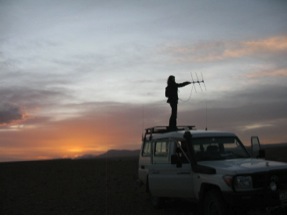
Radio-tracking of North African Houbara Bustard in Eastern Morocco

We used an extensive tracking data collected from captive-born individuals translocated to reinforce the wild populations of Houbara bustard (Chlamydotis undulata undulata). This translocation program provides an ideal study framework including information on the spatial distribution of wild-born individuals and intensive individual-based monitoring of captive-bred released individuals.

We first modelled and mapped the habitat suitability from presence data of wild individuals using niche models in a consensus framework (BIOMOD platform). We further analysed survival of 957 released individuals using capture-recapture modelling and its links to habitat suitability, as the trend in suitability from the release sites along movements.

Monnett2

North African Houbara Bustard (Chlamydotis undulata undulata)

We found that the survival of released individuals was related to changes in habitat suitability along their movements. For instance, individuals which moved to sites of lower habitat suitability than their release sites have lower survival probabilities than the others, independently of the habitat suitability of the release sites and daily movement rate. Interestingly, the most positive changes in habitat suitability were not characterized by highest survival probabilities, likely due to density-dependant processes.

We provide an empirical support of the relationship between habitat suitability and survival, a major fitness component. These results illustrate the relevance of linking demographic processes with Species Distribution models, but also underline the importance of other mechanisms acting on demographic parameters and possibly mitigating such relationship (social organisation, density dependence).

The authors through Anne-Christine Monnet


‘Peak oil’ – the wrong argument for the right reasons Updated for 2026


Collapsing oil prices should give everyone in the ‘green movement’ cause for reflection.

With lower prices forecast to last for the next couple of years, two lines of argument for sustainable energy – economic and peak oil – are now looking rather weaker. Equally, the case for reconsidering the arguments and the tactics of political environmentalism has strengthened.

Peak oil as an argument for environmental change was always flawed, as recent events have illustrated. Some writers and environmental organisations mention peak oil alongside wider environmental arguments for a transition to sustainable energy use (see this review for example).

Peak oil supporters predict that the price of oil will inevitably rise as ultimate exhaustion approaches. Rising prices, not lack of availability, will make oil-based products unviable.

Making sure the oil is left in the ground

If everything is left to the free market that scenario would undoubtedly occur at some point in the future. But what if the green movement achieves its aims of lower consumption, and switching to renewable energy sources while there’s still plenty of oil in the ground?

Remember the comment made 15 years ago by Sheikh Yamani, the former Saudi Oil Minister: “The Stone Age came to an end, not because we had a lack of stones.”

His suggestion was that lots of oil might remain unused, as the world switched to superior alternative energy sources – much as our ancestors stopped using stone for tools and weapons because other materials were more effective, notably bronze, iron and steel.

But the analogy with the Stone Age is misleading. Sustainable energy does not have obvious advantages for industry or consumers, never mind its wider benefits.

And even with very cheap solar power and large, efficient industries dedicated to converting it into fuels for aviation and other transport uses, it’s unlikely to compete on price with Saudi Arabian oil, whose production cost is around $5 per barrel

But if we are to avoid catastrophic climate change, most of the world’s fossil fuels will have to remain in the ground, according to the IPCC. So the success of any transition strategy will depend on artifically increasing the price of oil (and other fossil fuels), and / or applying regulations that discriminate against their use.

Being economical with our arguments

Peak oil is one of several ways conventional economics have been used to promote sustainable aims. As economic growth has faltered and governments have become obsessed with ‘the economy’, campaigners, professionals and academics have felt compelled to express their arguments in economic terms.

This has produced what later, saner generations may regard as ludicrous extremes. Several reports have attempted, for example, to justify the benefits of walking and cycling or the disbenefits of pollution on economic grounds – as though longer healthier lives were not sufficient justification in their own right.

This approach has proved no more effective than other ways of influencing politicians and business leaders. Cost-benefit analyses of transport projects typically show that small-scale pedestrian and cycling projects generate the highest rates of return.

So why do politicians who say they believe in the conventional economics behind cost-benefit analysis pour vastly more money into road-building and high speed rail, than into far cheaper, more effective and sustainable options?

I have been to many conferences where the presenters seem to implore: “if only we can show them the right economic evidence they’ll change their minds.”

This wishful thinking misunderstands the role of evidence and economics in political decision-making.

Building roads, and ignoring the evidence

In the mid-1990s the Conservative Government of John Major abandoned the ideology and the practice of big road-building, prompting a lively academic debate about the real reasons for these changes.

Some writers pointed to an influential report by SACTRA, a parliamentary committee, which amassed a convincing body of evidence that road-building is self-defeating because it “induces” more traffic.

Two other influences on the Major Government were pressure from the Treasury to cut public spending and the anti-roads protests which delayed road schemes and increased their cost.

No convincing evidence has emerged to challenge SACTRA’s findings since then, and yet those lessons have been comprehensively un-learned. The Coalition Government’s Command Paper Investing in the Future does not even pretend to offer any evidence for its claims about the economic necessity of road-building.

The CBI’s roads report Bold Thinking states that “the long-term benefits of road investment are well-known”, which is all the evidence they need. A senior civil servant from another country with a neoliberal political culture recently visited our research centre on a fact finding mission.

He reported similar views in his own country adding that “there’s a lot of scepticism about the health benefits of walking and cycling” as they appear in cost-benefit analyses. The evidence on road building and the economy is no stronger but these claims fit more easily with the values of political and business elites.

Faced with that reality, the argument that we must act sustainably for the sake of the economy was never going to persuade many decision-makers. In a context of low oil prices it will convince no-one.

Protecting the enviroment for its own sake (and ours)

When that argument becomes a common message people hear from the green movement, it weakens the values most readers of The Ecologist would share – that we must protect the environment for its own sake and for future generations (for a psychological analysis of the reasons for this, see the WWF report Common Cause).

If we are ever to change the values and practices of elites and the general public we must remain consistent, even when our arguments seem to be falling on deaf ears.

Comparing today’s situation with the mid-1990s, the evidence on road building hasn’t changed. The pressures on public spending are even greater. And yet the government is committed to spending £15 billion on building and ‘improving’ roads.

The fact that the bulk of the expenditure is being targetted at Tory and LibDem marginal constituencies tells us something important about how govenments really reach their decisions.

Make it political!

But that’s not all. One important element we are lacking today is the mass campaign of civil disobedience that rose up against Mrs Thatcher’s ‘biggest roads programme since the Romans’. We can only conclude that it must have been considerably more influential than most of us realised at the time.

It also tells us that to persuade government to force the transition away from fossil fuels, making economic arguments – however sound and well founded on irrefutable evidence – is never going to cut the mustard.

We have to make the transition to sustainable energy a political decision in the run-up to the 2015 election – and do what it takes to make the issue one that politicians cannot afford to ignore.


Dr Steve Melia is a Senior Lecture in Transport and Planning at the University of the West of England. His new book, ‘Urban Transport Without the Hot Air’, will be published by UIT Cambridge in May.


388391

‘Peak oil’ – the wrong argument for the right reasons Updated for 2026


Collapsing oil prices should give everyone in the ‘green movement’ cause for reflection.

With lower prices forecast to last for the next couple of years, two lines of argument for sustainable energy – economic and peak oil – are now looking rather weaker. Equally, the case for reconsidering the arguments and the tactics of political environmentalism has strengthened.

Peak oil as an argument for environmental change was always flawed, as recent events have illustrated. Some writers and environmental organisations mention peak oil alongside wider environmental arguments for a transition to sustainable energy use (see this review for example).

Peak oil supporters predict that the price of oil will inevitably rise as ultimate exhaustion approaches. Rising prices, not lack of availability, will make oil-based products unviable.

Making sure the oil is left in the ground

If everything is left to the free market that scenario would undoubtedly occur at some point in the future. But what if the green movement achieves its aims of lower consumption, and switching to renewable energy sources while there’s still plenty of oil in the ground?

Remember the comment made 15 years ago by Sheikh Yamani, the former Saudi Oil Minister: “The Stone Age came to an end, not because we had a lack of stones.”

His suggestion was that lots of oil might remain unused, as the world switched to superior alternative energy sources – much as our ancestors stopped using stone for tools and weapons because other materials were more effective, notably bronze, iron and steel.

But the analogy with the Stone Age is misleading. Sustainable energy does not have obvious advantages for industry or consumers, never mind its wider benefits.

And even with very cheap solar power and large, efficient industries dedicated to converting it into fuels for aviation and other transport uses, it’s unlikely to compete on price with Saudi Arabian oil, whose production cost is around $5 per barrel

But if we are to avoid catastrophic climate change, most of the world’s fossil fuels will have to remain in the ground, according to the IPCC. So the success of any transition strategy will depend on artifically increasing the price of oil (and other fossil fuels), and / or applying regulations that discriminate against their use.

Being economical with our arguments

Peak oil is one of several ways conventional economics have been used to promote sustainable aims. As economic growth has faltered and governments have become obsessed with ‘the economy’, campaigners, professionals and academics have felt compelled to express their arguments in economic terms.

This has produced what later, saner generations may regard as ludicrous extremes. Several reports have attempted, for example, to justify the benefits of walking and cycling or the disbenefits of pollution on economic grounds – as though longer healthier lives were not sufficient justification in their own right.

This approach has proved no more effective than other ways of influencing politicians and business leaders. Cost-benefit analyses of transport projects typically show that small-scale pedestrian and cycling projects generate the highest rates of return.

So why do politicians who say they believe in the conventional economics behind cost-benefit analysis pour vastly more money into road-building and high speed rail, than into far cheaper, more effective and sustainable options?

I have been to many conferences where the presenters seem to implore: “if only we can show them the right economic evidence they’ll change their minds.”

This wishful thinking misunderstands the role of evidence and economics in political decision-making.

Building roads, and ignoring the evidence

In the mid-1990s the Conservative Government of John Major abandoned the ideology and the practice of big road-building, prompting a lively academic debate about the real reasons for these changes.

Some writers pointed to an influential report by SACTRA, a parliamentary committee, which amassed a convincing body of evidence that road-building is self-defeating because it “induces” more traffic.

Two other influences on the Major Government were pressure from the Treasury to cut public spending and the anti-roads protests which delayed road schemes and increased their cost.

No convincing evidence has emerged to challenge SACTRA’s findings since then, and yet those lessons have been comprehensively un-learned. The Coalition Government’s Command Paper Investing in the Future does not even pretend to offer any evidence for its claims about the economic necessity of road-building.

The CBI’s roads report Bold Thinking states that “the long-term benefits of road investment are well-known”, which is all the evidence they need. A senior civil servant from another country with a neoliberal political culture recently visited our research centre on a fact finding mission.

He reported similar views in his own country adding that “there’s a lot of scepticism about the health benefits of walking and cycling” as they appear in cost-benefit analyses. The evidence on road building and the economy is no stronger but these claims fit more easily with the values of political and business elites.

Faced with that reality, the argument that we must act sustainably for the sake of the economy was never going to persuade many decision-makers. In a context of low oil prices it will convince no-one.

Protecting the enviroment for its own sake (and ours)

When that argument becomes a common message people hear from the green movement, it weakens the values most readers of The Ecologist would share – that we must protect the environment for its own sake and for future generations (for a psychological analysis of the reasons for this, see the WWF report Common Cause).

If we are ever to change the values and practices of elites and the general public we must remain consistent, even when our arguments seem to be falling on deaf ears.

Comparing today’s situation with the mid-1990s, the evidence on road building hasn’t changed. The pressures on public spending are even greater. And yet the government is committed to spending £15 billion on building and ‘improving’ roads.

The fact that the bulk of the expenditure is being targetted at Tory and LibDem marginal constituencies tells us something important about how govenments really reach their decisions.

Make it political!

But that’s not all. One important element we are lacking today is the mass campaign of civil disobedience that rose up against Mrs Thatcher’s ‘biggest roads programme since the Romans’. We can only conclude that it must have been considerably more influential than most of us realised at the time.

It also tells us that to persuade government to force the transition away from fossil fuels, making economic arguments – however sound and well founded on irrefutable evidence – is never going to cut the mustard.

We have to make the transition to sustainable energy a political decision in the run-up to the 2015 election – and do what it takes to make the issue one that politicians cannot afford to ignore.


Dr Steve Melia is a Senior Lecture in Transport and Planning at the University of the West of England. His new book, ‘Urban Transport Without the Hot Air’, will be published by UIT Cambridge in May.


388391

‘Peak oil’ – the wrong argument for the right reasons Updated for 2026


Collapsing oil prices should give everyone in the ‘green movement’ cause for reflection.

With lower prices forecast to last for the next couple of years, two lines of argument for sustainable energy – economic and peak oil – are now looking rather weaker. Equally, the case for reconsidering the arguments and the tactics of political environmentalism has strengthened.

Peak oil as an argument for environmental change was always flawed, as recent events have illustrated. Some writers and environmental organisations mention peak oil alongside wider environmental arguments for a transition to sustainable energy use (see this review for example).

Peak oil supporters predict that the price of oil will inevitably rise as ultimate exhaustion approaches. Rising prices, not lack of availability, will make oil-based products unviable.

Making sure the oil is left in the ground

If everything is left to the free market that scenario would undoubtedly occur at some point in the future. But what if the green movement achieves its aims of lower consumption, and switching to renewable energy sources while there’s still plenty of oil in the ground?

Remember the comment made 15 years ago by Sheikh Yamani, the former Saudi Oil Minister: “The Stone Age came to an end, not because we had a lack of stones.”

His suggestion was that lots of oil might remain unused, as the world switched to superior alternative energy sources – much as our ancestors stopped using stone for tools and weapons because other materials were more effective, notably bronze, iron and steel.

But the analogy with the Stone Age is misleading. Sustainable energy does not have obvious advantages for industry or consumers, never mind its wider benefits.

And even with very cheap solar power and large, efficient industries dedicated to converting it into fuels for aviation and other transport uses, it’s unlikely to compete on price with Saudi Arabian oil, whose production cost is around $5 per barrel

But if we are to avoid catastrophic climate change, most of the world’s fossil fuels will have to remain in the ground, according to the IPCC. So the success of any transition strategy will depend on artifically increasing the price of oil (and other fossil fuels), and / or applying regulations that discriminate against their use.

Being economical with our arguments

Peak oil is one of several ways conventional economics have been used to promote sustainable aims. As economic growth has faltered and governments have become obsessed with ‘the economy’, campaigners, professionals and academics have felt compelled to express their arguments in economic terms.

This has produced what later, saner generations may regard as ludicrous extremes. Several reports have attempted, for example, to justify the benefits of walking and cycling or the disbenefits of pollution on economic grounds – as though longer healthier lives were not sufficient justification in their own right.

This approach has proved no more effective than other ways of influencing politicians and business leaders. Cost-benefit analyses of transport projects typically show that small-scale pedestrian and cycling projects generate the highest rates of return.

So why do politicians who say they believe in the conventional economics behind cost-benefit analysis pour vastly more money into road-building and high speed rail, than into far cheaper, more effective and sustainable options?

I have been to many conferences where the presenters seem to implore: “if only we can show them the right economic evidence they’ll change their minds.”

This wishful thinking misunderstands the role of evidence and economics in political decision-making.

Building roads, and ignoring the evidence

In the mid-1990s the Conservative Government of John Major abandoned the ideology and the practice of big road-building, prompting a lively academic debate about the real reasons for these changes.

Some writers pointed to an influential report by SACTRA, a parliamentary committee, which amassed a convincing body of evidence that road-building is self-defeating because it “induces” more traffic.

Two other influences on the Major Government were pressure from the Treasury to cut public spending and the anti-roads protests which delayed road schemes and increased their cost.

No convincing evidence has emerged to challenge SACTRA’s findings since then, and yet those lessons have been comprehensively un-learned. The Coalition Government’s Command Paper Investing in the Future does not even pretend to offer any evidence for its claims about the economic necessity of road-building.

The CBI’s roads report Bold Thinking states that “the long-term benefits of road investment are well-known”, which is all the evidence they need. A senior civil servant from another country with a neoliberal political culture recently visited our research centre on a fact finding mission.

He reported similar views in his own country adding that “there’s a lot of scepticism about the health benefits of walking and cycling” as they appear in cost-benefit analyses. The evidence on road building and the economy is no stronger but these claims fit more easily with the values of political and business elites.

Faced with that reality, the argument that we must act sustainably for the sake of the economy was never going to persuade many decision-makers. In a context of low oil prices it will convince no-one.

Protecting the enviroment for its own sake (and ours)

When that argument becomes a common message people hear from the green movement, it weakens the values most readers of The Ecologist would share – that we must protect the environment for its own sake and for future generations (for a psychological analysis of the reasons for this, see the WWF report Common Cause).

If we are ever to change the values and practices of elites and the general public we must remain consistent, even when our arguments seem to be falling on deaf ears.

Comparing today’s situation with the mid-1990s, the evidence on road building hasn’t changed. The pressures on public spending are even greater. And yet the government is committed to spending £15 billion on building and ‘improving’ roads.

The fact that the bulk of the expenditure is being targetted at Tory and LibDem marginal constituencies tells us something important about how govenments really reach their decisions.

Make it political!

But that’s not all. One important element we are lacking today is the mass campaign of civil disobedience that rose up against Mrs Thatcher’s ‘biggest roads programme since the Romans’. We can only conclude that it must have been considerably more influential than most of us realised at the time.

It also tells us that to persuade government to force the transition away from fossil fuels, making economic arguments – however sound and well founded on irrefutable evidence – is never going to cut the mustard.

We have to make the transition to sustainable energy a political decision in the run-up to the 2015 election – and do what it takes to make the issue one that politicians cannot afford to ignore.


Dr Steve Melia is a Senior Lecture in Transport and Planning at the University of the West of England. His new book, ‘Urban Transport Without the Hot Air’, will be published by UIT Cambridge in May.


388391

‘Peak oil’ – the wrong argument for the right reasons Updated for 2026


Collapsing oil prices should give everyone in the ‘green movement’ cause for reflection.

With lower prices forecast to last for the next couple of years, two lines of argument for sustainable energy – economic and peak oil – are now looking rather weaker. Equally, the case for reconsidering the arguments and the tactics of political environmentalism has strengthened.

Peak oil as an argument for environmental change was always flawed, as recent events have illustrated. Some writers and environmental organisations mention peak oil alongside wider environmental arguments for a transition to sustainable energy use (see this review for example).

Peak oil supporters predict that the price of oil will inevitably rise as ultimate exhaustion approaches. Rising prices, not lack of availability, will make oil-based products unviable.

Making sure the oil is left in the ground

If everything is left to the free market that scenario would undoubtedly occur at some point in the future. But what if the green movement achieves its aims of lower consumption, and switching to renewable energy sources while there’s still plenty of oil in the ground?

Remember the comment made 15 years ago by Sheikh Yamani, the former Saudi Oil Minister: “The Stone Age came to an end, not because we had a lack of stones.”

His suggestion was that lots of oil might remain unused, as the world switched to superior alternative energy sources – much as our ancestors stopped using stone for tools and weapons because other materials were more effective, notably bronze, iron and steel.

But the analogy with the Stone Age is misleading. Sustainable energy does not have obvious advantages for industry or consumers, never mind its wider benefits.

And even with very cheap solar power and large, efficient industries dedicated to converting it into fuels for aviation and other transport uses, it’s unlikely to compete on price with Saudi Arabian oil, whose production cost is around $5 per barrel

But if we are to avoid catastrophic climate change, most of the world’s fossil fuels will have to remain in the ground, according to the IPCC. So the success of any transition strategy will depend on artifically increasing the price of oil (and other fossil fuels), and / or applying regulations that discriminate against their use.

Being economical with our arguments

Peak oil is one of several ways conventional economics have been used to promote sustainable aims. As economic growth has faltered and governments have become obsessed with ‘the economy’, campaigners, professionals and academics have felt compelled to express their arguments in economic terms.

This has produced what later, saner generations may regard as ludicrous extremes. Several reports have attempted, for example, to justify the benefits of walking and cycling or the disbenefits of pollution on economic grounds – as though longer healthier lives were not sufficient justification in their own right.

This approach has proved no more effective than other ways of influencing politicians and business leaders. Cost-benefit analyses of transport projects typically show that small-scale pedestrian and cycling projects generate the highest rates of return.

So why do politicians who say they believe in the conventional economics behind cost-benefit analysis pour vastly more money into road-building and high speed rail, than into far cheaper, more effective and sustainable options?

I have been to many conferences where the presenters seem to implore: “if only we can show them the right economic evidence they’ll change their minds.”

This wishful thinking misunderstands the role of evidence and economics in political decision-making.

Building roads, and ignoring the evidence

In the mid-1990s the Conservative Government of John Major abandoned the ideology and the practice of big road-building, prompting a lively academic debate about the real reasons for these changes.

Some writers pointed to an influential report by SACTRA, a parliamentary committee, which amassed a convincing body of evidence that road-building is self-defeating because it “induces” more traffic.

Two other influences on the Major Government were pressure from the Treasury to cut public spending and the anti-roads protests which delayed road schemes and increased their cost.

No convincing evidence has emerged to challenge SACTRA’s findings since then, and yet those lessons have been comprehensively un-learned. The Coalition Government’s Command Paper Investing in the Future does not even pretend to offer any evidence for its claims about the economic necessity of road-building.

The CBI’s roads report Bold Thinking states that “the long-term benefits of road investment are well-known”, which is all the evidence they need. A senior civil servant from another country with a neoliberal political culture recently visited our research centre on a fact finding mission.

He reported similar views in his own country adding that “there’s a lot of scepticism about the health benefits of walking and cycling” as they appear in cost-benefit analyses. The evidence on road building and the economy is no stronger but these claims fit more easily with the values of political and business elites.

Faced with that reality, the argument that we must act sustainably for the sake of the economy was never going to persuade many decision-makers. In a context of low oil prices it will convince no-one.

Protecting the enviroment for its own sake (and ours)

When that argument becomes a common message people hear from the green movement, it weakens the values most readers of The Ecologist would share – that we must protect the environment for its own sake and for future generations (for a psychological analysis of the reasons for this, see the WWF report Common Cause).

If we are ever to change the values and practices of elites and the general public we must remain consistent, even when our arguments seem to be falling on deaf ears.

Comparing today’s situation with the mid-1990s, the evidence on road building hasn’t changed. The pressures on public spending are even greater. And yet the government is committed to spending £15 billion on building and ‘improving’ roads.

The fact that the bulk of the expenditure is being targetted at Tory and LibDem marginal constituencies tells us something important about how govenments really reach their decisions.

Make it political!

But that’s not all. One important element we are lacking today is the mass campaign of civil disobedience that rose up against Mrs Thatcher’s ‘biggest roads programme since the Romans’. We can only conclude that it must have been considerably more influential than most of us realised at the time.

It also tells us that to persuade government to force the transition away from fossil fuels, making economic arguments – however sound and well founded on irrefutable evidence – is never going to cut the mustard.

We have to make the transition to sustainable energy a political decision in the run-up to the 2015 election – and do what it takes to make the issue one that politicians cannot afford to ignore.


Dr Steve Melia is a Senior Lecture in Transport and Planning at the University of the West of England. His new book, ‘Urban Transport Without the Hot Air’, will be published by UIT Cambridge in May.


388391