Yes, made it through the wallaby attack!, No, no, no- no reason to celebrate Eucalyptus trees. Less marsupial browsing – opens up for more insects. Life is just not easy. Read more in the Early View paper “Direct and indirect effects of marsupial browsing on a foundation tree species” by Christina L. Borzak, Julianne M. O’Reilly-Wapstra and Brad M. Potts. Below is their summary of the study: Herbivores have impacts on plant survival, growth and form and these induced changes can have important flow-on consequences to subsequent organisms. Although a large number of studies in eucalypt systems have previously investigated vertebrate feeding preferences and the direct impacts of herbivory, few studies have focused on how herbivores interact to directly affect each other’s feeding preferences, and even less have addressed the indirect plant-mediated effects of herbivores. We investigated the direct and indirect effects of uncontrolled browsing by marsupial herbivores including the common brushtail possum (Trichosurus vulpecula), Bennetts wallaby (Macropus rufogriseus) and the red-bellied pademelon (Thylogale billardierii), in a Eucalyptus system known to have extended community and ecosystem genetic effects. In a common garden trial containing 525 full-sib Eucalyptus globulus families from an incomplete diallel crossing program located in north-eastern Tasmania, Australia, we assessed the genetic basis to herbivore preferences, the impact of a single and repeated marsupial browsing event on tree fitness and morphological traits and the associated indirect plant-mediated effects on a subsequent herbivore, autumn gum moth (Mnesampela privata).
-

- Autumn gum moth larvae (Mnesampela privita)
-

- Common brushtail possum (Trichosurus vulpecula)
-

- Red-bellied pademelon (Thylogale billardierii)
We found that marsupial browsing was not influenced by plant genetics, but spatial components instead affected the pattern of damage across the trial. Marsupial browsing had significant impacts on tree development, morphology and survival, resulting in reductions in survival, height and basal area, an increase proportion in multiple stems, delays in flowering as well as delays in phase change from juvenile to adult foliage. Fitness impacts were minimal in response to a once-off browsing event, but effects were exacerbated when trees suffered repeated browsing.
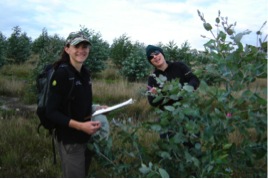
Trait assessments under way at the Eucalyptus globulus trial site by authors Christina Borzak (left) and Julianne O’Reilly-Wapstra (right).
Assessments of autumn gum moth damage showed that their presence was linked to marsupial browsing, with browsed plants being less susceptible to the insect herbivore. The majority of the effect was attributed to the indirect effects of browsing on tree height, where AGM were attracted to taller trees that were not browsed. Such indirect effects have the potential to influence biotic community structure on a foundation species host-plant, and the evolutionary interactions that occur between organisms and the host-plant themselves.

