Tag Archives: trees

Amazon carbon sink declines as trees grow fast, die faster Updated for 2026


Tropical forests are being exposed to unprecedented environmental change, with huge knock-on effects. In the past decade, the carbon absorbed annually by the Amazon rain forest has declined by almost a third.

At 6 million sq.km, the Amazon forest covers an area 25 times that of the UK, and spans large parts of nine countries. The region contains a fifth of all species on earth, including more than 15,000 types of tree.

Its 300 billion trees store 20% of all the carbon in the Earth’s biomass, and each year they actively cycle 18 billion tonnes of carbon, twice as much as is emitted by all the fossil fuels burnt in the world.

The Amazon Basin is also a hydrological powerhouse. Water vapour from the forest nurtures agriculture to the south, including the biofuel crops which power many of Brazil’s cars and the soybeans which feed increasing numbers of people (and cows) across the planet.

What happens to the Amazon thus matters to the world. As we describe in research published in Nature, the biomass dynamics of apparently intact forests of the Amazon have been changing for decades now with important consequences.

Is climate changing the Amazon?

There are two competing narratives of how tropical forests should be responding to global changes. On one hand, there is the theoretical prospect (and some experimental evidence) that more carbon dioxide will be ‘good’ for plants.

Carbon dioxide is the key chemical ingredient in photosynthesis, so more of it should lead to faster growth and thus more opportunities for trees and whole forests to store carbon. In fact almost all global models of vegetation predict faster growth and, for a time at least, greater carbon storage.

Arrayed against this has been an opposing expectation, based on the physical climate impacts of the very same increase in atmospheric CO2. As the tropics warm further, respiration by plants and soil microbes should increase faster than photosynthesis, meaning more carbon is pumped into the air than is captured in the ‘sink’.

More extreme seasons will also mean more droughts, slowing growth and sometimes even killing trees.

Which process will win?

The work we have led takes a simple approach. With many colleagues, we track the behaviour of individual trees through time across permanent plots distributed right across South America’s rain forests.

Together with hundreds of partners in the RAINFOR network, this close-up look at the Amazon ecosystem has been underway since the 1980s, allowing an unprecedented assessment of how tropical forests have changed over the past three decades.

Our analysis – based on work across 321 plots, 30 years, eight nations, and involving almost 500 people – first of all confirms earlier results. The Amazon forest has acted as a vast sponge for atmospheric carbon. That is, trees have been growing faster than they have been dying.

The difference – the ‘sink’ – has helped to put a modest brake on the rate of climate change by taking up an additional two billion tonnes of carbon dioxide each year.

This extra carbon has been going into ostensibly mature forests, ecosystems which according to classical ecology should be at a dynamic equilibrium and thus close to carbon-neutral.

Amazon trees are finding it harder to survive

However we also found a long and sustained increase in the rate of trees dying in Amazon forests that are undisturbed by direct human impacts.

Tree mortality rates have surged by more than a third since the mid-1980s, while growth rates have stalled over the past decade. This had a significant impact on the Amazon’s capacity to take-up carbon.

Recent droughts and unusually high temperatures in the Amazon are almost certainly behind some of this ‘mortality catch-up’. One major drought in 2005 killed millions of trees. However the data shows tree mortality increases began well before then. Some other, non-climatic mechanism may be killing off Amazonian trees.

The simplest answer is that faster growth, which is consistent with a CO2 stimulation, is now causing trees to also die faster. As the extra carbon feeds through the system, trees not only grow quicker but they also mature earlier. In short, they are living faster, and therefore dying younger.

Thus, 30 years of painstakingly monitoring the Amazon has revealed a complex and changing picture. Predictions of a continuing increase of carbon storage in tropical forests may be overly optimistic – these models simply don’t capture the important feed-through effect of faster growth on mortality.

Forests’ ability to store carbon is reducing

As the Amazon forest growth cycle has been accelerating, carbon is moving through it more rapidly. One consequence of the increase in death should be an increase in the amount of necromass – dead wood – on the forest floor.

While we haven’t measured these changes directly, our model suggests the amount of dead wood in the Amazon has increased by 30% (more than 3 billion tonnes of carbon) since the 1980s. Most of this decaying matter is destined to return to the atmosphere sooner rather than later.

More than a quarter of current emissions are being taken up by the land sink, mostly by forests. But a key element appears to be saturating.

This reminds us that the subsidy from nature is likely to be strictly time-limited, and deeper cuts in emissions will be required to stabilise our climate.


Published on #IntlForestDay, 21st March 2015.

Oliver Phillips is Professor of Tropical Ecology at the University of Leeds.

Roel Brienen is NERC Research Fellow at the University of Leeds.

This article was originally published on The Conversation. Read the original article.


The Conversation


391468

Arboricide in Palestine – olive orchard destroyed Updated for 2026


Palestinians in the South Hebron Hills awoke last Friday to find that 36 olive trees had been cut or seriously damaged during the night, probably by Israeli settlers.

The 25 year-old trees, owned by the Hushiy family from Yatta, were located near the village of Qawawis in the South Hebron Hills, between the Israeli illegal outpost of Mitzpe Yair and the Israeli settlement of Suseya, beside Bypass road 317.

This is the third incident of Israeli settler ‘price tag’ vandalism against the Palestinian inhabitants of the South Hebron Hills in the last two months.

On 9th January 2015, in the same area between the Bypass road 317 and Suseya settlement, Palestinians discovered nearly 200 olive trees cut on their property as well as established almond trees. Some days before, on 31st December, two settlers threw a Molotov cocktail into a Palestinian house in Ad Deirat village.

Palestinian residents of the South Hebron hills have suffered from the presence of Israeli settlers since the 70s. Ongoing settler violence deprives Palestinian families of security in daily life and restricts their freedom of movement. The violence and vandalism is also aimed at undermining the basis of their subsistence on the land.

By occupying Palestinian agricultural lands and destroying Palestinian olive trees, crops and property, Israeli settlers seek to deprive the Palestinians of their main livelihood. Olive trees are also of huge symbolic, cultural and historic significance to Palestinains, and represent their ‘rootedness’ in the land. As reported by Electronic Intifada in 2007:

“Universally regarded as the symbol of peace, the olive tree has become the object of violence. For more than forty years, Israel has uprooted over one million olive trees and hundreds of thousands of fruit trees in Palestine with terrible economic and ecological consequences for the Palestinian people.

“Their wilful destruction has so threatened Palestinian culture, heritage and identity that the olive tree has now become the symbol of Palestinian steadfastness because of its own rootedness and ability to survive in a land where water is perennially scarce.”

An illegal attack on Palestinian history, culture and livelihood

According to the Fourth Geneva Convention, the Hague Regulations, the International Court of Justice, and several United Nations resolutions, all Israeli settlements and outposts in the Occupied Palestinian Territories are illegal, despite Israel’s refusal to accept their application.

Most settlement outposts, including Havat Ma’on (Hill 833), are also considered illegal also under Israeli law, but even these are mostly tolerated by the authorities and protected from attempts by Palestinians to reclaim their land.

The destruction of the olive trees is also a specific violation of Article 54 of the 1977 Protocol to the 1949 Geneva Conventions, which prohibits the “starvation of civilians as a method of warfare”. It states:

“It is prohibited to attack, destroy, remove or render useless objects indispensable to the survival of the civilian population, such as foodstuffs, agricultural areas for the production of foodstuffs, crops, livestock, drinking water installations and supplies and irrigation works, for the specific purpose of denying them for their sustenance value to the civilian population or to the adverse Party, whatever the motive, whether in order to starve out civilians, to cause them to move away, or for any other motive.”

In the West Bank an estimated 100,000 Palestinian families depend on olive sales, and the olive harvest provides farmers with 25-50% of their annual income. Indeed for many it is essential to their survival.

Given the olive trees’ cultural value to Palestinians, along with the festivities and communal work that accompanies the olive harvest, their destruction also violates Article 53 of the 1977 Protocol, which prohibits “acts of hostility directed against the historic monuments, works of art or places of worship which constitute the cultural or spiritual heritage of peoples” and “to make such objects the object of reprisals.”

Despite their international obligations, Israeli police and army personnel rarely intervene when settlers cut down trees or commit other acts of vandalism.

Forbidden to plant olive trees on their own land

Indeed they carry out their own attacks on Palestinian civilians and their international supporters, as they did about a month ago on 23rd January when a group of Palestinians from Susiya village in the South Hebron Hills tried to plant olive trees on a plot of village land between the Israeli army base and the Israeli settlement of Suseya.

First the Israeli army declared the area a ‘closed military zone’ then they attacked the procession of about 150 people as it made its way towards the land, using stun grenades, tear gas, water cannon and physical and verbal violence. During the action, the Israeli forces arrested four Palestinians.

In spite of this most of the demonstrators reached the land and started to plant the olive trees. Immediately, Israeli soldiers and policemen pushed the crowd back towards Susiya village, again deploying stun grenades, tear gas and waer cannon, pushing and attacking the people, and arresting another two Palestinians.

A few days before, on 19th January, soldiers killed a sheep in the Tuba village area, while they were chasing away a flock owned by Palestinians. A day later Israeli soldiers arrested a 14 year-old Palestinian boy while he was grazing a flock near Maghayir Al Abeed village, and demolished four structures in the Ar-Rifa’iyya village.

“Despite attempts by settlers to force them from the area through violence and intimidation, the Palestinian communities of the South Hebron Hills remain strong in their commitment to nonviolent popular resistance against the Israeli occupation”, reports Operation Dove.


Action: Operation Dove has maintained an international presence in At-Tuwani and South Hebron Hills since 2004. It is a project of Italy-based Operazione Colomba, a project open to all people, believers and nonbelievers, who believe that nonviolence is the only way to get a true Peace, based on truth, justice, forgiveness and reconciliation. Its principles are:

  • Nonviolence: an active and creative strength which comes to life through various actions such as interposition, accompaniment, mediation, advocacy, protection, reconciliation, animation …
  • Sharing life: volunteers share their lives with the victims of both parts of the conflict, no matter the ethnic group, the religion or political view …
  • People involvement: the few requirements to be a volunteer are: the will to live in a nonviolent way, the ability to live in a group, to be of age and finally to take part in the training course.


390771

Herbivory response to global warming Updated for 2026

Experimental warming is an effective approach to determine the effect of increasing temperature on ecological processes, with few confounding factors (e.g., other variables that covary spatially and temporally with temperature). Therefore, a number of field experiments have been initiated worldwide to study the effects of simulated global warming. A wide range of techniques (e.g., greenhouses, open-top chambers, and electric infrared heaters) have been developed to experimentally warm a variety of small plants, including those of the tundra, grasslands, and sapling trees. Within forests, most insect species diversity and plant-insect interactions are concentrated in the canopy of mature trees, rather than in the understory, because of higher plant productivity. However, few studies have examined the responses of mature trees to experimental warming in natural forests.

Bild1

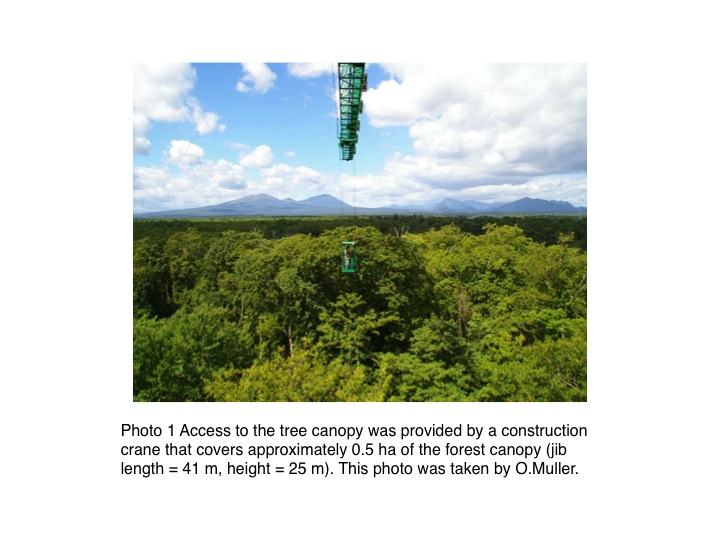
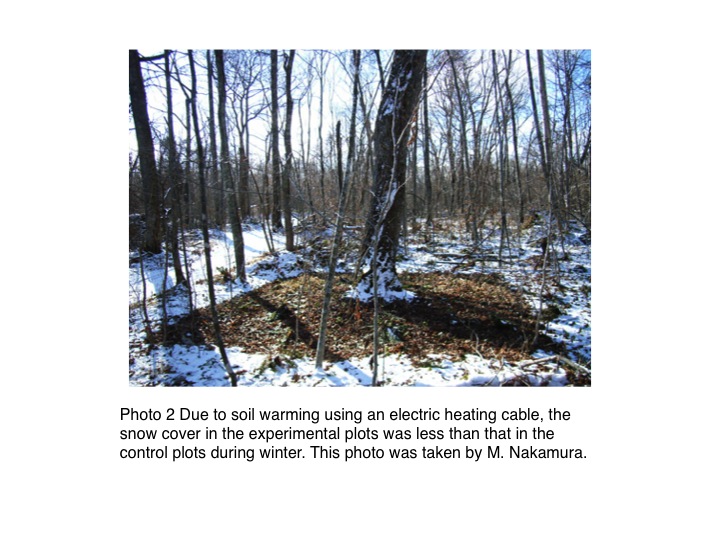
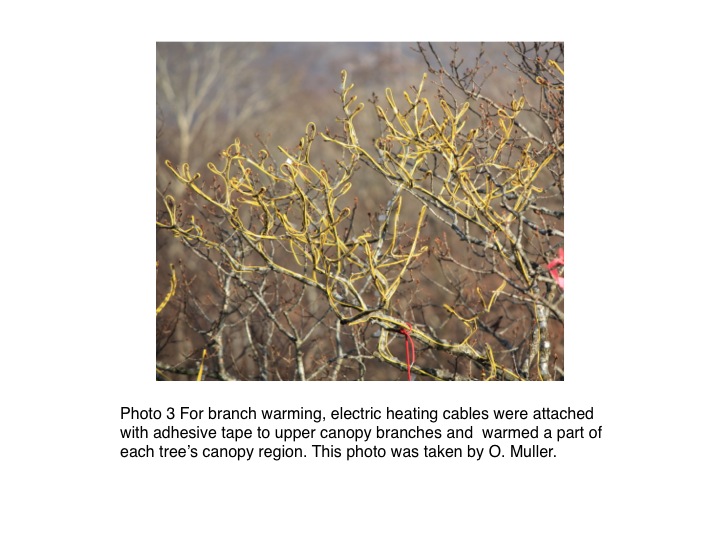
In the paper “Different initial responses of the canopy herbivory rate in mature oak trees to experimental soil and branch warming in a soil-freezing area”, we report the initial 3-year (2007–2009) results of an experimental warming of mature Quercus crispula (18–20 m in height), a late-successional tree species. Five mature Q. crispula trees whose canopy was accessible by a gondola hanging from a construction crane were selected (Photo1). To better understand the mechanism by which global warming affects plant-insect interactions in the canopy of mature oak trees, field experiments must warm aboveground and belowground regions separately. Thus, we experimentally increased the temperature of the surrounding soil and canopy branches of mature oak trees by approximately 5°C using electric heating cables (Photo 2 and 3).

Bild2

Our warming experiment clearly demonstrates that plant-insect interactions in the canopy responded differently to soil and branch warming of mature oak trees. Soil warming in a mature cool-temperate forest with a freeze-thaw cycle decreased the nutritional quality of leaves and the rate of herbivory in the canopy, whereas branch warming had no effect on canopy leaf traits or the herbivory rate. The magnitude of the indirect (plant-mediated) effects of belowground temperature elevation on canopy herbivory was gradually enhanced during the initial 3 years of the study. These results suggest that belowground temperature elevation due to global warming in a soil freezing area is an important driving force of plant-insect interactions in the canopy. For a better understanding of the mechanism by which global warming affects plant-insect interactions in mature cool-temperate forests, this warming experiment should be continued using mature oak trees because indirect effects of temperature are likely more pronounced in the long- than in the short-term.

Bild3

Masahiro Nakamura and co-workers