Tag Archives: food

All out for November 4th: GMO fight at the crossroads Updated for 2026


On November 4, final votes will be tallied in two hard-fought and highly publicized state mandatory GMO food labeling ballot initiatives: Measure 92 in Oregon and Initiative 105 in Colorado.

It is no exaggeration to say that these two crucial ballot initiatives will quite likely determine the future of chemical-intensive, genetically engineered agriculture in North America.

Despite the fact that the Gene Giants (Monsanto Dupont, Dow, Syngenta, BASF, and Bayer), backed by the world’s largest junk food manufactures (Coca Cola, Pepsi, Kraft, General Mills, Kellogg’s), have spent over $30 million to mislead and confuse voters in these two states, latest indications are that voters in at least one state, Oregon, will vote for mandatory labeling.

Voters in Colorado (where the Yes on GMO labeling forces have been outspent 25-to-1) are waging a valiant struggle against overwhelming odds.

Victory in any state wil be victory in all states

What is important to understand is that a victory in either of these two front line states will be decisive.

A David versus Goliath victory in either Oregon or Colorado, coupled with the previous strategic victory for GMO labeling in Vermont in May (2104) will mark the beginning of the end for Monsanto and its allies.

And a victory would be further amplified by Chipotle and Whole Foods Markets’ pledge that all GMO-tainted foods (including meat, eggs and dairy) will soon be labeled in their restaurants and stores.

Despite massive lobbying and a lawsuit filed against the state by Big Food and GMO companies, Vermont passed the nation’s first mandatory GMO food labeling law in May 2014. Vermont’s law also prohibits labeling GMO-tainted foods as ‘natural’.

And although the Vermont law (which goes into effect in 2016) is legally enforceable only inside the state’s borders, this law (along with others such as Oregon) will have an enormous national impact.

Large food and beverage and supermarket brands (Coca-Cola, Pepsi, Kraft, Nestle, Unilever, Nestle, General Mills, Kellogg’s, Conagra) whose products contain GMO ingredients will not be able, in terms of public relations, to just label their products as containing GMOs in Vermont, while denying consumers in the other 49 states this information.

If forced to label (or to reformulate their products to get rid of GMOs, as they’ve done in Europe) in Vermont, Big Food will have to do the same in all 50 states, and Canada as well. This is why the Grocery Manufacturers Association and the International Dairy Foods Association have sued Vermont in federal court to try to get the labeling law reversed.

Americans are overwhelmingly ‘GMO-skeptic’

Since genetically engineered (GE) crops and foods were forced onto the market in the 1990s by Monsanto and the FDA, with no pre-market safety testing and no labels required, consumers have mobilized to either ban or to require mandatory labeling of these ‘Frankenfoods’.

Survey after survey has shown that Americans, especially mothers and parents of small children, are either suspicious of, or alarmed by, unlabeled GMO foods.

This is understandable given the toxic track records of the chemical companies pushing this technology, as well as the mounting scientific evidence that these controversial foods and crops-and the toxic herbicides and insecticides sprayed on them or laced into their cells-severely damage or kill birds, bees, butterflies, lab rats, farm animals and no doubt, humans.

Most polls indicate that 90% of Americans want to know whether their food has been genetically engineered or not, even though massive advertising by the Frankenfood lobby has brainwashed millions of consumers into believing that state-mandated GMO labels will raise grocery store costs or hurt small producers. In Europe where GMO labeling is mandatory, GMO foods and crops have been nearly driven from the marketplace.

Fear and anger against Frankenfoods have spawned an unprecedented national grassroots Movement that has persevered for over two decades, despite hundreds of millions of dollars spent by the GMO and junk food industries to buy off federal and state lawmakers and regulatory agencies.

The GE lobby in recent years has waged vicious anti-labeling propaganda campaigns against grassroots-powered ballot initiatives in California (2012), Washington State (2013), Oregon (2014) and Colorado (2014).

Unfortunately for Monsanto and big food interests, most legal analysts predict that Vermont’s carefully written law will stand up in court. But once Oregon (and perhaps) Colorado pass similar laws to the one in Vermont, it will be ‘game over’ for large food corporations and supermarket chains hell-bent on keeping consumers in the dark about hidden GMOs in their foods.

Responsible corporations joining the movement

Of perhaps equal importance to Vermont’s law, consumer pressure has prompted the nation’s largest retailer of organic and natural foods, Whole Foods Market, to announce that all 40,000 or so food items in its stores will have to be labeled by 2018 if they contain GMOs. The labeling policy includes meat, eggs, dairy and all deli or take-out items.

Again, although this policy will only affect the 40,000 or so food products sold in WFM stores, brands selling to Whole Foods will suffer a public relations disaster if they are forced to label their items in WFM as GMO-tainted, but then refuse to do so in other stores.

Many of the thousands of suppliers to Whole Foods are now racing to get GMOs out of their products so they won’t have to put the proverbial GMO ‘skull and crossbones’ on their products in 2018.

On the restaurant front, consumer pressure has forced the highly profitable Chipotle restaurant chain to make a similar promise.

Other grocery brands and restaurant chains (most of whom are watching their profits decrease, while WFM’s and Chipotle’s rise) will shortly be facing enormous pressures from their customers to do the same.

Next, the debate will ‘go Federal’

Beyond November 4, additional states are likely to pass ballot initiatives or state legislation over the next year. Given the cumulative impact of these victories for consumer power, Monsanto and Big Food’s minions in the federal government face a difficult dilemma.

Do they allow these state labeling laws to stand, thereby drastically reducing the presence of GMO foods in the marketplace and set what to them appears to be a dangerous precedent for consumer power?

Or will they move to thwart the people’s will and stomp on state’s rights by passing a federal GMO labeling bill that is industry-friendly, voluntary, and patently dishonest?

And of course with the 2016 Presidential campaign fast approaching, Hillary Clinton, Elizabeth Warren, Jeb Bush, Rand Paul and others aspiring to be President will be facing the same dilemma. Are you with us or against us?

So far only one national leader likely running for President, Bernie Sanders, Senator from Vermont, has come out for states rights’ to require mandatory GMO labeling.

There is indeed currently an industry-sponsored bill languishing in the US House of Representatives, the Pompeo bill, that will

  1. take away the right of states to pass mandatory GMO labeling laws;
  2. take junk food companies off the hook by making GMO labeling voluntary; and
  3. make it legal to continue the fraudulent industry practice of labeling or marketing GMO-tainted foods as ‘natural’ or ‘all natural’.

The Pompeo ‘Monsanto Bill’ is so blatantly anti-consumer and unpopular that it has so far managed to attract very few co-sponsors in the House, and has generated no corresponding bill in the Senate.

Still, we should not underestimate the power of the Gene Giants and Big Food – not to mention the treachery of indentured elected public officials and the White House.

Recent moves by Monsanto’s Minions in Washington (including approving Agent Orange crops and negotiating secret international trade deals) make it clear that many of them are quite willing to abolish democracy, if necessary, in order to protect the massive profits of their paymasters, the big corporations.

Future labelling demands will only grow

Notwithstanding future battles with the Washington Establishment, November 4 will likely prove decisive, setting the stage for future, even more comprehensive consumer right-to-know campaigns.

These future campaigns, now percolating behind the scenes, will include the demand for labels on meat and animal products coming from factory farms, where the animals are routinely fed GMOs, antibiotics, growth hormones and slaughterhouse waste (including manure and blood).

This forthcoming factory farm right-to-know campaign, will expose the horrors of the entire US food and farming system, and hopefully over time move the country away from an out-of-control food and farming system that is destroying not only public health, and the health of billions of farm animals, but the fundamental health of the environment and the climate that are necessary for human survival.

At the same time we organize to change public policies through grassroots lobbying and ballot initiatives, we must continue to educate and mobilize consumers in the marketplace to pressure stores and brands to label and or remove GMO and factory farmed foods from the marketplace.

Part of this campaign will be to spread the ‘Traitor Brands’ boycott whereby consumers have begun boycotting the products of food companies who are members of the Grocery Manufactures Association, the industry front group opposed to consumers right-to-know.

The key to driving GMOs into the margins, and moving away from the ‘fatal harvest’ of industrial agriculture, is public education and grassroots mobilization, both online and on the ground.

Likewise the key to stopping the federal government from pre-empting state GMO labeling laws is to create so much public awareness that politicians will be afraid to thwart the people’s will.

America’s contemporary food fight is not just a battle for health and sustainability, but a fundamental struggle over whether we and our children will live in a Democracy or a Corporatocracy.

All out for November 4th!


Action: please make a donation or volunteer to get out the vote.

Ronnie Cummins is international director of the Organic Consumers Association and its Mexico affiliate, Via Organica.

This article was originally published by the Organic Consumers Association.

More: for related articles and more information, please visit OCA’s Genetic Engineering page and our Millions Against Monsanto page.


386222

The great Hallowe’en pumpkin rescue Updated for 2026


An estimated 18,000 tonnes of pumpkin was sent to landfill sites in the UK last Hallowe’en, which is why new the environmental organisation Hubbub has launched the #pumpkinrescue campaign to inform people about the amount of edible food that gets sent to landfill.

New research by Populus shows that nearly two thirds (64%) of people throw their pumpkins away once Halloween is over. More than half (52%) of those who buy pumpkins would welcome more recipes to decrease waste.

18,000 tonnes of pumpkin is the same weight as 1,500 double decker buses – and if made into pumpkin pie it could make 360 million portions!

It’s a shocking fact that demonstrates how much edible food is thrown away throughout the country, at a time when an estimated 5.8 million people are living in deep poverty.

In the UK we throw away over 7 million tonnes of edible food and drink from our homes each year, according to WRAP. Wasting edible food costs the average UK family £60 a month, and when food is sent to landfill it emits harmful greenhouse gases which contribute to climate change.

Glowing pumpkins of the night,
Ours to eat! Not just to fright …

To encourage consumers to think about the food they throw away and teach them new skills to combat waste, Hubbub has launched the #pumpkinrescue campaign and is hosting the Oxford Pumpkin Festival – which continues until 9th November.

Local restaurants, farmers, retailers, food banks, school children and students will all be involved in a series of events – including an outdoor mini food festival, communal soup making, immersive performances and cooking workshops.

There’s also a tweetathon using #pumpkinrescue today, Friday 31st October.

As my colleague Trewin Restorick, Hubbub‘s founder and CEO, says: “Hallowe’en is increasingly popular in the UK, but we seem to have ignored a crucial part of the US tradition: cooking with pumpkins rather than throwing them in the bin. With household food budgets under pressure, and 18,000 tonnes sent to landfill each year, it’s time we rescued the pumpkin.”

“Pumpkin Rescue aims to help consumers think about the food they throw away – providing recipes and new skills to help tackle food waste.”

The #pumpkinrescue manifesto

To support the launch of #pumpkinrescue, Hubbub has launched a five-point manifesto, which calls on communities, retailers and the Government to take action to end food waste.

  1. All supermarkets to make publicly available the amount of food waste they create and detail what happens to it.  These figures should be independently verified and consistent so that the public can accurately compare supermarket performance.
  2. All supermarkets to ensure safe and healthy surplus food is redistributed to those on low incomes and to actively work with charities to make this happen.
  3. English local authorities to follow the lead set by the rest of the UK and increase domestic food waste collection provision from a fifth to all households by 2020.
  4. Government to increase their investment in the Love Food Hate Waste campaign which is successfully cutting food waste.
  5. To increase consumer awareness of the benefits of freezing food that would otherwise be thrown away saving them £250 a year and reducing domestic food waste by 47%.

And with many households simply not knowing how to turn all their Hallowe’en pumpkins into delicious edible form, we are promoting these fantastic #pumpkinrescue recipes to help you get the most out of them. Enjoy!

Ainsley’s Spiced Pumpkin Cake

Ingredients: 250g plain flour / 1 tsp bicarb of soda / 1 tsp cinnamon / ¼ tsp ground cloves / 1 ½ tsp ground ginger / ½ tsp allspice / Pinch of salt / 150g soft brown sugar / 60g softened butter / 1 large egg / 150g molasses or black treacle / 120ml boiling water / 200g pumpkin flesh

For the pumpkin puree, cut the pumpkin into quarters, then peel and cut into chunks. Place in a large saucepan, cover with water, bring to the boil and cook for 20 minutes or until tender. Drain, cool, then puree in a food processor or mash with a potato masher.

Preheat oven to 180°C/350°F/Gas 4. Grease and line a 20cm/8inch deep cake tin. Sift flour, bicarb, ginger, spices and salt into a large bowl. Stir the molasses / treacle into the boiling water until well combined, then stir in 200g of pumpkin puree.

Beat together the butter and sugar until pale, add the egg and continue to beat until light and fluffy. Gradually mix in the pumpkin and egg mixture into the dry ingredients until well combined. Do not over mix.

Pour into the cake tin and bake in the middle of the oven for 45-50 mins or until an inserted skewer comes out clean. Cool on a wire rack and serve with custard or coconut custard. Serves 8.

Recipe provided by Ainsley Harriet.

Rubies’ Pumpkin Chutney

Ingredients: 750g 1cm diced pumpkin / 500g sugar / 400ml cider vinegar / 1 large onion, chopped / 2 tsp dried chilli flakes / 1 tsp paprika / 80g fresh ginger / 1 tsp cinnamon powder / 150g sultanas / 400g apple, peeled and 1cm diced / 1 tbsp oil / handful of pumpkin seeds (optional)

Put the oil in a pan with the chilli flakes, cinnamon, fresh ginger (and pumpkin seeds if adding). Heat through being careful the spices don’t burn.

Add the chopped onion and cook through for 5 mins, then add the vinegar, sultanas and sugar. Stir until boiling and the sugar dissolves. Add the pumpkin and apple and cook until the chutney is thick and the pumpkin is cooked through (this could take 2 hours). 

Taste and vary spices according to your liking, then jar in to dry, clean jars and start decorating your label! Happy Pumpkin preserving!

Recipe provided by Rubies in the Rubble.

Tom’s Pumpkin, Ricotta and Ginger Tarts

Pumpkin Puree: 200g of rough dice pumpkin / 25g of shallots / knob of butter / 150ml of double cream / 10g of ginger, grated / 1 pinch of salt / 3 pinches of pepper

Pastry: 125g plain flour / 1 pinch of salt / 55g butter, cubed / 2-3 tbsp cold water

Pumpkin & Ricotta: 100g of 2cm dice pumpkin / 15mls of olive oil / 2 sprigs of picked thyme / 1 pinch of salt / 3 pinches of pepper / 100g ricotta cheese

Filling: 50g crème fraiche / 50ml whole milk / 50ml double cream / 2 eggs

Puree: Peel and de-seed the pumpkin and cut into a rough dice. Sweat off the shallots in the butter, then add the squash and ginger and gently cook for approximately 5 minutes in an oiled pan. Add the cream and cook until the pumpkin is tender, then strain off the cream and blend the squash to a puree – add back some of the strained cream if needed to give it a smooth consistency.

Pastry: Put the flour and salt in a large bowl and add the cubes of butter. Rub the butter into the flour until you have a mixture that resembles breadcrumbs. Stir in just enough cold water to bind the dough. Wrap the dough in clingfilm and chill for 10-15 mins.

Pumpkin and Ricotta: Peel and dice the pumpkin, place in a large bowl, dress with olive oil, thyme and seasoning, place on a large tray and cover with foil. Cook at 160°C until tender. Crumble the ricotta and leave to one side until ready to assemble.

Main filling: Whisk all the ingredients together in a large bowl.

To assemble: Line 4 individual tart tins with the pastry, then pour 1tbsp of puree in each tin and spread it around the pastry bottom using the back of a spoon. Sprinkle the pumpkin and ricotta over the top of the puree, then pour in the filling. Add the final small spoonful’s of the pumpkin puree on top and garnish with the thyme. Bake the tarts in the oven at 160°C for 15 minutes.

Recipe provided by Tom Aikens / Tom’s Kitchen.


Gavin Ellis is one of the Founders of Hubbub. Previously Gavin was Senior Client Manager at Global Action Plan, one of the UK’s leading environmental charities. There he led major environmental behaviour change campaigns with clients such as Sainsbury’s, Telefonica and Unilever. Prior to that Gavin was Marketing Manager at Global Action Plan. He also set up the UK’s first online carbon calculator and the UK’s first environmental lifestyle magazine Ergo.

Twitter: @hubbubuk

More pumpkin recipes on these Facebook group pages:


386191

The future of family farming is in our hands Updated for 2026


Family farming is a hot topic this year. The Food and Agriculture Organisation (FAO) of the United Nations has declared 2014 the International Year of Family Farming. And last week, family farming was the focus of World Food Day 2014.

Of course there’s is no guarantee that a family farm is well-run or sustainable. But the best farms – those that best preserve traditional food and culture, contribute to balanced and culturally appropriate diets, maintain agricultural biodiversity and use natural resources sustainably – tend to be family farms.

That is, farms that are managed, worked and often (but certainly not always) owned by a family and its members.

This year’s focus on family farming is both wise and welcome. In both ‘developing’ and ‘developed’ countries it is the predominant mode of food production, and it is essential in providing both national and global food security.

The FAO has found that worldwide, family farms are responsible for at least 56% of agricultural production, and that family farmers are more productive per hectare than industrial monocultures – despite receiving lower subsidies and using fewer chemical and fossil fuel inputs. Check out this great infographic for more information

But around the world, fami8ly farming is under threat

However, the future of family farming, and therefore of food security, is under threat. A World Economic Forum document from 2012 warned of a future where the contribution of small-scale farmers to world food production will drop from 40% to 0% by 2030, and be replaced with large-scale industrial monocultures.

Such reports do not address the massive effects this change will have on the local economic and social structure in countries around the world.

There is no clear policy in place to deal with the millions of farmers who have already lost their livelihoods to land grabbing and the numbers will rise if more small-scale family farms are allowed to disappear.

The UK government is a case in point. It claims to support sustainable agricultural production – yet its trade policies and international aid programme benefit multinational corporations at the expense of smallholders.

These policies facilitate corporate land grabs, the criminalisation of local seed exchange allowing companies like Monsanto and Syngenta to dominate seed markets, and favour high-input industrial monocultures of non-food cash crops for export.

Such initiatives include the G8’s New Alliance on Food Security and Nutrition and the Trans-Atlantic Trade and Investment Partnership (TTIP).

Defra’s attack on small, sustainable farmers in the UK

Domestic policies that damage small-scale farming that have been pushed by the Department for Environment, Food and Rural Affairs (Defra) include the cancellation of subsidies for any agricultural holding less than five hectares / 12 acres.

This immediately excludes a large number of smallholders, many of which can be extremely productive and profitable (as shown by research from the Ecological Land Cooperative showing a livelihood can be made on 10 acres or less).

At the same time Defra was lobbying against EU proposals to cap subsidy payments to large landowners at €300,000 per year.

“Defra policy is increasingly driven by the demands of big business and large landowners”, says Dan Taylor from the Land Workers’ Alliance (LWA), a national coalition of producers and member organisation of the international peasant farming movement La Via Campesina.

“We have seen clear examples of this with their recent decision to strip small farmers of entitlements to public support while at the same time refusing to limit payments to the country’s biggest industrial producers. As a referee for UK farming, Defra is not only short sighted but inherently biased.”

Food sovereignty

If we are really serious about the future of family farming we need food sovereignty – the ‘right of peoples to define their own food systems’ – to protect family farmers and reclaim control of the world’s food supply.

Food sovereignty puts the people who produce, distribute and consume food at the heart of decisions around food policy and practice, rather than the markets and corporations that have come to dominate the global food system.

A policy environment that supports food sovereignty would include measures to support small-scale farmers that ensure access to markets for their produce, strengthen land tenure rights and improve access to appropriate new technologies that can increase production and build resilience.

It would also mean improving the transparency of the food chain to allow people to know more about where their food came from and how it was produced.

The Pig Pledge

Farms Not Factories is one organisation working to engage and empower consumers to put food sovereignty into practice.

The Pig Pledge campaign, launched last week by Farms Not Factories to coincide with World Food Day, targets consumer habits as a method of supporting real farming over intensive livestock production.

It is a call to collective action, which urges people to pledge to boycott meat from animal factories and instead support real (and mostly family) farms by buying only ethically produced, high welfare pork.

The campaign focuses on the pig industry to highlight injustices in the global food system – from the unfair advantages agribusiness has over small-scale producers, to the environmental, economic and social destruction caused by intensive animal factories and big agribusiness.

Supporting food sovereignty through buying meat from real farms, not animal factories, will enable producers to prioritise animal welfare and contribute to agricultural biodiversity and the sustainable use of natural resources.

By taking the Pig Pledge, informing ourselves about the true costs of intensive industrial farming and changing our shopping habits to support the principles of food sovereignty, consumers will be sending a clear message to government, big agribusiness and retailers:

“We want to take control of our food systems. The future of sustainable family farming is in our hands – we must support the food sovereignty movement in order to create a good policy environment in which family farming can prosper.”


Take the Pig Pledge: pigpledge.org/

Follow us on Twitter: twitter.com/pigbusiness

Like us on Facebook: facebook.com/FarmsNotFactories

Holly Creighton-Hird is Campaigns Coordinator at Farms Not Factories, a nonprofit organisation working through filmmaking and campaigning to support the food sovereignty movement. She is currently working on the Pig Pledge, a new campaign exposing the true costs of meat from animal factories and inspiring people to make food choices that enable fairer food and farming systems. She also campaigns on food and access to land with Transition Heathrow and the Food Sovereignty Movement UK.

The Food and Agriculture Organisation (FAO) of the United Nations has declared 2014 the International Year of Family Farming.


385582

Scotland: time for a National Food Service? Updated for 2026


Scotland’s brief period at the top of the international news agenda last month is over, for now. But the debate leading up to the independence referendum revealed a huge desire to make Scotland a better place.

Since the referendum, thousands of Scots have joined political parties for the first times in their lives, and the networks formed during the campaign are busy planning for the future. Conversations about change are continuing.

This Thursday and Friday in Glasgow, farmers from Scotland, India, Malawi and Trinidad and Tobago and campaigners from Canada and California will join nutritionists, climate scientists and experts on food poverty and food banks at the Nourish Scotland conference to discuss how to make food in Scotland better, fairer, healthier and more sustainable.

Only one in five Scots get their ‘five a day’

It’s a formidable challenge. More than a quarter of people in Scotland are obese. Only one in five adults eats five portions of fruit and vegetables per day, and Scots eat less fruit, vegetables and fish than their English neighbours.

There is a huge and growing inequality of diet between rich and poor, and the number of people using food banks has risen sharply in the past two years. Supermarkets dominate food retail, and highly processed food features prominently in many people’s diets.

Industrial farming methods are harming soil quality and biodiversity. Meanwhile 40% of Scotland’s food is imported, with serious implications for our carbon footprint and for our impact on the lives of others.

But the resources available are also impressive. Despite its high rate of imports, Scotland is a net exporter of food, producing far more than it eats. The seas around Scotland are rich in fish and seafood. There is plenty of arable land – around the same area per person as in India, which produces almost all of its own food.

To grow enough vegetables for everyone in Scotland to eat the recommended quantity would require an area of land smaller than that taken up by Scotland’s urban gardens.

A more holistic food policy

Change is required on many different levels if we are to make sure everyone in Scotland can eat well, as well as playing our part in ensuring everyone in the world can eat well, without trashing the planet.

Crucially, we need to look at our food system as a whole. For many years, government policy on food production in Scotland has been all about profit and export – and the food industry has been allowed to pursue ever greater profit regardless of the social, environmental and health impact in Scotland and beyond.

Nutrition has been seen largely as the responsibility of individuals, with government providing dietary advice but making little attempt to make healthy food more available and affordable.

The Scottish government has started to take small steps towards a more holistic food policy. For example, it has committed to extending the provision of free school meals, and improving the quality of food in schools and hospitals.

Food, and the land that produces it, as common goods?

Land – intimately bound up with food – is also receiving some long overdue attention.

Distribution of land in Scotland is more unequal than anywhere else in Europe, with fewer than one thousand people owning half of all land. Many landowners use their land for recreational hunting, shooting and fishing, rather than for food production.

The Scottish government has promised to make land distribution fairer, and a recent government study recommended limiting the size of landholdings and giving tenant farmers the right to buy the land they farm.

Legislation introduced in 2003 to help communities acquire land has already allowed 500,000 acres of land to come under community ownership, and a target of a million acres has been set for 2020.

A new strategy published for consultation this year, entitled ‘Becoming a Good Food Nation’, sets out aspirations for government policy to focus on health, particularly for children, and to support the production and sale of locally grown food, including through public sector food buying.

These are steps in the right direction, and the impetus towards a fairer, more sustainable food system is being driven forward by a diverse movement of small farmers and food businesses, community gardens, and networks established to increase access to affordable, healthy, local food.

However, the reality is that food remains overwhelmingly dominated by big, global businesses, which focus on profit, not on feeding people well or on preserving the planet for future generations.

There are, to be sure, positive initiatives by big business, for example to reduce salt content in foods and to use less packaging. But with food being primarily driven by profit, such voluntary programmes cannot bring about the huge changes we need.

If we started treating food as a common good, and farming and food production as services delivering good nutrition, good work, strong communities and healthy, biodiverse, resilient environments, we could create the potential for profound positive transformation.

Vegetables on prescription?

In Scotland, this could lead to farmers having a similar role as GPs (‘general practitioners’ – family doctors) do in the National Health Service: GPs are public servants at the same time as being small to medium enterprises. Vegetables could be available on prescription, and subsidised for low-income families.

It could mean people sharing responsibility for food production, as citizens not just consumers, with much more of our food coming from allotments, community gardens and farms in and around cities.

Government could adopt a zero-tolerance approach to hunger in Scotland, monitoring it, measuring it, and finding a better long-term solution than food banks.

Small-scale, organic, sustainable farming could be supported through public subsidies, and food policy focused on production for local people rather than for export. Trees could be planted on pasture, reducing the risks of soil erosion and flooding.

We could introduce rules to help ensure the food we do import is produced to high social and environmental standards.

These are just a few of the many, many things we could do to radically reshape food in Scotland for the better. Food sustains and nourishes not just individuals but also families, communities and our whole society. It’s too important to be left to the market.


The conference: Nourish Scotland takes place in Glasgow this week on 16th and 17th October 2014.

Pete Ritchie is the director of Nourish Scotland. Nourish aims to reshape the way food works in Scotland into a system that’s fair, healthy, affordable and sustainable.

Miriam Ross is a freelance writer and researcher.


385475

UN: only small farmers and agroecology can feed the world Updated for 2026


Modern industrial agricultural methods can no longer feed the world, due to the impacts of overlapping environmental and ecological crises linked to land, water and resource availability.

The stark warning comes from the new United Nations Special Rapporteur on the Right to Food, Prof Hilal Elver, In her first public speech since being appointed in June

“Food policies which do not address the root causes of world hunger would be bound to fail”, she told a packed audience in Amsterdam.

One billion people globally are hungry, she declared, before calling on governments to support a transition to “agricultural democracy” which would empower rural small farmers.

Agriculture needs a new direction: agroecology

“The 2009 global food crisis signalled the need for a turning point in the global food system”, she said at the event hosted by the Transnational Institute (TNI), a leading international think tank.

“Modern agriculture, which began in the 1950s, is more resource intensive, very fossil fuel dependent, using fertilisers, and based on massive production. This policy has to change.

“We are already facing a range of challenges. Resource scarcity, increased population, decreasing land availability and accessibility, emerging water scarcity, and soil degradation require us to re-think how best to use our resources for future generations.”

The UN official said that new scientific research increasingly shows how ‘agroecology’ offers far more environmentally sustainable methods that can still meet the rapidly growing demand for food:

“Agroecology is a traditional way of using farming methods that are less resource oriented, and which work in harmony with society. New research in agroecology allows us to explore more effectively how we can use traditional knowledge to protect people and their environment at the same time.”

Small farmers are the key to feeding the world

“There is a geographical and distributional imbalance in who is consuming and producing. Global agricultural policy needs to adjust. In the crowded and hot world of tomorrow, the challenge of how to protect the vulnerable is heightened”, Hilal Elver continued.

“That entails recognising women’s role in food production – from farmer, to housewife, to working mother, women are the world’s major food providers. It also means recognising small farmers, who are also the most vulnerable, and the most hungry.

“Across Europe, the US and the developing world, small farms face shrinking numbers. So if we deal with small farmers we solve hunger and we also deal with food production.”

And Elver speaks not just with the authority of her UN role, but as a respected academic. She is research professor and co-director at the Project on Global Climate Change, Human Security, and Democracy in the Orfalea Center for Global and International Studies, University of California, Santa Barbara.

She is also an experienced lawyer and diplomat. A former founding legal advisor at the Turkish Ministry of Environment, she was previously appointed to the United Nations Environment Program (UNEP) Chair in Environmental Diplomacy at the Mediterranean Academy of Diplomatic Studies, University of Malta.

Industrial agriculture grabs 80% of subsidies and 90% of research funds

Hinting at the future direction of her research and policy recommendations, she criticised the vast subsidies going to large monocultural agribusiness companies. Currently, in the European Union about 80% of subsidies and 90% of research funding go to support conventional industrial agriculture.

“Empirical and scientific evidence shows that small farmers feed the world. According to the UN Food & Agricultural Organisation (FAO), 70% of food we consume globally comes from small farmers”, said Prof Elver.

“This is critical for future agricultural policies. Currently, most subsidies go to large agribusiness. This must change. Governments must support small farmers. As rural people are migrating increasingly to cities, this is generating huge problems.

“If these trends continue, by 2050, 75% of the entire human population will live in urban areas. We must reverse these trends by providing new possibilities and incentives to small farmers, especially for young people in rural areas.”

If implemented, Elver’s suggestions would represent a major shift in current government food policies.

But Marcel Beukeboom, a Dutch civil servant specialising in food and nutrition at the Ministry of Trade & Development who spoke after Elver, dissented from Elver’s emphasis on small farms:

“While I agree that we must do more to empower small farmers, the fact is that the big monocultural farms are simply not going to disappear. We have to therefore find ways to make the practices of industrial agribusiness more effective, and this means working in partnership with the private sector, small and large.”

A UN initiative on agroecology?

The new UN food rapporteur’s debut speech coincided with a landmark two-day International Symposium on Agroecology for Food and Nutrition Security in Rome, hosted by the FAO. Over 50 experts participated in the symposium, including scientists, the private sector, government officials, and civil society leaders.

A high-level roundtable at the close of the symposium included the agricultural ministers of France, Algeria, Costa Rica, Japan, Brazil and the European Union agricultural commissioner.

FAO Director-General José Graziano da Silva said: “Agroecology continues to grow, both in science and in policies. It is an approach that will help to address the challenge of ending hunger and malnutrition in all its forms, in the context of the climate change adaptation needed.”

A letter to the FAO signed by nearly 70 international food scientists congratulated the UN agency for convening the agroecology symposium and called for a “UN system-wide initiative on agroecology as the central strategy for addressing climate change and building resilience in the face of water crises.”

The scientists described agroecology as “a well-grounded science, a set of time-tested agronomic practices and, when embedded in sound socio-political institutions, the most promising pathway for achieving sustainable food production.”

More than just a science – a social movement!

A signatory to the letter, Mindi Schneider, assistant professor of Agrarian, Food and Environmental Studies at the Institute of Social Studies (ISS) in The Hague, said:

“Agroecology is more than just a science, it’s also a social movement for justice that recognises and respects the right of communities of farmers to decide what they grow and how they grow it.”

Several other food experts at the Transnational Institute offered criticisms of prevailing industrial practices. Dr David Fig, who serves on the board of Biowatch South Africa, an NGO concerned with food sovereignty and sustainable agriculture, said:

“We are being far too kind to industrialised agriculture. The private sector has endorsed it, but it has failed to feed the world, it has contributed to major environmental contamination and misuse of natural resources. It’s time we switched more attention, public funds and policy measures to agroecology, to replace the old model as soon as possible.”

Prof Sergio Sauer, formerly Brazil’s National Rapporteur for Human Rights in Land, Territory and Food, added: “Agroecology is related to the way you relate to land, to nature to each other – it is more than just organic production, it is a sustainable livelihood.

“In Brazil we have the National Association of Agroecology which brings together 7,000 people from all over the country pooling together their concrete empirical experiences of agroecological practices. They try to base all their knowledge on practice, not just on concepts.

“Generally, nobody talks about agroecology, because it’s too political. The simple fact that the FAO is calling a major international gathering to discuss agroecology is therefore a very significant milestone.”


Dr. Nafeez Ahmed is an investigative journalist, bestselling author, and international security scholar. He is a regular contributor to The Ecologist and The Guardian where he writes about the geopolitics of interconnected environmental, energy and economic crises. He has also written for The Independent, Sydney Morning Herald, The Age, The Scotsman, Foreign Policy, Prospect, New Statesman, Le Monde diplomatique, among many others. His new novel of the near future is ZERO POINT.

Follow him on Twitter @nafeezahmed and Facebook.

Website: www.nafeezahmed.com


384405

Finding the food in complex environments Updated for 2026

Many animals locate resources and orient in rather complex environments like vegetation, coral reefs or leaf litter. How does the presence of a stimulus affect animal movement in such complex environments? And what is the relative contribution of a stimulus vs. the complexity of the environment on animal movements? Find out in the Early View paper “Relative roles of resource stimulus and vegetation architecture on the paths of flies foraging for fruit” by Oriol Verdeny-Vilalta and co-workers.

Below is the author’s summary of the study:

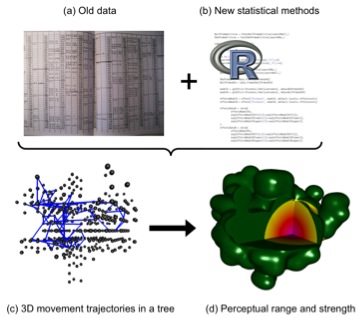
To answer the questions above, we developed a novel method using random walks on graphs to accurately estimate both the perceptual range and the attraction strength from 3D movement trajectories of individuals. The perceptual range gives us an idea of the maximal distance at which a stimulus source biases the movement. The attraction strength measures how the attraction of the stimulus varies at different distances within the perceptual range. Additionally, the methodology enabled us to calculate the relative roles of the architecture of vegetation and of the strength of attraction of a stimulus on the movement of individuals. We applied the methodology to estimate perceptual range and strength of apple maggot flies (Rhagoletis pomonella) foraging for artificial fruit in apple trees of varying complexity.


Movements

Figure: Main steps (a-d) followed to study animal orientation in complex vegetation structures.


In our study we have shown that, conditional on visiting the stimulus location, the presence of the fruit affects animal movement much more than the plant architecture. Moreover, we found that plant complexity makes a minor contribution to defining the perceptual range, but a large contribution to the attraction strength. Thus, we highlight the importance of estimating not only the perceptual range but also the attraction strength of animals, which has been traditionally neglected. Our findings have implications for studying foraging ecology and landscape connectivity. For example, several dispersal models developed to study landscape connectivity incorporate the perceptual range of individuals, but the distinction between perceptual range and attraction strength is still lacking. We expect that landscape connectivity will be higher in animals showing higher attraction strengths for equal perceptual ranges. Given that animals use their sensory systems to make informed decisions and that they move and interact in heterogeneous environments, our approach might be of relevance to the myriad of animals walking and searching in complex environmental structures.

On trial today – Thailand’s food workers’ rights Updated for 2026


Four criminal and civil prosecutions have been filed against me since 2013 by Natural Fruit Company Ltd, an exporter of tinned and concentrate pineapple and member of NatGroup.

More prosecutions were threatened last week also by the Thai Pineapple Industry Association (TPIA), whose President owns Natural Fruit, after an international solidarity campaign.

The first criminal trial in these cases, together carrying a maximum prison sentence of 8 years and a US$10m damages claim, starts today, 2nd September 2014.

But I am indeed not a criminal. I am just a 34 year old British migrant rights defender and researcher working in Thailand for a decade now. During this time, I simply tried to empower and defend migrant workers, particularly from Myanmar. I feel I can contribute uniquely and effectively on this issue.

In my mind, I have two greatest achievements in my life so far. First is supporting the founding and growth of the Migrant Worker Rights Network (MWRN), a Myanmar worker funded and managed migrant organisation that continues to make me proud and happy.

Second is organising Daw Aung San Suu Kyi’s 2012 visit to Myanmar migrants in Mahachai, Samut Sakhon Province, at the office of MWRN.

Natural Fruit Company determined to punish me

Given my character and area of work in defending and empowering migrant workers, I have disputed with many people. Particularly employers, official, brokers and companies. But beyond some expression of discomfort by those on the receiving end, sometimes of public denunciations when companies or people didn’t respect migrants’ rights and continued to refuse to do so, I never faced many problems.

I began to work more closely with Thai industry, particularly the food industry. I have even acted as a migration advisor for a number of major food export companies since the beginning of 2014.

However, this situation changed after the launch in January 2013 of a Finnwatch report on working conditions in Thai tuna and pineapple processing factories that exported to Finland and other Western countries. It exposed appalling practices including forced and child labour, unlawfully low wages, excessive overtime, abuse by managers and unsafe working conditions.

Although I only researched the report and did not publish it, Natural Fruit Company Ltd – Thailand’s biggest exporter of pineapple products – decided to harass me over the report and its findings. I was an easy target as I live in the region.

It took a while to understand and adjust to the situation I was in. My future life and decisions and movements became restricted by Natural Fruit Company’s private actions.

Once the Attorney General approved the first of 3 criminal charges against me in June 2014, I was detained in a cell prior to being granted bail, actually paid for by the Thai seafood industry – which has committed to working with Finnwatch to improve migrant working conditions.

From then on, my passport was confiscated by the Court as I was a perceived flight risk, even though I returned to Thailand from where I lived in Myanmar just to fight the cases. Now the Thai government and courts formally will decide my fate.

This cloud has a silver lining – for the food workers

My prosecution made me realize however that every perceivably negative situation can be seen in a positive light. The increasingly high profile nature of the judicial harassment against me has proven to be beneficial in contributing to achieving more effectively just those goals of increased rights and access to justice for migrants in Thailand that I have worked hard to achieve for so many years.

My harassment is being used effectively by me, consumer groups, trade unions and rights groups as a means of increasing awareness and interest of consumers and importers of Thai products on the systematic nature of migrant exploitation in Thailand and the link to trade, export and corporate social responsibility. With more awareness surely comes more pressure for positive change and then eventually the change itself.

Already United Nordic, the giant Nordic buyer, has spoken out against the Thai food industries actions in prosecuting me. Now the Ethical Trading Initiative has followed suit, and more support is on the way. Natural Fruit’s actions are impacting negatively on Thailand’s reputation and its economy, not only itself.

At least 10% of Thailand workers are vulnerable migrants

For almost 3 decades, Thailand’s export orientated economy has been dependent on millions of overseas migrants, particularly from Myanmar and Cambodia. These generally impoverished low skilled workers fled from military dictatorships or economic stagnation.

They make up at least 10% of the labour market in Thailand, if not more. Increasingly these vulnerable workers make up the majority of workers in low skilled labour intensive food export and other industries.

Exploitation of migrants by employers, officials and brokers is widespread and systematic in Thailand. Thai migration policy has always been a shambles, devoid of long term planning and the rule of law. Corruption and abuse of power are all encompassing features of the migration system here, every day experiences for the workers themselves.

For this reason, in 2014 Thailand fell to Tier 3 on the US government’s trafficking in persons (TIP) annual report. Migrants are generally silent in the face of abuse and oppression. To stand up and defend their rights, to fight for better conditions, would risk their lives.

Abuse is widespread in export industries

Abuse experienced by migrants in Thailand, often treated as second class citizens or walking ATMs, extends to many export markets. Consumers across the world should be increasingly aware of this. The abuse extends beyond fishing, seafood and pineapples, those products whose abusive supply chains have already been well publicized.

Abuse against migrants is also present in the poultry, fruit, vegetable and rubber industries. Even more now, migrants are working and facing abuse in Thailand’s retail, food and beverage and tourism industry too. This abuse needs publicizing and addressing also.

There are good employers, good companies and good conditions within some labour intensive export industries in Thailand. It’s important to stress this point and promote these ‘good apples’.

But in my experience, these good, ethical and respectable companies are in the minority. Selfish business attitude, appalling treatment of workers, particularly migrants, as machines or commodities to use for personal profit too often trumps respect and rights.

It’s time for change in Thailand, and it’s time for consumers, purchasers and retailers to take a stand against abuse of workers, particularly migrants, that is ongoing. It’s time for Thai industry to face the reality of the situation, address challenges they face, weed out bad guys and promote the good guys.

Our retailers must take a lead – and pay more for ethical produce

Respecting workers rights should also be rewarded and paid for. Lowest priced products can contribute to abuse so we all may have to pay more. Importantly, large retailers or purchasers may need to make less, manufacturers to provide workers more. Workers deserve a share of the profit of their hard work.

Whatever happens in my own personal criminal prosecutions, only time will tell. The past few weeks have shown me however that I am not alone in my campaign to address migrant conditions in Thailand, whatever may happen. Indeed I have never felt alone in the battle either.

Unions, rights groups, consumers and even now purchasers and buyers of Thai products, as well as sectors of Thai industry itself, have come out to support my work and the principles I fight for. I have a strong and committed group of colleagues on the ground here too.


Andy Hall is an investigator and campaigner on migrant workers’ rights in Thailand, one of the world’s major exporters of tropical fruits and fish to worldwide markets. He blogs at andyjhall.wordpress.com/.

The Finnwatch report: Cheap has a high price.


383463

On trial today – Thailand’s food workers’ rights Updated for 2026


Four criminal and civil prosecutions have been filed against me since 2013 by Natural Fruit Company Ltd, an exporter of tinned and concentrate pineapple and member of NatGroup.

More prosecutions were threatened last week also by the Thai Pineapple Industry Association (TPIA), whose President owns Natural Fruit, after an international solidarity campaign.

The first criminal trial in these cases, together carrying a maximum prison sentence of 8 years and a US$10m damages claim, starts today, 2nd September 2014.

But I am indeed not a criminal. I am just a 34 year old British migrant rights defender and researcher working in Thailand for a decade now. During this time, I simply tried to empower and defend migrant workers, particularly from Myanmar. I feel I can contribute uniquely and effectively on this issue.

In my mind, I have two greatest achievements in my life so far. First is supporting the founding and growth of the Migrant Worker Rights Network (MWRN), a Myanmar worker funded and managed migrant organisation that continues to make me proud and happy.

Second is organising Daw Aung San Suu Kyi’s 2012 visit to Myanmar migrants in Mahachai, Samut Sakhon Province, at the office of MWRN.

Natural Fruit Company determined to punish me

Given my character and area of work in defending and empowering migrant workers, I have disputed with many people. Particularly employers, official, brokers and companies. But beyond some expression of discomfort by those on the receiving end, sometimes of public denunciations when companies or people didn’t respect migrants’ rights and continued to refuse to do so, I never faced many problems.

I began to work more closely with Thai industry, particularly the food industry. I have even acted as a migration advisor for a number of major food export companies since the beginning of 2014.

However, this situation changed after the launch in January 2013 of a Finnwatch report on working conditions in Thai tuna and pineapple processing factories that exported to Finland and other Western countries. It exposed appalling practices including forced and child labour, unlawfully low wages, excessive overtime, abuse by managers and unsafe working conditions.

Although I only researched the report and did not publish it, Natural Fruit Company Ltd – Thailand’s biggest exporter of pineapple products – decided to harass me over the report and its findings. I was an easy target as I live in the region.

It took a while to understand and adjust to the situation I was in. My future life and decisions and movements became restricted by Natural Fruit Company’s private actions.

Once the Attorney General approved the first of 3 criminal charges against me in June 2014, I was detained in a cell prior to being granted bail, actually paid for by the Thai seafood industry – which has committed to working with Finnwatch to improve migrant working conditions.

From then on, my passport was confiscated by the Court as I was a perceived flight risk, even though I returned to Thailand from where I lived in Myanmar just to fight the cases. Now the Thai government and courts formally will decide my fate.

This cloud has a silver lining – for the food workers

My prosecution made me realize however that every perceivably negative situation can be seen in a positive light. The increasingly high profile nature of the judicial harassment against me has proven to be beneficial in contributing to achieving more effectively just those goals of increased rights and access to justice for migrants in Thailand that I have worked hard to achieve for so many years.

My harassment is being used effectively by me, consumer groups, trade unions and rights groups as a means of increasing awareness and interest of consumers and importers of Thai products on the systematic nature of migrant exploitation in Thailand and the link to trade, export and corporate social responsibility. With more awareness surely comes more pressure for positive change and then eventually the change itself.

Already United Nordic, the giant Nordic buyer, has spoken out against the Thai food industries actions in prosecuting me. Now the Ethical Trading Initiative has followed suit, and more support is on the way. Natural Fruit’s actions are impacting negatively on Thailand’s reputation and its economy, not only itself.

At least 10% of Thailand workers are vulnerable migrants

For almost 3 decades, Thailand’s export orientated economy has been dependent on millions of overseas migrants, particularly from Myanmar and Cambodia. These generally impoverished low skilled workers fled from military dictatorships or economic stagnation.

They make up at least 10% of the labour market in Thailand, if not more. Increasingly these vulnerable workers make up the majority of workers in low skilled labour intensive food export and other industries.

Exploitation of migrants by employers, officials and brokers is widespread and systematic in Thailand. Thai migration policy has always been a shambles, devoid of long term planning and the rule of law. Corruption and abuse of power are all encompassing features of the migration system here, every day experiences for the workers themselves.

For this reason, in 2014 Thailand fell to Tier 3 on the US government’s trafficking in persons (TIP) annual report. Migrants are generally silent in the face of abuse and oppression. To stand up and defend their rights, to fight for better conditions, would risk their lives.

Abuse is widespread in export industries

Abuse experienced by migrants in Thailand, often treated as second class citizens or walking ATMs, extends to many export markets. Consumers across the world should be increasingly aware of this. The abuse extends beyond fishing, seafood and pineapples, those products whose abusive supply chains have already been well publicized.

Abuse against migrants is also present in the poultry, fruit, vegetable and rubber industries. Even more now, migrants are working and facing abuse in Thailand’s retail, food and beverage and tourism industry too. This abuse needs publicizing and addressing also.

There are good employers, good companies and good conditions within some labour intensive export industries in Thailand. It’s important to stress this point and promote these ‘good apples’.

But in my experience, these good, ethical and respectable companies are in the minority. Selfish business attitude, appalling treatment of workers, particularly migrants, as machines or commodities to use for personal profit too often trumps respect and rights.

It’s time for change in Thailand, and it’s time for consumers, purchasers and retailers to take a stand against abuse of workers, particularly migrants, that is ongoing. It’s time for Thai industry to face the reality of the situation, address challenges they face, weed out bad guys and promote the good guys.

Our retailers must take a lead – and pay more for ethical produce

Respecting workers rights should also be rewarded and paid for. Lowest priced products can contribute to abuse so we all may have to pay more. Importantly, large retailers or purchasers may need to make less, manufacturers to provide workers more. Workers deserve a share of the profit of their hard work.

Whatever happens in my own personal criminal prosecutions, only time will tell. The past few weeks have shown me however that I am not alone in my campaign to address migrant conditions in Thailand, whatever may happen. Indeed I have never felt alone in the battle either.

Unions, rights groups, consumers and even now purchasers and buyers of Thai products, as well as sectors of Thai industry itself, have come out to support my work and the principles I fight for. I have a strong and committed group of colleagues on the ground here too.


Andy Hall is an investigator and campaigner on migrant workers’ rights in Thailand, one of the world’s major exporters of tropical fruits and fish to worldwide markets. He blogs at andyjhall.wordpress.com/.

The Finnwatch report: Cheap has a high price.


383463