Tag Archives: other

Frugivores and seed dispersal Updated for 2026

Everyone who likes to spend some time in nature, or who has trees at home, knows that several animals love to feed on fruits. Figs, tomatoes, peppers, guavas, mangos, bananas, and many other delicacies are harvested by frugivores that range from tiny bats to huge elephants.

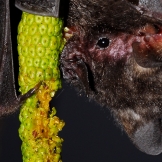
Those animals render the plants a service known as seed dispersal: in other words, they carry their seeds away and so increase the chances of their offspring surviving attacks by natural enemies, establishing, and colonizing new sites. This myriad of interactions forms a tangled web of frugivores and fruits, which is vital to maintain and regenerate forests and other natural ecosystems. Some frugivores seem to be more important than others to keep those webs functioning. In our study “Keystone species in seed dispersal networks are mainly determined by dietary specialization”, focused on bats and birds, the main groups of seed dispersers in the Neotropics, we found out that, even though animals with other kinds of primary diets participate in seed dispersal networks, specialized frugivores are the keystones of those systems and hold them together. This finding may help plan for the conservation and restoration of seed dispersal in degraded areas, and also provide insights on how to accelerate the regeneration of tropical rainforests and savannas.

Marco A.R. Mello and co-authors

barro colorado island - bat-fruit network (marco mello) 2 barro colorado island - bat-fruit network (marco mello)

The other reason I joined UKIP – to save our nightingales! Updated for 2026


Following a fantastic campaign – which the Airports Commission said generated more representations than any other – the Thames estuary airport pie-in-the-sky proposal promoted by the Mayor of London was categorically ruled out on the 2nd of September.

Unfortunately, two days later, Medway Council’s own planning committee attacked the Hoo peninsula with its own threat – a very serious threat – to build approximately 5,000 houses at Lodge hill, a bird sanctuary in my constituency.

Two days after we had had the dreadful threat of the Thames estuary airport ruled out, we had this other one to deal with. Five days later, Medway Council had to refer the application to the Secretary of State to consider whether it should be called in.

The rules are clear – minister must call in the plans

The criteria used for planning application call-ins used to be called the ‘Caborn criteria’. Three of those criteria appear to be met very clearly by this application to the extent that a call-in is required.

The first relates to conflicting with national policies on important matters, notably the protection of sites of special scientific interest – and, indeed, the whole integrity of our system of environmental protection.

The second relates to having significant effects beyond the immediate locality. It could even have an effect as far away as west Africa, where the nightingales that are the cause of this area becoming an SSSI spend the British winter.

There could be an impact on Essex, because the planning committee of Medway council has, in its wisdom, accepted a proposal that the nightingales can be told to go to an alternative location somewhere in Essex.

We do not have much in the way of detail, but this clearly suggests significant effects beyond the immediate locality. Perhaps most importantly, approving the proposal or failing to call it in and seeking to nod it through with a green light could have impacts on other SSSIs across the country.

The third criterion is where the development would give rise to substantial cross-border or national controversy. Having been at the centre of such controversy during the recent Rochester and Strood by-election, I can vouch for that.

Medway Council assured – ‘there will be no call-in’

On 25 September, the Secretary of State for Communities and Local Government recused himself from considering the application on the basis that he is a member of the Royal Society for the Protection of Birds.

Two days later, I recused myself from the Conservative party and was determined to fight a by-election partly on this issue. Since the Secretary of State recused himself, the matter has been considered by the Minister of State, Department for Communities and Local Government, the hon. Member for Great Yarmouth (Brandon Lewis).

He wrote to me on 15 October, and I was glad to hear that no ministerial decision had been taken on whether the matter should be called in. He criticised what he described as my claim that such a decision had been taken.

Of course, that was not my claim. It was a claim made by the deputy leader of Medway council, Councillor Alan Jarrett, in a meeting of Conservative councillors. His statement was that it had apparently been communicated to him by the Government that the proposal would be green-lighted and would not be called in.

That led to another councillor present at the meeting, Councillor Peter Rodberg, leaving the Conservative group and joining me in UKIP.

‘Just keep quiet until after the election’

He says – and this is borne out by another councillor who has spoken to me, and who remains a Conservative – that at the end of the meeting, after the councillors had been told that the Government would green-light the proposal, Councillor Peter Hicks, who represents Strood Rural, said that they should keep quiet about it until after the election.

It was a pleasure to learn from the Minister that he was dealing with the issue of the call-in properly. He clearly recognises that he is acting in a quasi-judicial capacity, and – at least in terms of the time that he has already devoted to the issue and the correspondence that he has issued – he appears to be performing his duties with diligence.

His most recent letter was written on 8 December to Councillor Rodney Chambers, the leader of Medway Council. I understand that since this Government have been in office no more than a dozen applications have been called in each year, whereas under the last Government about 30 a year were called in, but I am not aware of any precedent for such a letter.

A most irregular correspondence

The Minister wrote asking for Medway Council’s views, and in particular the views of the planning committee that had considered the application on 4 September, on a number of representations that had been received, including representations from the RSPB and Natural England.

Unfortunately the Minister did not attach the representations that he said he had attached to the letter, and, as far as I know, they have not been published. The letter is peculiar, however. It is not clear whether Medway Council’s views were being sought, or the views of the planning committee, or both, and it is not clear how any conflict between them should be resolved.

The planning committee meeting was, of course, on the record, so the extent to which it has considered – or, one suspects, not considered – the matters that it should have considered should have been made clear either in its decision notice or in the record of that meeting.

I therefore question the credibility and reliability of any ex post facto justifications that Medway Council may now produce for its decision, and any statement in which it purports to have abided by the national planning policy framework.

Only one reasonable conclusion to this sorry affair

Given that letter, given that at least three of the criteria for call-in were clearly met, and given the statement by the deputy leader of the Council that the proposal would be green-lighted in the light of communications that he at least believed were taking place within the Government or among those who he thought could speak for them in respect of there not being a call-in, I think it is clear that the safest and, indeed, the only appropriate option is for the Government to call in the application, appoint an inspector, and give proper consideration to what is, in my view, an incredibly damaging application.

This application would result in the pulling together of several villages into a single conglomeration, and would cause a Site of Special Scientific Interest to be almost completely built over, which would undermine the whole system of environmental protection in this country.

It should now be considered by an inspector and then by the Secretary of State, and, hopefully, turned down as a result.


Mark Reckless is the UKIP MP for Rochester and Strood.

This article is an extract from a speech by Mark Reckless MP to the House of Commons on 18th December 2014, also reproduced on his own website.


388441

2015 will see nuclear dream fade as wind and solar soar Updated for 2026


With nuclear power falling ever further behind renewables as a global energy source, and as the price of oil and gas falls, the future of the industry in 2015 and beyond looks bleak.

Renewables now supply 22% of global electricity and nuclear only 11% – a share that is gradually falling as old plants close and fewer new ones are commissioned.

New large-scale installations of wind and solar power arrays continue to surge across the world. Countries without full grids and power outages, such as India, increasingly find that wind and solar are quick and easy ways to bring electricity to people who have previously had no supply.

Developed countries, meanwhile, faced with reducing carbon dioxide emissions, find that the cost of both these renewable technologies is coming down substantially.

Subsidies for wind and solar are being reduced and, in some cases, will disappear altogether in the next 10 years.

Renewables’ enviable speed of installation

The other advantage that renewables have is speed of installation. Solar panels, once manufactured, can be installed on a rooftop and be in operation in a single day. Wind turbines can be put up in a week.

Nuclear power, on the other hand, continues to get more expensive. In China and Russia, costs are not transparent, and even in democracies they hard to pin down. But it is clear that they are rising dramatically.

Building of the proposed twin European Pressurised Water reactors, called Hinkley Point C, in Britain’s West Country is due to start in 2015, but the price has risen several times already. Estimated construction costs have now jumped from £16 billion to £24 billion – before the first concrete has even been poured.

The other problem with nuclear is the time frame. Originally, Hinkley Point C was due to be completed by 2018. This has now slipped to 2024, but even this is optimistic judging by the performance of the two prototypes in Finland and France, both of which are late and over budget.

The Finnish plant was due to open in 2009, but is still at least three years from commissioning. The French plant is five years overdue.

In many countries, there are plans on paper for new nuclear stations, and China, South Korea and India are among those that are continuing to build them. Other countries, particularly where private capital is needed to finance them, are putting their plans on hold.

Extend life

The US, which still has the largest number of reactors of any country in the world, is opting instead to extend the life of its plants. Many operators are considering applying for such extensions from 60 to 80 years.

Provided they are up to modern safety standards, there seems no barrier to this. However experience shows that as reactors age they become less reliable – both requiring scheduled maintenance, and prone to sudden unexpected cut-outs that place huge demands on power grids.

Many other countries, including the UK, are also extending the lives of their plants as long as possible, however, so the industry won’t be disappearing any time soon.

But one of the key problems for the nuclear sector is that reactors have been designed to be at full power all of the time. With renewables taking an increasing share of the market, a combination of nuclear, wind and solar can produce more electricity than required – leaving a problem of what to turn off, or how to use the surplus power.

A way round this problem being developed in Britain is large, strategically-based batteries. A five-megawatt battery, the largest in Europe, has just been commissioned in Leighton Buzzard, Bedfordshire, in the middle of England.

This is charged up when there is too much power in the grid, and releases its energy when there is a surge in demand.

If, during a two-year trial, this works to smooth the peaks and troughs of demand, and cuts the costs of switching on expensive gas turbines, then a network of batteries will be installed across the country to harvest the intermittent supplies of renewables.

The only bright spot for nuclear at the moment is the development of small nuclear reactors. These are from 30 megawatts upwards and are designed to be built in a factory and assembled on site – a bit like wind turbines are.

These can be installed singly or in a series, depending on the demand. Their two greatest selling points are that they would be good in remote locations far from other power sources, and are said to be much safer than their larger cousins.

Price tag

However, a drawback is the price tag of around $3 billion dollars. Both the US and UK are supporting private firms in research and development, but commercial operation is a long way off.

Whether a small nuclear power station would be any more welcomed than a wind or solar farm to provide power in a neighbourhood is a question still to be tested.

Nuclear enthusiasts – and there are still many in the political and scientific world – continue to work on fast breeder reactors, fusion and thorium reactors, heavily supported by governments who still believe that one day the technology will be the source of cheap and unlimited power. But, so far, that remains a distant dream.

In the meantime, investors are increasingly sceptical about putting their money into nuclear – whereas renewables promise an increasingly rapid return on investment, and may get a further boost if the governments of the world finally take climate change seriously.


Paul Brown writes for Climate News Network.


388423

Journalists doing their job are not ‘domestic extremists’ Updated for 2026


Wander around Thrupp lake, a disused gravel pit near Abingdon and you’ll be mesmerised by the golden hues of autumn leaves, and the tranquility punctuated by the calls of terns, geese and ducks. Look a bit harder and you’ll see egrets, fieldfares, kingfishers and a host of other birds.

The place is swarming with wildlife. Otters have reportedly been seen here, a sure sign of a well established ecosystem. It’s also people friendly, with boarded out walkways, wooden bird hides, and information signs. It’s a beautiful, well cared for place.

But just seven years ago, in 2007, all of this was to be destroyed. The energy company NPower, operator of the now-closed Didcot A coal-fired power station, wanted somewhere to dump their fly ash – half a million tonnes of it.

And since they owned the land at Thrupp lakes – where they and the former CEGB had been filling lake after lake for decades – dumping their coal ash there was, they claimed, their cheapest option.

All the surrounding trees would be cut down, the water drained out and the toxic ash poured in. The site would be capped off and fenced with ‘Danger’ signs, as with other lakes nearby.

A lake too far!

For the locals who regularly walked around Thrupp lake its impending destruction was the last straw. Objections were strong but polite. Why couldn’t NPower use other means of disposal for the fly ash – increasingly sought after for making Portland cement, pour-on screeds, lightweight ‘thermalite’ blocks and other building materials?

And they were up against a surprisingly heavy-handed security operation for what was basically a local protest. NPower’s balaclava-clad security guards – many of them ex-military as I found out later – filmed every movement of the protestors.

My own involvement was as a freelance journalist and photographer and National Union of Journalists (NUJ) member.

One day I received a phone call from a local who told me to get down to the lake as quick as I could as NPower contractors were cutting down trees in an area long used by kingfishers for breeding and feeding – and kingfishers are protected under the EC Habitats Directive, and our own Wildlife & Countryside Act. Destroying their habitat is a criminal offence.

Within minutes of arrival I found the scene and was filming the felling of trees in the very place where, a few weeks earlier, I had photographed the iridescent jewel of a Kingsfisher.

Hit by a legal sledgehammer

Minutes later I could hardly believe my eyes when I saw a team of balaclava’d security guards in hi-vis jackets and two men in pinstripe suits approaching me carrying a pile of papers.

The suits were lawyers who served on me an injunction that NPower had obtained from the High Court the day before, which applied to anyone who even knew of its existence it, no matter who they were or what their business.

The injunction – granted in a secret hearing based on the anonymous and unchallenged evidence of security guards – created a seclusion zone around the lake, and forbade filming or photographing NPower employees and contractors. Breaking the injunction would result in a five year jail sentence.

Fortunately I was already filming while they came up to me, and I showed them my NUJ press card. Although the fact that my video camera was running as the injunction was served on me potentially put me in breach of the injunction.

But NPower’s heavy-handed action achieved precisely what the company, part of Germany’s RWE power giant, did not want: it got the story into the national news.

As Jon Snow observed in his report on Channel 4 News (see video, above), “it is a cautionary tale of how some large corporations are able to suspend some basic human freedoms we thought we enjoyed.” And as the C4 reporter Alex Thompson said, “In effect covering the story of the destruction of the lake is now a criminal offence.”

The injunction was later successfully challenged by the NUJ and the wording altered to allow reporting by the press. The embarrassment also caused to Npower to abandon their plans to fill the lake with ash. Ultimately the lake and surrounding land was handed over to a local wildlife charity, the Earth Trust. It is now a nature reserve and well visited by locals.

‘Hello Mr Arbib, we know all about you … ‘

Years later in 2013 I had been covering a news story near Hastings on the building of the A259 Bexhill bypass, widely derided as a ‘road to nowhere‘. Protestors from the Combe Haven Defenders had set up camps along the route and climbed trees that were due to be felled.

I understood that the tree evictions were imminent so I climbed up a rope to get a good vantage point for photographs from a tree platform.

After a day and a night on the platform I decided to get down. within minutes I was surrounded by security who attempted to pin me to the ground. I explained I was a member of the press. Their team leader said: “OK we know who you are. Escort him off site lads.”

The next day I met him and other members of his team at the perimeter fence. They addressed me by my name though I had never divulged my identity … so how was that?

Domestic extremism?

Last year the NUJ notified their members that for £10 anyone could ask the police for any records that they might hold on the Domestic Extremist register. The incident at Hastings sprung to mind, I applied.

What came back was short but it did hold some interesting observations: “Arbib is a known environmental protester”; “Arbib appears to be a professional photographer with an interest in the environment”.

There was more. An incident was also logged where I had been identified undertaking the highly subversive action of photographing apple orchards close to Heathrow airport for a feature on apples for the Guardian.

However It was the first statement which bothered me. The word ‘known’ had an Orwellian ring to it. It indicated another layer to this that wasn’t being shared. Where was the evidence for ‘known’.

I had photographed a lot of the protests in the 1990’s including road protests at Twyford Down, Newbury, Solsbury Hill and other sites, covering it extensively for the Guardian newspaper and other news outlets. I eventually ended up publishing a book on it.

You could say that I specialised in photographing protest but I did a lot of other kinds of photography too. I travelled to India, Sudan and Zimbabwe for the likes of Christian Aid, I worked for the BBC and Channel 4 as a stills photographer and completed lots of features and portraits for a variety of magazines.

A good photographer knows his subjects

While studying photography in the 1980’s l learned that every good social documentary photographer achieved their best works because they were close to their subject matter.

Eugene Smith, one of the most famous, put his heart and soul into photographing the Minamata chemical leak in Japan. He got beaten up for his efforts by the company that were trying to keep the story silent.

So I stand by rule that if your pictures aren’t good enough you’re not close enough. You need to know your material. All the best work that I’ve done has been due to research, a passion for the subject and time spent on the ground. 

And while no Eugene Smith myself I’ve got close to my subjects to get the story. I’m often sympathetic to them, but not always. But whether I am or not, it’s essential to know them and understand them. When Leo Regan photographed his book Public Enemies about neo-Nazis in the UK it didn’t mean he was a neo-Nazi.

None of my activities have ever taken me into the realms of illegality. For me to feature on the Domestic Extremist Database seems at best absurd and at worst deeply sinister.

It should be of huge concern to everyone that this data is being held on journalists. It is the journalists who get silenced first in a totalitarian regime.

Five other journalists in the same boat

And it’s not just me. Six NUJ journalists (myself included) find ourselves in this position and backed by the NUJ we are taking legal action against the Metropolitan Police Commissioner and the Home Secretary to challenge this ongoing police surveillance.

Amongst other things, our aims are to have the data they hold on us destroyed – and to find out, if possible, where this information is being shared and by what criteria it is gathered.

My colleagues – all of whom have similarly covered protests and have done stories on the police or held corporations to account – have thicker files on them than I do. Jules Mattson, for example, has information on his records delving into the medical history of one of his family members – amongst many other things, and much of it is patently wrong.

I was delighted with the statement by our lawyer Shamik Dutta, from Bhatt Murphy solicitors, that “Journalists who seek to expose corporate and state misconduct are entitled to legal protection which enables them to do their job.”

Shamik also questioned “how it could possibly be reasonable, proportionate or necessary for the police to monitor and retain information about journalists for any purpose, let alone for the purposes of policing ‘domestic extremism’.”

Now: ‘extreme disruption orders’

But the story does not end here. I’m deeply concerned that the Home Secreary, Theresa May, is now proposing a further clampdown on civil liberties by creating a legal mechanism that would further impact so-called ‘domestic extremists’.

Under her proposals, even people whose activities are entirely within the law could be subject to so-called ‘extreme disruption orders’ if they “undertake harmful activities”. The orders would be issued by a High Court judge on an application from the police based on a legal test of ‘balance of probabilities’

The orders could ban individuals from broadcasting or speaking at public events, or from being with other named people, or from being in specified locations, and force them to get police permission to attend any public event, protest or meeting, and before publishing anything – even on social media.

Theresa May says the measures are aimed at those who would “spread, incite or justify hatred against people on grounds of race, religion, sexual orientation or disability” – but this could be a slippery slope.

We already know how police and prosecutors have used anti-terrorism legislation against peaceful protestors – in many cases against people who were not even breaking any law, like the case against Juliet McBride, an anti-nuclear weapons protestor at Aldermarston.

I and my fellow appellants also know how the wrong people can end up being labelled ‘domestic extremists’ – and that’s not just journalists but also people who have done no more than organise environmental meetings.

While no one wants to empower the small minority of people in this country who represent real danger to the peace and security of the realm, the state already has enormous powers and resources at its disposal.

And to judge by its shabby record, the British state is all too ready to abuse its powers by turning them against people in ways that were never envisaged or intended by legislators, including legitimate and peaceful campaigners, protestors, dissidents of various stripes – and the media.

The last thing we should allow is for the state to take on yet greater powers, only for them to turn against us when it suits them, and further restrict the freedom of the media that holds an essential role in any free and democratic nation.


Adrian Arbib is a freelance journalist and photographer.

Petition: Stop the UK Government from Introducing ‘Extreme Disruption Orders’!


387136

Journalists doing their job are not ‘domestic extremists’ Updated for 2026


Wander around Thrupp lake, a disused gravel pit near Abingdon and you’ll be mesmerised by the golden hues of autumn leaves, and the tranquility punctuated by the calls of terns, geese and ducks. Look a bit harder and you’ll see egrets, fieldfares, kingfishers and a host of other birds.

The place is swarming with wildlife. Otters have reportedly been seen here, a sure sign of a well established ecosystem. It’s also people friendly, with boarded out walkways, wooden bird hides, and information signs. It’s a beautiful, well cared for place.

But just seven years ago, in 2007, all of this was to be destroyed. The energy company NPower, operator of the now-closed Didcot A coal-fired power station, wanted somewhere to dump their fly ash – half a million tonnes of it.

And since they owned the land at Thrupp lakes – where they and the former CEGB had been filling lake after lake for decades – dumping their coal ash there was, they claimed, their cheapest option.

All the surrounding trees would be cut down, the water drained out and the toxic ash poured in. The site would be capped off and fenced with ‘Danger’ signs, as with other lakes nearby.

A lake too far!

For the locals who regularly walked around Thrupp lake its impending destruction was the last straw. Objections were strong but polite. Why couldn’t NPower use other means of disposal for the fly ash – increasingly sought after for making Portland cement, pour-on screeds, lightweight ‘thermalite’ blocks and other building materials?

And they were up against a surprisingly heavy-handed security operation for what was basically a local protest. NPower’s balaclava-clad security guards – many of them ex-military as I found out later – filmed every movement of the protestors.

My own involvement was as a freelance journalist and photographer and National Union of Journalists (NUJ) member.

One day I received a phone call from a local who told me to get down to the lake as quick as I could as NPower contractors were cutting down trees in an area long used by kingfishers for breeding and feeding – and kingfishers are protected under the EC Habitats Directive, and our own Wildlife & Countryside Act. Destroying their habitat is a criminal offence.

Within minutes of arrival I found the scene and was filming the felling of trees in the very place where, a few weeks earlier, I had photographed the iridescent jewel of a Kingsfisher.

Hit by a legal sledgehammer

Minutes later I could hardly believe my eyes when I saw a team of balaclava’d security guards in hi-vis jackets and two men in pinstripe suits approaching me carrying a pile of papers.

The suits were lawyers who served on me an injunction that NPower had obtained from the High Court the day before, which applied to anyone who even knew of its existence it, no matter who they were or what their business.

The injunction – granted in a secret hearing based on the anonymous and unchallenged evidence of security guards – created a seclusion zone around the lake, and forbade filming or photographing NPower employees and contractors. Breaking the injunction would result in a five year jail sentence.

Fortunately I was already filming while they came up to me, and I showed them my NUJ press card. Although the fact that my video camera was running as the injunction was served on me potentially put me in breach of the injunction.

But NPower’s heavy-handed action achieved precisely what the company, part of Germany’s RWE power giant, did not want: it got the story into the national news.

As Jon Snow observed in his report on Channel 4 News (see video, above), “it is a cautionary tale of how some large corporations are able to suspend some basic human freedoms we thought we enjoyed.” And as the C4 reporter Alex Thompson said, “In effect covering the story of the destruction of the lake is now a criminal offence.”

The injunction was later successfully challenged by the NUJ and the wording altered to allow reporting by the press. The embarrassment also caused to Npower to abandon their plans to fill the lake with ash. Ultimately the lake and surrounding land was handed over to a local wildlife charity, the Earth Trust. It is now a nature reserve and well visited by locals.

‘Hello Mr Arbib, we know all about you … ‘

Years later in 2013 I had been covering a news story near Hastings on the building of the A259 Bexhill bypass, widely derided as a ‘road to nowhere‘. Protestors from the Combe Haven Defenders had set up camps along the route and climbed trees that were due to be felled.

I understood that the tree evictions were imminent so I climbed up a rope to get a good vantage point for photographs from a tree platform.

After a day and a night on the platform I decided to get down. within minutes I was surrounded by security who attempted to pin me to the ground. I explained I was a member of the press. Their team leader said: “OK we know who you are. Escort him off site lads.”

The next day I met him and other members of his team at the perimeter fence. They addressed me by my name though I had never divulged my identity … so how was that?

Domestic extremism?

Last year the NUJ notified their members that for £10 anyone could ask the police for any records that they might hold on the Domestic Extremist register. The incident at Hastings sprung to mind, I applied.

What came back was short but it did hold some interesting observations: “Arbib is a known environmental protester”; “Arbib appears to be a professional photographer with an interest in the environment”.

There was more. An incident was also logged where I had been identified undertaking the highly subversive action of photographing apple orchards close to Heathrow airport for a feature on apples for the Guardian.

However It was the first statement which bothered me. The word ‘known’ had an Orwellian ring to it. It indicated another layer to this that wasn’t being shared. Where was the evidence for ‘known’.

I had photographed a lot of the protests in the 1990’s including road protests at Twyford Down, Newbury, Solsbury Hill and other sites, covering it extensively for the Guardian newspaper and other news outlets. I eventually ended up publishing a book on it.

You could say that I specialised in photographing protest but I did a lot of other kinds of photography too. I travelled to India, Sudan and Zimbabwe for the likes of Christian Aid, I worked for the BBC and Channel 4 as a stills photographer and completed lots of features and portraits for a variety of magazines.

A good photographer knows his subjects

While studying photography in the 1980’s l learned that every good social documentary photographer achieved their best works because they were close to their subject matter.

Eugene Smith, one of the most famous, put his heart and soul into photographing the Minamata chemical leak in Japan. He got beaten up for his efforts by the company that were trying to keep the story silent.

So I stand by rule that if your pictures aren’t good enough you’re not close enough. You need to know your material. All the best work that I’ve done has been due to research, a passion for the subject and time spent on the ground. 

And while no Eugene Smith myself I’ve got close to my subjects to get the story. I’m often sympathetic to them, but not always. But whether I am or not, it’s essential to know them and understand them. When Leo Regan photographed his book Public Enemies about neo-Nazis in the UK it didn’t mean he was a neo-Nazi.

None of my activities have ever taken me into the realms of illegality. For me to feature on the Domestic Extremist Database seems at best absurd and at worst deeply sinister.

It should be of huge concern to everyone that this data is being held on journalists. It is the journalists who get silenced first in a totalitarian regime.

Five other journalists in the same boat

And it’s not just me. Six NUJ journalists (myself included) find ourselves in this position and backed by the NUJ we are taking legal action against the Metropolitan Police Commissioner and the Home Secretary to challenge this ongoing police surveillance.

Amongst other things, our aims are to have the data they hold on us destroyed – and to find out, if possible, where this information is being shared and by what criteria it is gathered.

My colleagues – all of whom have similarly covered protests and have done stories on the police or held corporations to account – have thicker files on them than I do. Jules Mattson, for example, has information on his records delving into the medical history of one of his family members – amongst many other things, and much of it is patently wrong.

I was delighted with the statement by our lawyer Shamik Dutta, from Bhatt Murphy solicitors, that “Journalists who seek to expose corporate and state misconduct are entitled to legal protection which enables them to do their job.”

Shamik also questioned “how it could possibly be reasonable, proportionate or necessary for the police to monitor and retain information about journalists for any purpose, let alone for the purposes of policing ‘domestic extremism’.”

Now: ‘extreme disruption orders’

But the story does not end here. I’m deeply concerned that the Home Secreary, Theresa May, is now proposing a further clampdown on civil liberties by creating a legal mechanism that would further impact so-called ‘domestic extremists’.

Under her proposals, even people whose activities are entirely within the law could be subject to so-called ‘extreme disruption orders’ if they “undertake harmful activities”. The orders would be issued by a High Court judge on an application from the police based on a legal test of ‘balance of probabilities’

The orders could ban individuals from broadcasting or speaking at public events, or from being with other named people, or from being in specified locations, and force them to get police permission to attend any public event, protest or meeting, and before publishing anything – even on social media.

Theresa May says the measures are aimed at those who would “spread, incite or justify hatred against people on grounds of race, religion, sexual orientation or disability” – but this could be a slippery slope.

We already know how police and prosecutors have used anti-terrorism legislation against peaceful protestors – in many cases against people who were not even breaking any law, like the case against Juliet McBride, an anti-nuclear weapons protestor at Aldermarston.

I and my fellow appellants also know how the wrong people can end up being labelled ‘domestic extremists’ – and that’s not just journalists but also people who have done no more than organise environmental meetings.

While no one wants to empower the small minority of people in this country who represent real danger to the peace and security of the realm, the state already has enormous powers and resources at its disposal.

And to judge by its shabby record, the British state is all too ready to abuse its powers by turning them against people in ways that were never envisaged or intended by legislators, including legitimate and peaceful campaigners, protestors, dissidents of various stripes – and the media.

The last thing we should allow is for the state to take on yet greater powers, only for them to turn against us when it suits them, and further restrict the freedom of the media that holds an essential role in any free and democratic nation.


Adrian Arbib is a freelance journalist and photographer.

Petition: Stop the UK Government from Introducing ‘Extreme Disruption Orders’!


387136

Journalists doing their job are not ‘domestic extremists’ Updated for 2026


Wander around Thrupp lake, a disused gravel pit near Abingdon and you’ll be mesmerised by the golden hues of autumn leaves, and the tranquility punctuated by the calls of terns, geese and ducks. Look a bit harder and you’ll see egrets, fieldfares, kingfishers and a host of other birds.

The place is swarming with wildlife. Otters have reportedly been seen here, a sure sign of a well established ecosystem. It’s also people friendly, with boarded out walkways, wooden bird hides, and information signs. It’s a beautiful, well cared for place.

But just seven years ago, in 2007, all of this was to be destroyed. The energy company NPower, operator of the now-closed Didcot A coal-fired power station, wanted somewhere to dump their fly ash – half a million tonnes of it.

And since they owned the land at Thrupp lakes – where they and the former CEGB had been filling lake after lake for decades – dumping their coal ash there was, they claimed, their cheapest option.

All the surrounding trees would be cut down, the water drained out and the toxic ash poured in. The site would be capped off and fenced with ‘Danger’ signs, as with other lakes nearby.

A lake too far!

For the locals who regularly walked around Thrupp lake its impending destruction was the last straw. Objections were strong but polite. Why couldn’t NPower use other means of disposal for the fly ash – increasingly sought after for making Portland cement, pour-on screeds, lightweight ‘thermalite’ blocks and other building materials?

And they were up against a surprisingly heavy-handed security operation for what was basically a local protest. NPower’s balaclava-clad security guards – many of them ex-military as I found out later – filmed every movement of the protestors.

My own involvement was as a freelance journalist and photographer and National Union of Journalists (NUJ) member.

One day I received a phone call from a local who told me to get down to the lake as quick as I could as NPower contractors were cutting down trees in an area long used by kingfishers for breeding and feeding – and kingfishers are protected under the EC Habitats Directive, and our own Wildlife & Countryside Act. Destroying their habitat is a criminal offence.

Within minutes of arrival I found the scene and was filming the felling of trees in the very place where, a few weeks earlier, I had photographed the iridescent jewel of a Kingsfisher.

Hit by a legal sledgehammer

Minutes later I could hardly believe my eyes when I saw a team of balaclava’d security guards in hi-vis jackets and two men in pinstripe suits approaching me carrying a pile of papers.

The suits were lawyers who served on me an injunction that NPower had obtained from the High Court the day before, which applied to anyone who even knew of its existence it, no matter who they were or what their business.

The injunction – granted in a secret hearing based on the anonymous and unchallenged evidence of security guards – created a seclusion zone around the lake, and forbade filming or photographing NPower employees and contractors. Breaking the injunction would result in a five year jail sentence.

Fortunately I was already filming while they came up to me, and I showed them my NUJ press card. Although the fact that my video camera was running as the injunction was served on me potentially put me in breach of the injunction.

But NPower’s heavy-handed action achieved precisely what the company, part of Germany’s RWE power giant, did not want: it got the story into the national news.

As Jon Snow observed in his report on Channel 4 News (see video, above), “it is a cautionary tale of how some large corporations are able to suspend some basic human freedoms we thought we enjoyed.” And as the C4 reporter Alex Thompson said, “In effect covering the story of the destruction of the lake is now a criminal offence.”

The injunction was later successfully challenged by the NUJ and the wording altered to allow reporting by the press. The embarrassment also caused to Npower to abandon their plans to fill the lake with ash. Ultimately the lake and surrounding land was handed over to a local wildlife charity, the Earth Trust. It is now a nature reserve and well visited by locals.

‘Hello Mr Arbib, we know all about you … ‘

Years later in 2013 I had been covering a news story near Hastings on the building of the A259 Bexhill bypass, widely derided as a ‘road to nowhere‘. Protestors from the Combe Haven Defenders had set up camps along the route and climbed trees that were due to be felled.

I understood that the tree evictions were imminent so I climbed up a rope to get a good vantage point for photographs from a tree platform.

After a day and a night on the platform I decided to get down. within minutes I was surrounded by security who attempted to pin me to the ground. I explained I was a member of the press. Their team leader said: “OK we know who you are. Escort him off site lads.”

The next day I met him and other members of his team at the perimeter fence. They addressed me by my name though I had never divulged my identity … so how was that?

Domestic extremism?

Last year the NUJ notified their members that for £10 anyone could ask the police for any records that they might hold on the Domestic Extremist register. The incident at Hastings sprung to mind, I applied.

What came back was short but it did hold some interesting observations: “Arbib is a known environmental protester”; “Arbib appears to be a professional photographer with an interest in the environment”.

There was more. An incident was also logged where I had been identified undertaking the highly subversive action of photographing apple orchards close to Heathrow airport for a feature on apples for the Guardian.

However It was the first statement which bothered me. The word ‘known’ had an Orwellian ring to it. It indicated another layer to this that wasn’t being shared. Where was the evidence for ‘known’.

I had photographed a lot of the protests in the 1990’s including road protests at Twyford Down, Newbury, Solsbury Hill and other sites, covering it extensively for the Guardian newspaper and other news outlets. I eventually ended up publishing a book on it.

You could say that I specialised in photographing protest but I did a lot of other kinds of photography too. I travelled to India, Sudan and Zimbabwe for the likes of Christian Aid, I worked for the BBC and Channel 4 as a stills photographer and completed lots of features and portraits for a variety of magazines.

A good photographer knows his subjects

While studying photography in the 1980’s l learned that every good social documentary photographer achieved their best works because they were close to their subject matter.

Eugene Smith, one of the most famous, put his heart and soul into photographing the Minamata chemical leak in Japan. He got beaten up for his efforts by the company that were trying to keep the story silent.

So I stand by rule that if your pictures aren’t good enough you’re not close enough. You need to know your material. All the best work that I’ve done has been due to research, a passion for the subject and time spent on the ground. 

And while no Eugene Smith myself I’ve got close to my subjects to get the story. I’m often sympathetic to them, but not always. But whether I am or not, it’s essential to know them and understand them. When Leo Regan photographed his book Public Enemies about neo-Nazis in the UK it didn’t mean he was a neo-Nazi.

None of my activities have ever taken me into the realms of illegality. For me to feature on the Domestic Extremist Database seems at best absurd and at worst deeply sinister.

It should be of huge concern to everyone that this data is being held on journalists. It is the journalists who get silenced first in a totalitarian regime.

Five other journalists in the same boat

And it’s not just me. Six NUJ journalists (myself included) find ourselves in this position and backed by the NUJ we are taking legal action against the Metropolitan Police Commissioner and the Home Secretary to challenge this ongoing police surveillance.

Amongst other things, our aims are to have the data they hold on us destroyed – and to find out, if possible, where this information is being shared and by what criteria it is gathered.

My colleagues – all of whom have similarly covered protests and have done stories on the police or held corporations to account – have thicker files on them than I do. Jules Mattson, for example, has information on his records delving into the medical history of one of his family members – amongst many other things, and much of it is patently wrong.

I was delighted with the statement by our lawyer Shamik Dutta, from Bhatt Murphy solicitors, that “Journalists who seek to expose corporate and state misconduct are entitled to legal protection which enables them to do their job.”

Shamik also questioned “how it could possibly be reasonable, proportionate or necessary for the police to monitor and retain information about journalists for any purpose, let alone for the purposes of policing ‘domestic extremism’.”

Now: ‘extreme disruption orders’

But the story does not end here. I’m deeply concerned that the Home Secreary, Theresa May, is now proposing a further clampdown on civil liberties by creating a legal mechanism that would further impact so-called ‘domestic extremists’.

Under her proposals, even people whose activities are entirely within the law could be subject to so-called ‘extreme disruption orders’ if they “undertake harmful activities”. The orders would be issued by a High Court judge on an application from the police based on a legal test of ‘balance of probabilities’

The orders could ban individuals from broadcasting or speaking at public events, or from being with other named people, or from being in specified locations, and force them to get police permission to attend any public event, protest or meeting, and before publishing anything – even on social media.

Theresa May says the measures are aimed at those who would “spread, incite or justify hatred against people on grounds of race, religion, sexual orientation or disability” – but this could be a slippery slope.

We already know how police and prosecutors have used anti-terrorism legislation against peaceful protestors – in many cases against people who were not even breaking any law, like the case against Juliet McBride, an anti-nuclear weapons protestor at Aldermarston.

I and my fellow appellants also know how the wrong people can end up being labelled ‘domestic extremists’ – and that’s not just journalists but also people who have done no more than organise environmental meetings.

While no one wants to empower the small minority of people in this country who represent real danger to the peace and security of the realm, the state already has enormous powers and resources at its disposal.

And to judge by its shabby record, the British state is all too ready to abuse its powers by turning them against people in ways that were never envisaged or intended by legislators, including legitimate and peaceful campaigners, protestors, dissidents of various stripes – and the media.

The last thing we should allow is for the state to take on yet greater powers, only for them to turn against us when it suits them, and further restrict the freedom of the media that holds an essential role in any free and democratic nation.


Adrian Arbib is a freelance journalist and photographer.

Petition: Stop the UK Government from Introducing ‘Extreme Disruption Orders’!


387136

Journalists doing their job are not ‘domestic extremists’ Updated for 2026


Wander around Thrupp lake, a disused gravel pit near Abingdon and you’ll be mesmerised by the golden hues of autumn leaves, and the tranquility punctuated by the calls of terns, geese and ducks. Look a bit harder and you’ll see egrets, fieldfares, kingfishers and a host of other birds.

The place is swarming with wildlife. Otters have reportedly been seen here, a sure sign of a well established ecosystem. It’s also people friendly, with boarded out walkways, wooden bird hides, and information signs. It’s a beautiful, well cared for place.

But just seven years ago, in 2007, all of this was to be destroyed. The energy company NPower, operator of the now-closed Didcot A coal-fired power station, wanted somewhere to dump their fly ash – half a million tonnes of it.

And since they owned the land at Thrupp lakes – where they and the former CEGB had been filling lake after lake for decades – dumping their coal ash there was, they claimed, their cheapest option.

All the surrounding trees would be cut down, the water drained out and the toxic ash poured in. The site would be capped off and fenced with ‘Danger’ signs, as with other lakes nearby.

A lake too far!

For the locals who regularly walked around Thrupp lake its impending destruction was the last straw. Objections were strong but polite. Why couldn’t NPower use other means of disposal for the fly ash – increasingly sought after for making Portland cement, pour-on screeds, lightweight ‘thermalite’ blocks and other building materials?

And they were up against a surprisingly heavy-handed security operation for what was basically a local protest. NPower’s balaclava-clad security guards – many of them ex-military as I found out later – filmed every movement of the protestors.

My own involvement was as a freelance journalist and photographer and National Union of Journalists (NUJ) member.

One day I received a phone call from a local who told me to get down to the lake as quick as I could as NPower contractors were cutting down trees in an area long used by kingfishers for breeding and feeding – and kingfishers are protected under the EC Habitats Directive, and our own Wildlife & Countryside Act. Destroying their habitat is a criminal offence.

Within minutes of arrival I found the scene and was filming the felling of trees in the very place where, a few weeks earlier, I had photographed the iridescent jewel of a Kingsfisher.

Hit by a legal sledgehammer

Minutes later I could hardly believe my eyes when I saw a team of balaclava’d security guards in hi-vis jackets and two men in pinstripe suits approaching me carrying a pile of papers.

The suits were lawyers who served on me an injunction that NPower had obtained from the High Court the day before, which applied to anyone who even knew of its existence it, no matter who they were or what their business.

The injunction – granted in a secret hearing based on the anonymous and unchallenged evidence of security guards – created a seclusion zone around the lake, and forbade filming or photographing NPower employees and contractors. Breaking the injunction would result in a five year jail sentence.

Fortunately I was already filming while they came up to me, and I showed them my NUJ press card. Although the fact that my video camera was running as the injunction was served on me potentially put me in breach of the injunction.

But NPower’s heavy-handed action achieved precisely what the company, part of Germany’s RWE power giant, did not want: it got the story into the national news.

As Jon Snow observed in his report on Channel 4 News (see video, above), “it is a cautionary tale of how some large corporations are able to suspend some basic human freedoms we thought we enjoyed.” And as the C4 reporter Alex Thompson said, “In effect covering the story of the destruction of the lake is now a criminal offence.”

The injunction was later successfully challenged by the NUJ and the wording altered to allow reporting by the press. The embarrassment also caused to Npower to abandon their plans to fill the lake with ash. Ultimately the lake and surrounding land was handed over to a local wildlife charity, the Earth Trust. It is now a nature reserve and well visited by locals.

‘Hello Mr Arbib, we know all about you … ‘

Years later in 2013 I had been covering a news story near Hastings on the building of the A259 Bexhill bypass, widely derided as a ‘road to nowhere‘. Protestors from the Combe Haven Defenders had set up camps along the route and climbed trees that were due to be felled.

I understood that the tree evictions were imminent so I climbed up a rope to get a good vantage point for photographs from a tree platform.

After a day and a night on the platform I decided to get down. within minutes I was surrounded by security who attempted to pin me to the ground. I explained I was a member of the press. Their team leader said: “OK we know who you are. Escort him off site lads.”

The next day I met him and other members of his team at the perimeter fence. They addressed me by my name though I had never divulged my identity … so how was that?

Domestic extremism?

Last year the NUJ notified their members that for £10 anyone could ask the police for any records that they might hold on the Domestic Extremist register. The incident at Hastings sprung to mind, I applied.

What came back was short but it did hold some interesting observations: “Arbib is a known environmental protester”; “Arbib appears to be a professional photographer with an interest in the environment”.

There was more. An incident was also logged where I had been identified undertaking the highly subversive action of photographing apple orchards close to Heathrow airport for a feature on apples for the Guardian.

However It was the first statement which bothered me. The word ‘known’ had an Orwellian ring to it. It indicated another layer to this that wasn’t being shared. Where was the evidence for ‘known’.

I had photographed a lot of the protests in the 1990’s including road protests at Twyford Down, Newbury, Solsbury Hill and other sites, covering it extensively for the Guardian newspaper and other news outlets. I eventually ended up publishing a book on it.

You could say that I specialised in photographing protest but I did a lot of other kinds of photography too. I travelled to India, Sudan and Zimbabwe for the likes of Christian Aid, I worked for the BBC and Channel 4 as a stills photographer and completed lots of features and portraits for a variety of magazines.

A good photographer knows his subjects

While studying photography in the 1980’s l learned that every good social documentary photographer achieved their best works because they were close to their subject matter.

Eugene Smith, one of the most famous, put his heart and soul into photographing the Minamata chemical leak in Japan. He got beaten up for his efforts by the company that were trying to keep the story silent.

So I stand by rule that if your pictures aren’t good enough you’re not close enough. You need to know your material. All the best work that I’ve done has been due to research, a passion for the subject and time spent on the ground. 

And while no Eugene Smith myself I’ve got close to my subjects to get the story. I’m often sympathetic to them, but not always. But whether I am or not, it’s essential to know them and understand them. When Leo Regan photographed his book Public Enemies about neo-Nazis in the UK it didn’t mean he was a neo-Nazi.

None of my activities have ever taken me into the realms of illegality. For me to feature on the Domestic Extremist Database seems at best absurd and at worst deeply sinister.

It should be of huge concern to everyone that this data is being held on journalists. It is the journalists who get silenced first in a totalitarian regime.

Five other journalists in the same boat

And it’s not just me. Six NUJ journalists (myself included) find ourselves in this position and backed by the NUJ we are taking legal action against the Metropolitan Police Commissioner and the Home Secretary to challenge this ongoing police surveillance.

Amongst other things, our aims are to have the data they hold on us destroyed – and to find out, if possible, where this information is being shared and by what criteria it is gathered.

My colleagues – all of whom have similarly covered protests and have done stories on the police or held corporations to account – have thicker files on them than I do. Jules Mattson, for example, has information on his records delving into the medical history of one of his family members – amongst many other things, and much of it is patently wrong.

I was delighted with the statement by our lawyer Shamik Dutta, from Bhatt Murphy solicitors, that “Journalists who seek to expose corporate and state misconduct are entitled to legal protection which enables them to do their job.”

Shamik also questioned “how it could possibly be reasonable, proportionate or necessary for the police to monitor and retain information about journalists for any purpose, let alone for the purposes of policing ‘domestic extremism’.”

Now: ‘extreme disruption orders’

But the story does not end here. I’m deeply concerned that the Home Secreary, Theresa May, is now proposing a further clampdown on civil liberties by creating a legal mechanism that would further impact so-called ‘domestic extremists’.

Under her proposals, even people whose activities are entirely within the law could be subject to so-called ‘extreme disruption orders’ if they “undertake harmful activities”. The orders would be issued by a High Court judge on an application from the police based on a legal test of ‘balance of probabilities’

The orders could ban individuals from broadcasting or speaking at public events, or from being with other named people, or from being in specified locations, and force them to get police permission to attend any public event, protest or meeting, and before publishing anything – even on social media.

Theresa May says the measures are aimed at those who would “spread, incite or justify hatred against people on grounds of race, religion, sexual orientation or disability” – but this could be a slippery slope.

We already know how police and prosecutors have used anti-terrorism legislation against peaceful protestors – in many cases against people who were not even breaking any law, like the case against Juliet McBride, an anti-nuclear weapons protestor at Aldermarston.

I and my fellow appellants also know how the wrong people can end up being labelled ‘domestic extremists’ – and that’s not just journalists but also people who have done no more than organise environmental meetings.

While no one wants to empower the small minority of people in this country who represent real danger to the peace and security of the realm, the state already has enormous powers and resources at its disposal.

And to judge by its shabby record, the British state is all too ready to abuse its powers by turning them against people in ways that were never envisaged or intended by legislators, including legitimate and peaceful campaigners, protestors, dissidents of various stripes – and the media.

The last thing we should allow is for the state to take on yet greater powers, only for them to turn against us when it suits them, and further restrict the freedom of the media that holds an essential role in any free and democratic nation.


Adrian Arbib is a freelance journalist and photographer.

Petition: Stop the UK Government from Introducing ‘Extreme Disruption Orders’!


387136

Journalists doing their job are not ‘domestic extremists’ Updated for 2026


Wander around Thrupp lake, a disused gravel pit near Abingdon and you’ll be mesmerised by the golden hues of autumn leaves, and the tranquility punctuated by the calls of terns, geese and ducks. Look a bit harder and you’ll see egrets, fieldfares, kingfishers and a host of other birds.

The place is swarming with wildlife. Otters have reportedly been seen here, a sure sign of a well established ecosystem. It’s also people friendly, with boarded out walkways, wooden bird hides, and information signs. It’s a beautiful, well cared for place.

But just seven years ago, in 2007, all of this was to be destroyed. The energy company NPower, operator of the now-closed Didcot A coal-fired power station, wanted somewhere to dump their fly ash – half a million tonnes of it.

And since they owned the land at Thrupp lakes – where they and the former CEGB had been filling lake after lake for decades – dumping their coal ash there was, they claimed, their cheapest option.

All the surrounding trees would be cut down, the water drained out and the toxic ash poured in. The site would be capped off and fenced with ‘Danger’ signs, as with other lakes nearby.

A lake too far!

For the locals who regularly walked around Thrupp lake its impending destruction was the last straw. Objections were strong but polite. Why couldn’t NPower use other means of disposal for the fly ash – increasingly sought after for making Portland cement, pour-on screeds, lightweight ‘thermalite’ blocks and other building materials?

And they were up against a surprisingly heavy-handed security operation for what was basically a local protest. NPower’s balaclava-clad security guards – many of them ex-military as I found out later – filmed every movement of the protestors.

My own involvement was as a freelance journalist and photographer and National Union of Journalists (NUJ) member.

One day I received a phone call from a local who told me to get down to the lake as quick as I could as NPower contractors were cutting down trees in an area long used by kingfishers for breeding and feeding – and kingfishers are protected under the EC Habitats Directive, and our own Wildlife & Countryside Act. Destroying their habitat is a criminal offence.

Within minutes of arrival I found the scene and was filming the felling of trees in the very place where, a few weeks earlier, I had photographed the iridescent jewel of a Kingsfisher.

Hit by a legal sledgehammer

Minutes later I could hardly believe my eyes when I saw a team of balaclava’d security guards in hi-vis jackets and two men in pinstripe suits approaching me carrying a pile of papers.

The suits were lawyers who served on me an injunction that NPower had obtained from the High Court the day before, which applied to anyone who even knew of its existence it, no matter who they were or what their business.

The injunction – granted in a secret hearing based on the anonymous and unchallenged evidence of security guards – created a seclusion zone around the lake, and forbade filming or photographing NPower employees and contractors. Breaking the injunction would result in a five year jail sentence.

Fortunately I was already filming while they came up to me, and I showed them my NUJ press card. Although the fact that my video camera was running as the injunction was served on me potentially put me in breach of the injunction.

But NPower’s heavy-handed action achieved precisely what the company, part of Germany’s RWE power giant, did not want: it got the story into the national news.

As Jon Snow observed in his report on Channel 4 News (see video, above), “it is a cautionary tale of how some large corporations are able to suspend some basic human freedoms we thought we enjoyed.” And as the C4 reporter Alex Thompson said, “In effect covering the story of the destruction of the lake is now a criminal offence.”

The injunction was later successfully challenged by the NUJ and the wording altered to allow reporting by the press. The embarrassment also caused to Npower to abandon their plans to fill the lake with ash. Ultimately the lake and surrounding land was handed over to a local wildlife charity, the Earth Trust. It is now a nature reserve and well visited by locals.

‘Hello Mr Arbib, we know all about you … ‘

Years later in 2013 I had been covering a news story near Hastings on the building of the A259 Bexhill bypass, widely derided as a ‘road to nowhere‘. Protestors from the Combe Haven Defenders had set up camps along the route and climbed trees that were due to be felled.

I understood that the tree evictions were imminent so I climbed up a rope to get a good vantage point for photographs from a tree platform.

After a day and a night on the platform I decided to get down. within minutes I was surrounded by security who attempted to pin me to the ground. I explained I was a member of the press. Their team leader said: “OK we know who you are. Escort him off site lads.”

The next day I met him and other members of his team at the perimeter fence. They addressed me by my name though I had never divulged my identity … so how was that?

Domestic extremism?

Last year the NUJ notified their members that for £10 anyone could ask the police for any records that they might hold on the Domestic Extremist register. The incident at Hastings sprung to mind, I applied.

What came back was short but it did hold some interesting observations: “Arbib is a known environmental protester”; “Arbib appears to be a professional photographer with an interest in the environment”.

There was more. An incident was also logged where I had been identified undertaking the highly subversive action of photographing apple orchards close to Heathrow airport for a feature on apples for the Guardian.

However It was the first statement which bothered me. The word ‘known’ had an Orwellian ring to it. It indicated another layer to this that wasn’t being shared. Where was the evidence for ‘known’.

I had photographed a lot of the protests in the 1990’s including road protests at Twyford Down, Newbury, Solsbury Hill and other sites, covering it extensively for the Guardian newspaper and other news outlets. I eventually ended up publishing a book on it.

You could say that I specialised in photographing protest but I did a lot of other kinds of photography too. I travelled to India, Sudan and Zimbabwe for the likes of Christian Aid, I worked for the BBC and Channel 4 as a stills photographer and completed lots of features and portraits for a variety of magazines.

A good photographer knows his subjects

While studying photography in the 1980’s l learned that every good social documentary photographer achieved their best works because they were close to their subject matter.

Eugene Smith, one of the most famous, put his heart and soul into photographing the Minamata chemical leak in Japan. He got beaten up for his efforts by the company that were trying to keep the story silent.

So I stand by rule that if your pictures aren’t good enough you’re not close enough. You need to know your material. All the best work that I’ve done has been due to research, a passion for the subject and time spent on the ground. 

And while no Eugene Smith myself I’ve got close to my subjects to get the story. I’m often sympathetic to them, but not always. But whether I am or not, it’s essential to know them and understand them. When Leo Regan photographed his book Public Enemies about neo-Nazis in the UK it didn’t mean he was a neo-Nazi.

None of my activities have ever taken me into the realms of illegality. For me to feature on the Domestic Extremist Database seems at best absurd and at worst deeply sinister.

It should be of huge concern to everyone that this data is being held on journalists. It is the journalists who get silenced first in a totalitarian regime.

Five other journalists in the same boat

And it’s not just me. Six NUJ journalists (myself included) find ourselves in this position and backed by the NUJ we are taking legal action against the Metropolitan Police Commissioner and the Home Secretary to challenge this ongoing police surveillance.

Amongst other things, our aims are to have the data they hold on us destroyed – and to find out, if possible, where this information is being shared and by what criteria it is gathered.

My colleagues – all of whom have similarly covered protests and have done stories on the police or held corporations to account – have thicker files on them than I do. Jules Mattson, for example, has information on his records delving into the medical history of one of his family members – amongst many other things, and much of it is patently wrong.

I was delighted with the statement by our lawyer Shamik Dutta, from Bhatt Murphy solicitors, that “Journalists who seek to expose corporate and state misconduct are entitled to legal protection which enables them to do their job.”

Shamik also questioned “how it could possibly be reasonable, proportionate or necessary for the police to monitor and retain information about journalists for any purpose, let alone for the purposes of policing ‘domestic extremism’.”

Now: ‘extreme disruption orders’

But the story does not end here. I’m deeply concerned that the Home Secreary, Theresa May, is now proposing a further clampdown on civil liberties by creating a legal mechanism that would further impact so-called ‘domestic extremists’.

Under her proposals, even people whose activities are entirely within the law could be subject to so-called ‘extreme disruption orders’ if they “undertake harmful activities”. The orders would be issued by a High Court judge on an application from the police based on a legal test of ‘balance of probabilities’

The orders could ban individuals from broadcasting or speaking at public events, or from being with other named people, or from being in specified locations, and force them to get police permission to attend any public event, protest or meeting, and before publishing anything – even on social media.

Theresa May says the measures are aimed at those who would “spread, incite or justify hatred against people on grounds of race, religion, sexual orientation or disability” – but this could be a slippery slope.

We already know how police and prosecutors have used anti-terrorism legislation against peaceful protestors – in many cases against people who were not even breaking any law, like the case against Juliet McBride, an anti-nuclear weapons protestor at Aldermarston.

I and my fellow appellants also know how the wrong people can end up being labelled ‘domestic extremists’ – and that’s not just journalists but also people who have done no more than organise environmental meetings.

While no one wants to empower the small minority of people in this country who represent real danger to the peace and security of the realm, the state already has enormous powers and resources at its disposal.

And to judge by its shabby record, the British state is all too ready to abuse its powers by turning them against people in ways that were never envisaged or intended by legislators, including legitimate and peaceful campaigners, protestors, dissidents of various stripes – and the media.

The last thing we should allow is for the state to take on yet greater powers, only for them to turn against us when it suits them, and further restrict the freedom of the media that holds an essential role in any free and democratic nation.


Adrian Arbib is a freelance journalist and photographer.

Petition: Stop the UK Government from Introducing ‘Extreme Disruption Orders’!


387136

Journalists doing their job are not ‘domestic extremists’ Updated for 2026


Wander around Thrupp lake, a disused gravel pit near Abingdon and you’ll be mesmerised by the golden hues of autumn leaves, and the tranquility punctuated by the calls of terns, geese and ducks. Look a bit harder and you’ll see egrets, fieldfares, kingfishers and a host of other birds.

The place is swarming with wildlife. Otters have reportedly been seen here, a sure sign of a well established ecosystem. It’s also people friendly, with boarded out walkways, wooden bird hides, and information signs. It’s a beautiful, well cared for place.

But just seven years ago, in 2007, all of this was to be destroyed. The energy company NPower, operator of the now-closed Didcot A coal-fired power station, wanted somewhere to dump their fly ash – half a million tonnes of it.

And since they owned the land at Thrupp lakes – where they and the former CEGB had been filling lake after lake for decades – dumping their coal ash there was, they claimed, their cheapest option.

All the surrounding trees would be cut down, the water drained out and the toxic ash poured in. The site would be capped off and fenced with ‘Danger’ signs, as with other lakes nearby.

A lake too far!

For the locals who regularly walked around Thrupp lake its impending destruction was the last straw. Objections were strong but polite. Why couldn’t NPower use other means of disposal for the fly ash – increasingly sought after for making Portland cement, pour-on screeds, lightweight ‘thermalite’ blocks and other building materials?

And they were up against a surprisingly heavy-handed security operation for what was basically a local protest. NPower’s balaclava-clad security guards – many of them ex-military as I found out later – filmed every movement of the protestors.

My own involvement was as a freelance journalist and photographer and National Union of Journalists (NUJ) member.

One day I received a phone call from a local who told me to get down to the lake as quick as I could as NPower contractors were cutting down trees in an area long used by kingfishers for breeding and feeding – and kingfishers are protected under the EC Habitats Directive, and our own Wildlife & Countryside Act. Destroying their habitat is a criminal offence.

Within minutes of arrival I found the scene and was filming the felling of trees in the very place where, a few weeks earlier, I had photographed the iridescent jewel of a Kingsfisher.

Hit by a legal sledgehammer

Minutes later I could hardly believe my eyes when I saw a team of balaclava’d security guards in hi-vis jackets and two men in pinstripe suits approaching me carrying a pile of papers.

The suits were lawyers who served on me an injunction that NPower had obtained from the High Court the day before, which applied to anyone who even knew of its existence it, no matter who they were or what their business.

The injunction – granted in a secret hearing based on the anonymous and unchallenged evidence of security guards – created a seclusion zone around the lake, and forbade filming or photographing NPower employees and contractors. Breaking the injunction would result in a five year jail sentence.

Fortunately I was already filming while they came up to me, and I showed them my NUJ press card. Although the fact that my video camera was running as the injunction was served on me potentially put me in breach of the injunction.

But NPower’s heavy-handed action achieved precisely what the company, part of Germany’s RWE power giant, did not want: it got the story into the national news.

As Jon Snow observed in his report on Channel 4 News (see video, above), “it is a cautionary tale of how some large corporations are able to suspend some basic human freedoms we thought we enjoyed.” And as the C4 reporter Alex Thompson said, “In effect covering the story of the destruction of the lake is now a criminal offence.”

The injunction was later successfully challenged by the NUJ and the wording altered to allow reporting by the press. The embarrassment also caused to Npower to abandon their plans to fill the lake with ash. Ultimately the lake and surrounding land was handed over to a local wildlife charity, the Earth Trust. It is now a nature reserve and well visited by locals.

‘Hello Mr Arbib, we know all about you … ‘

Years later in 2013 I had been covering a news story near Hastings on the building of the A259 Bexhill bypass, widely derided as a ‘road to nowhere‘. Protestors from the Combe Haven Defenders had set up camps along the route and climbed trees that were due to be felled.

I understood that the tree evictions were imminent so I climbed up a rope to get a good vantage point for photographs from a tree platform.

After a day and a night on the platform I decided to get down. within minutes I was surrounded by security who attempted to pin me to the ground. I explained I was a member of the press. Their team leader said: “OK we know who you are. Escort him off site lads.”

The next day I met him and other members of his team at the perimeter fence. They addressed me by my name though I had never divulged my identity … so how was that?

Domestic extremism?

Last year the NUJ notified their members that for £10 anyone could ask the police for any records that they might hold on the Domestic Extremist register. The incident at Hastings sprung to mind, I applied.

What came back was short but it did hold some interesting observations: “Arbib is a known environmental protester”; “Arbib appears to be a professional photographer with an interest in the environment”.

There was more. An incident was also logged where I had been identified undertaking the highly subversive action of photographing apple orchards close to Heathrow airport for a feature on apples for the Guardian.

However It was the first statement which bothered me. The word ‘known’ had an Orwellian ring to it. It indicated another layer to this that wasn’t being shared. Where was the evidence for ‘known’.

I had photographed a lot of the protests in the 1990’s including road protests at Twyford Down, Newbury, Solsbury Hill and other sites, covering it extensively for the Guardian newspaper and other news outlets. I eventually ended up publishing a book on it.

You could say that I specialised in photographing protest but I did a lot of other kinds of photography too. I travelled to India, Sudan and Zimbabwe for the likes of Christian Aid, I worked for the BBC and Channel 4 as a stills photographer and completed lots of features and portraits for a variety of magazines.

A good photographer knows his subjects

While studying photography in the 1980’s l learned that every good social documentary photographer achieved their best works because they were close to their subject matter.

Eugene Smith, one of the most famous, put his heart and soul into photographing the Minamata chemical leak in Japan. He got beaten up for his efforts by the company that were trying to keep the story silent.

So I stand by rule that if your pictures aren’t good enough you’re not close enough. You need to know your material. All the best work that I’ve done has been due to research, a passion for the subject and time spent on the ground. 

And while no Eugene Smith myself I’ve got close to my subjects to get the story. I’m often sympathetic to them, but not always. But whether I am or not, it’s essential to know them and understand them. When Leo Regan photographed his book Public Enemies about neo-Nazis in the UK it didn’t mean he was a neo-Nazi.

None of my activities have ever taken me into the realms of illegality. For me to feature on the Domestic Extremist Database seems at best absurd and at worst deeply sinister.

It should be of huge concern to everyone that this data is being held on journalists. It is the journalists who get silenced first in a totalitarian regime.

Five other journalists in the same boat

And it’s not just me. Six NUJ journalists (myself included) find ourselves in this position and backed by the NUJ we are taking legal action against the Metropolitan Police Commissioner and the Home Secretary to challenge this ongoing police surveillance.

Amongst other things, our aims are to have the data they hold on us destroyed – and to find out, if possible, where this information is being shared and by what criteria it is gathered.

My colleagues – all of whom have similarly covered protests and have done stories on the police or held corporations to account – have thicker files on them than I do. Jules Mattson, for example, has information on his records delving into the medical history of one of his family members – amongst many other things, and much of it is patently wrong.

I was delighted with the statement by our lawyer Shamik Dutta, from Bhatt Murphy solicitors, that “Journalists who seek to expose corporate and state misconduct are entitled to legal protection which enables them to do their job.”

Shamik also questioned “how it could possibly be reasonable, proportionate or necessary for the police to monitor and retain information about journalists for any purpose, let alone for the purposes of policing ‘domestic extremism’.”

Now: ‘extreme disruption orders’

But the story does not end here. I’m deeply concerned that the Home Secreary, Theresa May, is now proposing a further clampdown on civil liberties by creating a legal mechanism that would further impact so-called ‘domestic extremists’.

Under her proposals, even people whose activities are entirely within the law could be subject to so-called ‘extreme disruption orders’ if they “undertake harmful activities”. The orders would be issued by a High Court judge on an application from the police based on a legal test of ‘balance of probabilities’

The orders could ban individuals from broadcasting or speaking at public events, or from being with other named people, or from being in specified locations, and force them to get police permission to attend any public event, protest or meeting, and before publishing anything – even on social media.

Theresa May says the measures are aimed at those who would “spread, incite or justify hatred against people on grounds of race, religion, sexual orientation or disability” – but this could be a slippery slope.

We already know how police and prosecutors have used anti-terrorism legislation against peaceful protestors – in many cases against people who were not even breaking any law, like the case against Juliet McBride, an anti-nuclear weapons protestor at Aldermarston.

I and my fellow appellants also know how the wrong people can end up being labelled ‘domestic extremists’ – and that’s not just journalists but also people who have done no more than organise environmental meetings.

While no one wants to empower the small minority of people in this country who represent real danger to the peace and security of the realm, the state already has enormous powers and resources at its disposal.

And to judge by its shabby record, the British state is all too ready to abuse its powers by turning them against people in ways that were never envisaged or intended by legislators, including legitimate and peaceful campaigners, protestors, dissidents of various stripes – and the media.

The last thing we should allow is for the state to take on yet greater powers, only for them to turn against us when it suits them, and further restrict the freedom of the media that holds an essential role in any free and democratic nation.


Adrian Arbib is a freelance journalist and photographer.

Petition: Stop the UK Government from Introducing ‘Extreme Disruption Orders’!


387136

Journalists doing their job are not ‘domestic extremists’ Updated for 2026


Wander around Thrupp lake, a disused gravel pit near Abingdon and you’ll be mesmerised by the golden hues of autumn leaves, and the tranquility punctuated by the calls of terns, geese and ducks. Look a bit harder and you’ll see egrets, fieldfares, kingfishers and a host of other birds.

The place is swarming with wildlife. Otters have reportedly been seen here, a sure sign of a well established ecosystem. It’s also people friendly, with boarded out walkways, wooden bird hides, and information signs. It’s a beautiful, well cared for place.

But just seven years ago, in 2007, all of this was to be destroyed. The energy company NPower, operator of the now-closed Didcot A coal-fired power station, wanted somewhere to dump their fly ash – half a million tonnes of it.

And since they owned the land at Thrupp lakes – where they and the former CEGB had been filling lake after lake for decades – dumping their coal ash there was, they claimed, their cheapest option.

All the surrounding trees would be cut down, the water drained out and the toxic ash poured in. The site would be capped off and fenced with ‘Danger’ signs, as with other lakes nearby.

A lake too far!

For the locals who regularly walked around Thrupp lake its impending destruction was the last straw. Objections were strong but polite. Why couldn’t NPower use other means of disposal for the fly ash – increasingly sought after for making Portland cement, pour-on screeds, lightweight ‘thermalite’ blocks and other building materials?

And they were up against a surprisingly heavy-handed security operation for what was basically a local protest. NPower’s balaclava-clad security guards – many of them ex-military as I found out later – filmed every movement of the protestors.

My own involvement was as a freelance journalist and photographer and National Union of Journalists (NUJ) member.

One day I received a phone call from a local who told me to get down to the lake as quick as I could as NPower contractors were cutting down trees in an area long used by kingfishers for breeding and feeding – and kingfishers are protected under the EC Habitats Directive, and our own Wildlife & Countryside Act. Destroying their habitat is a criminal offence.

Within minutes of arrival I found the scene and was filming the felling of trees in the very place where, a few weeks earlier, I had photographed the iridescent jewel of a Kingsfisher.

Hit by a legal sledgehammer

Minutes later I could hardly believe my eyes when I saw a team of balaclava’d security guards in hi-vis jackets and two men in pinstripe suits approaching me carrying a pile of papers.

The suits were lawyers who served on me an injunction that NPower had obtained from the High Court the day before, which applied to anyone who even knew of its existence it, no matter who they were or what their business.

The injunction – granted in a secret hearing based on the anonymous and unchallenged evidence of security guards – created a seclusion zone around the lake, and forbade filming or photographing NPower employees and contractors. Breaking the injunction would result in a five year jail sentence.

Fortunately I was already filming while they came up to me, and I showed them my NUJ press card. Although the fact that my video camera was running as the injunction was served on me potentially put me in breach of the injunction.

But NPower’s heavy-handed action achieved precisely what the company, part of Germany’s RWE power giant, did not want: it got the story into the national news.

As Jon Snow observed in his report on Channel 4 News (see video, above), “it is a cautionary tale of how some large corporations are able to suspend some basic human freedoms we thought we enjoyed.” And as the C4 reporter Alex Thompson said, “In effect covering the story of the destruction of the lake is now a criminal offence.”

The injunction was later successfully challenged by the NUJ and the wording altered to allow reporting by the press. The embarrassment also caused to Npower to abandon their plans to fill the lake with ash. Ultimately the lake and surrounding land was handed over to a local wildlife charity, the Earth Trust. It is now a nature reserve and well visited by locals.

‘Hello Mr Arbib, we know all about you … ‘

Years later in 2013 I had been covering a news story near Hastings on the building of the A259 Bexhill bypass, widely derided as a ‘road to nowhere‘. Protestors from the Combe Haven Defenders had set up camps along the route and climbed trees that were due to be felled.

I understood that the tree evictions were imminent so I climbed up a rope to get a good vantage point for photographs from a tree platform.

After a day and a night on the platform I decided to get down. within minutes I was surrounded by security who attempted to pin me to the ground. I explained I was a member of the press. Their team leader said: “OK we know who you are. Escort him off site lads.”

The next day I met him and other members of his team at the perimeter fence. They addressed me by my name though I had never divulged my identity … so how was that?

Domestic extremism?

Last year the NUJ notified their members that for £10 anyone could ask the police for any records that they might hold on the Domestic Extremist register. The incident at Hastings sprung to mind, I applied.

What came back was short but it did hold some interesting observations: “Arbib is a known environmental protester”; “Arbib appears to be a professional photographer with an interest in the environment”.

There was more. An incident was also logged where I had been identified undertaking the highly subversive action of photographing apple orchards close to Heathrow airport for a feature on apples for the Guardian.

However It was the first statement which bothered me. The word ‘known’ had an Orwellian ring to it. It indicated another layer to this that wasn’t being shared. Where was the evidence for ‘known’.

I had photographed a lot of the protests in the 1990’s including road protests at Twyford Down, Newbury, Solsbury Hill and other sites, covering it extensively for the Guardian newspaper and other news outlets. I eventually ended up publishing a book on it.

You could say that I specialised in photographing protest but I did a lot of other kinds of photography too. I travelled to India, Sudan and Zimbabwe for the likes of Christian Aid, I worked for the BBC and Channel 4 as a stills photographer and completed lots of features and portraits for a variety of magazines.

A good photographer knows his subjects

While studying photography in the 1980’s l learned that every good social documentary photographer achieved their best works because they were close to their subject matter.

Eugene Smith, one of the most famous, put his heart and soul into photographing the Minamata chemical leak in Japan. He got beaten up for his efforts by the company that were trying to keep the story silent.

So I stand by rule that if your pictures aren’t good enough you’re not close enough. You need to know your material. All the best work that I’ve done has been due to research, a passion for the subject and time spent on the ground. 

And while no Eugene Smith myself I’ve got close to my subjects to get the story. I’m often sympathetic to them, but not always. But whether I am or not, it’s essential to know them and understand them. When Leo Regan photographed his book Public Enemies about neo-Nazis in the UK it didn’t mean he was a neo-Nazi.

None of my activities have ever taken me into the realms of illegality. For me to feature on the Domestic Extremist Database seems at best absurd and at worst deeply sinister.

It should be of huge concern to everyone that this data is being held on journalists. It is the journalists who get silenced first in a totalitarian regime.

Five other journalists in the same boat

And it’s not just me. Six NUJ journalists (myself included) find ourselves in this position and backed by the NUJ we are taking legal action against the Metropolitan Police Commissioner and the Home Secretary to challenge this ongoing police surveillance.

Amongst other things, our aims are to have the data they hold on us destroyed – and to find out, if possible, where this information is being shared and by what criteria it is gathered.

My colleagues – all of whom have similarly covered protests and have done stories on the police or held corporations to account – have thicker files on them than I do. Jules Mattson, for example, has information on his records delving into the medical history of one of his family members – amongst many other things, and much of it is patently wrong.

I was delighted with the statement by our lawyer Shamik Dutta, from Bhatt Murphy solicitors, that “Journalists who seek to expose corporate and state misconduct are entitled to legal protection which enables them to do their job.”

Shamik also questioned “how it could possibly be reasonable, proportionate or necessary for the police to monitor and retain information about journalists for any purpose, let alone for the purposes of policing ‘domestic extremism’.”

Now: ‘extreme disruption orders’

But the story does not end here. I’m deeply concerned that the Home Secreary, Theresa May, is now proposing a further clampdown on civil liberties by creating a legal mechanism that would further impact so-called ‘domestic extremists’.

Under her proposals, even people whose activities are entirely within the law could be subject to so-called ‘extreme disruption orders’ if they “undertake harmful activities”. The orders would be issued by a High Court judge on an application from the police based on a legal test of ‘balance of probabilities’

The orders could ban individuals from broadcasting or speaking at public events, or from being with other named people, or from being in specified locations, and force them to get police permission to attend any public event, protest or meeting, and before publishing anything – even on social media.

Theresa May says the measures are aimed at those who would “spread, incite or justify hatred against people on grounds of race, religion, sexual orientation or disability” – but this could be a slippery slope.

We already know how police and prosecutors have used anti-terrorism legislation against peaceful protestors – in many cases against people who were not even breaking any law, like the case against Juliet McBride, an anti-nuclear weapons protestor at Aldermarston.

I and my fellow appellants also know how the wrong people can end up being labelled ‘domestic extremists’ – and that’s not just journalists but also people who have done no more than organise environmental meetings.

While no one wants to empower the small minority of people in this country who represent real danger to the peace and security of the realm, the state already has enormous powers and resources at its disposal.

And to judge by its shabby record, the British state is all too ready to abuse its powers by turning them against people in ways that were never envisaged or intended by legislators, including legitimate and peaceful campaigners, protestors, dissidents of various stripes – and the media.

The last thing we should allow is for the state to take on yet greater powers, only for them to turn against us when it suits them, and further restrict the freedom of the media that holds an essential role in any free and democratic nation.


Adrian Arbib is a freelance journalist and photographer.

Petition: Stop the UK Government from Introducing ‘Extreme Disruption Orders’!


387136