Tag Archives: everything

10-04-2010 in Warsaw.jpg

On this day: April 10 explained simply: everything you need to know

Key Takeaways

  • Definition: On this day: April 10 is a core element for optimizing processes in the Eco Bio III Millennio sector.
  • Competitive Advantage: Proper implementation improves operational efficiency and reduces long-term costs.
  • Application: It requires initial context analysis, gradual testing, and constant data monitoring.
  • Trends: Integration with automation and AI is transforming On this day: April 10 best practices.

Updated: 19/04/2026 | Sector: Eco Bio III Millennio

10-04-2010 in Warsaw.jpg
10-04-2010 in Warsaw.jpg — Fonte: Wikimedia Commons

In the Eco Bio III Millennio context, On this day: April 10 is one of the most relevant and discussed topics right now. This guide offers a complete overview: from the basics to practical applications, common mistakes to winning strategies for achieving concrete and measurable results.

Whether you are approaching this topic for the first time or want to consolidate your knowledge, you will find everything you need here to navigate confidently and fully understand the dynamics driving this trend in today’s landscape. Clarity is the starting point for any effective action.

[Tell HN] 95 days to go to the death of IE7

Thought I’d get the word out early. Internet Explorer 7’s support schedule is goverered by the release schedule of Windows Vista [1]. Standard (non-extended) support for this finishes on the 10th April [2].What this means is that by supporting IE7 with your sites and apps beyond this date you’re implicitly suggesting to your users that it’s OK to stay on a browser that’s no longer receiving security updates, which I think we’d all agree is a bad idea.You all looking forwards to this date too? :)[1] http://support.microsoft.com/lifecycle/?p1=8722
[2] http://support.microsoft.com/lifecycle/?c2=11732

Fonte: HackerNews

Want to Make a Crypto Bot

Hi,
I am an ex-app developer (McKinsey, WalmartLabs) with a math/statistics background (UC Berkeley, UCLA) originally from Millbrae, California. I use Python, Ruby, Elixir, NodeJS, and learning Rust. Looking for anyone who is interested in developing an automated crypto trading bot on a legitimate exchange like Kraken, Binance or Coinbase. I'm lookng for someone who would want to develop this with me, and/or an investor who can support me to build this. I lost about 90% of my crypto on FTX, so my savings account is kind of starting from scratch, and I'm highly motivated to work now. To avoid what happened to me, we can run the bot on multiple exchanges to distribute co

Fonte: HackerNews

What is On this day: April 10 and why it matters in 2026

To fully understand On this day: April 10, we need to start with its definition and the context in which it operates. In the Eco Bio III Millennio sector, this concept represents one of the pillars on which the most effective and lasting strategies are built. It is not simply a passing trend, but a structured approach that responds to real and measurable needs of the contemporary market.

Its relevance is confirmed by a growing number of professionals and companies that adopt it as an integral part of their operational model. Those who choose to ignore it risk losing ground to competitors who, on the contrary, use it as a strategic lever to differentiate themselves and create added value for their customers and stakeholders.

Why On this day: April 10 is a priority in the Eco Bio III Millennio sector

The Eco Bio III Millennio sector is constantly evolving, driven by technological changes, new consumer expectations, and increasingly intense competitive pressures. In this scenario, On this day: April 10 emerges as one of the most powerful tools to address these challenges proactively and systematically, rather than reactively and in a fragmented way.

Available data shows that organizations that invest in On this day: April 10 record significant improvements in operational efficiency, customer satisfaction, and overall profitability. These results are not coincidental: they derive from a methodical approach that integrates analysis, planning, and continuous measurement of progress.

How to apply On this day: April 10 in practice

Moving from theory to practice with On this day: April 10 requires a structured and progressive approach. The first step is analyzing the current context: understanding where you are, what resources are available, and what goals you intend to achieve. This diagnostic phase is fundamental to avoid investing energy in directions that do not lead to the desired results.

Once the analysis is complete, you can proceed with gradual planning and implementation. It is advisable to start with small-scale pilot projects that allow testing the approach, collecting feedback, and making necessary corrections before scaling the intervention to the entire organization or broader project.

The most common mistakes with On this day: April 10 (and how to avoid them)

The first mistake many make when approaching On this day: April 10 is wanting immediate results without a clear strategy. This approach often leads to hasty decisions, wasted resources, and in some cases, counterproductive results that make it harder to recover the situation. Patience and planning are indispensable virtues in this context.

A second frequent mistake concerns the lack of monitoring and measurement. Without accurate and up-to-date data, it is impossible to evaluate the effectiveness of actions taken and make necessary corrections. Investing in analytics tools and dedicating time to reading results is not a luxury, but a strategic necessity for anyone who wants to get the most out of On this day: April 10.

The third mistake, often underestimated, is team misalignment. When the people involved do not share the same vision or do not fully understand the objectives, even the best strategy risks failing. Clear internal communication and continuous training are key elements to ensure everyone is rowing in the same direction.

Trends in On this day: April 10 for 2026

The landscape of On this day: April 10 in 2026 is characterized by a series of emerging trends that are redefining the rules of the game. Integration with artificial intelligence and automation is opening new possibilities that until recently seemed like science fiction, making it possible to achieve unprecedented levels of efficiency and personalization.

Another significant trend concerns the growing attention to sustainability and social impact. Companies and professionals operating in the On this day: April 10 sector are increasingly called upon to demonstrate not only their economic effectiveness, but also their positive contribution to society and the environment. This dual responsibility is becoming a decisive competitive factor.

Finally, extreme personalization is emerging as one of the main drivers of the evolution of On this day: April 10. Consumers and customers expect increasingly tailored solutions, capable of responding to their specific needs quickly and precisely. Those who can embrace this trend and develop the necessary skills to satisfy it will be able to build a solid and lasting competitive advantage over time.

Frequently Asked Questions (FAQ)

What exactly is On this day: April 10?

On this day: April 10 is a structured and methodical approach that allows optimizing processes, resources, and results in the Eco Bio III Millennio sector. It is based on established principles and internationally recognized best practices, adaptable to different organizational contexts and sizes.

What are the main benefits of On this day: April 10?

The main benefits include: improved operational efficiency, reduced costs in the medium to long term, increased customer satisfaction, greater ability to adapt to market changes, and development of a sustainable competitive advantage.

How to get started with On this day: April 10 without prior experience?

The ideal starting point is training: there are numerous online resources, courses, and communities dedicated to On this day: April 10. Subsequently, it is advisable to start a small pilot project to gain practical experience before scaling the approach to broader contexts.

What are the main risks associated with On this day: April 10?

Main risks include hasty implementation without a clear strategy, lack of result monitoring, and team misalignment. A gradual, data-driven approach supported by effective internal communication mitigates these issues.

How long does it take to see results with On this day: April 10?

Timelines vary based on context and implementation complexity. Generally, the first measurable results related to On this day: April 10 emerge between 30 and 90 days from launch, while structural benefits consolidate in the medium-long term.

Conclusions and Next Steps

On this day: April 10 is a constantly evolving topic that requires attention, continuous updating, and a clear strategy. The information in this guide is a solid starting point, but real value comes from practical application and the ability to adapt to market changes.

Experimenting, measuring, and adapting are the keys to turning theory into tangible and lasting results. Remember: success with On this day: April 10 is not a single event, but a continuous process of improvement. Have specific questions? Leave a comment or contact us directly to explore the topic further with a sector expert.

Everything is connected – in nature too Updated for 2026

You might, sometimes, have heard the phrase ‘everything is connected’. Maybe you are thinking about computers and mobile phones, but in fact this statement is particularly true in nature. For instance, we know that species are not isolated entities, instead they are part of communities in which multiple different species are interacting with each other. Some of these interspecific interactions are cooperative and positive for all interacting partners, and are called mutualistic interactions. Virtually all species on Earth are involved in one or more mutualistic interactions. Specifically, the interactions between plants and their pollinators may be some of the most studied ones, as nearly 85% of plants rely on animals for pollination service. In the last 20 years the study of pollination interactions using network analysis has been a hot topic in ecology. Networks have proven to be a useful tool to unravel patterns in plant-pollinator interactions at the whole community level. Usually, almost all plant-pollinator networks are constructed at the species-level (species-based networks), i.e. nodes in the network are plant and animal species and links represent the interactions occurring between them (e.g. flower visits). However, species are composed of populations of individuals and those individuals are the true actors establishing interactions in nature. Even more interesting is the fact that conspecific individuals are phenotypically and behaviourally diverse with respect to, e.g. size, sex, age, and social status, which also might imply that their foraging decisions become different. Most ecological networks studied to date have not considered this intraspecific variation in interactions, despite the importance of individual variation within natural populations addressed in the theory of evolution by natural selection. For that reason, moving from species-based networks to individual-based networks, to disentangle a process, which can be defined as network downscaling, is probably one of the major challenges right now in ecological network research.


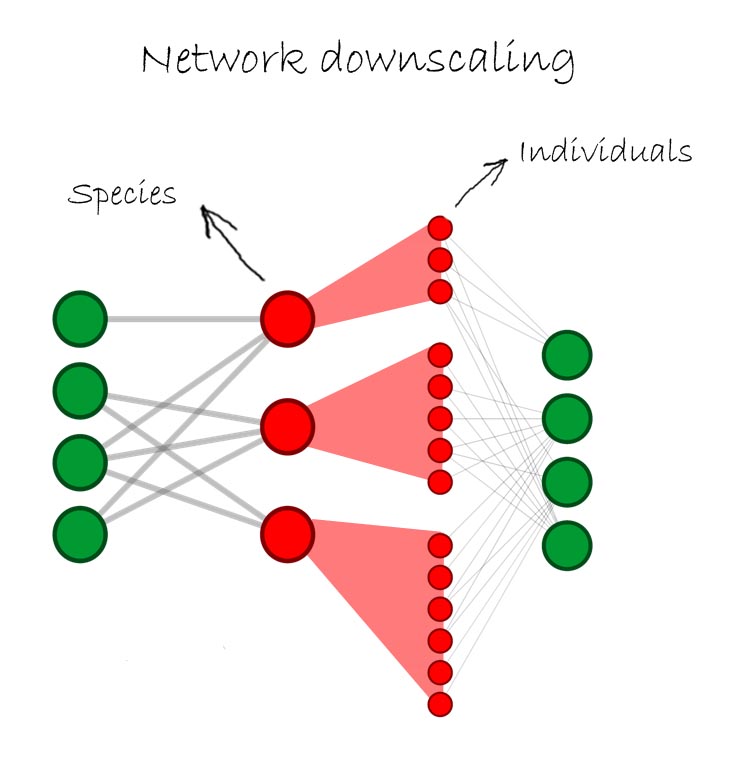
Network downscaling. In traditional species-based networks each node represents a species (red nodes are pollinators and green ones are plants), but if we decompose a species into its constituting individuals we can obtain an individual-based network. In the figure, downscaling is only represented for the pollinator subset.

Network downscaling. In traditional species-based networks each node represents a species (red nodes are pollinators and green ones are plants), but if we decompose a species into its constituting individuals we can obtain an individual-based network. In the figure, downscaling is only represented for the pollinator subset.


In an attempt to fill this gap of knowledge, we got the idea of downscaling an entire pollination network to the individual level for the pollinator subset and explore network patterns at both interacting scales: species and individuals. This was possible with the study of pollen loads of insect individuals. Insect flower visitors in two mountain shrub communities from Mallorca (Balearic Islands) were captured, and later in the laboratory, pollen carried by each one was identified and quantified under the microscope. It was a highly time consuming and difficult task, but it paid well off as it provided a record of the flowering species visited by each individual pollinator over time. Data revealed that generalized species in the plant-pollinator network are composed of specialized and idiosyncratic individuals. The high heterogeneity in individual foraging behaviour and the high individual specialization of pollinators are obviously hidden in traditional species-based networks, and thus determine differences in several topological properties between species-based and individual-based networks. Particularly, the modular structure – a broadly described pattern in pollination networks which consists of densely connected groups or cliques of nodes with sparse connections to other groups– is not consistent across networks at the two scales. We found that modularity increases when downscaling networks to the individual level, and we confirmed this result using different modularity detection algorithms. In contrast to the view of modules as a set of taxonomically related species or species with convergent morphological traits in species-based networks, modules in individual-based networks are groups of functionally different pollinators distantly related but with overlapping pollen niches. Thus, interestingly, conspecific individuals are distributed in different modules. Modules showed to have a strong phenological component, and attributes related to the phenophase of plants and individuals even determined the topological roles of nodes in the network. Only when downscaling to the individual level it was possible to detect a dynamical interaction switching within-species and a module turnover throughout the flowering season, thus modules of individuals assembled and disassembled over time.

Study site. The study was conducted on two locations in Puig Major (1445 m), the highest mountain in Mallorca (Balearic Islands).

Study site. The study was conducted on two locations in Puig Major (1445 m), the highest mountain in Mallorca (Balearic Islands).

Methods. Pollinator observations were conducted in the field. Insects visiting flowers were captured and, later, their pollen loads were analyzed in the lab.

Methods. Pollinator observations were conducted in the field. Insects visiting flowers were captured and, later, their pollen loads were analyzed in the lab.


In conclusion, findings reported in our study, “Increasing modularity when downscaling networks from species to individuals”  (Tur et al.) highlight that network patterns differed across the individuals and the species scales, because much within-species variation exists. This implies that it is not always possible to deduce structure at one hierarchical level from information about structure at an adjacent level. Combining the study of networks at both scales offers the possibility of uncovering important properties and processes, which might influence network stability, dynamics and the outcomes of interactions.

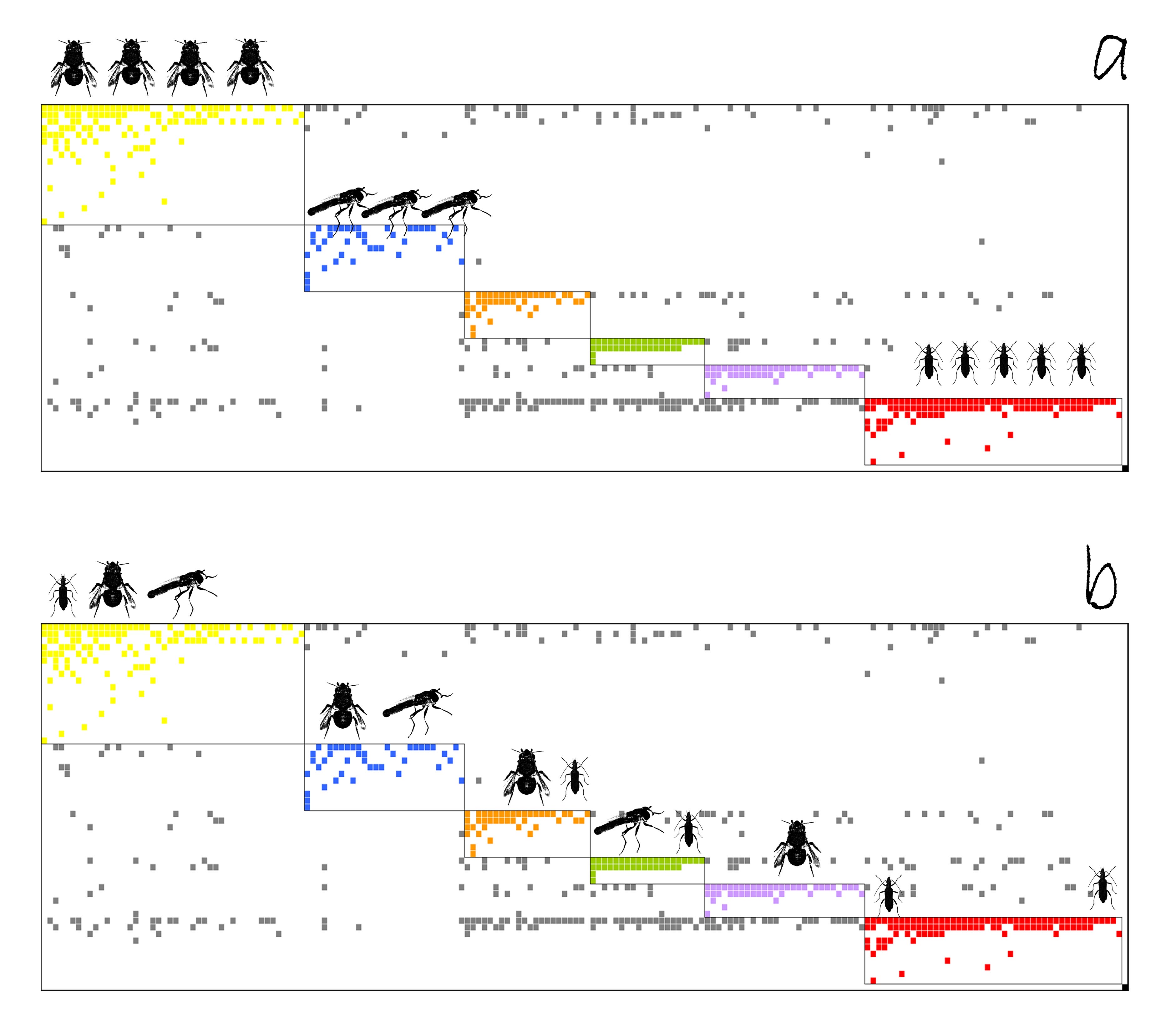
Distribution of conspecifics into modules. One of the objectives in our study was to investigate whether individual-based networks were modular and if this was true, to analize how conspecific individuals were distributed among modules. There are two possibilities: (a) all conspecific individuals belong to the same module, or alternatively, (b) conspecific individuals belong to different modules. In most species we found ‘b’.

Distribution of conspecifics into modules. One of the objectives in our study was to investigate whether individual-based networks were modular and if this was true, to analize how conspecific individuals were distributed among modules. There are two possibilities: (a) all conspecific individuals belong to the same module, or alternatively, (b) conspecific individuals belong to different modules. In most species we found ‘b’.


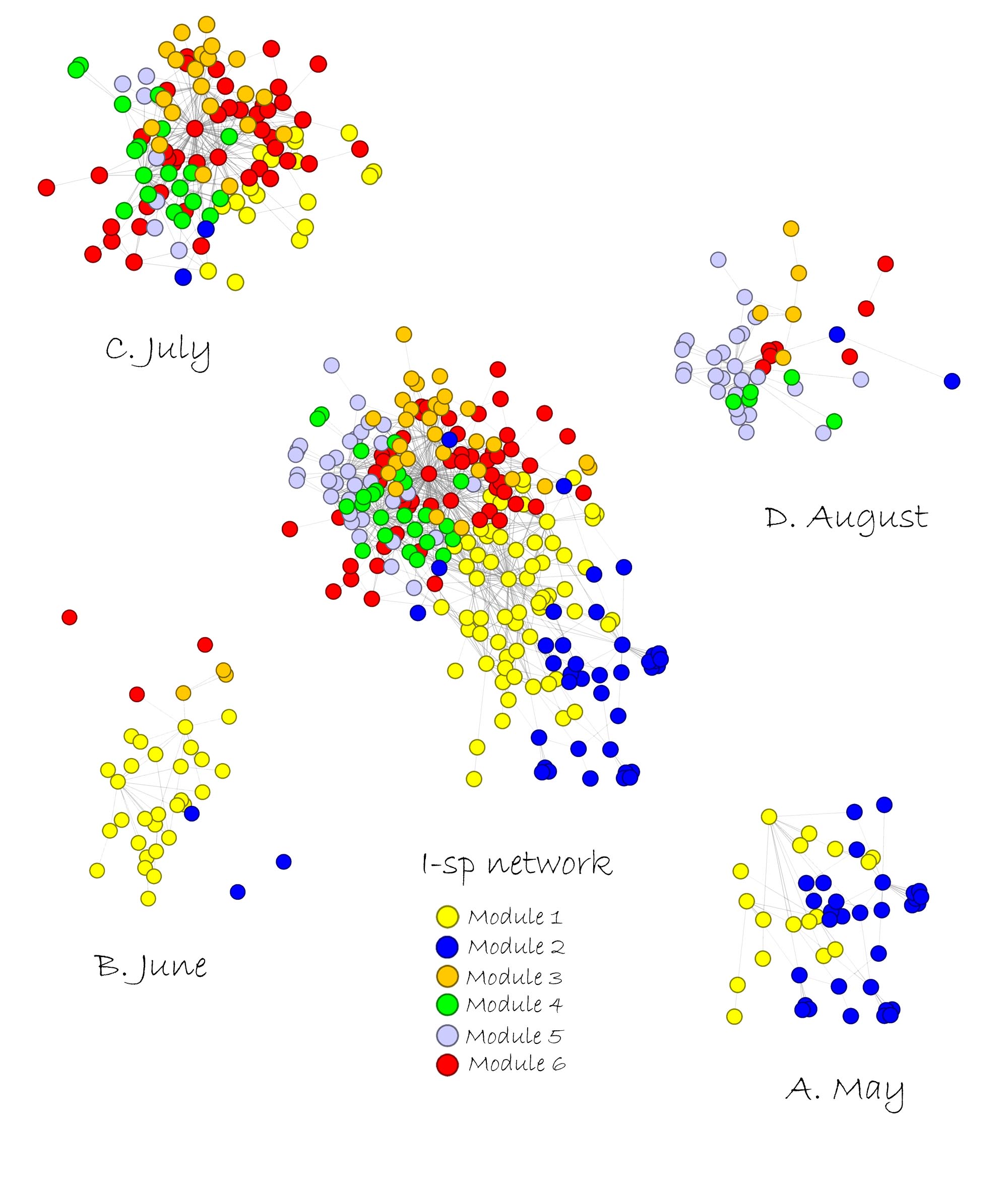
Module turnover. When downscaling from species to individuals, a module turnover associated to seasonality was identified, so that at a given moment of the season there is predominance of a particular module of individuals. The complete individual-species network and the different slices of each month are shown in the figure.

Module turnover. When downscaling from species to individuals, a module turnover associated to seasonality was identified, so that at a given moment of the season there is predominance of a particular module of individuals. The complete individual-species network and the different slices of each month are shown in the figure.

By Christina Tur