Tag Archives: Nature

I’ll talk politics with climate change deniers – but not science Updated for 2026


There are many complex reasons why people decide not to accept the science of climate change. The doubters range from the conspiracy theorist to the sceptical scientist, or from the paid lobbyist to the raving lunatic.

Climate scientists, myself included, and other academics have strived to understand this reluctance. We wonder why so many people are unable to accept a seemingly straight-forward pollution problem.

And we struggle to see why climate change debates have inspired such vitriol.

These questions are important. In a world increasingly dominated by science and technology, it is essential to understand why people accept certain types of science but not others.

In short, it seems when it comes to climate change, it is not about the science but all about the politics.

Risky business

Back in the late 1980s and early 1990s differing views on climate science were put down to how people viewed nature: was it benign or malevolent? In 1995 leading risk expert John Adams suggested there were four myths of nature, which he represented as a ball on different shaped landscapes.

  1. Nature is benign and forgiving of any insults that humankind might inflict upon it and it does not need to be managed.
  2. Nature ephemeral. Nature is fragile, precarious, and unforgiving and environmental management must protect nature from humans.
  3. Nature perverse/tolerant. Within limits, nature can be relied upon to behave predictably and regulation is required to prevent major excesses.
  4. Nature capricious. Nature is unpredictable and there is no point to management.

Different personality types can be matched on to these different views, producing very different opinions about the environment. Climate change deniers would map on to number one, Greenpeace number two, while most scientists would be number three. These views are influenced by an individual’s own belief system, personal agenda (either financial or political), or whatever is expedient to believe at the time.

However, this work on risk perception was ignored by mainstream science because science up to now operates on what is called the knowledge deficit model. This suggests that people do not accept the science because there is not enough evidence; therefore more needs to be gathered.

Scientists operate in exactly this way, and they assume wrongly the rest of the world is equally rational and logical. It explains why over the past 35 years a huge amount of work gone into investigating climate change.

However – despite many thousands of pages of IPCC reports – the weight of evidence argument does not seem to work with everyone.

No understanding of science?

At first failure of the knowledge deficit model was blamed on the fact that people simply did not understand science, perhaps due to a lack of education.

This was exacerbated as scientists from the late 1990s onwards started to be drawn into discussions about whether people believed or did not believe in climate change.

The use of the word ‘belief’ is important here, as it was a direct jump from the American-led argument between the science of evolution and the belief in creation.

But we know that science is not a belief system. You cannot decide that you believe in penicillin or the principles of flight while at the same time disbelieve humans evolved from apes or that greenhouse gases can cause climate change.

This is because science is an expert trust-based system that is underpinned by rational methodology that moves forward by using detailed observation and experimentation to constantly test ideas and theories.

It does not provide us with convenient yes/no answers to complex scientific questions, however much the media portrayal of scientific evidence would like the general public to ‘believe’ this to be true.

It’s all about the politics

However, many who deny climate change is an issue are extremely intelligent, eloquent and rational. They would not see the debate as one about belief and they would see themselves above the influence of the media.

So if the lack of acceptance of the science of climate change is neither due to a lack of knowledge, nor due to a misunderstanding of science, what is causing it?

Recent work has refocused on understanding people’s perceptions and how they are shared, and as climate denial authority George Marshall suggests these ideas can take on a life of their own, leaving the individual behind.

Colleagues at Yale University developed this further by using the views of nature shown above to define different groups of people and their views on climate change. They found that political views are the main predictor of the acceptance of climate change as a real phenomenon.

This is because climate change challenges the Anglo-American neoliberal view that is held so dear by mainstream economists and politicians. Climate change is a massive pollution issue that shows the markets have failed and it requires governments to act collectively to regulate industry and business.

In stark contrast neoliberalism is about free markets, minimal state intervention, strong property rights and individualism. It also purports to provide a market-based solution via ‘trickle down’ enabling everyone to become wealthier.

But calculations suggest to bring the incomes of the very poorest people in the world up to just $1.25 per day would require at least a 15 times increase in global GDP. This means huge increases in consumption, resource use and of course, carbon emissions.

It’s easier to deny climate change, than to deny our own ideologies

So in many cases the discussion of the science of climate change has nothing to do with the science and is all about the political views of the objectors. Many perceive climate change as a challenge to the very theories that have dominated global economics for the last 35 years, and the lifestyles that it has provided in developed, Anglophone countries.

Hence, is it any wonder that many people prefer climate change denial to having to face the prospect of building a new political (and socio-economic) system, which allows collective action and greater equality?

I am well aware of the abuse I will receive because of this article. But it is essential for people, including scientists, to recognise that it is the politics and not the science that drives many people to deny climate change.

This does mean, however, that no amount of discussing the ‘weight of scientific evidence’ for climate change will ever change the views of those who are politically or ideologically motivated.

Hence I am very sorry – but I will not be responding to comments posted concerning the science of climate change but I am happy to engage in discussion on the motivations of denial.


Mark Maslin is Professor of Climatology at University College London.

This article was originally published on The Conversation. Read the original article.

The Conversation


388305

I’ll talk politics with climate change deniers – but not science Updated for 2026


There are many complex reasons why people decide not to accept the science of climate change. The doubters range from the conspiracy theorist to the sceptical scientist, or from the paid lobbyist to the raving lunatic.

Climate scientists, myself included, and other academics have strived to understand this reluctance. We wonder why so many people are unable to accept a seemingly straight-forward pollution problem.

And we struggle to see why climate change debates have inspired such vitriol.

These questions are important. In a world increasingly dominated by science and technology, it is essential to understand why people accept certain types of science but not others.

In short, it seems when it comes to climate change, it is not about the science but all about the politics.

Risky business

Back in the late 1980s and early 1990s differing views on climate science were put down to how people viewed nature: was it benign or malevolent? In 1995 leading risk expert John Adams suggested there were four myths of nature, which he represented as a ball on different shaped landscapes.

  1. Nature is benign and forgiving of any insults that humankind might inflict upon it and it does not need to be managed.
  2. Nature ephemeral. Nature is fragile, precarious, and unforgiving and environmental management must protect nature from humans.
  3. Nature perverse/tolerant. Within limits, nature can be relied upon to behave predictably and regulation is required to prevent major excesses.
  4. Nature capricious. Nature is unpredictable and there is no point to management.

Different personality types can be matched on to these different views, producing very different opinions about the environment. Climate change deniers would map on to number one, Greenpeace number two, while most scientists would be number three. These views are influenced by an individual’s own belief system, personal agenda (either financial or political), or whatever is expedient to believe at the time.

However, this work on risk perception was ignored by mainstream science because science up to now operates on what is called the knowledge deficit model. This suggests that people do not accept the science because there is not enough evidence; therefore more needs to be gathered.

Scientists operate in exactly this way, and they assume wrongly the rest of the world is equally rational and logical. It explains why over the past 35 years a huge amount of work gone into investigating climate change.

However – despite many thousands of pages of IPCC reports – the weight of evidence argument does not seem to work with everyone.

No understanding of science?

At first failure of the knowledge deficit model was blamed on the fact that people simply did not understand science, perhaps due to a lack of education.

This was exacerbated as scientists from the late 1990s onwards started to be drawn into discussions about whether people believed or did not believe in climate change.

The use of the word ‘belief’ is important here, as it was a direct jump from the American-led argument between the science of evolution and the belief in creation.

But we know that science is not a belief system. You cannot decide that you believe in penicillin or the principles of flight while at the same time disbelieve humans evolved from apes or that greenhouse gases can cause climate change.

This is because science is an expert trust-based system that is underpinned by rational methodology that moves forward by using detailed observation and experimentation to constantly test ideas and theories.

It does not provide us with convenient yes/no answers to complex scientific questions, however much the media portrayal of scientific evidence would like the general public to ‘believe’ this to be true.

It’s all about the politics

However, many who deny climate change is an issue are extremely intelligent, eloquent and rational. They would not see the debate as one about belief and they would see themselves above the influence of the media.

So if the lack of acceptance of the science of climate change is neither due to a lack of knowledge, nor due to a misunderstanding of science, what is causing it?

Recent work has refocused on understanding people’s perceptions and how they are shared, and as climate denial authority George Marshall suggests these ideas can take on a life of their own, leaving the individual behind.

Colleagues at Yale University developed this further by using the views of nature shown above to define different groups of people and their views on climate change. They found that political views are the main predictor of the acceptance of climate change as a real phenomenon.

This is because climate change challenges the Anglo-American neoliberal view that is held so dear by mainstream economists and politicians. Climate change is a massive pollution issue that shows the markets have failed and it requires governments to act collectively to regulate industry and business.

In stark contrast neoliberalism is about free markets, minimal state intervention, strong property rights and individualism. It also purports to provide a market-based solution via ‘trickle down’ enabling everyone to become wealthier.

But calculations suggest to bring the incomes of the very poorest people in the world up to just $1.25 per day would require at least a 15 times increase in global GDP. This means huge increases in consumption, resource use and of course, carbon emissions.

It’s easier to deny climate change, than to deny our own ideologies

So in many cases the discussion of the science of climate change has nothing to do with the science and is all about the political views of the objectors. Many perceive climate change as a challenge to the very theories that have dominated global economics for the last 35 years, and the lifestyles that it has provided in developed, Anglophone countries.

Hence, is it any wonder that many people prefer climate change denial to having to face the prospect of building a new political (and socio-economic) system, which allows collective action and greater equality?

I am well aware of the abuse I will receive because of this article. But it is essential for people, including scientists, to recognise that it is the politics and not the science that drives many people to deny climate change.

This does mean, however, that no amount of discussing the ‘weight of scientific evidence’ for climate change will ever change the views of those who are politically or ideologically motivated.

Hence I am very sorry – but I will not be responding to comments posted concerning the science of climate change but I am happy to engage in discussion on the motivations of denial.


Mark Maslin is Professor of Climatology at University College London.

This article was originally published on The Conversation. Read the original article.

The Conversation


388305

Rallying for wildlife – we need a Nature and Wellbeing Act Updated for 2026


400 people who love and care about wildlife are (with a squirrel called Bob) taking part in a rally in London today.

They will come from all parts of England and will visit the House of Commons to urge their MP to include strong commitments to nature in their 2015 election manifestos.

The event is being organised by the RSPB, The Wildlife Trusts, the League Against Cruel Sports (90 years old this year – happy birthday!), and my predecessor, Dr Mark Avery. It is also supported by Butterfly Conservation, the Mammal Society and the Ramblers.

I’m looking forward to it. I expect it’s going to be cold, but I am sure that won’t stop folk using their voice for nature. The call for action is compelling …

The declining state of Britain’s nature

Last week’s Defra biodiversity indicators report showed that nearly two-thirds of England’s finest wildlife sites are not in favourable condition. There has been a decline in the area of these sites in favourable condition from 44% in 2003 to 37.5% in April 2014.

The trend since 2010 does not look too rosy and the Government’s target of reaching 50% in favourable condition by 2020 looks a long way off.

The State of Nature report, published in 2013, showed that 60% of species (for which we have trend data) have declined in my lifetime and one in ten UK species is at risk of extinction. And if the dramatic cuts in public spending heralded by the Chancellor’s announcements last week fall in the wrong place it could be at the cost of nature. 

Unless the value of nature is fully accounted in decision-making, we fear the situation will become even worse. The prominence of housing and infrastructure development in the Chancellor’s autumn statement risks casting a long shadow over the future of many of our finest wildlife sites.

These include Lodge Hill (here) in Kent, where housing threatens to destroy the only protected site for nightingales in the UK.

Politicians must take our ecological deficit seriously

The threats are real and challenging: habitat destruction, over-exploitation, pollution (especially climate change) and the invasive non-native species. These are being driven by a growing population, consuming more and a failure of the economic system to capture the value of nature in decision-making.

Despite the growing evidence of the link between a healthy environment and our own prosperity, politicians seem increasingly preoccupied by other factors that might affect our economy.

I do not see the same energy being invested in tackling the ecological deficit as is the case with the economic deficit. We are in danger of passing on our natural environment to our children in a depleted state. This needs to change which is why people have taken to the streets outside Westminster.

We have made it simple for our politicians and have come up with three priorities. We want action to protect and restore wildlife – and here’s how.

1. Celebrate and defend the wildlife laws we have

We must fight any weakening or dilution of the laws we have, such as the EU Birds and Habitats Directives which provide the foundation for nature conservation in this country.

In September 2014, European Commission President Jean-Claude Juncker asked new Environment Commissioner Karmenu Vella to consider merging the two directives into a modern piece of legislation.

The context of this announcement was an aggressively deregulatory and pro-growth agenda and therefore it is clear that ‘merge’ is code for ‘weaken’. This would be a disaster for nature conservation ambitions in this country and across Europe.

The Directives were established on the principle that no Member State should gain competitive advantage by trashing their environment. And this principle is respected by many businesses today. For example, Cemex, a global cement company recently said in defence of the directive

“These create a level playing field, and give our stakeholders confidence that we are operating to high standards.”

Despite what some may think, they do not act as a block to development. The 2012 Defra review of the Habitat Regulations designed to implement the directives in England showed that the main problems facing developers was a failure of implementation.

And, most importantly for any politician that wants to help nature, they work: research conducted by RSPB scientist showed that the Birds Directive has successfully protected those species considered to be at most risk and in need of most urgent protection across the EU – and has made a significant difference in protecting many of Europe’s birds from further decline.

2. Fully implement the laws – and clamp down on wildlife crime!

We must demand that the law as it is is fully implemented, ending wildlife crime so that threatened species like the hen harrier are able to fly free from harm.

This year’s Birdcrime report documented 164 incidents of shooting and destruction of birds of prey. We believe that these published figures represent only a fraction of the total number of incidents, as many crimes remain undetected and unreported, particularly those that occur in remote areas.

The hen harrier population, in particular, continues to reflect this persecution. In 2013, there were no successful breeding pairs left in England despite there being enough habitat to support over 300 breeding pairs.

We need politicians to wake up to the fact that without action, this bird could be lost from the English countryside. And action must start with cracking down on illegal killing.

3. A Nature & Wellbeing Act

We need a secure legal underpinning nature’s recovery by establishing a Nature and Wellbeing Act to mainstream nature in decision making, to establish long-term targets and powers to help meet them.

Defra’s biodiversity indicators are a timely reminder that we cannot rely on good will and an ever-dwindling pot of money to restore nature. We hope our proposed legislation will drive nature’s recovery in the same way that the Climate Change Act (2008) has begun to systematically reduce greenhouse gas emissions in the UK.

We know that action cannot be achieved by governments alone. Real change will also come from changes from other parts of society especially from developers, farmers, the grouse shooting community and other land managers.

But despite the state of the nation’s finances, government can still and must play its part. And that’s why people are coming to London to see their elected representatives. Thousands of people that are unable to attend have already written to their MP to urge them to take action for wildlife.

Civil society is united in its desire for a more positive relationship between people and wildlife.

We want 2015 to be the year that we take nature seriously and we expect politicians to recognise that in their election manifestos.


Support our Act for Nature campaign, asking your MP to back the Nature & Wellbeing Act.

Martin Harper is Conservation Director of RSPB. He blogs on the RSPB website, where this article was first published.


387901

Far Updated for 2026

Eriophorum in its environment

In a previous post, the photographing ecologist explained the importance of getting low to get the interesting and catchy pictures of your scientific subjects. As you can imagine the extra effort this would ask from your knees, I here want to highlight one more reason why it is certainly worth the effort: it creates the chance to display your subject in its wider environment.

Invasion of red clover along Norwegian fjord

Invasion of red clover along Norwegian fjord

This wider environment is an important factor. As scientists, we have the habit to focus too much on the details. From our first steps in the PhD, we dive too deep in our own little niche. And as we get closer and closer to our subjects, it might become difficult to communicate to uninformed outsiders about the broad picture.

Exotic dandelion in the mountains

Non-native dandelion in the mountains

A good picture could be the rescue here. It provides a non-scientific public immediately with a lot of useful information about your study object and its environment. Especially when you took into account the ‘Low’ and ‘Far’ strategies…

Experiment with its background view

Experiment in the Swedish mountains with its background view

When you dare to ignore the common urge to take a frame-filling picture of your subject, you improve your chances of explaining the details to your audience. A well-designed picture in which attention has been paid to the background, starts telling its own story. A story about the world in which your study object lives, the ecological framework in which everything is situated. Although you loose small-scale details if you refrain from close-up images, you get a large amount of information in return that broadens the view.

Herd of reindeer in their typical environment: roaming the tundra with the Lapporten mountains in the background

Herd of reindeer in their typical environment: roaming the tundra with the Lapporten mountains in the background

Taking some steps back might also help to get a simpler image, one that is easier to understand. Keep an eye out for distinct lines and shapes in the landscape, as they can provide a pause for the eye of the viewer. This will make the true subject of the picture to stand out.

With this close-up of a dead lemming in the Scandinavian mountains, for example, you can see the details of the gruesome torture that happened to this poor animal.

Dead lemming in close-up

But I also love the next overview, as it adds an extra dimension to the story. How the little fellow was probably left behind on that rock by a bird of prey. How the hunter was chased away from his favourite look-out on the valley by an unwanted visitor halfway its meal.

Lemming with valley overview


So, going ‘far’ from your subject turns out to be an interesting way to tell ecological stories. I experienced the trick to work for people as well. A picture of an ecologist in action in the middle of his ’natural habitat’ emits a lot more power than any detailed close-up will ever get.

Hiking towards the field site

Hiking through the Scandinavian mountains in search for an experimental plot


November 6, 2014

Everything is connected – in nature too Updated for 2026

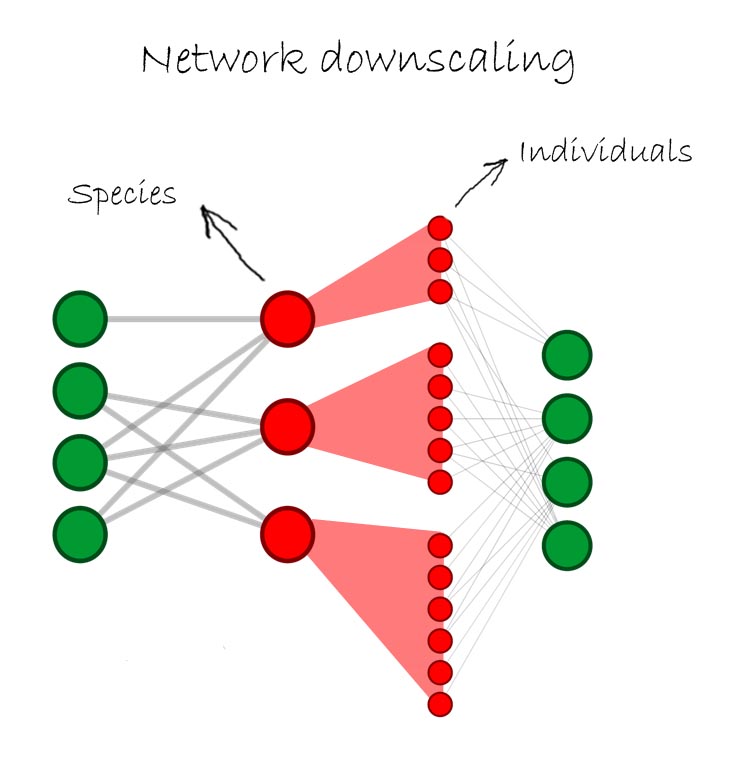
You might, sometimes, have heard the phrase ‘everything is connected’. Maybe you are thinking about computers and mobile phones, but in fact this statement is particularly true in nature. For instance, we know that species are not isolated entities, instead they are part of communities in which multiple different species are interacting with each other. Some of these interspecific interactions are cooperative and positive for all interacting partners, and are called mutualistic interactions. Virtually all species on Earth are involved in one or more mutualistic interactions. Specifically, the interactions between plants and their pollinators may be some of the most studied ones, as nearly 85% of plants rely on animals for pollination service. In the last 20 years the study of pollination interactions using network analysis has been a hot topic in ecology. Networks have proven to be a useful tool to unravel patterns in plant-pollinator interactions at the whole community level. Usually, almost all plant-pollinator networks are constructed at the species-level (species-based networks), i.e. nodes in the network are plant and animal species and links represent the interactions occurring between them (e.g. flower visits). However, species are composed of populations of individuals and those individuals are the true actors establishing interactions in nature. Even more interesting is the fact that conspecific individuals are phenotypically and behaviourally diverse with respect to, e.g. size, sex, age, and social status, which also might imply that their foraging decisions become different. Most ecological networks studied to date have not considered this intraspecific variation in interactions, despite the importance of individual variation within natural populations addressed in the theory of evolution by natural selection. For that reason, moving from species-based networks to individual-based networks, to disentangle a process, which can be defined as network downscaling, is probably one of the major challenges right now in ecological network research.


Network downscaling. In traditional species-based networks each node represents a species (red nodes are pollinators and green ones are plants), but if we decompose a species into its constituting individuals we can obtain an individual-based network. In the figure, downscaling is only represented for the pollinator subset.

Network downscaling. In traditional species-based networks each node represents a species (red nodes are pollinators and green ones are plants), but if we decompose a species into its constituting individuals we can obtain an individual-based network. In the figure, downscaling is only represented for the pollinator subset.


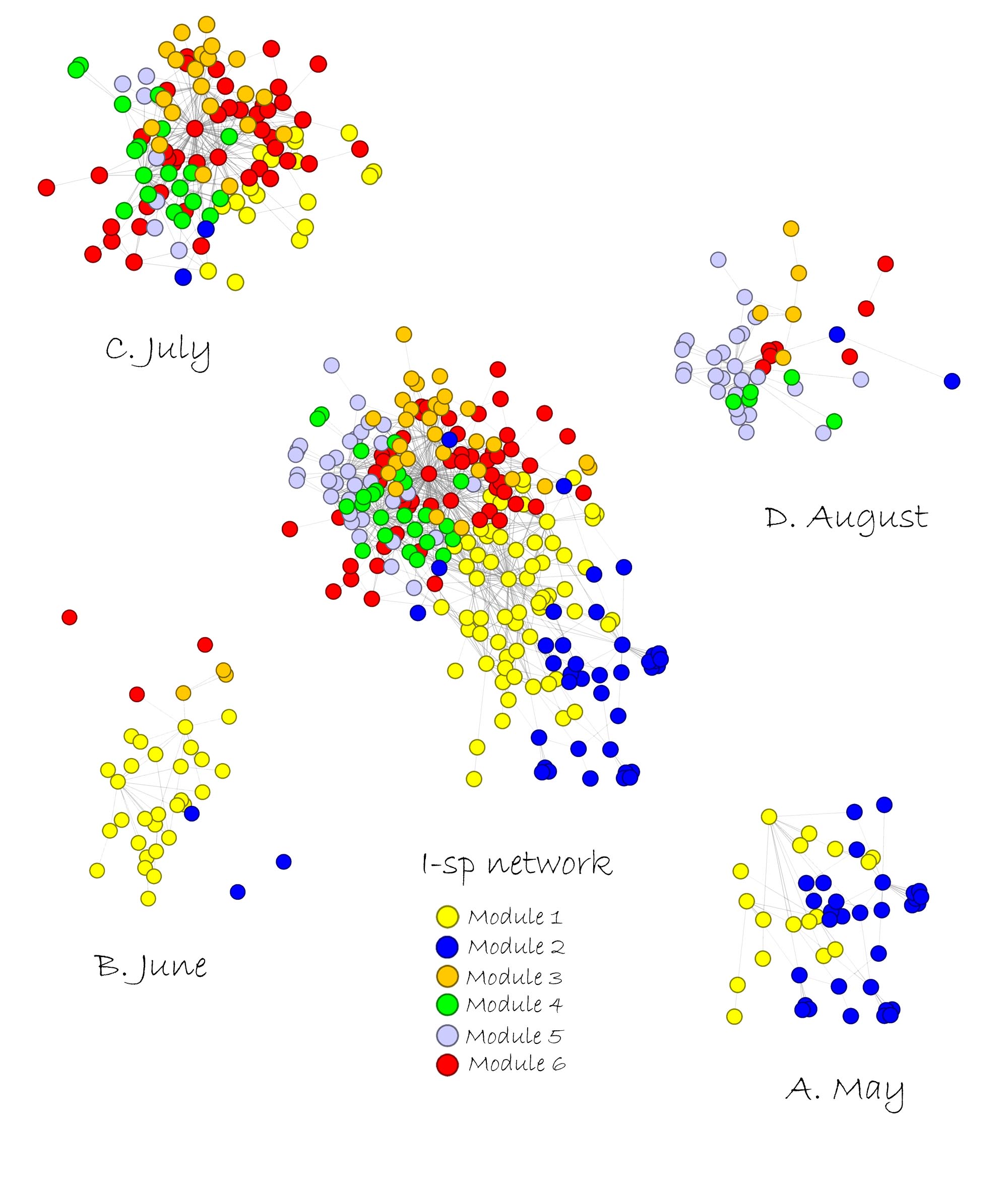
In an attempt to fill this gap of knowledge, we got the idea of downscaling an entire pollination network to the individual level for the pollinator subset and explore network patterns at both interacting scales: species and individuals. This was possible with the study of pollen loads of insect individuals. Insect flower visitors in two mountain shrub communities from Mallorca (Balearic Islands) were captured, and later in the laboratory, pollen carried by each one was identified and quantified under the microscope. It was a highly time consuming and difficult task, but it paid well off as it provided a record of the flowering species visited by each individual pollinator over time. Data revealed that generalized species in the plant-pollinator network are composed of specialized and idiosyncratic individuals. The high heterogeneity in individual foraging behaviour and the high individual specialization of pollinators are obviously hidden in traditional species-based networks, and thus determine differences in several topological properties between species-based and individual-based networks. Particularly, the modular structure – a broadly described pattern in pollination networks which consists of densely connected groups or cliques of nodes with sparse connections to other groups– is not consistent across networks at the two scales. We found that modularity increases when downscaling networks to the individual level, and we confirmed this result using different modularity detection algorithms. In contrast to the view of modules as a set of taxonomically related species or species with convergent morphological traits in species-based networks, modules in individual-based networks are groups of functionally different pollinators distantly related but with overlapping pollen niches. Thus, interestingly, conspecific individuals are distributed in different modules. Modules showed to have a strong phenological component, and attributes related to the phenophase of plants and individuals even determined the topological roles of nodes in the network. Only when downscaling to the individual level it was possible to detect a dynamical interaction switching within-species and a module turnover throughout the flowering season, thus modules of individuals assembled and disassembled over time.

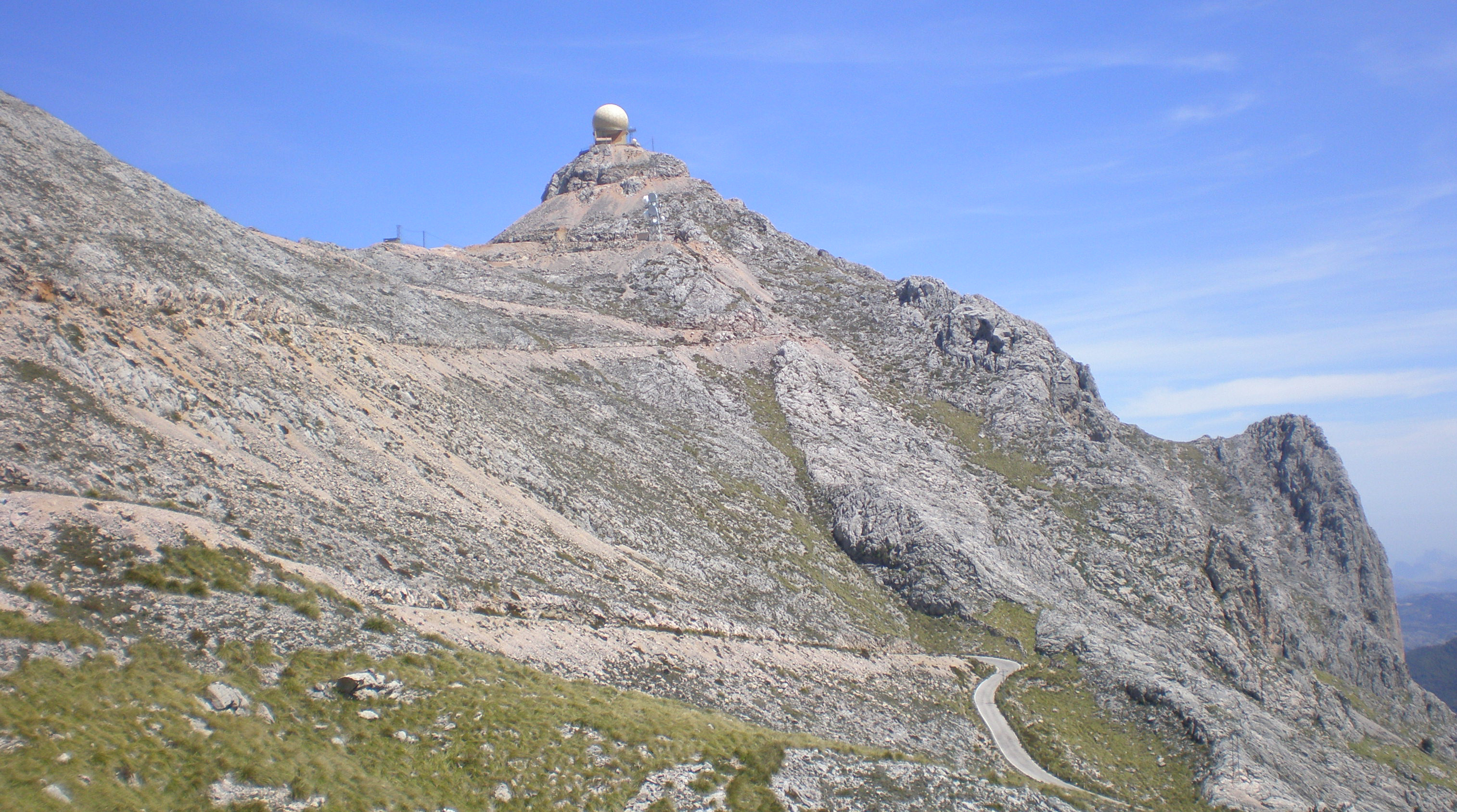
Study site. The study was conducted on two locations in Puig Major (1445 m), the highest mountain in Mallorca (Balearic Islands).

Study site. The study was conducted on two locations in Puig Major (1445 m), the highest mountain in Mallorca (Balearic Islands).

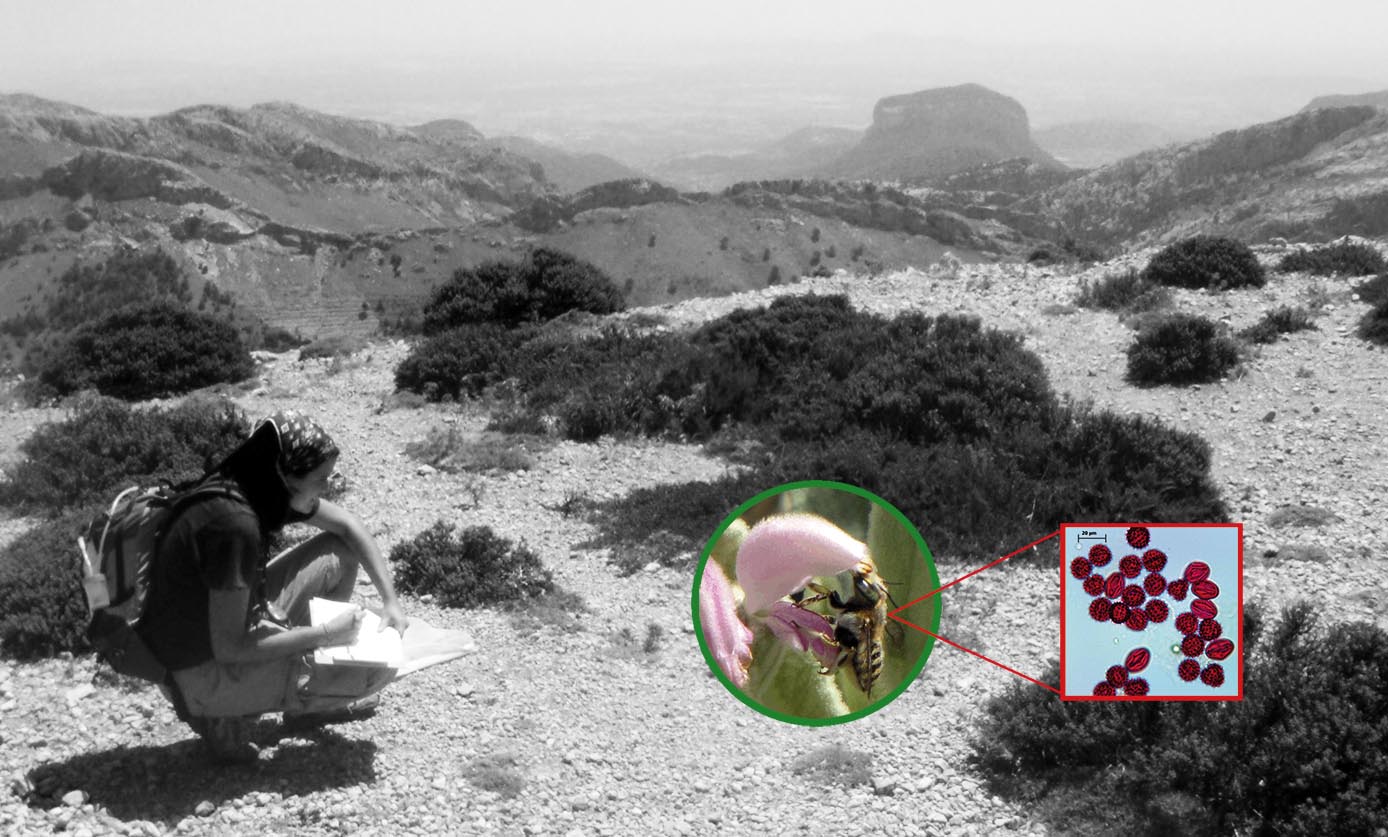
Methods. Pollinator observations were conducted in the field. Insects visiting flowers were captured and, later, their pollen loads were analyzed in the lab.

Methods. Pollinator observations were conducted in the field. Insects visiting flowers were captured and, later, their pollen loads were analyzed in the lab.


In conclusion, findings reported in our study, “Increasing modularity when downscaling networks from species to individuals”  (Tur et al.) highlight that network patterns differed across the individuals and the species scales, because much within-species variation exists. This implies that it is not always possible to deduce structure at one hierarchical level from information about structure at an adjacent level. Combining the study of networks at both scales offers the possibility of uncovering important properties and processes, which might influence network stability, dynamics and the outcomes of interactions.

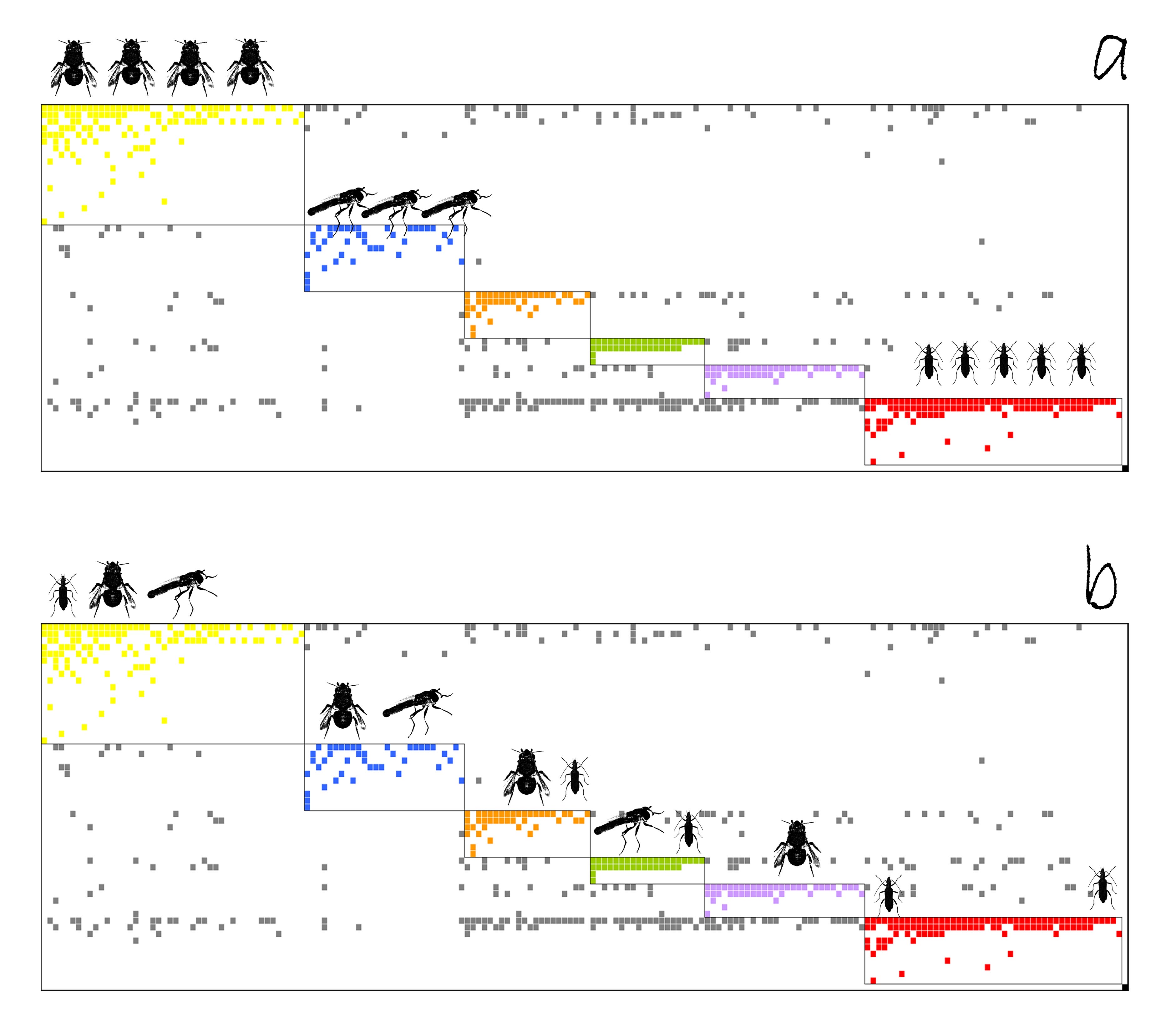
Distribution of conspecifics into modules. One of the objectives in our study was to investigate whether individual-based networks were modular and if this was true, to analize how conspecific individuals were distributed among modules. There are two possibilities: (a) all conspecific individuals belong to the same module, or alternatively, (b) conspecific individuals belong to different modules. In most species we found ‘b’.

Distribution of conspecifics into modules. One of the objectives in our study was to investigate whether individual-based networks were modular and if this was true, to analize how conspecific individuals were distributed among modules. There are two possibilities: (a) all conspecific individuals belong to the same module, or alternatively, (b) conspecific individuals belong to different modules. In most species we found ‘b’.


Module turnover. When downscaling from species to individuals, a module turnover associated to seasonality was identified, so that at a given moment of the season there is predominance of a particular module of individuals. The complete individual-species network and the different slices of each month are shown in the figure.

Module turnover. When downscaling from species to individuals, a module turnover associated to seasonality was identified, so that at a given moment of the season there is predominance of a particular module of individuals. The complete individual-species network and the different slices of each month are shown in the figure.

By Christina Tur


Low Updated for 2026

Cotton grass on the shore of a lake

In a previous post, I wrote about the power of photography for ecologists. Now, it is time to provide some real tips for photographing ecologists. How to take home some pictures that will impress others, without – importantly – losing any working time?

Cotton grass on the shore of a lake

Most ecologists will take a camera into the field anyway. It is used to take pictures of their research site or subject, or record some important details for later. As you already have your camera in your hand, it will not cost you too much effort to take just one more picture.

Autumn seeds in Lapland

In that case, it might be a smart idea to get a little bit lower, up to the level of your study object, to check the world from its point of view.

Mountain mushroom

The combination of integrating your study object in the landscape and letting it stand out of the background results in more interesting images. It makes it possible for an observer to feel a connection with the subject and it makes the picture tell a much more interesting story.

Hiking in the Swedish mountains

Even if your study object is a dull bird or a boring plant, getting on its level will bring out the best in it and give it a soul.

House sparrow

If possible, try to include the horizon in the picture. It will ask a lot more of your knees, but the rewards are big. As the (obviously real) Lappish proverb goes: ‘A beautiful horizon can even make a dead lemming look poetic’.

Dead lemming on a rock

I did not invest too much time in getting a nice overview of my study species, the invasive plants in my plots. An awfully difficult subject for an artist, I have to admit, but by quickly spending two minutes as a photographer before you dive into the science, might have been rewarding even in this case.

Experimental plot

Take home message: low! Take your pictures from a low angle and give their stories a boost!

Achillea millefolium

 Want more from Jonas Lembrechts?

October 3, 2014

Five ways to stop the world’s wildlife vanishing Updated for 2026


Full marks to colleagues at the World Wildlife Fund and the Zoological Society of London for the Living Planet Report 2014 and its headline message which one hopes ought to shock the world out of its complacency: a 52% decline of wildlife populations in the past 40 years.

Over the summer I re-read Fairfield Osborne’s 1948 classic Our Plundered Planet – the first mass-readership environmental book that detailed the scale of the damage humanity wrought on nature.

Faced with the figures in this report it is easy to slip into despondency and to blame others. But this would be a mistake. At the time, Osborne’s report must have been equally alarming, but the eclectic conservation movement of which he was part responded with confidence, hope and vision.

Their achievements were huge: the creation of a reserve network that forestalled the extinction of African creatures such as the elephant and rhino; the creation of a nature conservation agency, the International Union for Conservation of Nature) (IUCN) within the UN; and a raft of international wildlife agreements.

But what can we do now?

Today, conservation-minded people will probably be wondering what can be done to reverse wildlife declines.

For me the question is: how can today’s conservationists leave a wildlife legacy for the 21st century? I think there are five ways we can change conservation to better fit the circumstances we face.

1. Decentralise and diversify

The effort to ensure that nature conservation became a policy area of the UN necessitated developing a strong international conservation regime.

This has served us well, but the world has changed: centralised authority has given way to messy, networked governance organised across many levels.

If the Balinese want to restore Bali Starling populations in coconut plantations I say applaud their vision and learn from their innovation.

What matters is that wildlife populations flourish, not that some institutionalised notion of a ‘wild species’ gains global consensus. It is time to nurture diversity in conservation practice.

2. View wildlife as an asset

Since the 1990s conservation has become overly technocratic, with nature framed as a natural resource and stock of capital available for human economic development. Given human self-interest this just leads to arguments over who gets what share.

I suggest a better way to frame environmental policy is in terms of natural assets – places, attributes and processes that while representing forms of value to invest in, are also at risk of being eroded and must be protected.

We’ve done this before – think of great national parks where wildlife conservation, natural beautification and outdoor recreation combine for the benefit of wildlife, while also emphasising regional or national identity, health and cultural and economic worth.

3. Embrace re-wilding

Re-wilding is gaining traction. I see re-wilding as an opening, an opportunity for creative thinking and action that will affect the future.

A key theme is restoration of trophic levels – in which the missing large animals at the top of the food chain are reintroduced, allowing natural ecosystem processes to reassert themselves.

We might ask whether today’s reported declines in wildlife are a symptom of the ecosystem becoming more simple and, if so, whether re-wilding will lead to more abundant wildlife. Ecological intuition suggests the latter but in truth we don’t know.

In my view we need large-scale, publicly-financed re-wilding experiments to explore and develop new ways of rebuilding wildlife populations as an asset for society.

4. Harness new technologies

It’s clear that wildlife conservation is moving from being a data-poor to a data-rich science. The methods that underpin the Living Planet Report are state-of-the art, but even so we have yet to capture the analytical potential of ‘big data’.

Recent rapid developments in sensor technologies look set to bring about a step change in environmental research and monitoring.

In ten year’s time, I predict that the challenge for indexing the planet will shift from searching out and compiling data sets to working out how to deal with an environmental ‘data deluge’.

Despite this, wildlife conservation lacks a coherent vision and strategy. There are plenty of interesting technological innovations, but they are fragmented and individualistic in nature. We need leadership and investment to better harness them.

5. Re-engage the powerful

Like it or not, the wildlife conservation movement was at its most influential – as a policy and cultural imperative – when it was filled with active members drawn from the political, aristocratic, business, scientific, artistic and bureaucratic elites.

This was between 1890 and 1970. Over the past 40 years conservation organisations have become more professional, building close working relations with bureaucrats, but approaching other elites simply as sources of patronage, funds and publicity.

Conservation organisations must open-up, loosen their corporate structures and let leaders from other walks of life actively contribute their opinion, insight and influence to the cause.

But above all, keep caring

These are five starting points for discussion rather than prescriptions. Perhaps the greatest asset we have is the deep-rooted sense of concern for wildlife found across cultures, professions and classes.

It’s time to open up the discussion, to put forward new ideas for debate, and to ask others to suggest new and novel ways to save wildlife.


The report: Living Planet Report 2014.

Paul Jepson is Course Director, MSc Biodiversity, Conservation and Management at the University of Oxford. He does not work for, consult to, own shares in or receive funding from any company or organisation that would benefit from this article, and has no relevant affiliations.

This article was originally published on The Conversation. Read the original article.

Also on The Ecologist


The Conversation


384756

The photographing ecologist Updated for 2026

Plant in its natural environment

Photography is classified as art, ecology is science. Two distinct worlds that only very rarely show some overlap. I am however convinced that a combination of both disciplines could be very fruitful. Being a photographing ecologist, or ecological photographer not only gives artistic satisfaction, but it can also be a serious addition to your science.

Although taking pictures on a busy fieldwork day might feel like a waste of precious time, it can be really valuable to assign some minutes in the field to photography and make sure you are familiar with at least the basic skills of the art.

Overview of the plot

Inevitably, there will be a moment where you have to present your work: posters, powerpoint presentations, or just to a supervisor in the lab. The saying that one image is better than a 1000 words might be getting old, but it still holds true, a thing every scientist probably realizes when working on his slides.


Pictures for future reference

It might be common sense to spend at least five minutes of your working time in the field to photograph field sites, measuring methods and environmental characteristics, for your own reference or other peoples imagination. But it would even be better if you added another five minutes to the first five to zoom in on some details.

Plot on 1000 meters height, Abisko

Change the viewpoint and try to catch your field site in its environment. The lower scientific value is replaced by an aesthetic one. Or get some of your study species into focus…Plant in its natural environment

It is pretty obvious that a beautiful picture makes every story more attractive. If you want to convince the non-scientific world of the importance of your research, a catching picture will increase your impact factor a thousandfold (and I promise you, journalists are great at choosing the most irrelevant ones if you leave that task to them).

Hiking to the fieldwork

Even for the scientific public, however, a catchy picture will improve the results and the scope. No matter how interesting your story, nice illustrations will keep a larger audience awake during your presentation, and attract more people to your posters. Just give them those few seconds relief from the interesting but tiring statistical theories!

Plot for scale in the mountains

To finish, never forget the power of stories. Science is more than only the results and the 2 or 3 papers that come out of it. The process, arguably the largest part of the work, and the impressive, exotic, adventurous stories resulting from them can help enhancing the public’s understanding and appreciation of your research every day of the year. A photographic diary of your field trip might raise a lot more interest than all your scientific papers combined.

Angry lemming in the plot


Biology is a foreign discipline to a large part of the population. They do not have a clue about how our scientific statements come into existence. They will be surprised about the complexity of the scientific process, and the variation, excitement and attractiveness of ecological fieldwork. Scientific information will follow on the way. Enjoying the scenery at Torneträsk Lake, Abisko

This should make the importance of the use of photography as a powerful tool in science obvious. Let us thus all pack a camera as indispensable fieldwork gear in the future and revive our artistic alter ego’s. In some future posts, I will cover a set of useful skills to make those few artistic minutes as efficient as possible, so with only 3 or 4 clicks, you can get the best results out of your camera.

Jonas Lembrechts balances between being an ecological photographer and a photographing ecologist on his way to a PhD in mountain ecology. Follow his adventures here!

September 22, 2014