Tag Archives: birch

Herbivory effects of climate change Updated for 2026

Herbivory may be changed by climate change and how does that affect the host plants? Find out in the Early View paper “Colonization of a host tree by herbivorous insects under a changing climate” by Kaisa Heimonen and co-workers. Below is their summary of the paper: Climate warming is predicted to increase the abundance of herbivorous insects due to increased survival, growth and multivoltinism. In addition, due to warming climate many insect species are predicted to shift their ranges to higher latitudes. Host plants are adapted to the present day herbivore pressure and insect communities but in the future the abundance of insects and the composition of herbivorous insect communities might change which can lead to more intense herbivore damage. We wanted to study the susceptibility of silver birch (Betula pendula Roth) populations from different latitudes to the insect herbivores that are expected to spread northwards in the future. To do this we established three common gardens with 26 genotypes of silver birch from six latitudinal populations in Finland ranging from 60°N to 67°N. The common gardens were located at three different latitudes 60°N, 62°N and 67°N. At each study site 260 silver birches were growing. This experimental setup is being used also for several other studies (see the project homepage: http://www.uef.fi/fi/birchadaption).
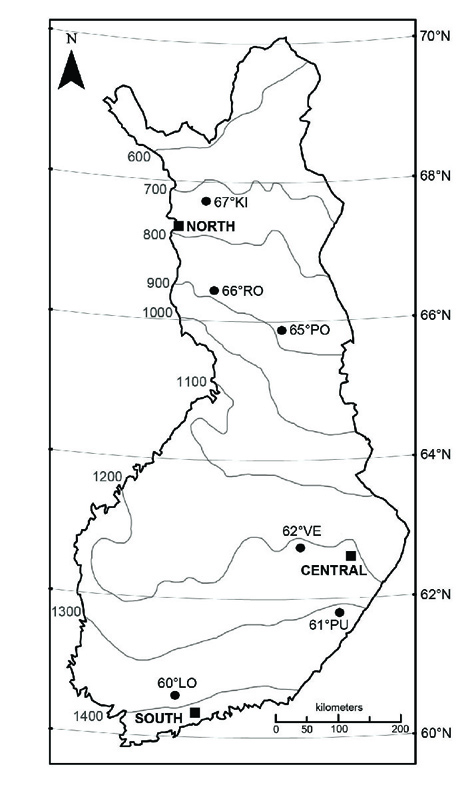
Figure 1. Map showing the three common garden sites (filled squares) and the six source populations (filled circles). Mean annual temperature isoclines are shown in grey.
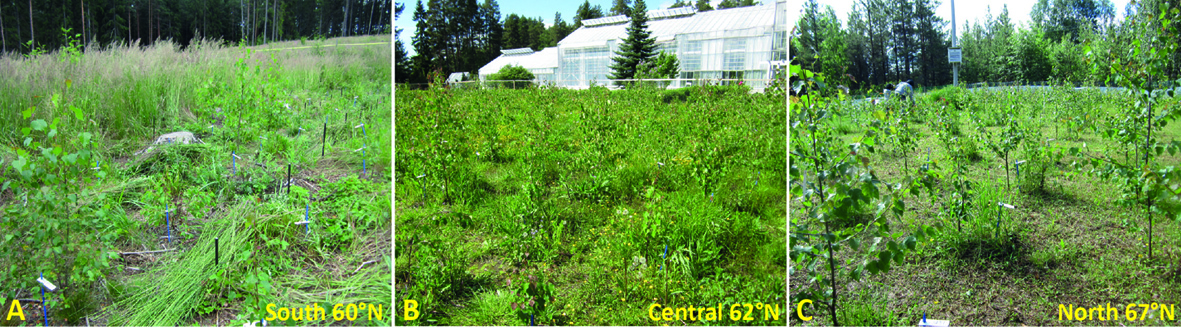
Figure 1. Map showing the three common garden sites (filled squares) and the six source populations (filled circles). Mean annual temperature isoclines are shown in grey.

Figure 2. The three common garden sites in Finland where the study was conducted. A) Southern study site is located in Tuusula 60°N, B) Central study site is located in Joensuu 62°N and C) Northern study site is located in Kolari 67°N. Photo credits: Kaisa Heimonen.

Figure 2. The three common garden sites in Finland where the study was conducted. A) Southern study site is located in Tuusula 60°N, B) Central study site is located in Joensuu 62°N and C) Northern study site is located in Kolari 67°N. Photo credits: Kaisa Heimonen.

We wanted to study how the local insects at each of the common garden sites colonized the translocated birch genotypes. We asked if the insect herbivore density, species richness or community composition could be explained by the source population of the birch or by the direction or distance of the latitudinal translocation. The herbivore community on the study birches was examined during two growing seasons in 2011 and in 2012.
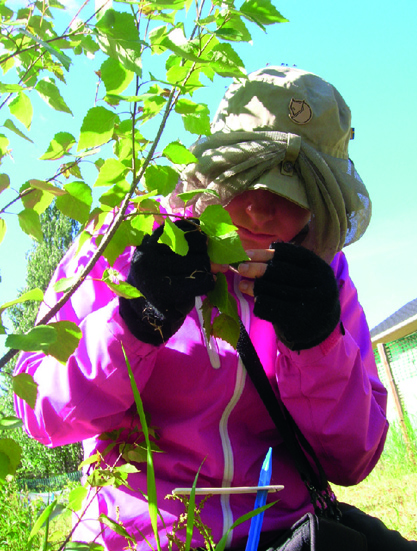
Figure 3. Kaisa Heimonen (lead author) observing the herbivorous insects on silver birch at the northern study site in 2012. Photo credits: Sari Kontunen-Soppela.

Figure 3. Kaisa Heimonen (lead author) observing the herbivorous insects on silver birch at the northern study site in 2012. Photo credits: Sari Kontunen-Soppela.

Herbivore density among the source populations differed in 2012 but not in 2011 and species richness was not affected by the source population. Latitudinal translocation could not explain the variation in the herbivore density or in the species richness. Community composition of the herbivores differed among the source populations at two of the three study sites and the similarity of the herbivore communities decreased with increasing latitudinal distance of the source populations.
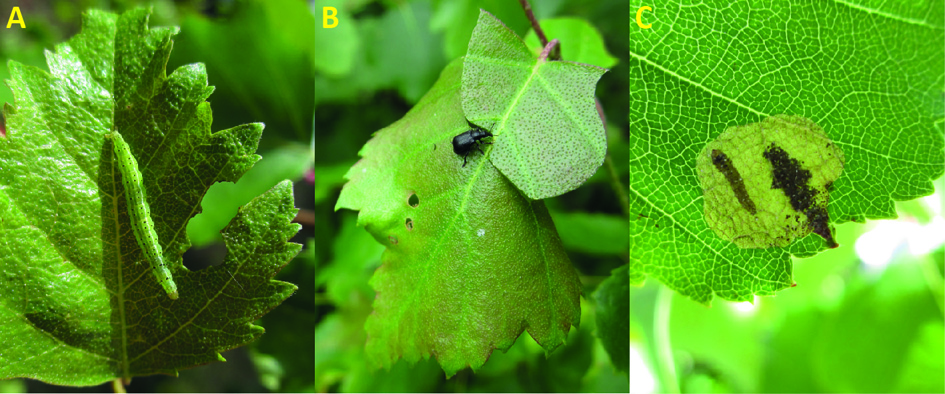
Figure 4. Common insect species on silver birch belonging to the orders Lepidoptera, Coleoptera and Hymenoptera. A) White-shouldered smudge (Ypsolopha parenthesella), B) Birch leaf roller (Deporaus betulae) and C) Early birch leaf edgeminer (Fenusella nana). Photo credits: Kaisa Heimonen.

Figure 4. Common insect species on silver birch belonging to the orders Lepidoptera, Coleoptera and Hymenoptera. A) White-shouldered smudge (Ypsolopha parenthesella), B) Birch leaf roller (Deporaus betulae) and C) Early birch leaf edgeminer (Fenusella nana). Photo credits: Kaisa Heimonen.

Silver birch genotypes from source populations originating from closer geographical distance had more similar herbivore community composition at our experimental sites possibly because they are genetically more similar than the geographically more distant birch genotypes. All birch genotypes were colonized by some of the local herbivores at all three study sites suggesting that in the future herbivorous insects are able to colonize novel host plant genotypes. The results of this study show that compositional changes in the insect communities on their host plants are expected in the future. Newly structured herbivore communities might affect the herbivore damage and thereby also the plant growth.
How plant genetic diversity affects herbivory Updated for 2026

Human activities drastically reduce biodiversity at various taxonomic levels. While much of the current effort in research and biological conservation focuses on species diversity, the importance of intraspecific genetic diversity is sometimes overlooked. At the same time, genetic diversity within and among populations is the fundamental unit of biodiversity because it provides raw material for the adaptation, evolution and survival of species and individuals.

Plantation forests are usually composed of selected stock bred for desirable silvicultural properties (e.g., rapid growth rate and high timber quality) and as a result often have a narrower genetic basis than the wild populations of the same species. Even when natural regeneration is used, a limited number of seed trees may result in less diversity in the regenerated stand compared to the original one. Commercial applications of vegetative propagation of forest trees (clonal forestry) may lead to the further reduction in genetic diversity up to only a few or even a single genotype per plantation. For instance, micropropagation is commonly used to clonally multiply superior birch genotypes in Finland, both for commercial production and for breeding purposes, but it has been proven successful for only a limited number of birch genotypes. Limited number of commercially available birch clones may thus narrow the genetic diversity of planted birch stands.

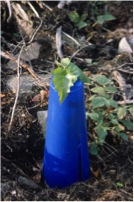
Figure 1. Micropropagated birch planted inside plastic vole protector in 2000.

Figure 1. Micropropagated birch planted inside plastic vole protector in 2000.

Limited genetic variation in plant stands can make them more vulnerable to pest invasion and outbreaks; if all the plants in a stand are genetically identical and susceptible to the same pest species, pest populations will spread rapidly from one plant to another. In agriculture, mixed planting of susceptible and resistant genotypes has been successfully used as a control tactic for plant pathogens in annual crops. However, the potential of using genotypes mixtures in plantation forestry for reducing pest damage has been little explored so far, although there are indications that mixtures may sometimes be of great value for controlling pests and diseases of trees as well, at least in short rotation energy forestry.

In this study, “Additive and non-additive effects of birch genotypic diversity on arthropod herbivory in a long-term field experiment”, now published Early View in Oikos,  we have experimentally tested whether genetic diversity of silver birch affects leaf damage by various arthropod pests. Silver birch (Betula pendula Roth) has broad distribution in the Northern Hemisphere and is one of the most important deciduous tree species in Finland, both ecologically and economically. In 2000, we established an experiment in Satakunta, SW Finland, by planting 8 different clones of silver birch which were obtained by micropropagation of vegetative buds of mature trees of southern Finnish origin. The eight clones selected for the experiment are known to differ in their growth and leaf characteristics as well as in resistance to herbivores and pathogens. The clones were planted in monoclonal plots and in different combinations of 2, 4 and 8 clones per plot. Damage by different types of arthropods was monitored on these experiments several times over nine years.

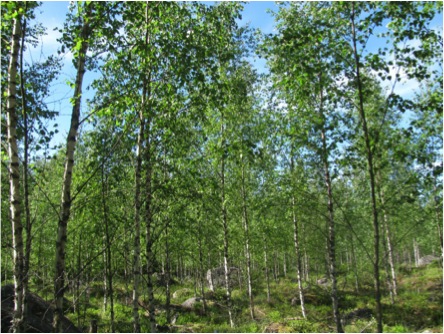
Figure 2. View of experimental area in 2014

Figure 2. View of experimental area in 2014


Results show that genotypic variation and diversity strongly influenced birch herbivory, but that patterns varied among arthropod guilds and over time (within and across years). In particular, leaf-chewing damage and leaf galls were significantly less abundant in genotypically diverse stands than in stands with only a single genotype. However, leaf-rolling damage was actually higher in diverse stands, illustrating how arthropod guilds may differ in their responses to genotypic diversity.


More detailed analyses at the genotype level revealed further interesting patterns. Genotypes varied considerably in their susceptibilities to most herbivore guilds examined, demonstrating that genetic variation existed among the 8 genotypes selected. Interestingly, the susceptibilities were not constant over time or among the guilds. This indicates that resistance to these guilds of herbivores is largely uncoupled genetically and that there is not a single genotype that is resistant to all types of herbivory. Furthermore, we observed shifts in the resistance rankings of genotypes between seasons and across years. Thus, while one genotype may be the most resistant to early-season leaf herbivory one year, it may not be the most resistant to leaf herbivory in the late season or the following year.

To try to understand the mechanisms underpinning the diversity effects observed, we used null modelling to test whether herbivory in diverse plots differed from expected levels generated from data in monoclonal plots. We found that diversity effects depended significantly on genotype, revealing that non-additive mechanisms operate in this system. In particular, more resistant genotypes often experienced greater than expected levels of herbivory (associational susceptibility) while more susceptible genotypes often had less than expected herbivory (associational resistance). These patterns indicate that associational resistance and susceptibility can occur simultaneously in genotypically diverse plots, presumably due to the reorganization of arthropods among genotypes. While these diversity effects do not scale up to influence plot-level rates of herbivory, they may strongly influence the fitness of plant genotypes within diverse plant stands, potentially playing a strong role in the evolutionary ecology of forest trees.

This study illustrates the value of long-term experiments for testing how genetic diversity influences the arthropod communities of woody plants. Diversity effects were complex and varied among the arthropod guilds, among the genotypes, and across time. Only by sampling multiple times over many years and including data for different kinds of herbivores did we detect these patterns. Future work looking at how plant phenotypes relate to these patterns and observing the behaviour of various arthropods can provide further insight into the mechanisms driving genotypic diversity effects.