Tag Archives: native

EU turns fire on invasive species already costing €12 billion a year Updated for 2026


Rivers covered entirely by water hyacinth, cracked pavement shifting under the force of sprouting Japanese knotweed, and a dead red squirrel infected by its invader cousin from North America …

These are the most dramatic pictures that drum home the effects of invasive species, and they weren’t missing from the agenda last Tuesday, when some of the biggest stakeholders and government representatives came together in London to discuss the latest step in the fight against alien invaders.

The star speaker at the conference, convened by the European Squirrel Initiative, was François Wakenhut, head of the biodiversity unit in the European Commission’s environmental department, who briefed the attending MPs and organisations on what’s next in the collective effort against the likes of the killer shrimp and the Asian hornet.

But his main focus was on the new EU Regulation that came into force in January. It marks the first effort geared specifically towards the management of invasive exotics across the union’s member states – and hopes to get a grip on the most problematic plants and animals intruding on native wildlife.

A very British problem – and a growing one

Britain is home to at least 2,000 species that are not native to the country and currently sees ten new species cross its borders every year – as documented in the newly published
Field Guide to Invasive Plants & Animals in Britain‘.

Only around 15% of non-native species are actually invasive, meaning that they have negative effects on native wildlife and, in some cases, are also a burden on the economy. But they are the second biggest threat to biodiversity and cost the UK more than £1.7bn annually; across Europe, that number grows to €12bn.

Invasive species in Britain are already covered, at least partly, by various bits of existing legislation as well as several EU directives that deal with wildlife and conservation. And as Wakenhut correctly observed,

“The UK has been at the forefront of the invasive alien species fight over the past years and, in this sense, it is probably not a coincidence that one of the first debates on the implementation for the regulation is taking place here.”

The main legislation in the UK is the Wildlife and Countryside Act of 1981, which makes it illegal – and punishable by hefty fines and even prison – to release any non-native plant or animal into the wild and also prohibits the sale of some species, like water fern and floating pennywort.

In addition, in 2008 the Department for Environment, Food and Rural Affairs (Defra) put together, along with the Scottish and Welsh governments, an Invasive Non-Native Species Framework Strategy for Great Britain that is currently under review and will be updated later this year.

The different government agencies that are affected by invasive species also have representatives on a programme board, which works to coordinate policy throughout the UK.

Its secretariat, a small body within the Animal and Plant Health Agency, maintains an online database of invasive species and action plans against them, and spearheads campaigns like ‘Check, Clean, Dry’, an effort to educate boat and angling clubs on how to avoid importing and spreading aquatic invaders.

More cooperation between member states

Under the new EU regulation, invasive alien species of Union concern will be banned from possession, trade and release into the wild. Additionally, likely pathways across Europe will be increasingly monitored to prevent the spread of new as well as already established species.

In other words, what is already in place in Britain will now be enforced across all member states. How much this sharing of expertise and monitoring will actually change the situation in this country is questionable, at least until effective pathway management becomes measurable, for example by a decreasing rate of new invasions.

“I’m confident that, within two years, we will be able to show what the trend will be”, says Wakenhut. “Whether that trend will go in the right direction or not – too soon to tell.”

Another aspect of the regulation deals with polluters – those rare cases where the source of an introduction, intentional or not, can actually be proven. “If you can demonstrate that a private operator is at the source of the introduction, you will then be able to direct the responsibility and the burden of the restoration effort or the eradication effort to that operator”, says Wakenhut.

Countries will also be able to enforce emergency measures to circumvent the voting and vetting process of the commission when a surprise invasion calls for immediate action.

Which species are of Union concern will be decided over the course of this year. The European Commission will draw up a list of the most threatening species, which can then be managed across borders and, so goes the plan, eradicated or stopped from invading in the first place.

Priority would ideally be divided between those that haven’t arrived yet and those already wreaking havoc on national ecosystems and economies. But the process brings together a variety of different stakeholders, all with their own axe to grind.

Which is the peskiest of them all?

At the conference, three speakers made their case for three very different species to be placed high on the list: the grey squirrel, the American signal crayfish and Japanese knotweed.

All of these have well documented and often devastating effects. The grey squirrel has all but eradicated the British red squirrel since its introduction in 1876 while Japanese knotweed receives by far the most media attention out of all invasive species in Britain.

In fact, the infamous weed, known for cracking its way through concrete and tarmac and decreasing property values, is a good example of a species that has received enough attention and research funding that there is now a direct effort to keep it in check.

In 2010, after years of quarantined testing, a sap-sucking plant louse that exclusively targets Japanese knotweed was introduced at a few target locations throughout the country. It marked the first time an insect had ever been released against a weed in the EU, but five years later it is still too early to assess how successful this attempt at biological control will be.

“It’s a release program that’s been slightly hindered by the regulatory environment under which we work, so we haven’t been able to release on what we would call dream sites”, says Dick Shaw, the UK director of the non-profit research organization CABI, which is behind the knotweed cure.

“For the UK, we can’t do much more than we’re already doing [about Japanese knotweed]. If you go to France and you see tens of kilometres of rivers completely covered by Japanese knotweed and no one’s doing anything, I think there’s an awful lot more that can be done in the EU”, he adds.

During his presentation with the catchy name ‘Don’t ignore the biggest species: weeds are the worst’, Shaw was making the case for more than just Japanese knotweed. The plant he sees as the most threatening in Europe is actually floating pennywort, which is also widespread and close to getting its own bio control agent in the UK.

Himalayan balsam, another well-known invader whose uncontrollable spread has spurred local ‘balsam bashing’ events, now has to deal with a rust fungus that CABI released last year. As with Japanese knotweed, this intentionally introduced species does not affect native plants – and it’s not meant to eradicate Himalayan balsam, which covers an estimated 13% of Britain’s riverbanks, either.

“If it does work, it can at least stop it from spreading and being as competitive. So you wouldn’t get those monocultures [of knotweed or balsam], you would get it more interspersed with competitive native species. And then slowly they would begin to outcompete the knotweed. That’s the long-term goal”, said Shaw.

The most dangerous species will be decided on at the beginning of next year and the initial EU-wide list will likely be limited to species that already have solid risk assessments to prove their worthiness.

Until then, the member states and, at a lower level, organisations like CABI and the European Squirrel Initiative will try to influence the national and EU-wide selection process as much as possible.

“Inevitably, for the initial proposal that we’ll make, there will be a tendency to build upon what’s already been developed”, said Wakenhut. “So in that sense, we will borrow from what has already been peer-reviewed and risk-assessed. But we need to bear in mind that the list will be a dynamic one. Once we adopt it, it can be changed anytime.”

The main focus must be to keep out what has not yet arrived

One risk with this naturally biased process is that too much focus is put on plants and animals that have already invaded or spread, simply because a strong case for them is easily made – but at the cost of neglecting the prevention of future invasions.

During his talk, Wakenhut repeatedly emphasised the need for proportionality; that prevention is, in most cases, more cost-effective and easier to achieve than the eradication of an established species.

When the quagga mussel, a small invader from the Ponto-Caspian region around the Black Sea, was first found in Surrey last fall, it was already too late. As David Aldridge, an ecologist at the University of Cambridge and expert on the mussel, observed at the time: “We’re really just waiting for these pests to arrive. And you can’t do much once they’re here.”

The quagga is believed to have made its way, largely unhindered, through Central Europe and then to the UK from the Netherlands. “At the moment, there’s a number of species, like the Ponto-Caspian ones, that aren’t yet here but might arrive”, Trevor Salmon, who heads the Environment Agency’s native and invasive non-native species team, said at the conference.

Many of these will come to Britain through Europe and vice-versa. Even though Britain is at the forefront of the fight against them in Europe, this nonetheless makes cooperation between countries imperative.

Especially so since 75% of non-native species are introduced unintentionally, meaning that they can only be stopped by controlling their likely pathways. “It’s hitchhikers. It’s not like the problem is someone sticking a squirrel into a suitcase”, as Salmon puts it.

For now, which species will be included and how high they will place on the list is still up in the air. By next January, the commission will have completed a first draft of invasive alien species that are of Union concern. Its current biodiversity strategy envisions that, by 2020, already established species will be eradicated or controlled and new invasions a thing of the past.

But with the huge volume of people and goods crossing Europe every day, does this regulation have any hope of fulfilling its ambitious goal?

Wakenhut stays vague. “Whether we’ll deliver by 2020 is something we will assess then”, he says.


Yannic Rack is the editor of a hyperlocal news website and a journalism student at City University London who has written for local newspapers in the UK and the US.

Read:Field Guide to Invasive Plants & Animals in Britain‘ by Olaf Booy, Max Wade & Helen Roy, is published by Bloomsbury this month.


385575

Fighting invasive species with EU regulations – slamming the stable door? Updated for 2026


Rivers covered entirely by water hyacinth, cracked pavement shifting under the force of sprouting Japanese knotweed, and a dead red squirrel infected by its invader cousin from North America …

These are the most dramatic pictures that drum home the effects of invasive species, and they weren’t missing from the agenda last Tuesday, when some of the biggest stakeholders and government representatives came together in London to discuss the latest step in the fight against alien invaders.

The star speaker at the conference, convened by the European Squirrel Initiative, was François Wakenhut, head of the biodiversity unit in the European Commission’s environmental department, who briefed the attending MPs and organisations on what’s next in the collective effort against the likes of the killer shrimp and the Asian hornet.

But his main focus was on the new EU Regulation that came into force in January. It marks the first effort geared specifically towards the management of invasive exotics across the union’s member states – and hopes to get a grip on the most problematic plants and animals intruding on native wildlife.

A very British problem – and a growing one

Britain is home to at least 2,000 species that are not native to the country and currently sees ten new species cross its borders every year – as documented in the newly published
Field Guide to Invasive Plants & Animals in Britain‘.

Only around 15% of non-native species are actually invasive, meaning that they have negative effects on native wildlife and, in some cases, are also a burden on the economy. But they are the second biggest threat to biodiversity and cost the UK more than £1.7bn annually; across Europe, that number grows to €12bn.

Invasive species in Britain are already covered, at least partly, by various bits of existing legislation as well as several EU directives that deal with wildlife and conservation. And as Wakenhut correctly observed,

“The UK has been at the forefront of the invasive alien species fight over the past years and, in this sense, it is probably not a coincidence that one of the first debates on the implementation for the regulation is taking place here.”

The main legislation in the UK is the Wildlife and Countryside Act of 1981, which makes it illegal – and punishable by hefty fines and even prison – to release any non-native plant or animal into the wild and also prohibits the sale of some species, like water fern and floating pennywort.

In addition, in 2008 the Department for Environment, Food and Rural Affairs (Defra) put together, along with the Scottish and Welsh governments, an Invasive Non-Native Species Framework Strategy for Great Britain that is currently under review and will be updated later this year.

The different government agencies that are affected by invasive species also have representatives on a programme board, which works to coordinate policy throughout the UK.

Its secretariat, a small body within the Animal and Plant Health Agency, maintains an online database of invasive species and action plans against them, and spearheads campaigns like ‘Check, Clean, Dry’, an effort to educate boat and angling clubs on how to avoid importing and spreading aquatic invaders.

More cooperation between member states

Under the new EU regulation, invasive alien species of Union concern will be banned from possession, trade and release into the wild. Additionally, likely pathways across Europe will be increasingly monitored to prevent the spread of new as well as already established species.

In other words, what is already in place in Britain will now be enforced across all member states. How much this sharing of expertise and monitoring will actually change the situation in this country is questionable, at least until effective pathway management becomes measurable, for example by a decreasing rate of new invasions.

“I’m confident that, within two years, we will be able to show what the trend will be”, says Wakenhut. “Whether that trend will go in the right direction or not – too soon to tell.”

Another aspect of the regulation deals with polluters – those rare cases where the source of an introduction, intentional or not, can actually be proven. “If you can demonstrate that a private operator is at the source of the introduction, you will then be able to direct the responsibility and the burden of the restoration effort or the eradication effort to that operator”, says Wakenhut.

Countries will also be able to enforce emergency measures to circumvent the voting and vetting process of the commission when a surprise invasion calls for immediate action.

Which species are of Union concern will be decided over the course of this year. The European Commission will draw up a list of the most threatening species, which can then be managed across borders and, so goes the plan, eradicated or stopped from invading in the first place.

Priority would ideally be divided between those that haven’t arrived yet and those already wreaking havoc on national ecosystems and economies. But the process brings together a variety of different stakeholders, all with their own axe to grind.

Which is the peskiest of them all?

At the conference, three speakers made their case for three very different species to be placed high on the list: the grey squirrel, the American signal crayfish and Japanese knotweed.

All of these have well documented and often devastating effects. The grey squirrel has all but eradicated the British red squirrel since its introduction in 1876 while Japanese knotweed receives by far the most media attention out of all invasive species in Britain.

In fact, the infamous weed, known for cracking its way through concrete and tarmac and decreasing property values, is a good example of a species that has received enough attention and research funding that there is now a direct effort to keep it in check.

In 2010, after years of quarantined testing, a sap-sucking plant louse that exclusively targets Japanese knotweed was introduced at a few target locations throughout the country. It marked the first time an insect had ever been released against a weed in the EU, but five years later it is still too early to assess how successful this attempt at biological control will be.

“It’s a release program that’s been slightly hindered by the regulatory environment under which we work, so we haven’t been able to release on what we would call dream sites”, says Dick Shaw, the UK director of the non-profit research organization CABI, which is behind the knotweed cure.

“For the UK, we can’t do much more than we’re already doing [about Japanese knotweed]. If you go to France and you see tens of kilometres of rivers completely covered by Japanese knotweed and no one’s doing anything, I think there’s an awful lot more that can be done in the EU”, he adds.

During his presentation with the catchy name ‘Don’t ignore the biggest species: weeds are the worst’, Shaw was making the case for more than just Japanese knotweed. The plant he sees as the most threatening in Europe is actually floating pennywort, which is also widespread and close to getting its own bio control agent in the UK.

Himalayan balsam, another well-known invader whose uncontrollable spread has spurred local ‘balsam bashing’ events, now has to deal with a rust fungus that CABI released last year. As with Japanese knotweed, this intentionally introduced species does not affect native plants – and it’s not meant to eradicate Himalayan balsam, which covers an estimated 13% of Britain’s riverbanks, either.

“If it does work, it can at least stop it from spreading and being as competitive. So you wouldn’t get those monocultures [of knotweed or balsam], you would get it more interspersed with competitive native species. And then slowly they would begin to outcompete the knotweed. That’s the long-term goal”, said Shaw.

The most dangerous species will be decided on at the beginning of next year and the initial EU-wide list will likely be limited to species that already have solid risk assessments to prove their worthiness.

Until then, the member states and, at a lower level, organisations like CABI and the European Squirrel Initiative will try to influence the national and EU-wide selection process as much as possible.

“Inevitably, for the initial proposal that we’ll make, there will be a tendency to build upon what’s already been developed”, said Wakenhut. “So in that sense, we will borrow from what has already been peer-reviewed and risk-assessed. But we need to bear in mind that the list will be a dynamic one. Once we adopt it, it can be changed anytime.”

The main focus must be to keep out what has not yet arrived

One risk with this naturally biased process is that too much focus is put on plants and animals that have already invaded or spread, simply because a strong case for them is easily made – but at the cost of neglecting the prevention of future invasions.

During his talk, Wakenhut repeatedly emphasised the need for proportionality; that prevention is, in most cases, more cost-effective and easier to achieve than the eradication of an established species.

When the quagga mussel, a small invader from the Ponto-Caspian region around the Black Sea, was first found in Surrey last fall, it was already too late. As David Aldridge, an ecologist at the University of Cambridge and expert on the mussel, observed at the time: “We’re really just waiting for these pests to arrive. And you can’t do much once they’re here.”

The quagga is believed to have made its way, largely unhindered, through Central Europe and then to the UK from the Netherlands. “At the moment, there’s a number of species, like the Ponto-Caspian ones, that aren’t yet here but might arrive”, Trevor Salmon, who heads the Environment Agency’s native and invasive non-native species team, said at the conference.

Many of these will come to Britain through Europe and vice-versa. Even though Britain is at the forefront of the fight against them in Europe, this nonetheless makes cooperation between countries imperative.

Especially so since 75% of non-native species are introduced unintentionally, meaning that they can only be stopped by controlling their likely pathways. “It’s hitchhikers. It’s not like the problem is someone sticking a squirrel into a suitcase”, as Salmon puts it.

For now, which species will be included and how high they will place on the list is still up in the air. By next January, the commission will have completed a first draft of invasive alien species that are of Union concern. Its current biodiversity strategy envisions that, by 2020, already established species will be eradicated or controlled and new invasions a thing of the past.

But with the huge volume of people and goods crossing Europe every day, does this regulation have any hope of fulfilling its ambitious goal?

Wakenhut stays vague. “Whether we’ll deliver by 2020 is something we will assess then”, he says.


Yannic Rack is the editor of a hyperlocal news website and a journalism student at City University London who has written for local newspapers in the UK and the US.

Read:Field Guide to Invasive Plants & Animals in Britain‘ by Olaf Booy, Max Wade & Helen Roy, is published by Bloomsbury this month.


391599

Amphibian responses to diversity of native and non-native litter Updated for 2026


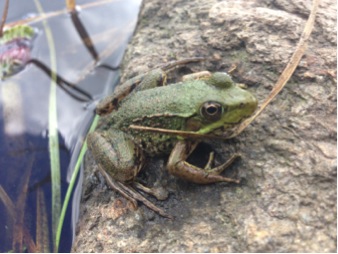
Fig. 1. Recently metamorphosed green frog (Lithobates clamitans) at the edge of a pond (photo by Laura Martin)

Fig. 1. Recently metamorphosed green frog (Lithobates clamitans) at the edge of a pond (photo by Laura Martin)


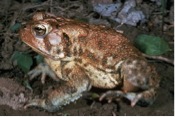
Fig. 2 American toad (Anaxyrus (Bufo) americanus) adult (photo by Carrie Brown-Lima) American

Fig. 2 American toad (Anaxyrus (Bufo) americanus) adult (photo by Carrie Brown-Lima) American


Amphibians develop in watery places that are full of plants. And yet we know little about how these plants affect larval amphibians. As disease, climate change, and land-use change continue to threaten amphibian populations worldwide, it is more important than ever to understand what makes for good amphibian habitat.


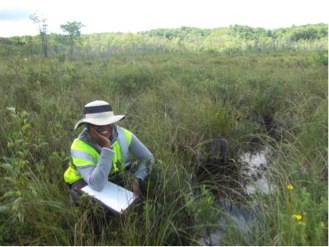
Fig. 3 Shauna-kay Rainford at Bear Swamp, NY, one of the litter collection locations(photo by Laura Martin)

Fig. 3 Shauna-kay Rainford at Bear Swamp, NY, one of the litter collection locations(photo by Laura Martin)


In the study “Effects of plant litter diversity, species, origin and traits on larval toad performance,” Cornell undergraduate Shauna-kay Rainford (now a graduate student at Penn State University), graduate student Laura Martin, and Professor Bernd Blossey investigated how plant litter communities influence the growth and survival of Anaxyrus americanus (American toad) larvae. They reared tadpoles in singles species and litter mixtures using 15 native and 9 nonnative plant species common to central New York, USA, recording survival, time to metamorphosis, and growth rate.


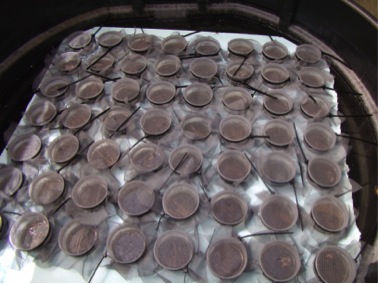
Fig. 4 Microcosms in which individual larval amphibians were reared in leaf litter treatments. (photo by Shauna-kay Rainford)

Fig. 4 Microcosms in which individual larval amphibians were reared in leaf litter treatments. (photo by Shauna-kay Rainford)


Survival in single species treatments ranged from 0% (in Rhamnus cathartica litter) to 96% (Pinus strobus). Tadpoles also failed to metamorphose in Acer rubrum, Cornus racemosa, Rosa multiflora, and Tsuga canadensis. Percent metamorphosis was highest in nonnative Lonicera spp. (76.7%), native Phragmites australis americanus (73.3%), nonnative P. australis (60.0%), and nonnative Alnus glutinosa (60.0%). Interestingly, whether the plant was native or nonnative did not affect amphibian performance.

In multi-species treatments, number of plant species had no effect on larval survival or metamorphosis. However, larvae reared in mixtures of 3 species were larger than those reared in single species treatments of the same species. But increasing litter diversity to 6 or 12 species did not further improve larval survival or performance. This result is consistent with analyses that reveal that most ecological processes saturate at relatively low levels of diversity.

Currently, understanding of the relationships of biodiversity and ecosystem function is drawn largely from studies of plant communities in temperate grassland ecosystems. But the vast majority of plant material is not consumed green; it enters detrital food webs like the one studied in this experiment. This study is an important first step towards understanding the mechanisms that underlie plant-amphibian interactions. It further highlights the importance of plant traits, but not origin, when considering amphibian habitat restoration and conservation.

Native Hawaiians protest ‘sacred mountain’ telescope Updated for 2026


The ‘Thirty Meter Telescope’ (TMT) international observatory is moving ahead today with a ground-breaking ceremony.

But the chosen site on the summit of Mauna Kea is sacred to the Hawaiian people, who maintain a deep connection and spiritual tradition there that goes back millennia.

With its giant mirror, 30 metres (nearly 100 feet) across, the TMT promises the highest definition views ever of planets, orbiting stars, and well beyond.

But for many native Hawaiians, the $1.4 billion new telescope is a monstrosity and a defilement of their sacred mountain. “The TMT is an atrocity the size of Aloha Stadium”, said Kamahana Kealoha, a Hawaiian cultural practitioner and protest organizer.

“It’s 19 stories tall, which is like building a sky-scraper on top of the mountain, a place that is being violated in many ways culturally, environmentally and spiritually.”

“We are in solidarity with individuals fighting against this project in US courts, and those taking our struggle for de-occupation to the international courts. Others of us must protest this ground-breaking ceremony and intervene in hopes of stopping a desecration.”

Clarence ‘Ku’ Ching, longtime activist, cultural practitioner, and a member of the Mauna Kea Hui, a group of Hawaiians bringing legal challenges to the TMT project in state court, said:

“We will be gathering at Pu’u Huluhulu, at the bottom of the Mauna Kea Access Road, and we will be doing prayers and ceremony for the mountain.”

Environmental issues

The principle fresh water aquifer for Hawaii Island is on Mauna Kea, yet there have been mercury spills on the summit. Water-hazardous pollutants including ethylene glycol and diesel fuel are used there.

Chemicals used to clean telescope mirrors drain into the septic system, along with half a million gallons a year of human sewage that goes into septic tanks, cesspools and leach fields.

“All of this poisonous activity at the source of our fresh water aquifer is unconscionable, and it threatens the life of the island”, said Kealoha.

“But that’s only part of the story of this mountain’s environmental fragility. It’s also home to endangered species, such as the palila bird, which is endangered in part because of the damage to its critical habitat, which includes the mamane tree.”

Whose land is it anyway?

The new telescope is to be built within a 500-acre (2.0 km2) ‘Astronomy Precinct’, inside the Mauna Kea Science Reserve. The Precinct was established in 1967 on land protected by the Historical Preservation Act for its significance to Hawaiian culture.

Mauna Kea is designated as part of the Crown and Government lands of the Hawaiian Kingdom – lands that have been effectively annexed by the US Government, as Professor Williamson PC Chang, from the University of Hawaii’s Richardson School of Law, explains:

“The United States bases its claim to the Crown and Government land of the Hawaiian Kingdom on the 1898 Joint Resolution of Congress, but that resolution has no power to convey the lands of Hawaii to the US … they just seized it.”

Kealoha also refused to accept the validity of the US’s claim to ownership of sovereign Hawaiian land, saying, “Show us the title!”

“If the so-called ‘Treaty of Annexation’ exists, that would be proof that Hawaiian Kingdom citizens gave up sovereignty and agreed to be part of the United States 121 years ago.

“But we know that no such document exists. The so-called ‘state’ does not have jurisdiction over Mauna Kea or any other land in Hawaii that it illegally leases out to multi-national interests. I agree with how George Helm felt about Kahoolawe”, said Kealoha. “He wrote in his journal:

‘My veins are carrying the blood of a people who understood the sacredness of land and water. Their culture is my culture. No matter how remote the past is it does not make my culture extinct. Now I cannot continue to see the arrogance of the white man who maintains his science and rationality at the expense of my cultural instincts. They will not prostitute my soul.’

“We are calling on everyone, Hawaiians and non-Hawaiians alike, to stand with us, to protect Mauna Kea the way George and others protected Kahoolawe. I ask myself every day, what would George Helm do? Because we need to find the courage he had and stop the destruction of Mauna Kea.”


The protest: Tuesday 7th October, 7am to 2pm, at Saddle Road at the entrance to the Mauna Kea Observatory Road.

More information: sacredmaunakea.wordpress.com/

Funding for the $1.4 billion project is being provided by:

  • The Gordon & Betty Moore Foundation of Palo Alto, California
  • National Institutes of Natural Sciences in Japan
    The National Observatories of the Chinese Academy of Sciences
  • The California Institute of Technology
  • The University of California
  • The Indian Institute for Astrophysics
  • Association of Canadian Universities for Research in Astronomy (ACURA)
  • University of Hawaii


385083

Native Hawaiians protest ‘sacred mountain’ telescope Updated for 2026


The ‘Thirty Meter Telescope’ (TMT) international observatory is moving ahead today with a ground-breaking ceremony.

But the chosen site on the summit of Mauna Kea is sacred to the Hawaiian people, who maintain a deep connection and spiritual tradition there that goes back millennia.

With its giant mirror, 30 metres (nearly 100 feet) across, the TMT promises the highest definition views ever of planets, orbiting stars, and well beyond.

But for many native Hawaiians, the $1.4 billion new telescope is a monstrosity and a defilement of their sacred mountain. “The TMT is an atrocity the size of Aloha Stadium”, said Kamahana Kealoha, a Hawaiian cultural practitioner and protest organizer.

“It’s 19 stories tall, which is like building a sky-scraper on top of the mountain, a place that is being violated in many ways culturally, environmentally and spiritually.”

“We are in solidarity with individuals fighting against this project in US courts, and those taking our struggle for de-occupation to the international courts. Others of us must protest this ground-breaking ceremony and intervene in hopes of stopping a desecration.”

Clarence ‘Ku’ Ching, longtime activist, cultural practitioner, and a member of the Mauna Kea Hui, a group of Hawaiians bringing legal challenges to the TMT project in state court, said:

“We will be gathering at Pu’u Huluhulu, at the bottom of the Mauna Kea Access Road, and we will be doing prayers and ceremony for the mountain.”

Environmental issues

The principle fresh water aquifer for Hawaii Island is on Mauna Kea, yet there have been mercury spills on the summit. Water-hazardous pollutants including ethylene glycol and diesel fuel are used there.

Chemicals used to clean telescope mirrors drain into the septic system, along with half a million gallons a year of human sewage that goes into septic tanks, cesspools and leach fields.

“All of this poisonous activity at the source of our fresh water aquifer is unconscionable, and it threatens the life of the island”, said Kealoha.

“But that’s only part of the story of this mountain’s environmental fragility. It’s also home to endangered species, such as the palila bird, which is endangered in part because of the damage to its critical habitat, which includes the mamane tree.”

Whose land is it anyway?

The new telescope is to be built within a 500-acre (2.0 km2) ‘Astronomy Precinct’, inside the Mauna Kea Science Reserve. The Precinct was established in 1967 on land protected by the Historical Preservation Act for its significance to Hawaiian culture.

Mauna Kea is designated as part of the Crown and Government lands of the Hawaiian Kingdom – lands that have been effectively annexed by the US Government, as Professor Williamson PC Chang, from the University of Hawaii’s Richardson School of Law, explains:

“The United States bases its claim to the Crown and Government land of the Hawaiian Kingdom on the 1898 Joint Resolution of Congress, but that resolution has no power to convey the lands of Hawaii to the US … they just seized it.”

Kealoha also refused to accept the validity of the US’s claim to ownership of sovereign Hawaiian land, saying, “Show us the title!”

“If the so-called ‘Treaty of Annexation’ exists, that would be proof that Hawaiian Kingdom citizens gave up sovereignty and agreed to be part of the United States 121 years ago.

“But we know that no such document exists. The so-called ‘state’ does not have jurisdiction over Mauna Kea or any other land in Hawaii that it illegally leases out to multi-national interests. I agree with how George Helm felt about Kahoolawe”, said Kealoha. “He wrote in his journal:

‘My veins are carrying the blood of a people who understood the sacredness of land and water. Their culture is my culture. No matter how remote the past is it does not make my culture extinct. Now I cannot continue to see the arrogance of the white man who maintains his science and rationality at the expense of my cultural instincts. They will not prostitute my soul.’

“We are calling on everyone, Hawaiians and non-Hawaiians alike, to stand with us, to protect Mauna Kea the way George and others protected Kahoolawe. I ask myself every day, what would George Helm do? Because we need to find the courage he had and stop the destruction of Mauna Kea.”


The protest: Tuesday 7th October, 7am to 2pm, at Saddle Road at the entrance to the Mauna Kea Observatory Road.

More information: sacredmaunakea.wordpress.com/

Funding for the $1.4 billion project is being provided by:

  • The Gordon & Betty Moore Foundation of Palo Alto, California
  • National Institutes of Natural Sciences in Japan
    The National Observatories of the Chinese Academy of Sciences
  • The California Institute of Technology
  • The University of California
  • The Indian Institute for Astrophysics
  • Association of Canadian Universities for Research in Astronomy (ACURA)
  • University of Hawaii


385083

Native Hawaiians protest ‘sacred mountain’ telescope Updated for 2026


The ‘Thirty Meter Telescope’ (TMT) international observatory is moving ahead today with a ground-breaking ceremony.

But the chosen site on the summit of Mauna Kea is sacred to the Hawaiian people, who maintain a deep connection and spiritual tradition there that goes back millennia.

With its giant mirror, 30 metres (nearly 100 feet) across, the TMT promises the highest definition views ever of planets, orbiting stars, and well beyond.

But for many native Hawaiians, the $1.4 billion new telescope is a monstrosity and a defilement of their sacred mountain. “The TMT is an atrocity the size of Aloha Stadium”, said Kamahana Kealoha, a Hawaiian cultural practitioner and protest organizer.

“It’s 19 stories tall, which is like building a sky-scraper on top of the mountain, a place that is being violated in many ways culturally, environmentally and spiritually.”

“We are in solidarity with individuals fighting against this project in US courts, and those taking our struggle for de-occupation to the international courts. Others of us must protest this ground-breaking ceremony and intervene in hopes of stopping a desecration.”

Clarence ‘Ku’ Ching, longtime activist, cultural practitioner, and a member of the Mauna Kea Hui, a group of Hawaiians bringing legal challenges to the TMT project in state court, said:

“We will be gathering at Pu’u Huluhulu, at the bottom of the Mauna Kea Access Road, and we will be doing prayers and ceremony for the mountain.”

Environmental issues

The principle fresh water aquifer for Hawaii Island is on Mauna Kea, yet there have been mercury spills on the summit. Water-hazardous pollutants including ethylene glycol and diesel fuel are used there.

Chemicals used to clean telescope mirrors drain into the septic system, along with half a million gallons a year of human sewage that goes into septic tanks, cesspools and leach fields.

“All of this poisonous activity at the source of our fresh water aquifer is unconscionable, and it threatens the life of the island”, said Kealoha.

“But that’s only part of the story of this mountain’s environmental fragility. It’s also home to endangered species, such as the palila bird, which is endangered in part because of the damage to its critical habitat, which includes the mamane tree.”

Whose land is it anyway?

The new telescope is to be built within a 500-acre (2.0 km2) ‘Astronomy Precinct’, inside the Mauna Kea Science Reserve. The Precinct was established in 1967 on land protected by the Historical Preservation Act for its significance to Hawaiian culture.

Mauna Kea is designated as part of the Crown and Government lands of the Hawaiian Kingdom – lands that have been effectively annexed by the US Government, as Professor Williamson PC Chang, from the University of Hawaii’s Richardson School of Law, explains:

“The United States bases its claim to the Crown and Government land of the Hawaiian Kingdom on the 1898 Joint Resolution of Congress, but that resolution has no power to convey the lands of Hawaii to the US … they just seized it.”

Kealoha also refused to accept the validity of the US’s claim to ownership of sovereign Hawaiian land, saying, “Show us the title!”

“If the so-called ‘Treaty of Annexation’ exists, that would be proof that Hawaiian Kingdom citizens gave up sovereignty and agreed to be part of the United States 121 years ago.

“But we know that no such document exists. The so-called ‘state’ does not have jurisdiction over Mauna Kea or any other land in Hawaii that it illegally leases out to multi-national interests. I agree with how George Helm felt about Kahoolawe”, said Kealoha. “He wrote in his journal:

‘My veins are carrying the blood of a people who understood the sacredness of land and water. Their culture is my culture. No matter how remote the past is it does not make my culture extinct. Now I cannot continue to see the arrogance of the white man who maintains his science and rationality at the expense of my cultural instincts. They will not prostitute my soul.’

“We are calling on everyone, Hawaiians and non-Hawaiians alike, to stand with us, to protect Mauna Kea the way George and others protected Kahoolawe. I ask myself every day, what would George Helm do? Because we need to find the courage he had and stop the destruction of Mauna Kea.”


The protest: Tuesday 7th October, 7am to 2pm, at Saddle Road at the entrance to the Mauna Kea Observatory Road.

More information: sacredmaunakea.wordpress.com/

Funding for the $1.4 billion project is being provided by:

  • The Gordon & Betty Moore Foundation of Palo Alto, California
  • National Institutes of Natural Sciences in Japan
    The National Observatories of the Chinese Academy of Sciences
  • The California Institute of Technology
  • The University of California
  • The Indian Institute for Astrophysics
  • Association of Canadian Universities for Research in Astronomy (ACURA)
  • University of Hawaii


385083

Native Hawaiians protest ‘sacred mountain’ telescope Updated for 2026


The ‘Thirty Meter Telescope’ (TMT) international observatory is moving ahead today with a ground-breaking ceremony.

But the chosen site on the summit of Mauna Kea is sacred to the Hawaiian people, who maintain a deep connection and spiritual tradition there that goes back millennia.

With its giant mirror, 30 metres (nearly 100 feet) across, the TMT promises the highest definition views ever of planets, orbiting stars, and well beyond.

But for many native Hawaiians, the $1.4 billion new telescope is a monstrosity and a defilement of their sacred mountain. “The TMT is an atrocity the size of Aloha Stadium”, said Kamahana Kealoha, a Hawaiian cultural practitioner and protest organizer.

“It’s 19 stories tall, which is like building a sky-scraper on top of the mountain, a place that is being violated in many ways culturally, environmentally and spiritually.”

“We are in solidarity with individuals fighting against this project in US courts, and those taking our struggle for de-occupation to the international courts. Others of us must protest this ground-breaking ceremony and intervene in hopes of stopping a desecration.”

Clarence ‘Ku’ Ching, longtime activist, cultural practitioner, and a member of the Mauna Kea Hui, a group of Hawaiians bringing legal challenges to the TMT project in state court, said:

“We will be gathering at Pu’u Huluhulu, at the bottom of the Mauna Kea Access Road, and we will be doing prayers and ceremony for the mountain.”

Environmental issues

The principle fresh water aquifer for Hawaii Island is on Mauna Kea, yet there have been mercury spills on the summit. Water-hazardous pollutants including ethylene glycol and diesel fuel are used there.

Chemicals used to clean telescope mirrors drain into the septic system, along with half a million gallons a year of human sewage that goes into septic tanks, cesspools and leach fields.

“All of this poisonous activity at the source of our fresh water aquifer is unconscionable, and it threatens the life of the island”, said Kealoha.

“But that’s only part of the story of this mountain’s environmental fragility. It’s also home to endangered species, such as the palila bird, which is endangered in part because of the damage to its critical habitat, which includes the mamane tree.”

Whose land is it anyway?

The new telescope is to be built within a 500-acre (2.0 km2) ‘Astronomy Precinct’, inside the Mauna Kea Science Reserve. The Precinct was established in 1967 on land protected by the Historical Preservation Act for its significance to Hawaiian culture.

Mauna Kea is designated as part of the Crown and Government lands of the Hawaiian Kingdom – lands that have been effectively annexed by the US Government, as Professor Williamson PC Chang, from the University of Hawaii’s Richardson School of Law, explains:

“The United States bases its claim to the Crown and Government land of the Hawaiian Kingdom on the 1898 Joint Resolution of Congress, but that resolution has no power to convey the lands of Hawaii to the US … they just seized it.”

Kealoha also refused to accept the validity of the US’s claim to ownership of sovereign Hawaiian land, saying, “Show us the title!”

“If the so-called ‘Treaty of Annexation’ exists, that would be proof that Hawaiian Kingdom citizens gave up sovereignty and agreed to be part of the United States 121 years ago.

“But we know that no such document exists. The so-called ‘state’ does not have jurisdiction over Mauna Kea or any other land in Hawaii that it illegally leases out to multi-national interests. I agree with how George Helm felt about Kahoolawe”, said Kealoha. “He wrote in his journal:

‘My veins are carrying the blood of a people who understood the sacredness of land and water. Their culture is my culture. No matter how remote the past is it does not make my culture extinct. Now I cannot continue to see the arrogance of the white man who maintains his science and rationality at the expense of my cultural instincts. They will not prostitute my soul.’

“We are calling on everyone, Hawaiians and non-Hawaiians alike, to stand with us, to protect Mauna Kea the way George and others protected Kahoolawe. I ask myself every day, what would George Helm do? Because we need to find the courage he had and stop the destruction of Mauna Kea.”


The protest: Tuesday 7th October, 7am to 2pm, at Saddle Road at the entrance to the Mauna Kea Observatory Road.

More information: sacredmaunakea.wordpress.com/

Funding for the $1.4 billion project is being provided by:

  • The Gordon & Betty Moore Foundation of Palo Alto, California
  • National Institutes of Natural Sciences in Japan
    The National Observatories of the Chinese Academy of Sciences
  • The California Institute of Technology
  • The University of California
  • The Indian Institute for Astrophysics
  • Association of Canadian Universities for Research in Astronomy (ACURA)
  • University of Hawaii


385083

Better being early? Updated for 2026

If invaders do better by early arrival and growing, will native species also benefit from being early? Not necessarily, as found in the Early View paper “Priority effects vary with species identity and origin in an experiment varying the timing of seed arrival” by Elsa E. Cleland and co-workers. Below is their summary of the study and a photo of the students helping out with field work.

Studies show that exotic species differ in phenology (i.e. are active at different times in the season) from the native species in the communities they invade. In Southern California many of our common invaders are exotic annual grasses and forbs that germinate earlier with the onset of winter rains than native herbaceous species. Hence, exotic species might benefit from emerging earlier in the season, allowing them to pre-empt space and other resources to suppress later emerging species, a kind of seasonal priority effect. We tested this hypothesis in an experiment varying the “arrival” time of pairs of species, by placing seeds of focal species into pots of field-collected soil either simultaneously or one week apart. In contrast to our expectations, native species benefited from earlier arrival more often than exotic species. An important implication of this finding is that giving native species a long “head start” likely aids in ecological restoration efforts.

Then, if being active early is so beneficial, why don’t native species have earlier phenology? Isn’t there sufficient selective pressure to favor earlier phenology in native species? Two additional aspects of our experiment support this idea. First, our results show that different species have various strength and even direction of priority effects. In diverse communities where the identity of neighbors will differ among individuals in the population, this could dampen directional selection on phenology. Second, we found that no significant disadvantage to arriving later when compared to being planted at the same time as a competitor. Thus, for native species that tend to have later emergence time than exotic competitors, there seem not to earlier emergence, as this still exposes them to similar levels of competition.

A final aspect of our experiment that is noteworthy; it was planted and harvested by 36 students enrolled in an undergraduate Ecology Lab course at the University of California, San Diego taught by the lead author (the co-authors on this manuscript were the Teaching Assistants for the course). Teaching evaluations and surveys showed that the students enjoyed contributing to original research, and the amount of preparation and oversight necessary to ensure data quality was not much greater than for any of the other lab activities where data were not destined for publication; a clear “win-win” for both the faculty and the students. Hence, our results demonstrate the synergies can arise by merging undergraduate teaching with faculty research programs.

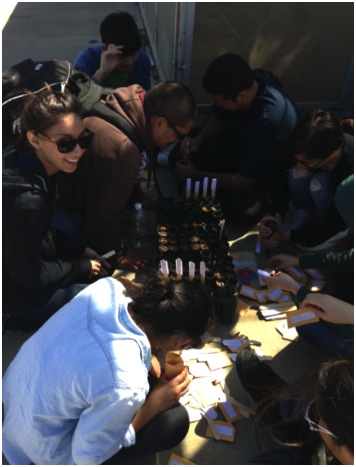
Undergraduate students contributed to this study by aiding in both planting and harvesting. Here they are shown planting seeds for species pairs at the start of the experiment.

Undergraduate students contributed to this study by aiding in both planting and harvesting. Here they are shown planting seeds for species pairs at the start of the experiment.