Tag Archives: Ecologic

Are mismatches the norm? Updated for 2026

Conservation biologists and climate change researchers are worried by the observed phenological changes, that is, timing of biological events. These concerns are partly motivated by the expected species-specific and thus potentially non-parallell phenological shifts among interacting species, leading to what is often-named ’mismatches’ for ’plants (that) are finely tuned to the seasonality of their environment’.
These concerns are rarely accompanied by empirical data showing that phenological change leads to changes in fitness or population dynamics, and most often they focus on a single phase in the plant’s annual cycle. In our study, we observed the timing of flowering, fruiting, dispersal and germination and their effects on fitness components in the insect-pollinated, and bird-dispersed shrub Frangula alnus (Rhamnaceae).

Frangula alnus bicolored fruit display

Framgual alnus bicolored fruit display

In our study “Are mismatches the norm? Timing of flowering, fruiting, dispersal and germination and their fitness effects in Frangula alnus (Rhamnaceae)” we found that the effects of earliness (in phenological terms) varies between different phases and between different fitness components. Thus, we argue that the timing and temporal distribution of every single phase, e.g., flowering, fruiting or germination, is not at all finely tuned, but a robust compromise to selection pressures varying between phases and years.

Kjell Bolmgren and Ove Eriksson

TTIP – challenging the European Commission’s unlawful intransigence Updated for 2026


Well, thanks to some encouraging ruckus in the last few months, you may actually have heard of TTIP: the anodynely-acronymed ‘Transatlantic Trade and Investment Partnership’.

In plain English, it’s a massive trade deal between the EU and North America which could affect everything from healthcare choices to government banking regulations to the air we breathe. (And it gets better, TPP is the US-Asia Pacific counterpart.)

Activists and even some politicians have been up in arms about one particularly nasty element of these behemoths, which together will cover almost 50% of global GDP.

That element is the proposed secret courts where, in theory, oil companies could sue governments who try to bring in green-friendly policies, tobacco companies could challenge advertising restrictions, and private healthcare providers could pick apart what’s left of national health services. To name a few.

Don’t mention the deal behind the curtain

But in truth, we just don’t know what TTIP will mean because the negotiations are happening in secret. And the European Commission has made a mockery of its own European Citizens’ Initiative, whereby citizens are supposed to be able to register dissent.

Last September it refused to ‘allow’ that dissent to be registered – a spectacular own goal because, in making it so plain that this supposedly democratic mechanism is toothless, it paved the way for a challenge in the courts – filed this morning in the European Court of Justice.

Stop TTIP – an alliance counting over 250 organisations from across Europe – had tried to use the European Citizens’ Initiative (ECI) to repeal the negotiating mandate for TTIP and not to conclude CETA – the Canada-Europe Trade Agreement.

The ECI was established with the Lisbon Treaty and was regarded as a major improvement of the “democratic life of the European Union”.

Long before requesting registration of the ECI, Stop TTIP asked for a legal pre-check of our petition text. A public servant of the Commission said that it would be no problem to get an answer.

But even after phoning and e-mailing again and again, they failed to deliver an answer. That´s why we decided to submit our request on 15 July.

The Commission’s highly questionable legalities

Then the Commission needed another two months to refuse the registration in a short letter based on two surprising arguments:

The first is that the Commission sees the mandate for an international agreement only as a preparatory act with no legal effect on citizens, and so could not be influenced by an ECI. This interpretation has no basis in the European Treaties. An ECI could request a legal act. There is no need to request a legal act with direct effect on citizens.

The second is even more disturbing. The Commission distinguishes between two forms of ECIs directed at the conclusion of an international agreement of the EU. The first one is to request positively the conclusion of an agreement. This is admissible according to the Commission.

But when an ECI – as in our case – wants to say No to the conclusion of an agreement it is not admissible because it produces no legal effect on citizens. This formalistic approach is more than questionable from a legal point of view.

‘Say want you want but it doesn’t change anything’

Politically, the argument of the Commission has a simple message: international trade agreements should be negotiated without public intervention. It is absolutely unacceptable that, after secret negotiations over which we have no influence, the European Parliament and the public are presented with a fait accompli.

The Commissions’ decision is very much in line with similar acts in the last months. For example, look at the so-called consultation on investor-state-dispute-settlement (ISDS) in TTIP.

The retiring trade Commissioner Karel de Gucht – who denounces some TTIP critics as liars – regarded the coordinated contributions of 150,000 people to the consultation as an “attack” on the system. And shortly after the deadline of the consultation, he proudly declared the CETA negotiations as finalized.

The draft text has a chapter on ISDS almost identical to that of the consultation on ISDS in TTIP. So the Commissions’ maxim seems to be: “you can say want you want but it doesn´t change anything.”

Even national parliaments are excluded

The Commission also wants to avoid the ratification of CETA and TTIP in the national parliaments. It regards the treaties as ‘EU-only’ agreements, only to be ratified in the European Parliament and concluded by the Council. Not only do the people of Europe have no say or ‘right to know’ – nor even do national parliaments.

What we do know, however, are the lessons from recent history. As Saskia Sassen, who has looked at this question for decades, points out: time and again, when global corporations gain rights through free trade deals, citizens lose out – in large part through a negative boomerang effect of job losses and wage stagnation that cheaper goods just don’t compensate for.

We also know that it’s farcical of the European Commission to try and claim that Europe’s citizens cannot have a say in this process because the treaty will have “no legal effect” on citizens. Grist to the mill of UKIP and others – as if they needed it.

So, how will we proceed with the ECI campaign? We will not be ending our protest just because the European Commission wants to gain time with an unfounded and politically motivated rejection.

Democracy arises through social intervention and participation in the political process; it is not something to be granted or denied by Brussels. That is why in early October, we launched an unofficial self-organised European Citizens’ Initiative.

The European Commission is trying to ignore us. We will ignore the European Commission. And this morning we – the Stop TTIP coalition laid down our challenge to the Commissions’ decision at the European Court of Justice.


Mary Fitzgerald is Editor-in-Chief of openDemocracy. Before joining oD she worked for Avaaz, the global campaigning organisation, and is a former Senior Editor of Prospect Magazine. She has written for the Guardian, Observer, New Statesman and others. Follow her on Twitter @maryftz

Michael Efler is a member of the citizens´ committee of the ECI Stop TTIP.

For more information please visit: Stop TTIP.

To sign the unofficial Citizens Initiative please visit: Stop TTIP.

Also on The Ecologist:


This article
was originally published on Open Democracy with additional reporting also from Open Democracy.


386608

TTIP – challenging the European Commission’s unlawful intransigence Updated for 2026


Well, thanks to some encouraging ruckus in the last few months, you may actually have heard of TTIP: the anodynely-acronymed ‘Transatlantic Trade and Investment Partnership’.

In plain English, it’s a massive trade deal between the EU and North America which could affect everything from healthcare choices to government banking regulations to the air we breathe. (And it gets better, TPP is the US-Asia Pacific counterpart.)

Activists and even some politicians have been up in arms about one particularly nasty element of these behemoths, which together will cover almost 50% of global GDP.

That element is the proposed secret courts where, in theory, oil companies could sue governments who try to bring in green-friendly policies, tobacco companies could challenge advertising restrictions, and private healthcare providers could pick apart what’s left of national health services. To name a few.

Don’t mention the deal behind the curtain

But in truth, we just don’t know what TTIP will mean because the negotiations are happening in secret. And the European Commission has made a mockery of its own European Citizens’ Initiative, whereby citizens are supposed to be able to register dissent.

Last September it refused to ‘allow’ that dissent to be registered – a spectacular own goal because, in making it so plain that this supposedly democratic mechanism is toothless, it paved the way for a challenge in the courts – filed this morning in the European Court of Justice.

Stop TTIP – an alliance counting over 250 organisations from across Europe – had tried to use the European Citizens’ Initiative (ECI) to repeal the negotiating mandate for TTIP and not to conclude CETA – the Canada-Europe Trade Agreement.

The ECI was established with the Lisbon Treaty and was regarded as a major improvement of the “democratic life of the European Union”.

Long before requesting registration of the ECI, Stop TTIP asked for a legal pre-check of our petition text. A public servant of the Commission said that it would be no problem to get an answer.

But even after phoning and e-mailing again and again, they failed to deliver an answer. That´s why we decided to submit our request on 15 July.

The Commission’s highly questionable legalities

Then the Commission needed another two months to refuse the registration in a short letter based on two surprising arguments:

The first is that the Commission sees the mandate for an international agreement only as a preparatory act with no legal effect on citizens, and so could not be influenced by an ECI. This interpretation has no basis in the European Treaties. An ECI could request a legal act. There is no need to request a legal act with direct effect on citizens.

The second is even more disturbing. The Commission distinguishes between two forms of ECIs directed at the conclusion of an international agreement of the EU. The first one is to request positively the conclusion of an agreement. This is admissible according to the Commission.

But when an ECI – as in our case – wants to say No to the conclusion of an agreement it is not admissible because it produces no legal effect on citizens. This formalistic approach is more than questionable from a legal point of view.

‘Say want you want but it doesn’t change anything’

Politically, the argument of the Commission has a simple message: international trade agreements should be negotiated without public intervention. It is absolutely unacceptable that, after secret negotiations over which we have no influence, the European Parliament and the public are presented with a fait accompli.

The Commissions’ decision is very much in line with similar acts in the last months. For example, look at the so-called consultation on investor-state-dispute-settlement (ISDS) in TTIP.

The retiring trade Commissioner Karel de Gucht – who denounces some TTIP critics as liars – regarded the coordinated contributions of 150,000 people to the consultation as an “attack” on the system. And shortly after the deadline of the consultation, he proudly declared the CETA negotiations as finalized.

The draft text has a chapter on ISDS almost identical to that of the consultation on ISDS in TTIP. So the Commissions’ maxim seems to be: “you can say want you want but it doesn´t change anything.”

Even national parliaments are excluded

The Commission also wants to avoid the ratification of CETA and TTIP in the national parliaments. It regards the treaties as ‘EU-only’ agreements, only to be ratified in the European Parliament and concluded by the Council. Not only do the people of Europe have no say or ‘right to know’ – nor even do national parliaments.

What we do know, however, are the lessons from recent history. As Saskia Sassen, who has looked at this question for decades, points out: time and again, when global corporations gain rights through free trade deals, citizens lose out – in large part through a negative boomerang effect of job losses and wage stagnation that cheaper goods just don’t compensate for.

We also know that it’s farcical of the European Commission to try and claim that Europe’s citizens cannot have a say in this process because the treaty will have “no legal effect” on citizens. Grist to the mill of UKIP and others – as if they needed it.

So, how will we proceed with the ECI campaign? We will not be ending our protest just because the European Commission wants to gain time with an unfounded and politically motivated rejection.

Democracy arises through social intervention and participation in the political process; it is not something to be granted or denied by Brussels. That is why in early October, we launched an unofficial self-organised European Citizens’ Initiative.

The European Commission is trying to ignore us. We will ignore the European Commission. And this morning we – the Stop TTIP coalition laid down our challenge to the Commissions’ decision at the European Court of Justice.


Mary Fitzgerald is Editor-in-Chief of openDemocracy. Before joining oD she worked for Avaaz, the global campaigning organisation, and is a former Senior Editor of Prospect Magazine. She has written for the Guardian, Observer, New Statesman and others. Follow her on Twitter @maryftz

Michael Efler is a member of the citizens´ committee of the ECI Stop TTIP.

For more information please visit: Stop TTIP.

To sign the unofficial Citizens Initiative please visit: Stop TTIP.

Also on The Ecologist:


This article
was originally published on Open Democracy with additional reporting also from Open Democracy.


386608

TTIP – challenging the European Commission’s unlawful intransigence Updated for 2026


Well, thanks to some encouraging ruckus in the last few months, you may actually have heard of TTIP: the anodynely-acronymed ‘Transatlantic Trade and Investment Partnership’.

In plain English, it’s a massive trade deal between the EU and North America which could affect everything from healthcare choices to government banking regulations to the air we breathe. (And it gets better, TPP is the US-Asia Pacific counterpart.)

Activists and even some politicians have been up in arms about one particularly nasty element of these behemoths, which together will cover almost 50% of global GDP.

That element is the proposed secret courts where, in theory, oil companies could sue governments who try to bring in green-friendly policies, tobacco companies could challenge advertising restrictions, and private healthcare providers could pick apart what’s left of national health services. To name a few.

Don’t mention the deal behind the curtain

But in truth, we just don’t know what TTIP will mean because the negotiations are happening in secret. And the European Commission has made a mockery of its own European Citizens’ Initiative, whereby citizens are supposed to be able to register dissent.

Last September it refused to ‘allow’ that dissent to be registered – a spectacular own goal because, in making it so plain that this supposedly democratic mechanism is toothless, it paved the way for a challenge in the courts – filed this morning in the European Court of Justice.

Stop TTIP – an alliance counting over 250 organisations from across Europe – had tried to use the European Citizens’ Initiative (ECI) to repeal the negotiating mandate for TTIP and not to conclude CETA – the Canada-Europe Trade Agreement.

The ECI was established with the Lisbon Treaty and was regarded as a major improvement of the “democratic life of the European Union”.

Long before requesting registration of the ECI, Stop TTIP asked for a legal pre-check of our petition text. A public servant of the Commission said that it would be no problem to get an answer.

But even after phoning and e-mailing again and again, they failed to deliver an answer. That´s why we decided to submit our request on 15 July.

The Commission’s highly questionable legalities

Then the Commission needed another two months to refuse the registration in a short letter based on two surprising arguments:

The first is that the Commission sees the mandate for an international agreement only as a preparatory act with no legal effect on citizens, and so could not be influenced by an ECI. This interpretation has no basis in the European Treaties. An ECI could request a legal act. There is no need to request a legal act with direct effect on citizens.

The second is even more disturbing. The Commission distinguishes between two forms of ECIs directed at the conclusion of an international agreement of the EU. The first one is to request positively the conclusion of an agreement. This is admissible according to the Commission.

But when an ECI – as in our case – wants to say No to the conclusion of an agreement it is not admissible because it produces no legal effect on citizens. This formalistic approach is more than questionable from a legal point of view.

‘Say want you want but it doesn’t change anything’

Politically, the argument of the Commission has a simple message: international trade agreements should be negotiated without public intervention. It is absolutely unacceptable that, after secret negotiations over which we have no influence, the European Parliament and the public are presented with a fait accompli.

The Commissions’ decision is very much in line with similar acts in the last months. For example, look at the so-called consultation on investor-state-dispute-settlement (ISDS) in TTIP.

The retiring trade Commissioner Karel de Gucht – who denounces some TTIP critics as liars – regarded the coordinated contributions of 150,000 people to the consultation as an “attack” on the system. And shortly after the deadline of the consultation, he proudly declared the CETA negotiations as finalized.

The draft text has a chapter on ISDS almost identical to that of the consultation on ISDS in TTIP. So the Commissions’ maxim seems to be: “you can say want you want but it doesn´t change anything.”

Even national parliaments are excluded

The Commission also wants to avoid the ratification of CETA and TTIP in the national parliaments. It regards the treaties as ‘EU-only’ agreements, only to be ratified in the European Parliament and concluded by the Council. Not only do the people of Europe have no say or ‘right to know’ – nor even do national parliaments.

What we do know, however, are the lessons from recent history. As Saskia Sassen, who has looked at this question for decades, points out: time and again, when global corporations gain rights through free trade deals, citizens lose out – in large part through a negative boomerang effect of job losses and wage stagnation that cheaper goods just don’t compensate for.

We also know that it’s farcical of the European Commission to try and claim that Europe’s citizens cannot have a say in this process because the treaty will have “no legal effect” on citizens. Grist to the mill of UKIP and others – as if they needed it.

So, how will we proceed with the ECI campaign? We will not be ending our protest just because the European Commission wants to gain time with an unfounded and politically motivated rejection.

Democracy arises through social intervention and participation in the political process; it is not something to be granted or denied by Brussels. That is why in early October, we launched an unofficial self-organised European Citizens’ Initiative.

The European Commission is trying to ignore us. We will ignore the European Commission. And this morning we – the Stop TTIP coalition laid down our challenge to the Commissions’ decision at the European Court of Justice.


Mary Fitzgerald is Editor-in-Chief of openDemocracy. Before joining oD she worked for Avaaz, the global campaigning organisation, and is a former Senior Editor of Prospect Magazine. She has written for the Guardian, Observer, New Statesman and others. Follow her on Twitter @maryftz

Michael Efler is a member of the citizens´ committee of the ECI Stop TTIP.

For more information please visit: Stop TTIP.

To sign the unofficial Citizens Initiative please visit: Stop TTIP.

Also on The Ecologist:


This article
was originally published on Open Democracy with additional reporting also from Open Democracy.


386608

TTIP – challenging the European Commission’s unlawful intransigence Updated for 2026


Well, thanks to some encouraging ruckus in the last few months, you may actually have heard of TTIP: the anodynely-acronymed ‘Transatlantic Trade and Investment Partnership’.

In plain English, it’s a massive trade deal between the EU and North America which could affect everything from healthcare choices to government banking regulations to the air we breathe. (And it gets better, TPP is the US-Asia Pacific counterpart.)

Activists and even some politicians have been up in arms about one particularly nasty element of these behemoths, which together will cover almost 50% of global GDP.

That element is the proposed secret courts where, in theory, oil companies could sue governments who try to bring in green-friendly policies, tobacco companies could challenge advertising restrictions, and private healthcare providers could pick apart what’s left of national health services. To name a few.

Don’t mention the deal behind the curtain

But in truth, we just don’t know what TTIP will mean because the negotiations are happening in secret. And the European Commission has made a mockery of its own European Citizens’ Initiative, whereby citizens are supposed to be able to register dissent.

Last September it refused to ‘allow’ that dissent to be registered – a spectacular own goal because, in making it so plain that this supposedly democratic mechanism is toothless, it paved the way for a challenge in the courts – filed this morning in the European Court of Justice.

Stop TTIP – an alliance counting over 250 organisations from across Europe – had tried to use the European Citizens’ Initiative (ECI) to repeal the negotiating mandate for TTIP and not to conclude CETA – the Canada-Europe Trade Agreement.

The ECI was established with the Lisbon Treaty and was regarded as a major improvement of the “democratic life of the European Union”.

Long before requesting registration of the ECI, Stop TTIP asked for a legal pre-check of our petition text. A public servant of the Commission said that it would be no problem to get an answer.

But even after phoning and e-mailing again and again, they failed to deliver an answer. That´s why we decided to submit our request on 15 July.

The Commission’s highly questionable legalities

Then the Commission needed another two months to refuse the registration in a short letter based on two surprising arguments:

The first is that the Commission sees the mandate for an international agreement only as a preparatory act with no legal effect on citizens, and so could not be influenced by an ECI. This interpretation has no basis in the European Treaties. An ECI could request a legal act. There is no need to request a legal act with direct effect on citizens.

The second is even more disturbing. The Commission distinguishes between two forms of ECIs directed at the conclusion of an international agreement of the EU. The first one is to request positively the conclusion of an agreement. This is admissible according to the Commission.

But when an ECI – as in our case – wants to say No to the conclusion of an agreement it is not admissible because it produces no legal effect on citizens. This formalistic approach is more than questionable from a legal point of view.

‘Say want you want but it doesn’t change anything’

Politically, the argument of the Commission has a simple message: international trade agreements should be negotiated without public intervention. It is absolutely unacceptable that, after secret negotiations over which we have no influence, the European Parliament and the public are presented with a fait accompli.

The Commissions’ decision is very much in line with similar acts in the last months. For example, look at the so-called consultation on investor-state-dispute-settlement (ISDS) in TTIP.

The retiring trade Commissioner Karel de Gucht – who denounces some TTIP critics as liars – regarded the coordinated contributions of 150,000 people to the consultation as an “attack” on the system. And shortly after the deadline of the consultation, he proudly declared the CETA negotiations as finalized.

The draft text has a chapter on ISDS almost identical to that of the consultation on ISDS in TTIP. So the Commissions’ maxim seems to be: “you can say want you want but it doesn´t change anything.”

Even national parliaments are excluded

The Commission also wants to avoid the ratification of CETA and TTIP in the national parliaments. It regards the treaties as ‘EU-only’ agreements, only to be ratified in the European Parliament and concluded by the Council. Not only do the people of Europe have no say or ‘right to know’ – nor even do national parliaments.

What we do know, however, are the lessons from recent history. As Saskia Sassen, who has looked at this question for decades, points out: time and again, when global corporations gain rights through free trade deals, citizens lose out – in large part through a negative boomerang effect of job losses and wage stagnation that cheaper goods just don’t compensate for.

We also know that it’s farcical of the European Commission to try and claim that Europe’s citizens cannot have a say in this process because the treaty will have “no legal effect” on citizens. Grist to the mill of UKIP and others – as if they needed it.

So, how will we proceed with the ECI campaign? We will not be ending our protest just because the European Commission wants to gain time with an unfounded and politically motivated rejection.

Democracy arises through social intervention and participation in the political process; it is not something to be granted or denied by Brussels. That is why in early October, we launched an unofficial self-organised European Citizens’ Initiative.

The European Commission is trying to ignore us. We will ignore the European Commission. And this morning we – the Stop TTIP coalition laid down our challenge to the Commissions’ decision at the European Court of Justice.


Mary Fitzgerald is Editor-in-Chief of openDemocracy. Before joining oD she worked for Avaaz, the global campaigning organisation, and is a former Senior Editor of Prospect Magazine. She has written for the Guardian, Observer, New Statesman and others. Follow her on Twitter @maryftz

Michael Efler is a member of the citizens´ committee of the ECI Stop TTIP.

For more information please visit: Stop TTIP.

To sign the unofficial Citizens Initiative please visit: Stop TTIP.

Also on The Ecologist:


This article
was originally published on Open Democracy with additional reporting also from Open Democracy.


386608

TTIP – challenging the European Commission’s unlawful intransigence Updated for 2026


Well, thanks to some encouraging ruckus in the last few months, you may actually have heard of TTIP: the anodynely-acronymed ‘Transatlantic Trade and Investment Partnership’.

In plain English, it’s a massive trade deal between the EU and North America which could affect everything from healthcare choices to government banking regulations to the air we breathe. (And it gets better, TPP is the US-Asia Pacific counterpart.)

Activists and even some politicians have been up in arms about one particularly nasty element of these behemoths, which together will cover almost 50% of global GDP.

That element is the proposed secret courts where, in theory, oil companies could sue governments who try to bring in green-friendly policies, tobacco companies could challenge advertising restrictions, and private healthcare providers could pick apart what’s left of national health services. To name a few.

Don’t mention the deal behind the curtain

But in truth, we just don’t know what TTIP will mean because the negotiations are happening in secret. And the European Commission has made a mockery of its own European Citizens’ Initiative, whereby citizens are supposed to be able to register dissent.

Last September it refused to ‘allow’ that dissent to be registered – a spectacular own goal because, in making it so plain that this supposedly democratic mechanism is toothless, it paved the way for a challenge in the courts – filed this morning in the European Court of Justice.

Stop TTIP – an alliance counting over 250 organisations from across Europe – had tried to use the European Citizens’ Initiative (ECI) to repeal the negotiating mandate for TTIP and not to conclude CETA – the Canada-Europe Trade Agreement.

The ECI was established with the Lisbon Treaty and was regarded as a major improvement of the “democratic life of the European Union”.

Long before requesting registration of the ECI, Stop TTIP asked for a legal pre-check of our petition text. A public servant of the Commission said that it would be no problem to get an answer.

But even after phoning and e-mailing again and again, they failed to deliver an answer. That´s why we decided to submit our request on 15 July.

The Commission’s highly questionable legalities

Then the Commission needed another two months to refuse the registration in a short letter based on two surprising arguments:

The first is that the Commission sees the mandate for an international agreement only as a preparatory act with no legal effect on citizens, and so could not be influenced by an ECI. This interpretation has no basis in the European Treaties. An ECI could request a legal act. There is no need to request a legal act with direct effect on citizens.

The second is even more disturbing. The Commission distinguishes between two forms of ECIs directed at the conclusion of an international agreement of the EU. The first one is to request positively the conclusion of an agreement. This is admissible according to the Commission.

But when an ECI – as in our case – wants to say No to the conclusion of an agreement it is not admissible because it produces no legal effect on citizens. This formalistic approach is more than questionable from a legal point of view.

‘Say want you want but it doesn’t change anything’

Politically, the argument of the Commission has a simple message: international trade agreements should be negotiated without public intervention. It is absolutely unacceptable that, after secret negotiations over which we have no influence, the European Parliament and the public are presented with a fait accompli.

The Commissions’ decision is very much in line with similar acts in the last months. For example, look at the so-called consultation on investor-state-dispute-settlement (ISDS) in TTIP.

The retiring trade Commissioner Karel de Gucht – who denounces some TTIP critics as liars – regarded the coordinated contributions of 150,000 people to the consultation as an “attack” on the system. And shortly after the deadline of the consultation, he proudly declared the CETA negotiations as finalized.

The draft text has a chapter on ISDS almost identical to that of the consultation on ISDS in TTIP. So the Commissions’ maxim seems to be: “you can say want you want but it doesn´t change anything.”

Even national parliaments are excluded

The Commission also wants to avoid the ratification of CETA and TTIP in the national parliaments. It regards the treaties as ‘EU-only’ agreements, only to be ratified in the European Parliament and concluded by the Council. Not only do the people of Europe have no say or ‘right to know’ – nor even do national parliaments.

What we do know, however, are the lessons from recent history. As Saskia Sassen, who has looked at this question for decades, points out: time and again, when global corporations gain rights through free trade deals, citizens lose out – in large part through a negative boomerang effect of job losses and wage stagnation that cheaper goods just don’t compensate for.

We also know that it’s farcical of the European Commission to try and claim that Europe’s citizens cannot have a say in this process because the treaty will have “no legal effect” on citizens. Grist to the mill of UKIP and others – as if they needed it.

So, how will we proceed with the ECI campaign? We will not be ending our protest just because the European Commission wants to gain time with an unfounded and politically motivated rejection.

Democracy arises through social intervention and participation in the political process; it is not something to be granted or denied by Brussels. That is why in early October, we launched an unofficial self-organised European Citizens’ Initiative.

The European Commission is trying to ignore us. We will ignore the European Commission. And this morning we – the Stop TTIP coalition laid down our challenge to the Commissions’ decision at the European Court of Justice.


Mary Fitzgerald is Editor-in-Chief of openDemocracy. Before joining oD she worked for Avaaz, the global campaigning organisation, and is a former Senior Editor of Prospect Magazine. She has written for the Guardian, Observer, New Statesman and others. Follow her on Twitter @maryftz

Michael Efler is a member of the citizens´ committee of the ECI Stop TTIP.

For more information please visit: Stop TTIP.

To sign the unofficial Citizens Initiative please visit: Stop TTIP.

Also on The Ecologist:


This article
was originally published on Open Democracy with additional reporting also from Open Democracy.


386608

TTIP – challenging the European Commission’s unlawful intransigence Updated for 2026


Well, thanks to some encouraging ruckus in the last few months, you may actually have heard of TTIP: the anodynely-acronymed ‘Transatlantic Trade and Investment Partnership’.

In plain English, it’s a massive trade deal between the EU and North America which could affect everything from healthcare choices to government banking regulations to the air we breathe. (And it gets better, TPP is the US-Asia Pacific counterpart.)

Activists and even some politicians have been up in arms about one particularly nasty element of these behemoths, which together will cover almost 50% of global GDP.

That element is the proposed secret courts where, in theory, oil companies could sue governments who try to bring in green-friendly policies, tobacco companies could challenge advertising restrictions, and private healthcare providers could pick apart what’s left of national health services. To name a few.

Don’t mention the deal behind the curtain

But in truth, we just don’t know what TTIP will mean because the negotiations are happening in secret. And the European Commission has made a mockery of its own European Citizens’ Initiative, whereby citizens are supposed to be able to register dissent.

Last September it refused to ‘allow’ that dissent to be registered – a spectacular own goal because, in making it so plain that this supposedly democratic mechanism is toothless, it paved the way for a challenge in the courts – filed this morning in the European Court of Justice.

Stop TTIP – an alliance counting over 250 organisations from across Europe – had tried to use the European Citizens’ Initiative (ECI) to repeal the negotiating mandate for TTIP and not to conclude CETA – the Canada-Europe Trade Agreement.

The ECI was established with the Lisbon Treaty and was regarded as a major improvement of the “democratic life of the European Union”.

Long before requesting registration of the ECI, Stop TTIP asked for a legal pre-check of our petition text. A public servant of the Commission said that it would be no problem to get an answer.

But even after phoning and e-mailing again and again, they failed to deliver an answer. That´s why we decided to submit our request on 15 July.

The Commission’s highly questionable legalities

Then the Commission needed another two months to refuse the registration in a short letter based on two surprising arguments:

The first is that the Commission sees the mandate for an international agreement only as a preparatory act with no legal effect on citizens, and so could not be influenced by an ECI. This interpretation has no basis in the European Treaties. An ECI could request a legal act. There is no need to request a legal act with direct effect on citizens.

The second is even more disturbing. The Commission distinguishes between two forms of ECIs directed at the conclusion of an international agreement of the EU. The first one is to request positively the conclusion of an agreement. This is admissible according to the Commission.

But when an ECI – as in our case – wants to say No to the conclusion of an agreement it is not admissible because it produces no legal effect on citizens. This formalistic approach is more than questionable from a legal point of view.

‘Say want you want but it doesn’t change anything’

Politically, the argument of the Commission has a simple message: international trade agreements should be negotiated without public intervention. It is absolutely unacceptable that, after secret negotiations over which we have no influence, the European Parliament and the public are presented with a fait accompli.

The Commissions’ decision is very much in line with similar acts in the last months. For example, look at the so-called consultation on investor-state-dispute-settlement (ISDS) in TTIP.

The retiring trade Commissioner Karel de Gucht – who denounces some TTIP critics as liars – regarded the coordinated contributions of 150,000 people to the consultation as an “attack” on the system. And shortly after the deadline of the consultation, he proudly declared the CETA negotiations as finalized.

The draft text has a chapter on ISDS almost identical to that of the consultation on ISDS in TTIP. So the Commissions’ maxim seems to be: “you can say want you want but it doesn´t change anything.”

Even national parliaments are excluded

The Commission also wants to avoid the ratification of CETA and TTIP in the national parliaments. It regards the treaties as ‘EU-only’ agreements, only to be ratified in the European Parliament and concluded by the Council. Not only do the people of Europe have no say or ‘right to know’ – nor even do national parliaments.

What we do know, however, are the lessons from recent history. As Saskia Sassen, who has looked at this question for decades, points out: time and again, when global corporations gain rights through free trade deals, citizens lose out – in large part through a negative boomerang effect of job losses and wage stagnation that cheaper goods just don’t compensate for.

We also know that it’s farcical of the European Commission to try and claim that Europe’s citizens cannot have a say in this process because the treaty will have “no legal effect” on citizens. Grist to the mill of UKIP and others – as if they needed it.

So, how will we proceed with the ECI campaign? We will not be ending our protest just because the European Commission wants to gain time with an unfounded and politically motivated rejection.

Democracy arises through social intervention and participation in the political process; it is not something to be granted or denied by Brussels. That is why in early October, we launched an unofficial self-organised European Citizens’ Initiative.

The European Commission is trying to ignore us. We will ignore the European Commission. And this morning we – the Stop TTIP coalition laid down our challenge to the Commissions’ decision at the European Court of Justice.


Mary Fitzgerald is Editor-in-Chief of openDemocracy. Before joining oD she worked for Avaaz, the global campaigning organisation, and is a former Senior Editor of Prospect Magazine. She has written for the Guardian, Observer, New Statesman and others. Follow her on Twitter @maryftz

Michael Efler is a member of the citizens´ committee of the ECI Stop TTIP.

Also on The Ecologist:Lawsuit served on Commission for blocking TTIP challenge‘.

For more information please visit: Stop TTIP.

To sign the unofficial Citizens Initiative please visit: Stop TTIP.

This article was originally published on Open Democracy with additional reporting also from Open Democracy.


386608

Happy Flumpaween! Updated for 2026

1024px-Cymothoa_exigua_parassita_Lithognathus_mormyrus

It’s Friday and it’s October 31, so you are in store for a super spoooooky edition of our weekly list of links.

Zombies? Whatevs, anyone who studies parasites knows that zombies are all over the place in nature!

In the Pacific Northwest, the Sockeye salmon are running, and boy do they look like something out of Walking Dead. As they start the migration, they give up on fighting disease and other, you know, life-sustaining processes in favor of makin’ babies. By the time they are spawning, they are completely falling apart, covered in fungal lesions (increased local diversity!), with totally shredded fins. Hey LADIES!

And because poor spiders get such a bad rap this time of year, here is some spider public image enhancement propaganda. – Emily Grason

For your Halloween enjoyment, here’s Cymothoa exigua, a marine isopod that destroys and then replaces the tongue of an unlucky fish host. Females of this species crawl in through the fish’s gills, feed on the blood from the tongue (causing the organ to atrophy and die), and then spend the rest of their life as the new, more terrifying fish tongue. The worst part? C. exigua doesn’t actually kill the fish, meaning its host has to live out the rest of its life with a tiny little crustacean just inside its mouth.

You may know crinoids as the ancient, visually appealing stalked echinoderms commonly called sea lilies or feather stars. What you may not know is that though they’re mostly sessile, they are able to crawl along the seafloor in an unsettling, Samara-like manner. Speaking of unsuspecting scares, here’s an amazing video of a Clione (sea angel) catching its prey. – Nate Johnson

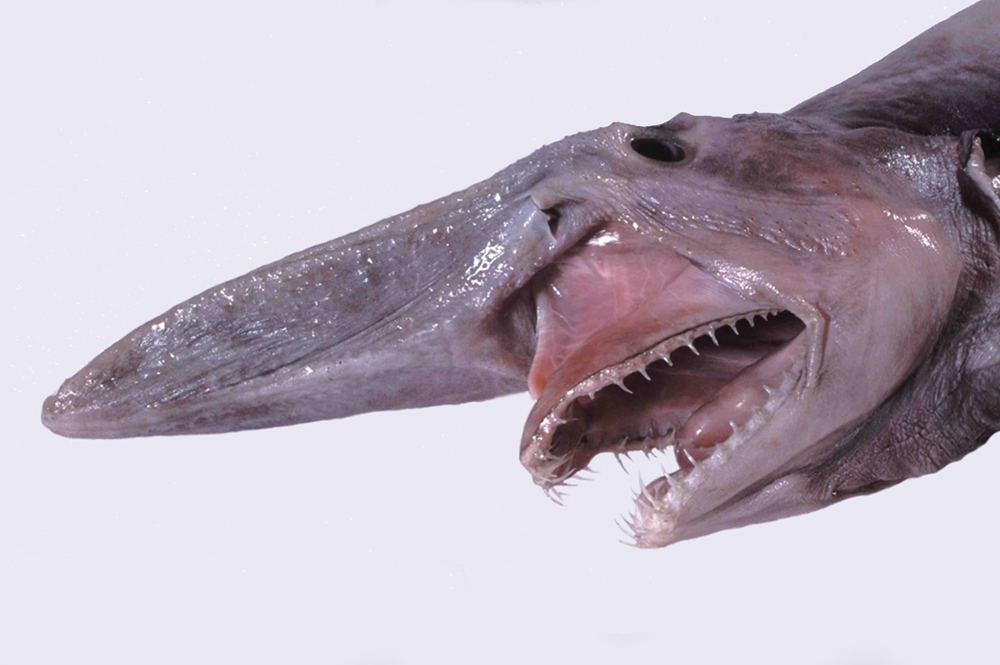
What’s that lurking in the deep dark cold waters of the abyss? Maybe it was a goblin shark with 30+ rows of teeth and a protrusible jaw to snap up its prey… hopefully, it was Vampyroteuthis infernalis… the “vampire” “squid” from hell. Check out this video for why this ghost of cephalopods past is really neither. If you make it into shallower waters, beware the Desmarestia spp. which produce sulfuric acid for that slow painful burn. Dubbing it the acid kelp. -Kylla Benes

I would have to say that nothing in nature is creepier than flesh eating bacteria, such as the Group A streptococcus, that can cause  Necrotizing fasciitis,  an infirmity commonly known as flesh-eating disease or flesh-eating bacteria syndrome that infects and kills thousands of people every year. 

If you want to learn a little bit more about mathematical modeling, while celebrating Halloween, here are a couple of interesting and educative papers inspired on some popular fictional characters: zombies and vampires. Both papers use differential equations and ecological and behavioral data “collected” from classic movies, books and/or TV series in order to understand the spread of these scary creatures in the human population; Munz et al. modeled the spread of a zombie outbreak among humans. Their results are very disturbing; a zombie outbreak is very likely to lead to the collapse of our civilized world, unless we deal with it right away, using aggressive “control methods”.  Strielkowski et al. modeled the co-existence of humans and vampires, under three different scenarios: i) the Stoker-King model, which was based on Bram Stoker’s “Dracula” and Stephen King’s “Salem’s Lot”; the Rice model, based on Anne Rice’s  “Vampire Chronicles”; iii)  the Harris-Meyer-Kostova model, based on Stephenie Meyer’s “Twilight series”, Charlaine Harris’ “Sookie Stockhouse, “True Blood”  and Elizabeth Kostova’s “The Historian”. Their results seem to be a little more comforting than Munz et al., as they show that, at least, the Harris-Meyer-Kostova model indicates that we could peacefully co-exist with vampires, without even noticing their existence. I guess, it comes as no surprise that the Stoker-King model is the most dramatic scenario, leading to a rapid extinction of both, humans and vampires… – Vinicius Bastazini.

Here’s a creepy, but (maybe psuedo)scientific book asking what the world will look like 50 million years after humans go extinct. A friend of mine found a first edition, and we’ve been thumbing through it over the past few weeks. My favorites are the creatures that inhabit the island of batavia – where bats have evolved to fill every ecological niche from flower-mimicking insectivores to seal-like creatures evocative humanity’s descendants in Kurt Vonnegut’s Galapagos.

5224704811_b1c98ea92b_b

The book was published two years after Gould and Lewontin’s Spandrels of San Marco, and I can’t help but wonder what they would have thought flipping through the pages. You can read through the entire book and check out all of the pictures here. -Fletcher Halliday

October 31, 2014

Ebola: don’t blame the bats! Updated for 2026


In an era flush with vaccines and antibiotics, when the greatest health risks in the developed world ride on the back of fried fish and hamburgers, it is easy to forget that infectious diseases still account for a quarter of all human deaths worldwide.

Although this is a burden largely carried by more impoverished nations, the unfolding Ebola outbreak is a dramatic reminder that infectious diseases, and the dangers they pose, have no respect for country borders.

Making the leap from animal to human

One of the greatest global health threats lies in emerging diseases, which have never been seen before in humans or – as with Ebola – appear sporadically in new locations.

Most emerging diseases are zoonoses, meaning they are caused by pathogens that can jump from animals into people. Out of more than 300 emerging infections identified since 1940, over 60% are zoonotic, and of these, 72% originate in wildlife.

Whereas some zoonotic infections, such as rabies, cannot be transmitted between human patients, others can spread across populations and borders: in 2003, SARS, a coronavirus linked to bats, spread to several continents within a few weeks before it was eliminated, while HIV has become, over several decades, a persistent pandemic.

The unpredictable nature and novelty of zoonotic pathogens make them incredibly difficult to defend against and respond to. But that does not mean we are helpless in the face of emerging ones.

Because we know that the majority of zoonoses pass from wildlife, we can start to identify high-risk points for transmission by determining which wildlife species may pose the greatest risk.

Searching for suspects

Of all wildlife species, bats in particular pose complex questions. The second most diverse group of mammals after rodents, they host more than 65 known human pathogens, including Ebola virus, coronavirus (the cause of SARS), henipaviruses (which can cause deadly encephalitis in humans) and rabies.

But they are also one of the mammalian groups most vulnerable to overhunting and habitat destruction, while providing indispensable ecological functions such as pest control by bats that eat insects, pollination and seed dispersal.

Whether eating their body weights in insects every night, or dispersing seeds from fruit trees across large areas, bats provide services to local economies worth billions of dollars across the world.

The loss of bats, whether from hunting or for disease control almost certainly would have far-reaching and long-lasting ecological and economic consequences.

This much we know, and yet the details of how zoonoses spill over from bats into people are vastly understudied. Understanding how humans and bats interact had, until recently, never been examined in West Africa, and only peripherally probed elsewhere in the world.

Uncovering behaviour that brings humans into contact with bats and other wildlife, and exposes people to zoonoses, could provide invaluable clues for preventing zoonotic outbreaks.

To address these questions, we put together an international network of collaborators, led in the UK by the Zoological Society of London and the University of Cambridge.

From Malaysia to Ghana, from Australia to Peru, bats are coming into contact with humans more and more frequently as people are expanding into previously virgin territories.

Bats as bushmeat – they didn’t ask us to eat them!

Fruit bats are also often attracted to orchards and gardens planted on the edge of their territories. But another human behaviour contributes significantly to the risk of zoonotic spillover from all wildlife species: hunting.

The consumption of bushmeat, or wild animal meat, is a global phenomenon on a massive scale – estimates of the combined bushmeat consumption in Central Africa and the Amazon Basin exceed 1 billion kilograms annually.

In Ghana, where fruit bats have tested positive for antibodies to henipaviruses and Ebola virus, the status of bats as bushmeat was essentially unknown until we began our investigation five years ago.

In two recent studies carried out in Ghana, we reported how many people hunt bats for both food and money. We estimated that more than 100,000 fruit bats, specifically the straw coloured fruit bat, are harvested every year.

Bat meat likely provides an important secondary source of protein for the hunters and their families, especially when other sources such as fish or antelope are scarce. Bat meat also fetches a fairly high price at markets, supplementing a hunter’s often inconsistent income.

Some people also depend on bat meat, and other bushmeat, for both their survival and livelihoods. Bushmeat hunting often occurs in remote or impoverished places, where little infrastructure exists to support alternative livelihoods or even enforcement of hunting laws.

But hunters and those who prepare bat meat for sale or consumption also place themselves at risk of exposure to bat-borne zoonotic pathogens. Such pathogens can pass through blood, scratches, bites, and urine.

Bat hunters handle live, often wounded bats and freshly killed bats, putting them into direct contact with bat blood and at risk of being bitten and scratched. Despite this, hunters are largely unaware of the risks they run.

The risks of zoonoses can be managed – but never eliminated

Understanding what risks bats pose, as little as we know, is only the beginning of the challenge. Reducing the risk of zoonoses is not simple or easy, and certainly not a simple question of stopping hunting or culling reservoir hosts.

Reducing risk sustainably and equitably will therefore likely need a combination of interventions, encompassing developmental approaches to strengthen local economies, expand job opportunities, and increase the supply of safer alternative protein sources in order to reduce the need to hunt wildlife – together with education to promote safer hunting practices.

Communities may have to change how they use land, and limit bushmeat hunting and human expansion activities to minimise the risks of spillover. At the same time, we need advances in medical technology and surveillance systems to monitor and swiftly respond when outbreaks do occur.

Such interventions can be complex and costly, but are essential. While the 2014 Ebola outbreak is the biggest to date, there will almost certainly be many zoonotic disease outbreaks in the future.

By bringing together expertise from ecology, epidemiology and social sciences, and concentrating on long-term management of risks, we hope to help communities maintain a safe and mutually beneficial relationship with their natural environment.


Alexandra Kamins is Research Analyst at the Colorado Hospital Association, and co-author of the paper ‘Uncovering the fruit bat bushmeat commodity chain and the true extent of fruit bat hunting in Ghana, West Africa’, funded by the University of Cambridge and the Gates Foundation. She works as a reacher for the Colorado Hospital Association.

Marcus Rowcliffe is Research Fellow at Zoological Society of London, and co-author of the paper ‘Uncovering the fruit bat bushmeat commodity chain and the true extent of fruit bat hunting in Ghana, West Africa’, funded by the University of Cambridge and the Gates Foundation.

Olivier Restif is Royal Society University Research Fellow at the University of Cambridge. He receives funding from the Royal Society, the BBSRC and US Federal Agencies.

This article was originally published on The Conversation. Read the original article.

The Conversation


385794

Marsupial browsing effects insect damages

Yes, made it through the wallaby attack!, No, no, no- no reason to celebrate Eucalyptus trees. Less marsupial browsing – opens up for more insects. Life is just not easy. Read more in the Early View paper “Direct and indirect effects of marsupial browsing on a foundation tree species” by Christina L. Borzak, Julianne M. O’Reilly-Wapstra and Brad M. Potts. Below is their summary of the study: Herbivores have impacts on plant survival, growth and form and these induced changes can have important flow-on consequences to subsequent organisms. Although a large number of studies in eucalypt systems have previously investigated vertebrate feeding preferences and the direct impacts of herbivory, few studies have focused on how herbivores interact to directly affect each other’s feeding preferences, and even less have addressed the indirect plant-mediated effects of herbivores. We investigated the direct and indirect effects of uncontrolled browsing by marsupial herbivores including the common brushtail possum (Trichosurus vulpecula), Bennetts wallaby (Macropus rufogriseus) and the red-bellied pademelon (Thylogale billardierii), in a Eucalyptus system known to have extended community and ecosystem genetic effects. In a common garden trial containing 525 full-sib Eucalyptus globulus families from an incomplete diallel crossing program located in north-eastern Tasmania, Australia, we assessed the genetic basis to herbivore preferences, the impact of a single and repeated marsupial browsing event on tree fitness and morphological traits and the associated indirect plant-mediated effects on a subsequent herbivore, autumn gum moth (Mnesampela privata).

We found that marsupial browsing was not influenced by plant genetics, but spatial components instead affected the pattern of damage across the trial. Marsupial browsing had significant impacts on tree development, morphology and survival, resulting in reductions in survival, height and basal area, an increase proportion in multiple stems, delays in flowering as well as delays in phase change from juvenile to adult foliage. Fitness impacts were minimal in response to a once-off browsing event, but effects were exacerbated when trees suffered repeated browsing.

Trait assessments under way at the Eucalyptus globulus trial site by authors Christina Borzak (left) and Julianne O’Reilly-Wapstra (right).

Trait assessments under way at the Eucalyptus globulus trial site by authors Christina Borzak (left) and Julianne O’Reilly-Wapstra (right).

Assessments of autumn gum moth damage showed that their presence was linked to marsupial browsing, with browsed plants being less susceptible to the insect herbivore. The majority of the effect was attributed to the indirect effects of browsing on tree height, where AGM were attracted to taller trees that were not browsed. Such indirect effects have the potential to influence biotic community structure on a foundation species host-plant, and the evolutionary interactions that occur between organisms and the host-plant themselves.