Tag Archives: climate

Fracking, the oil price crash, and the ‘greenest government ever’ Updated for 2026


This month, a powerful article in Nature highlighted yet again that most of the world’s oil, coal and gas needs to stay in the ground, if we want to prevent dangerous climate change.

This is the ‘unburnable carbon’ analysis that President Obama and Bank of England Governor Mark Carney have both made mainstream in recent months.

Related, over the last 6 months the world oil price has crashed, catching almost all economists and analysts by surprise. As well as profound economic effects, this crash affects ‘unburnable carbon’ in two broad and opposite ways.

It’s leading to cancellations of potential fossil fuel projects, as they become less or non-profitable. Great for stopping colossally dirty projects like Arctic oil and Canadian tar sands. And in the opposite direction, it makes oil cheaper, meaning people use it more. Bad for climate, though good for people’s pockets.

How should Governments react to this? A Government who genuinely thought climate change was a global priority would not sit passively by and let these conflicting effects of the oil price crash on climate sweep over us. It would act. Government surveys show the British public want more action on climate change.

Instead, we’re going all out for oil and fracking

Despite this, the sole response to the oil price crash from the UK Government is do the opposite! It announced detailed plans for tax cuts for oil companies to drill another 11-21 billion barrels of oil from the ground – way more than even the three billion barrels in the Government’s Wood Review on offshore oil and gas. Climate change impacts got one sentence of dismissal.

Then last week, it drove through a clause in the Infrastructure Bill – with almost no debate – requiring the UK to “maximise economic recovery” of North Sea oil.

These are crystal-clear examples of how Governments do not yet grasp that climate change requires a comprehensive plan. We can’t just do a little bit on renewable energy and energy efficiency, and think that this means we don’t need to do anything about fossil fuels.

And yet, for every announcement of a new wind-farm, or homes insulated, or rail investment, there is a corresponding – and often larger – Government announcement which makes climate change worse.

For example: £15 billion for new roads; whopping cuts in taxes on profits for North Sea oil drillers; consultations on which new airport to open; tax breaks for new fracking industries. High-carbon infrastructure has recently over-taken low-carbon infrastructure in the Government’s ‘infrastructure pipeline’.

After decades of subsidy, high-carbon industry shouldn’t need any more help. Colossally rich oil corporations know the global oil price yo-yos – they should have saved for this moment in the years when oil prices were over $100 a barrel and their profits were sky-high. But like the banks, they want their bail-out, and they know they will get it.

It’s shameful – that we have leaders who say climate change is desperately urgent, who call for more ambition, and yet who are still so deep in the pockets of fossil fuel companies they will not act and treat climate change as the emergency it is.

They are up-front about it too – the Government’s North Sea oil tax cut consultation is clear on three things – it’s derived in discussion with the oil barons; it’s being fast-tracked at their request; and the consultation primarily wants to hear from them.

Leaked letter shows the real agenda

They’re also not so up-front about it – you can see just how deeply the fracking industry is embedded in Government in this leaked-letter from George Osborne here.

The letter was from George Osborne, sent last September, to colleagues in the Cabinet’s Economic Affairs Committee, setting out how he wanted them to prioritise implementing the recommendations of a Cabinet Office report on how to get the shale gas industry going.

Of real interest here are the agreed plans between Government and fracking company Cuadrilla if their planning permission for fracking is turned down – which is exactly what Lancashire’s planners have recommended councillors to do.

According to the letter It is agreed that “if permission turned down … Cuadrilla to respond to concerns and appeal asap.” When that has happened, the Government will “Prepare PINS to respond promptly to appeal or SoS recovery if appropriate.”

In layperson’s terms, that means the Government will make sure the Planning Inspectorate fast-tracks the appeal or that Communities Secretary Eric Pickles intervenes. This stands in stark contrast to the line taken by the Prime Minister’s official spokesman that such decisions should be up to local authorities.

And how were these ‘asks’ made? Has Cuadrilla been meeting Ministers and officials, or has it been a few quiet words in the right ears? For let’s not forget that Cuadrilla’s chairman Lord Browne works in the Cabinet Office as a Non-Executive Director.

Moving to ‘full exploration’

The letter is also very revealing about longer-term plans for “moving to full exploration”. The Government clearly knows it’s losing the argument at the local level. Two recommendations stand out here:

  • “A cross-Government and industry group should be established … to assess the value and viability of focusing on a small number of sites in less contentious locations.”
  • “Public sector land (particularly MoD owned) should be mapped to potential sites and explored for possible concept testing.”

And the Government seems to accept that the bribes – sorry, benefits – it is offering top local communities to accept fracking aren’t working. The solution: it looks like offer them more. They plan to: “examine the nature of benefits to be offered to local communities where shale developments take place.”

They know they’re not winning the wider battle for hearts and minds either, so the Government is going to carry on doing the industry’s PR job and “build on existing network of neutral academic experts available to provide credible evidence-based views of matters of public concern”, and “develop a national communications plan on shale exploration.”

This isn’t the first evidence of collusion. Lord Browne has already intervened with the then chair of the Environment Agency, Lord Smith, to try to exempt Cuadrilla from compliance with drilling waste regulations.

On another occasion, after a separate personal intervention by Lord Browne, Lord Smith “offered to halve the consultation time for a waste permit”, and “agreed to intervene with a county council over Cuadrilla’s planning permission and to identify further risks to Cuadrilla’s plans.”

Here’s how the government should be acting!

Instead of colluding with the fossil fuel industry to increase production, a Government genuinely committed to action on climate change would treat the oil price crash as an opportunity to protect the climate, help consumers and protect jobs. It would say:

  • We need a ‘just transition’ plan to get jobs and growth and industry out of North Sea Oil, and into North Sea Renewables like off-shore wind. There will be no economic devastation as when the coal mines closed. But we need to move away from oil, not prop it up. We will do all we can to help people and businesses build new, clean industries in the North Sea.
  • We will put in place a plan to keep demand for oil low, to help keep prices low, and ensure undrilled oil stays in the ground. We’ll put in place a proper strategy to make public transport, walking and cycling decent alternatives to motoring. We’ll drive far stronger standards on car and lorry energy efficiency. We’ll invest in a national electric vehicle network. We’ll act at EU and International level to persuade our fellow nations to do the same.
  • We will make sure the oil and gas price falls don’t damage the growing renewables industry. We’ll reassure investors by setting a clear 2030 power decarbonisation target, with policies to ensure we meet it.
  • We will reverse our fossil-fuel strategy to “maximise recovery” and focus instead on ‘minimising demand’ – in every part of the economy.
  • We will treat climate change as an emergency, and make tackling it a priority across all departments of Government.

People want more action from Government on climate change. Not less. Not a botched half-plan, and half-truths about their commitment to action.

The inadequate, partial, feeble responses on climate change are yet another expression of why so many people feel alienated from Westminster governments – they do not act on their promises, or sufficiently in the public interest.

It’s election time soon. Which parties will put people’s interests ahead of propping up fossil fuel companies, and put in place a proper plan to tackle climate change?

In short, who will step up and show they are a party worth voting for?


More information on the impact of the oil price crash on climate change: Friends of the Earth briefing.

Simon Bullock is Senior Campaigner, Policy and Research Co-ordinator for Friends of the Earth UK.

Tony Bosworth is Energy Campaigner at Friends of the Earth UK.

This article is a synthesis of two articles published on the Friends of the Earth Policy & Politics blog:


389768

Fracking, the oil price crash, and the ‘greenest government ever’ Updated for 2026


This month, a powerful article in Nature highlighted yet again that most of the world’s oil, coal and gas needs to stay in the ground, if we want to prevent dangerous climate change.

This is the ‘unburnable carbon’ analysis that President Obama and Bank of England Governor Mark Carney have both made mainstream in recent months.

Related, over the last 6 months the world oil price has crashed, catching almost all economists and analysts by surprise. As well as profound economic effects, this crash affects ‘unburnable carbon’ in two broad and opposite ways.

It’s leading to cancellations of potential fossil fuel projects, as they become less or non-profitable. Great for stopping colossally dirty projects like Arctic oil and Canadian tar sands. And in the opposite direction, it makes oil cheaper, meaning people use it more. Bad for climate, though good for people’s pockets.

How should Governments react to this? A Government who genuinely thought climate change was a global priority would not sit passively by and let these conflicting effects of the oil price crash on climate sweep over us. It would act. Government surveys show the British public want more action on climate change.

Instead, we’re going all out for oil and fracking

Despite this, the sole response to the oil price crash from the UK Government is do the opposite! It announced detailed plans for tax cuts for oil companies to drill another 11-21 billion barrels of oil from the ground – way more than even the three billion barrels in the Government’s Wood Review on offshore oil and gas. Climate change impacts got one sentence of dismissal.

Then last week, it drove through a clause in the Infrastructure Bill – with almost no debate – requiring the UK to “maximise economic recovery” of North Sea oil.

These are crystal-clear examples of how Governments do not yet grasp that climate change requires a comprehensive plan. We can’t just do a little bit on renewable energy and energy efficiency, and think that this means we don’t need to do anything about fossil fuels.

And yet, for every announcement of a new wind-farm, or homes insulated, or rail investment, there is a corresponding – and often larger – Government announcement which makes climate change worse.

For example: £15 billion for new roads; whopping cuts in taxes on profits for North Sea oil drillers; consultations on which new airport to open; tax breaks for new fracking industries. High-carbon infrastructure has recently over-taken low-carbon infrastructure in the Government’s ‘infrastructure pipeline’.

After decades of subsidy, high-carbon industry shouldn’t need any more help. Colossally rich oil corporations know the global oil price yo-yos – they should have saved for this moment in the years when oil prices were over $100 a barrel and their profits were sky-high. But like the banks, they want their bail-out, and they know they will get it.

It’s shameful – that we have leaders who say climate change is desperately urgent, who call for more ambition, and yet who are still so deep in the pockets of fossil fuel companies they will not act and treat climate change as the emergency it is.

They are up-front about it too – the Government’s North Sea oil tax cut consultation is clear on three things – it’s derived in discussion with the oil barons; it’s being fast-tracked at their request; and the consultation primarily wants to hear from them.

Leaked letter shows the real agenda

They’re also not so up-front about it – you can see just how deeply the fracking industry is embedded in Government in this leaked-letter from George Osborne here.

The letter was from George Osborne, sent last September, to colleagues in the Cabinet’s Economic Affairs Committee, setting out how he wanted them to prioritise implementing the recommendations of a Cabinet Office report on how to get the shale gas industry going.

Of real interest here are the agreed plans between Government and fracking company Cuadrilla if their planning permission for fracking is turned down – which is exactly what Lancashire’s planners have recommended councillors to do.

According to the letter It is agreed that “if permission turned down … Cuadrilla to respond to concerns and appeal asap.” When that has happened, the Government will “Prepare PINS to respond promptly to appeal or SoS recovery if appropriate.”

In layperson’s terms, that means the Government will make sure the Planning Inspectorate fast-tracks the appeal or that Communities Secretary Eric Pickles intervenes. This stands in stark contrast to the line taken by the Prime Minister’s official spokesman that such decisions should be up to local authorities.

And how were these ‘asks’ made? Has Cuadrilla been meeting Ministers and officials, or has it been a few quiet words in the right ears? For let’s not forget that Cuadrilla’s chairman Lord Browne works in the Cabinet Office as a Non-Executive Director.

Moving to ‘full exploration’

The letter is also very revealing about longer-term plans for “moving to full exploration”. The Government clearly knows it’s losing the argument at the local level. Two recommendations stand out here:

  • “A cross-Government and industry group should be established … to assess the value and viability of focusing on a small number of sites in less contentious locations.”
  • “Public sector land (particularly MoD owned) should be mapped to potential sites and explored for possible concept testing.”

And the Government seems to accept that the bribes – sorry, benefits – it is offering top local communities to accept fracking aren’t working. The solution: it looks like offer them more. They plan to: “examine the nature of benefits to be offered to local communities where shale developments take place.”

They know they’re not winning the wider battle for hearts and minds either, so the Government is going to carry on doing the industry’s PR job and “build on existing network of neutral academic experts available to provide credible evidence-based views of matters of public concern”, and “develop a national communications plan on shale exploration.”

This isn’t the first evidence of collusion. Lord Browne has already intervened with the then chair of the Environment Agency, Lord Smith, to try to exempt Cuadrilla from compliance with drilling waste regulations.

On another occasion, after a separate personal intervention by Lord Browne, Lord Smith “offered to halve the consultation time for a waste permit”, and “agreed to intervene with a county council over Cuadrilla’s planning permission and to identify further risks to Cuadrilla’s plans.”

Here’s how the government should be acting!

Instead of colluding with the fossil fuel industry to increase production, a Government genuinely committed to action on climate change would treat the oil price crash as an opportunity to protect the climate, help consumers and protect jobs. It would say:

  • We need a ‘just transition’ plan to get jobs and growth and industry out of North Sea Oil, and into North Sea Renewables like off-shore wind. There will be no economic devastation as when the coal mines closed. But we need to move away from oil, not prop it up. We will do all we can to help people and businesses build new, clean industries in the North Sea.
  • We will put in place a plan to keep demand for oil low, to help keep prices low, and ensure undrilled oil stays in the ground. We’ll put in place a proper strategy to make public transport, walking and cycling decent alternatives to motoring. We’ll drive far stronger standards on car and lorry energy efficiency. We’ll invest in a national electric vehicle network. We’ll act at EU and International level to persuade our fellow nations to do the same.
  • We will make sure the oil and gas price falls don’t damage the growing renewables industry. We’ll reassure investors by setting a clear 2030 power decarbonisation target, with policies to ensure we meet it.
  • We will reverse our fossil-fuel strategy to “maximise recovery” and focus instead on ‘minimising demand’ – in every part of the economy.
  • We will treat climate change as an emergency, and make tackling it a priority across all departments of Government.

People want more action from Government on climate change. Not less. Not a botched half-plan, and half-truths about their commitment to action.

The inadequate, partial, feeble responses on climate change are yet another expression of why so many people feel alienated from Westminster governments – they do not act on their promises, or sufficiently in the public interest.

It’s election time soon. Which parties will put people’s interests ahead of propping up fossil fuel companies, and put in place a proper plan to tackle climate change?

In short, who will step up and show they are a party worth voting for?


More information on the impact of the oil price crash on climate change: Friends of the Earth briefing.

Simon Bullock is Senior Campaigner, Policy and Research Co-ordinator for Friends of the Earth UK.

Tony Bosworth is Energy Campaigner at Friends of the Earth UK.

This article is a synthesis of two articles published on the Friends of the Earth Policy & Politics blog:


389768

100GW solar support in US-India climate talks, but no emissions cuts Updated for 2026


Hopes that India and the US might announce ambitious plans to co-operate in tackling climate change have proved wide of the mark.

A meeting here between the visiting US president, Barack Obama, and Indian prime minister Narendra Modi, showed India determined to follow an independent line.

One agreement reached was on nuclear power: the two leaders smoothed the way for India to import US technology for any future nuclear plants, under a deal to limit the legal liability of US suppliers in the event of a nuclear power plant catastrophe.

Yes to renewables, no to emissions cuts

Modi and Obama also announced action to advance India’s transition to a low-carbon economy, and India reiterated its goal of increasing its solar target to 100 gigawatts by 2022, which the US said it would support.

Modi went on to urge nations with the greatest solar energy potential to join India in innovation and research to reduce the cost of the technology and make it more accessible.

But on emissions, there was no repeat of the recent agreement between the US and China reached just before the UN climate talks in Lima last December.

“The agreement that has been concluded between the US and China does not impose pressure on us”, said Modi. “India is an independent country. But climate change and global warning itself is huge pressure.”

He offered no indication of a reduction in the use of coal, which currently generates most of India’s power. However Modi did agree to phase out the use of the ‘super-GHG’ hydrofluorocarbon gases used in refrigeration and foam blowing – while insisting that India demands “equal treatment” in cutting GHGs. 

Anu Jogesh, a senior research associate with the Centre for Policy Research’s Climate Initiative, said: “There was a lot of buzz in policy circles and the media that there might be some kind of announcement, not on emission cuts per se but on renewable energy. However, apart from the nuclear agreement, little else has emerged.”

But other analysts argue that there has been little time yet for Modi and Obama to develop a strong working relationship, and that it could be premature to dismiss the outcome of this meeting as disappointing.

What does this presage for Paris 2015?

India’s Ministry of External Affairs said that Modi and Obama had “stressed the importance of working together and with other countries to conclude an ambitious climate agreement in Paris in 2015.” But there was no sign of any advances on key issues.

Before last month’s UN climate talks in Lima, Peru, India said it had put in place several action plans for achieving Intended Nationally Determined Contributions (INDCs), which are key elements of the climate agreement due to be concluded at the next round of talks in Paris in December.

However no details of India’s INDCs emerged during Obama’s visit, as officials continued to maintain that its INDCs will be announced “at an appropriate time with specific contributions.”

Last week Modi hinted at his country’s thinking on climate when he called for a paradigm shift in global attitudes towards climate change – from “carbon credits” towards “green credits”:

“Instead of focusing on emissions and cuts alone, the focus should shift to what we have done for clean energy generation, energy conservation and energy efficiency, and what more can be done in these areas.”

India is the world’s third largest GHG emitter, after China and the US. However it generates only two tonnes of CO2 equivalent per capita, compared with 20 tonnes in the US and eight in China.


Nivedita Khandekar is a Delhi-based independent journalist who writes on environmental, developmental and climate change issues for Climate News Network and other news media. Email: nivedita_him@rediffmail.com; Twitter: @nivedita_Him .


389584

Herbivory effects of climate change Updated for 2026

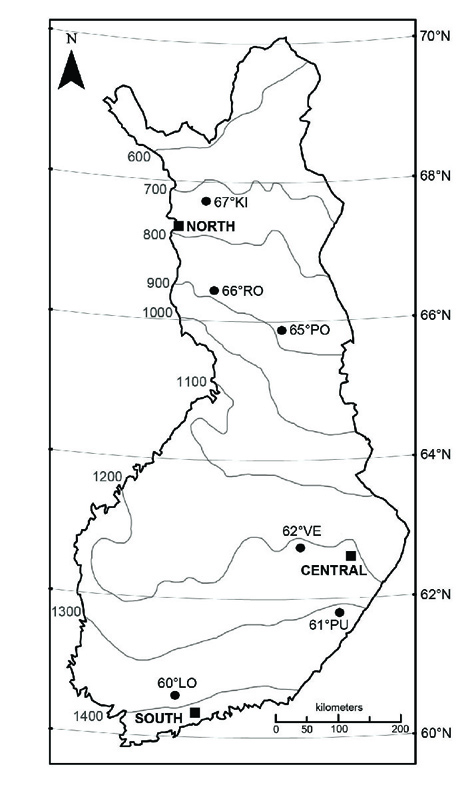
Herbivory may be changed by climate change and how does that affect the host plants? Find out in the Early View paper “Colonization of a host tree by herbivorous insects under a changing climate” by Kaisa Heimonen and co-workers. Below is their summary of the paper: Climate warming is predicted to increase the abundance of herbivorous insects due to increased survival, growth and multivoltinism. In addition, due to warming climate many insect species are predicted to shift their ranges to higher latitudes. Host plants are adapted to the present day herbivore pressure and insect communities but in the future the abundance of insects and the composition of herbivorous insect communities might change which can lead to more intense herbivore damage. We wanted to study the susceptibility of silver birch (Betula pendula Roth) populations from different latitudes to the insect herbivores that are expected to spread northwards in the future. To do this we established three common gardens with 26 genotypes of silver birch from six latitudinal populations in Finland ranging from 60°N to 67°N. The common gardens were located at three different latitudes 60°N, 62°N and 67°N. At each study site 260 silver birches were growing. This experimental setup is being used also for several other studies (see the project homepage: http://www.uef.fi/fi/birchadaption).

Figure 1. Map showing the three common garden sites (filled squares) and the six source populations (filled circles). Mean annual temperature isoclines are shown in grey.

Figure 1. Map showing the three common garden sites (filled squares) and the six source populations (filled circles). Mean annual temperature isoclines are shown in grey.

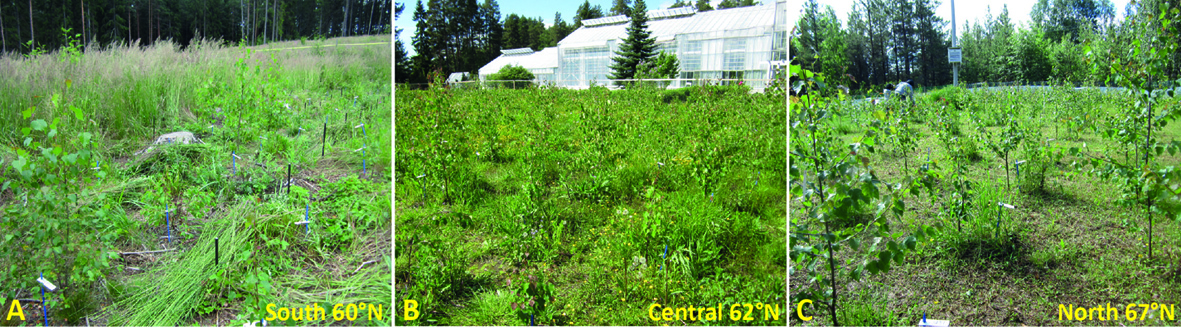
Figure 2. The three common garden sites in Finland where the study was conducted. A) Southern study site is located in Tuusula 60°N, B) Central study site is located in Joensuu 62°N and C) Northern study site is located in Kolari 67°N. Photo credits: Kaisa Heimonen.

Figure 2. The three common garden sites in Finland where the study was conducted. A) Southern study site is located in Tuusula 60°N, B) Central study site is located in Joensuu 62°N and C) Northern study site is located in Kolari 67°N. Photo credits: Kaisa Heimonen.

We wanted to study how the local insects at each of the common garden sites colonized the translocated birch genotypes. We asked if the insect herbivore density, species richness or community composition could be explained by the source population of the birch or by the direction or distance of the latitudinal translocation. The herbivore community on the study birches was examined during two growing seasons in 2011 and in 2012.

Figure 3. Kaisa Heimonen (lead author) observing the herbivorous insects on silver birch at the northern study site in 2012. Photo credits: Sari Kontunen-Soppela.

Figure 3. Kaisa Heimonen (lead author) observing the herbivorous insects on silver birch at the northern study site in 2012. Photo credits: Sari Kontunen-Soppela.

Herbivore density among the source populations differed in 2012 but not in 2011 and species richness was not affected by the source population. Latitudinal translocation could not explain the variation in the herbivore density or in the species richness. Community composition of the herbivores differed among the source populations at two of the three study sites and the similarity of the herbivore communities decreased with increasing latitudinal distance of the source populations.

Figure 4. Common insect species on silver birch belonging to the orders Lepidoptera, Coleoptera and Hymenoptera. A) White-shouldered smudge (Ypsolopha parenthesella), B) Birch leaf roller (Deporaus betulae) and C) Early birch leaf edgeminer (Fenusella nana). Photo credits: Kaisa Heimonen.

Figure 4. Common insect species on silver birch belonging to the orders Lepidoptera, Coleoptera and Hymenoptera. A) White-shouldered smudge (Ypsolopha parenthesella), B) Birch leaf roller (Deporaus betulae) and C) Early birch leaf edgeminer (Fenusella nana). Photo credits: Kaisa Heimonen.

Silver birch genotypes from source populations originating from closer geographical distance had more similar herbivore community composition at our experimental sites possibly because they are genetically more similar than the geographically more distant birch genotypes. All birch genotypes were colonized by some of the local herbivores at all three study sites suggesting that in the future herbivorous insects are able to colonize novel host plant genotypes. The results of this study show that compositional changes in the insect communities on their host plants are expected in the future. Newly structured herbivore communities might affect the herbivore damage and thereby also the plant growth.

Warmer world threatens wheat shortages Updated for 2026


Climate change threatens dramatic price fluctuations in the price of wheat and potential civil unrest because yields of one of the world’s most important staple foods are badly affected by temperature rise.

An international consortium of scientists have been testing wheat crops in laboratory and field trials in many areas of the world in changing climate conditions and discovered that yields drop on average by 6% for every one degree Celsius rise in temperature.

This represents 42 million tonnes of wheat lost – about a quarter of the current global wheat trade – for every degree. This would create serious shortages and cause price hikes of the kind that have previously caused food riots in developing countries after only one bad harvest.

Global production of wheat was 701 million tonnes in 2012, but most of this is consumed locally. Global trade is much smaller, at 147 tonnes in 2013.

Price hikes and food insecurity

If the predicted reduction of 42 million tonnes per 1˚C of temperature increase occurred, market shortages would cause price rises. Many developing countries, and the hungry poor within them, would not be able to afford wheat or bread.

Since temperatures – on current projections by the Intergovernmental Panel on Climate Change – are expected to rise up to 5˚C this century in many wheat-growing regions, this could be catastrophic for global food supply.

Dr. Reimund Rötter, professor of production ecology and agrosystems modelling at the Natural Resources Institute Finland, said that wheat yield declines were larger than previously thought.

He said: “Increased yield variability is critical economically as it could weaken regional and global stability in wheat grain supply and food security, amplifying market and price fluctuations, as experienced during recent years.”

One of the crucial problems is that there will be variability in supply from year to year, so the researchers systematically tested 30 different wheat crop models against field experiments in which growing season mean temperatures ranged from 15°C to 26°C.

Heat tolerant wheat strains are needed

The temperature impact on yield decline varied widely across field test conditions. In addition, year-to-year variability increased at some locations because of greater yield reductions in warmer years and lesser reductions in cooler years.

The scientists say that the way to adapt is to cultivate more heat-tolerant varieties, and so keep the harvest stable.

The results of the study – by scientists from the Finland, Germany, France, Denmark, Netherlands, Spain, United Kingdom, Colombia, Mexico, India, China, Australia, Canada and the United States – are published in Nature Climate Change.

Professor Martin Parry, who is leading the 20:20 Wheat Institute Strategic Programme at Rothamsted Research to increase wheat yields, commented:

“This is an excellent example of collaborative research, which will help ensure that we have the knowledge needed to develop the crops for the future environments.”


Paul Brown writes for Climate News Network.


389180

Climate sceptic Lord Ridley – Britain’s biggest carbon footprint? Updated for 2026


Lord Ridley is a powerhouse of climate denial in Britain – and a leading contender for the title of Britain’s biggest individual carbon polluter.

The self-styled Rational Optimist is an advisor to Lord Lawson’s secretly funded charity, the Global Warming Policy Foundation (GWPF), and acts as a one-man think tank to his brother-in-law, the sacked environment secretary Owen Paterson.

At the same time, the landed aristocrat will mine more than 10 million tonnes of coal from open cast mines scattered around his expansive Blagdon Estate in Northumberland during the next five years.

Miles King, a conservationist with almost 30 years of professional experience, has used publicly available information to estimate that the coal mined from Ridley’s estate will produce 28.6 million tonnes of CO2.

The government has estimated that the UK emitted a total of 570 million tonnes of CO2 or equivalent greenhouse gasses during 2013. This means Ridley’s mines will contribute an estimated 1% of the total annual emissions of a country of 60 million people.

Massive profit, in praise of coal

“I don’t know how much profit Ridley is making from his coal but it must be massive”, King writes on A New Nature Blog. “As the modern day King Coal, one might suggest Matt Ridley has an extremely large vested interest in stoking climate denial.”

Ridley declares an interest in coal when speaking in the House of Lords. He denies being a climate denier, and denies the charge of promoting the coal industry. He claims his arguments support gas rather than coal interests.

However, as King points out, Ridley has been known to defend coal. “It’s the fashion these days to vilify coal as the root of all environmental evil, but I think that’s mistaken”, Ridley writes on his own blog.

“Coal and the technologies it spawned made it possible to double human lifespan, end famine, provide electric light and spare forests for nature.

“Because we get coal out of the ground, we do not have to cut down forests; because we use petroleum we don’t have to kill whales for their oil; because we use gas to make fertilizer we don’t have to cultivate so much land to feed the world.

“This country can compete with China on the basis of either cheap labour or cheap energy. I know which I’d prefer.”

Matt Ridley was also the chairman of the Northern Rock bank from 2004 until its collapse in 2007, after which it was nationalised. In 2013 he was elected as hereditary peer in the House of Lords as a member of the Conservative Party.

Financial benefit unknown – estimated at £13m / year

King’s investigation into Ridley’s carbon footprint was inspired by reports launched by DeSmog UK just before the New Year where we claimed that the mines around the aristocrat’s estate would yield a further £13m a year due to recent planning approvals.

Ridley has so far refused to confirm the exact amount of money he is making from the coal under his family’s land, citing commercial confidentiality. “I receive no financial benefit other than a wayleave in exchange for providing access to the land”, he told DeSmog UK.

The Ridley mines are operated by family firm Banks Mining. The coal under the ground is still owned by the British government following nationalisation in 1947, although the Coal Authority charges very little for the extraction and sale of our most valuable and dangerous resource.

Yet, soon Ridley, his miners and the government could be mandated to reveal exactly how much in profits is being made by the Blagdon mines, how much is paid in taxation, and the amount in fees going to the Coal Authority.

The controversial Infrastructure Bill currently going through Parliament will, if passed, make the Extractive Industries Transparency Initiative (EITI) legally binding.

According to the government, “EITI is a global standard ensuring openness and accountability in the management of revenue from natural resources including coal, oil, natural gas, quarrying and mining.”

Unburnable coal

The transparency initiative was launched by campaigners concerned about the relationship between major oil companies and corrupt governments around the world.

They believe transparency will allow citizens to fully appreciate how national resources are being sold cheaply by their political elites.

But Britain’s support for this initiative could have serious implications for Ridley, when local residents find out exactly how much is being made in profits from the coal on his estate and can test the veracity of his claim to only receive a negligible amount in fees.

A study by academics at University College London (UCL) published in Nature confirms that 80% of the world’s coal is ‘unburnable’ if there is to be any hope of keeping climate change to less than two degrees – and averting catastrophe.

Dr Christophe McGlade, from the UCL Institute for Sustainable Resources, said: “Policymakers must realise that their instincts to completely use the fossil fuels within their countries are wholly incompatible with their commitments to the 2C goal.”


Brendan Montague writes for DeSmogUK. Follow him on Twitter @Brendanmontague.

This article was originally published on DeSmogUK.


388952

2015 – the fossil fuel endgame begins Updated for 2026


2014 was the hottest year on record. It was also the year, the industry that’s driving the warming came under unprecedented fire. As temperatures rise, so does the climate movement!

At the climate talks in Lima in December, politicians were for the first time talking about a goal to phase out carbon emissions by mid-century. That would mean the end of the fossil fuel industry as we know it.

2015 is going to be critical for the climate. At the end of the year, world leaders will gather in Paris to attempt once again to secure a global climate deal.

Given their track record, they will not act in accordance with the urgency of the climate crisis while the fossil fuel industry holds the balance of power. Therefore, the climate movement will turn up the heat to erode the industry’s might.

Already, people all over are gearing up to confront dirty energy projects, demand solutions and build pressure on decision makers. A key effort that has helped to build renewed momentum on climate change last year is the fossil fuel divestment campaign.

Removing the fossil fuel industry’s social license to operate

For decades, fossil fuel companies have successfully blocked political action on climate change. These companies have five times more carbon in their reserves than can be burnt to stay below the politically agreed 2 degrees global warming.

In other words, 80% of their current reserves are unburnable. For Europe, this translates into 89% of coal, 21% of oil, and 6% of gas reserves, according to a study published in the scientific journal Nature last week. Yet, fossil fuel companies spend billions every year to discover and develop yet more carbon.

Every institution that stops funding fossil fuel companies, is taking an active step towards removing the industry’s social acceptance and consequently its political influence. It is therefore not just actual divestment wins, the campaign aims to elevate the public debate leading to a change in social norms.

In 2014, the number of institutional divestment commitments more than doubled. High-ranking figures such as former archbishop Desmond Tutu, UN Secretary General Ban Ki-moon and World Bank president Jim Yong Kim got behind the campaign.

It is hard to believe that the divestment campaign kicked off only just over a year ago in Europe. Since then campaigns urging local authorities, universities, religious and other institutions have popped up at a dizzying pace, adding up to 94 active campaigns throughout the continent.

The European movement has already celebrated a number of big wins. The University of Glasgow has become the first academic institution in Europe to ditch its fossil fuel holdings. Boxtel in the Netherlands and Örebro in Sweden are the first local authorities on the continent to divest.

The Quakers in Britain and the Church of Sweden were among the first faith-based organisations to lead the way, and the British Medical Association has become the first medical organisation in the world to ban investments in fossil fuels.

Making fossil fuels history

Besides the rapid pace with which the divestment movement is spreading, it is its breadth and diversity that lend it its power. Diversity is essential to achieving social change.

What started with student campaigns at US college campuses, now encompasses a large variety of different groups of people. It is a movement of citizens who do not want their pension money invested in companies whose business model is based on undermining the very future their pension is meant to safeguard.

It is doctors who are concerned about the health impacts of climate change. It is people of faith who believe in our moral obligation to care for creation. It is academics demanding their institution’s finances stop undermining its mission.

It is concerned citizens from all walks of life who believe in climate justice, the stewardship role public institutions should play and in doing what’s right.

This first year has only been the start of the divestment movement in Europe. The year ahead already holds big promises as campaigns build their power to confront the power of the fossil fuel industry. The movement is also gaining strength globally. The first divestment campaigns have started in South Africa and the Pacific Islands.

On 13-14 February, the global movement is going to show its collective force. On Global Divestment Day, thousands of people everywhere will turn out to demand institutions do what is necessary for climate action by divesting from fossil fuels.

Local authorities will come under pressure to walk their talk on climate. New campaigns will be launched. University students will hold flash-mobs, vigils, sit-ins and rallies calling upon their endowments to invest in a liveable future.

Faith leaders and people living on the frontline of climate change will band together to urge their communities to divest from climate destruction. Individuals will close their accounts with banks investing in climate chaos.

Fossil fight-back goes into a tailspin

Of course the fossil fuel industry and its backers have also started to fight back fiercely, dismissing the movement and attacking divestment decisions.

Maybe it’s just coincidence – but big fossil’s attempt to dictate the terms of the debate comes at a time when large parts of the energy industry are in deep trouble owing to low energy prices, with oil sinking below $50 a barrel, and gas fast following suit.

High-cost ‘unconventional’ oil and gas – from shale fracking, tar sands, the Arctic and deep water marine wells – is already a loss-making proposition. One small Texas shale oil company went bust only last week. Many more will surely follow.

Of course prices could rise again – but the current financial bloodbath that has overtaken fossil fuels will permanently spook investors, who will no longer see fossil fuel investments as a reliable cash cow, but as a hazardous proposition fraught with financial risk.

As the fossil fuel industry throws more money at fossil fuel expansion, the divestment movement too is turning up the volume.

And now, history is on our side. Investors are turning away from fossil fuels in droves as fear of loss overtakes greed for profit, and as the ‘unburnable carbon’ meme hits home with a resounding slam that will reverberate through 2015, and beyond.


Melanie Mattauch is 350.org Europe Communications Coordinator. 350.org is building a global climate movement and initiated the Fossil Free campaign.

Action: Global Divestment Day, 13th-14th February.


388839

I’ll talk politics with climate change deniers – but not science Updated for 2026


There are many complex reasons why people decide not to accept the science of climate change. The doubters range from the conspiracy theorist to the sceptical scientist, or from the paid lobbyist to the raving lunatic.

Climate scientists, myself included, and other academics have strived to understand this reluctance. We wonder why so many people are unable to accept a seemingly straight-forward pollution problem.

And we struggle to see why climate change debates have inspired such vitriol.

These questions are important. In a world increasingly dominated by science and technology, it is essential to understand why people accept certain types of science but not others.

In short, it seems when it comes to climate change, it is not about the science but all about the politics.

Risky business

Back in the late 1980s and early 1990s differing views on climate science were put down to how people viewed nature: was it benign or malevolent? In 1995 leading risk expert John Adams suggested there were four myths of nature, which he represented as a ball on different shaped landscapes.

  1. Nature is benign and forgiving of any insults that humankind might inflict upon it and it does not need to be managed.
  2. Nature ephemeral. Nature is fragile, precarious, and unforgiving and environmental management must protect nature from humans.
  3. Nature perverse/tolerant. Within limits, nature can be relied upon to behave predictably and regulation is required to prevent major excesses.
  4. Nature capricious. Nature is unpredictable and there is no point to management.

Different personality types can be matched on to these different views, producing very different opinions about the environment. Climate change deniers would map on to number one, Greenpeace number two, while most scientists would be number three. These views are influenced by an individual’s own belief system, personal agenda (either financial or political), or whatever is expedient to believe at the time.

However, this work on risk perception was ignored by mainstream science because science up to now operates on what is called the knowledge deficit model. This suggests that people do not accept the science because there is not enough evidence; therefore more needs to be gathered.

Scientists operate in exactly this way, and they assume wrongly the rest of the world is equally rational and logical. It explains why over the past 35 years a huge amount of work gone into investigating climate change.

However – despite many thousands of pages of IPCC reports – the weight of evidence argument does not seem to work with everyone.

No understanding of science?

At first failure of the knowledge deficit model was blamed on the fact that people simply did not understand science, perhaps due to a lack of education.

This was exacerbated as scientists from the late 1990s onwards started to be drawn into discussions about whether people believed or did not believe in climate change.

The use of the word ‘belief’ is important here, as it was a direct jump from the American-led argument between the science of evolution and the belief in creation.

But we know that science is not a belief system. You cannot decide that you believe in penicillin or the principles of flight while at the same time disbelieve humans evolved from apes or that greenhouse gases can cause climate change.

This is because science is an expert trust-based system that is underpinned by rational methodology that moves forward by using detailed observation and experimentation to constantly test ideas and theories.

It does not provide us with convenient yes/no answers to complex scientific questions, however much the media portrayal of scientific evidence would like the general public to ‘believe’ this to be true.

It’s all about the politics

However, many who deny climate change is an issue are extremely intelligent, eloquent and rational. They would not see the debate as one about belief and they would see themselves above the influence of the media.

So if the lack of acceptance of the science of climate change is neither due to a lack of knowledge, nor due to a misunderstanding of science, what is causing it?

Recent work has refocused on understanding people’s perceptions and how they are shared, and as climate denial authority George Marshall suggests these ideas can take on a life of their own, leaving the individual behind.

Colleagues at Yale University developed this further by using the views of nature shown above to define different groups of people and their views on climate change. They found that political views are the main predictor of the acceptance of climate change as a real phenomenon.

This is because climate change challenges the Anglo-American neoliberal view that is held so dear by mainstream economists and politicians. Climate change is a massive pollution issue that shows the markets have failed and it requires governments to act collectively to regulate industry and business.

In stark contrast neoliberalism is about free markets, minimal state intervention, strong property rights and individualism. It also purports to provide a market-based solution via ‘trickle down’ enabling everyone to become wealthier.

But calculations suggest to bring the incomes of the very poorest people in the world up to just $1.25 per day would require at least a 15 times increase in global GDP. This means huge increases in consumption, resource use and of course, carbon emissions.

It’s easier to deny climate change, than to deny our own ideologies

So in many cases the discussion of the science of climate change has nothing to do with the science and is all about the political views of the objectors. Many perceive climate change as a challenge to the very theories that have dominated global economics for the last 35 years, and the lifestyles that it has provided in developed, Anglophone countries.

Hence, is it any wonder that many people prefer climate change denial to having to face the prospect of building a new political (and socio-economic) system, which allows collective action and greater equality?

I am well aware of the abuse I will receive because of this article. But it is essential for people, including scientists, to recognise that it is the politics and not the science that drives many people to deny climate change.

This does mean, however, that no amount of discussing the ‘weight of scientific evidence’ for climate change will ever change the views of those who are politically or ideologically motivated.

Hence I am very sorry – but I will not be responding to comments posted concerning the science of climate change but I am happy to engage in discussion on the motivations of denial.


Mark Maslin is Professor of Climatology at University College London.

This article was originally published on The Conversation. Read the original article.

The Conversation


388305

I’ll talk politics with climate change deniers – but not science Updated for 2026


There are many complex reasons why people decide not to accept the science of climate change. The doubters range from the conspiracy theorist to the sceptical scientist, or from the paid lobbyist to the raving lunatic.

Climate scientists, myself included, and other academics have strived to understand this reluctance. We wonder why so many people are unable to accept a seemingly straight-forward pollution problem.

And we struggle to see why climate change debates have inspired such vitriol.

These questions are important. In a world increasingly dominated by science and technology, it is essential to understand why people accept certain types of science but not others.

In short, it seems when it comes to climate change, it is not about the science but all about the politics.

Risky business

Back in the late 1980s and early 1990s differing views on climate science were put down to how people viewed nature: was it benign or malevolent? In 1995 leading risk expert John Adams suggested there were four myths of nature, which he represented as a ball on different shaped landscapes.

  1. Nature is benign and forgiving of any insults that humankind might inflict upon it and it does not need to be managed.
  2. Nature ephemeral. Nature is fragile, precarious, and unforgiving and environmental management must protect nature from humans.
  3. Nature perverse/tolerant. Within limits, nature can be relied upon to behave predictably and regulation is required to prevent major excesses.
  4. Nature capricious. Nature is unpredictable and there is no point to management.

Different personality types can be matched on to these different views, producing very different opinions about the environment. Climate change deniers would map on to number one, Greenpeace number two, while most scientists would be number three. These views are influenced by an individual’s own belief system, personal agenda (either financial or political), or whatever is expedient to believe at the time.

However, this work on risk perception was ignored by mainstream science because science up to now operates on what is called the knowledge deficit model. This suggests that people do not accept the science because there is not enough evidence; therefore more needs to be gathered.

Scientists operate in exactly this way, and they assume wrongly the rest of the world is equally rational and logical. It explains why over the past 35 years a huge amount of work gone into investigating climate change.

However – despite many thousands of pages of IPCC reports – the weight of evidence argument does not seem to work with everyone.

No understanding of science?

At first failure of the knowledge deficit model was blamed on the fact that people simply did not understand science, perhaps due to a lack of education.

This was exacerbated as scientists from the late 1990s onwards started to be drawn into discussions about whether people believed or did not believe in climate change.

The use of the word ‘belief’ is important here, as it was a direct jump from the American-led argument between the science of evolution and the belief in creation.

But we know that science is not a belief system. You cannot decide that you believe in penicillin or the principles of flight while at the same time disbelieve humans evolved from apes or that greenhouse gases can cause climate change.

This is because science is an expert trust-based system that is underpinned by rational methodology that moves forward by using detailed observation and experimentation to constantly test ideas and theories.

It does not provide us with convenient yes/no answers to complex scientific questions, however much the media portrayal of scientific evidence would like the general public to ‘believe’ this to be true.

It’s all about the politics

However, many who deny climate change is an issue are extremely intelligent, eloquent and rational. They would not see the debate as one about belief and they would see themselves above the influence of the media.

So if the lack of acceptance of the science of climate change is neither due to a lack of knowledge, nor due to a misunderstanding of science, what is causing it?

Recent work has refocused on understanding people’s perceptions and how they are shared, and as climate denial authority George Marshall suggests these ideas can take on a life of their own, leaving the individual behind.

Colleagues at Yale University developed this further by using the views of nature shown above to define different groups of people and their views on climate change. They found that political views are the main predictor of the acceptance of climate change as a real phenomenon.

This is because climate change challenges the Anglo-American neoliberal view that is held so dear by mainstream economists and politicians. Climate change is a massive pollution issue that shows the markets have failed and it requires governments to act collectively to regulate industry and business.

In stark contrast neoliberalism is about free markets, minimal state intervention, strong property rights and individualism. It also purports to provide a market-based solution via ‘trickle down’ enabling everyone to become wealthier.

But calculations suggest to bring the incomes of the very poorest people in the world up to just $1.25 per day would require at least a 15 times increase in global GDP. This means huge increases in consumption, resource use and of course, carbon emissions.

It’s easier to deny climate change, than to deny our own ideologies

So in many cases the discussion of the science of climate change has nothing to do with the science and is all about the political views of the objectors. Many perceive climate change as a challenge to the very theories that have dominated global economics for the last 35 years, and the lifestyles that it has provided in developed, Anglophone countries.

Hence, is it any wonder that many people prefer climate change denial to having to face the prospect of building a new political (and socio-economic) system, which allows collective action and greater equality?

I am well aware of the abuse I will receive because of this article. But it is essential for people, including scientists, to recognise that it is the politics and not the science that drives many people to deny climate change.

This does mean, however, that no amount of discussing the ‘weight of scientific evidence’ for climate change will ever change the views of those who are politically or ideologically motivated.

Hence I am very sorry – but I will not be responding to comments posted concerning the science of climate change but I am happy to engage in discussion on the motivations of denial.


Mark Maslin is Professor of Climatology at University College London.

This article was originally published on The Conversation. Read the original article.

The Conversation


388305

Rich nations must cough up for past carbon pollution Updated for 2026


Two weeks of international climate negotiations in Lima, Peru, are over, with an agreement pulled out of the bag at the eleventh hour.

While Lima has been seen by many as a mere curtain-raiser to talks in Paris in a year’s time, when a new deal needs to reached to replace the Kyoto Protocol, it will have an impact beyond this.

Lima has reinforced the familiar battle ground between the developed and developing world, and it has seen the re-emergence of a key concept: climate justice.

The idea of equity is at the heart of this – the question of how to ensure any UN-backed emissions deal is fair and that those countries that caused the problem do the most to clean it up. This had largely been ignored at previous summits but at Lima it was once again a big talking point.

2011: the US’s big ‘No’ to equity

“If equity is in, we are out.” Those were the reported words of Todd Stern, the US chief negotiator, on the eve of the last day of Durban talks back in 2011, when the foundations for a new global agreement were laid.

Stern was reacting to the clamour from developing countries that rich, developed nations should take the lead in making emission cuts under the principle of ‘common but differentiated responsibility and capability‘, given their historical responsibility for climate change and their enhanced technological capabilities.

While some observers were alarmed by Stern’s position, his words were a fair, if vulgar, rendition of the mind-set that is quite pervasive among many developed countries.

Rich nations tend to prefer to wave aside or at least make light their moral responsibility to tackle climate change, while appealing for concerted action by ‘all parties‘.

Pragmatism, realism, and ‘we are in this together’ are some of the phrases used by developed countries as they try to duck their responsibility and cajole developing nations to instead step up their own climate actions.

It was to this effect that many Western countries lined up behind the US in Durban. Eventually all references to equity, justice and common but differentiated responsibility were expunged from the text.

Lima – justice and transparency return

It was a short-lived victory. Events in Lima over the past two weeks have overwhelmingly demonstrated the utter futility of developed countries’ schemes to diminish issues of equity and justice, let alone sidestep them altogether.

In virtually all the key issues and categories under discussion – countries’ mitigation contributions, states’ adaptation commitments, the remit of the loss and damage, and climate finance, among others – equity and differentiation have stood out as sticking points.

For example, the G77 group of developing countries said that the principle of equity must guide all negotiations and long-term actions. Showing their heightened distrust in the progress, developing countries even requested that texts should be displayed on the big screen in real time while negotiating to enhance transparency.

The harshest word for developed countries, however, came from Bolivian president Evo Morales, who referred to industrialised nations that have appropriated more than their own fair share of global atmospheric space as thieves that must be made to pay back what they have stolen.

Without a moral dimension, there can be no climate agreement

Of course, none of this implies that developing countries should be given an easy ride in negotiating the 2015 climate agreement, or that there are easy approaches to finding a ‘just’ climate agreement.

Climate justice is a deeply contested concept, open to multiple interpretations, recommending diverse and sometimes conflicting policy. For example, there are plausible justice-based arguments for allocating carbon emissions quota on individual (per capita) and on national (per country) basis.

However it appears that the Stern approach to international climate politics, seemingly without morality, is beginning to lose ground. If Lima has taught us anything, it is that humanity badly needs a dose of international respect if we are to avoid climate chaos.

The brazen scheme to expunge equity from previous climate agreements by the US and its backers only served to further erode the mutual trust sorely needed to make compromises.

Morality might be a dirty word in some states’ foreign policy handbooks. But call it what you like, the world needs to find its guiding principles quickly, and developing countries want rich nations to pay for what they’ve broken.


Chukwumerije Okereke is Associate Professor of Environment and Development at the University of Reading.

This article was originally published on The Conversation. Read the original article.

The Conversation


388217