Tag Archives: change

Fracking, the oil price crash, and the ‘greenest government ever’ Updated for 2026


This month, a powerful article in Nature highlighted yet again that most of the world’s oil, coal and gas needs to stay in the ground, if we want to prevent dangerous climate change.

This is the ‘unburnable carbon’ analysis that President Obama and Bank of England Governor Mark Carney have both made mainstream in recent months.

Related, over the last 6 months the world oil price has crashed, catching almost all economists and analysts by surprise. As well as profound economic effects, this crash affects ‘unburnable carbon’ in two broad and opposite ways.

It’s leading to cancellations of potential fossil fuel projects, as they become less or non-profitable. Great for stopping colossally dirty projects like Arctic oil and Canadian tar sands. And in the opposite direction, it makes oil cheaper, meaning people use it more. Bad for climate, though good for people’s pockets.

How should Governments react to this? A Government who genuinely thought climate change was a global priority would not sit passively by and let these conflicting effects of the oil price crash on climate sweep over us. It would act. Government surveys show the British public want more action on climate change.

Instead, we’re going all out for oil and fracking

Despite this, the sole response to the oil price crash from the UK Government is do the opposite! It announced detailed plans for tax cuts for oil companies to drill another 11-21 billion barrels of oil from the ground – way more than even the three billion barrels in the Government’s Wood Review on offshore oil and gas. Climate change impacts got one sentence of dismissal.

Then last week, it drove through a clause in the Infrastructure Bill – with almost no debate – requiring the UK to “maximise economic recovery” of North Sea oil.

These are crystal-clear examples of how Governments do not yet grasp that climate change requires a comprehensive plan. We can’t just do a little bit on renewable energy and energy efficiency, and think that this means we don’t need to do anything about fossil fuels.

And yet, for every announcement of a new wind-farm, or homes insulated, or rail investment, there is a corresponding – and often larger – Government announcement which makes climate change worse.

For example: £15 billion for new roads; whopping cuts in taxes on profits for North Sea oil drillers; consultations on which new airport to open; tax breaks for new fracking industries. High-carbon infrastructure has recently over-taken low-carbon infrastructure in the Government’s ‘infrastructure pipeline’.

After decades of subsidy, high-carbon industry shouldn’t need any more help. Colossally rich oil corporations know the global oil price yo-yos – they should have saved for this moment in the years when oil prices were over $100 a barrel and their profits were sky-high. But like the banks, they want their bail-out, and they know they will get it.

It’s shameful – that we have leaders who say climate change is desperately urgent, who call for more ambition, and yet who are still so deep in the pockets of fossil fuel companies they will not act and treat climate change as the emergency it is.

They are up-front about it too – the Government’s North Sea oil tax cut consultation is clear on three things – it’s derived in discussion with the oil barons; it’s being fast-tracked at their request; and the consultation primarily wants to hear from them.

Leaked letter shows the real agenda

They’re also not so up-front about it – you can see just how deeply the fracking industry is embedded in Government in this leaked-letter from George Osborne here.

The letter was from George Osborne, sent last September, to colleagues in the Cabinet’s Economic Affairs Committee, setting out how he wanted them to prioritise implementing the recommendations of a Cabinet Office report on how to get the shale gas industry going.

Of real interest here are the agreed plans between Government and fracking company Cuadrilla if their planning permission for fracking is turned down – which is exactly what Lancashire’s planners have recommended councillors to do.

According to the letter It is agreed that “if permission turned down … Cuadrilla to respond to concerns and appeal asap.” When that has happened, the Government will “Prepare PINS to respond promptly to appeal or SoS recovery if appropriate.”

In layperson’s terms, that means the Government will make sure the Planning Inspectorate fast-tracks the appeal or that Communities Secretary Eric Pickles intervenes. This stands in stark contrast to the line taken by the Prime Minister’s official spokesman that such decisions should be up to local authorities.

And how were these ‘asks’ made? Has Cuadrilla been meeting Ministers and officials, or has it been a few quiet words in the right ears? For let’s not forget that Cuadrilla’s chairman Lord Browne works in the Cabinet Office as a Non-Executive Director.

Moving to ‘full exploration’

The letter is also very revealing about longer-term plans for “moving to full exploration”. The Government clearly knows it’s losing the argument at the local level. Two recommendations stand out here:

  • “A cross-Government and industry group should be established … to assess the value and viability of focusing on a small number of sites in less contentious locations.”
  • “Public sector land (particularly MoD owned) should be mapped to potential sites and explored for possible concept testing.”

And the Government seems to accept that the bribes – sorry, benefits – it is offering top local communities to accept fracking aren’t working. The solution: it looks like offer them more. They plan to: “examine the nature of benefits to be offered to local communities where shale developments take place.”

They know they’re not winning the wider battle for hearts and minds either, so the Government is going to carry on doing the industry’s PR job and “build on existing network of neutral academic experts available to provide credible evidence-based views of matters of public concern”, and “develop a national communications plan on shale exploration.”

This isn’t the first evidence of collusion. Lord Browne has already intervened with the then chair of the Environment Agency, Lord Smith, to try to exempt Cuadrilla from compliance with drilling waste regulations.

On another occasion, after a separate personal intervention by Lord Browne, Lord Smith “offered to halve the consultation time for a waste permit”, and “agreed to intervene with a county council over Cuadrilla’s planning permission and to identify further risks to Cuadrilla’s plans.”

Here’s how the government should be acting!

Instead of colluding with the fossil fuel industry to increase production, a Government genuinely committed to action on climate change would treat the oil price crash as an opportunity to protect the climate, help consumers and protect jobs. It would say:

  • We need a ‘just transition’ plan to get jobs and growth and industry out of North Sea Oil, and into North Sea Renewables like off-shore wind. There will be no economic devastation as when the coal mines closed. But we need to move away from oil, not prop it up. We will do all we can to help people and businesses build new, clean industries in the North Sea.
  • We will put in place a plan to keep demand for oil low, to help keep prices low, and ensure undrilled oil stays in the ground. We’ll put in place a proper strategy to make public transport, walking and cycling decent alternatives to motoring. We’ll drive far stronger standards on car and lorry energy efficiency. We’ll invest in a national electric vehicle network. We’ll act at EU and International level to persuade our fellow nations to do the same.
  • We will make sure the oil and gas price falls don’t damage the growing renewables industry. We’ll reassure investors by setting a clear 2030 power decarbonisation target, with policies to ensure we meet it.
  • We will reverse our fossil-fuel strategy to “maximise recovery” and focus instead on ‘minimising demand’ – in every part of the economy.
  • We will treat climate change as an emergency, and make tackling it a priority across all departments of Government.

People want more action from Government on climate change. Not less. Not a botched half-plan, and half-truths about their commitment to action.

The inadequate, partial, feeble responses on climate change are yet another expression of why so many people feel alienated from Westminster governments – they do not act on their promises, or sufficiently in the public interest.

It’s election time soon. Which parties will put people’s interests ahead of propping up fossil fuel companies, and put in place a proper plan to tackle climate change?

In short, who will step up and show they are a party worth voting for?


More information on the impact of the oil price crash on climate change: Friends of the Earth briefing.

Simon Bullock is Senior Campaigner, Policy and Research Co-ordinator for Friends of the Earth UK.

Tony Bosworth is Energy Campaigner at Friends of the Earth UK.

This article is a synthesis of two articles published on the Friends of the Earth Policy & Politics blog:


389768

Fracking, the oil price crash, and the ‘greenest government ever’ Updated for 2026


This month, a powerful article in Nature highlighted yet again that most of the world’s oil, coal and gas needs to stay in the ground, if we want to prevent dangerous climate change.

This is the ‘unburnable carbon’ analysis that President Obama and Bank of England Governor Mark Carney have both made mainstream in recent months.

Related, over the last 6 months the world oil price has crashed, catching almost all economists and analysts by surprise. As well as profound economic effects, this crash affects ‘unburnable carbon’ in two broad and opposite ways.

It’s leading to cancellations of potential fossil fuel projects, as they become less or non-profitable. Great for stopping colossally dirty projects like Arctic oil and Canadian tar sands. And in the opposite direction, it makes oil cheaper, meaning people use it more. Bad for climate, though good for people’s pockets.

How should Governments react to this? A Government who genuinely thought climate change was a global priority would not sit passively by and let these conflicting effects of the oil price crash on climate sweep over us. It would act. Government surveys show the British public want more action on climate change.

Instead, we’re going all out for oil and fracking

Despite this, the sole response to the oil price crash from the UK Government is do the opposite! It announced detailed plans for tax cuts for oil companies to drill another 11-21 billion barrels of oil from the ground – way more than even the three billion barrels in the Government’s Wood Review on offshore oil and gas. Climate change impacts got one sentence of dismissal.

Then last week, it drove through a clause in the Infrastructure Bill – with almost no debate – requiring the UK to “maximise economic recovery” of North Sea oil.

These are crystal-clear examples of how Governments do not yet grasp that climate change requires a comprehensive plan. We can’t just do a little bit on renewable energy and energy efficiency, and think that this means we don’t need to do anything about fossil fuels.

And yet, for every announcement of a new wind-farm, or homes insulated, or rail investment, there is a corresponding – and often larger – Government announcement which makes climate change worse.

For example: £15 billion for new roads; whopping cuts in taxes on profits for North Sea oil drillers; consultations on which new airport to open; tax breaks for new fracking industries. High-carbon infrastructure has recently over-taken low-carbon infrastructure in the Government’s ‘infrastructure pipeline’.

After decades of subsidy, high-carbon industry shouldn’t need any more help. Colossally rich oil corporations know the global oil price yo-yos – they should have saved for this moment in the years when oil prices were over $100 a barrel and their profits were sky-high. But like the banks, they want their bail-out, and they know they will get it.

It’s shameful – that we have leaders who say climate change is desperately urgent, who call for more ambition, and yet who are still so deep in the pockets of fossil fuel companies they will not act and treat climate change as the emergency it is.

They are up-front about it too – the Government’s North Sea oil tax cut consultation is clear on three things – it’s derived in discussion with the oil barons; it’s being fast-tracked at their request; and the consultation primarily wants to hear from them.

Leaked letter shows the real agenda

They’re also not so up-front about it – you can see just how deeply the fracking industry is embedded in Government in this leaked-letter from George Osborne here.

The letter was from George Osborne, sent last September, to colleagues in the Cabinet’s Economic Affairs Committee, setting out how he wanted them to prioritise implementing the recommendations of a Cabinet Office report on how to get the shale gas industry going.

Of real interest here are the agreed plans between Government and fracking company Cuadrilla if their planning permission for fracking is turned down – which is exactly what Lancashire’s planners have recommended councillors to do.

According to the letter It is agreed that “if permission turned down … Cuadrilla to respond to concerns and appeal asap.” When that has happened, the Government will “Prepare PINS to respond promptly to appeal or SoS recovery if appropriate.”

In layperson’s terms, that means the Government will make sure the Planning Inspectorate fast-tracks the appeal or that Communities Secretary Eric Pickles intervenes. This stands in stark contrast to the line taken by the Prime Minister’s official spokesman that such decisions should be up to local authorities.

And how were these ‘asks’ made? Has Cuadrilla been meeting Ministers and officials, or has it been a few quiet words in the right ears? For let’s not forget that Cuadrilla’s chairman Lord Browne works in the Cabinet Office as a Non-Executive Director.

Moving to ‘full exploration’

The letter is also very revealing about longer-term plans for “moving to full exploration”. The Government clearly knows it’s losing the argument at the local level. Two recommendations stand out here:

  • “A cross-Government and industry group should be established … to assess the value and viability of focusing on a small number of sites in less contentious locations.”
  • “Public sector land (particularly MoD owned) should be mapped to potential sites and explored for possible concept testing.”

And the Government seems to accept that the bribes – sorry, benefits – it is offering top local communities to accept fracking aren’t working. The solution: it looks like offer them more. They plan to: “examine the nature of benefits to be offered to local communities where shale developments take place.”

They know they’re not winning the wider battle for hearts and minds either, so the Government is going to carry on doing the industry’s PR job and “build on existing network of neutral academic experts available to provide credible evidence-based views of matters of public concern”, and “develop a national communications plan on shale exploration.”

This isn’t the first evidence of collusion. Lord Browne has already intervened with the then chair of the Environment Agency, Lord Smith, to try to exempt Cuadrilla from compliance with drilling waste regulations.

On another occasion, after a separate personal intervention by Lord Browne, Lord Smith “offered to halve the consultation time for a waste permit”, and “agreed to intervene with a county council over Cuadrilla’s planning permission and to identify further risks to Cuadrilla’s plans.”

Here’s how the government should be acting!

Instead of colluding with the fossil fuel industry to increase production, a Government genuinely committed to action on climate change would treat the oil price crash as an opportunity to protect the climate, help consumers and protect jobs. It would say:

  • We need a ‘just transition’ plan to get jobs and growth and industry out of North Sea Oil, and into North Sea Renewables like off-shore wind. There will be no economic devastation as when the coal mines closed. But we need to move away from oil, not prop it up. We will do all we can to help people and businesses build new, clean industries in the North Sea.
  • We will put in place a plan to keep demand for oil low, to help keep prices low, and ensure undrilled oil stays in the ground. We’ll put in place a proper strategy to make public transport, walking and cycling decent alternatives to motoring. We’ll drive far stronger standards on car and lorry energy efficiency. We’ll invest in a national electric vehicle network. We’ll act at EU and International level to persuade our fellow nations to do the same.
  • We will make sure the oil and gas price falls don’t damage the growing renewables industry. We’ll reassure investors by setting a clear 2030 power decarbonisation target, with policies to ensure we meet it.
  • We will reverse our fossil-fuel strategy to “maximise recovery” and focus instead on ‘minimising demand’ – in every part of the economy.
  • We will treat climate change as an emergency, and make tackling it a priority across all departments of Government.

People want more action from Government on climate change. Not less. Not a botched half-plan, and half-truths about their commitment to action.

The inadequate, partial, feeble responses on climate change are yet another expression of why so many people feel alienated from Westminster governments – they do not act on their promises, or sufficiently in the public interest.

It’s election time soon. Which parties will put people’s interests ahead of propping up fossil fuel companies, and put in place a proper plan to tackle climate change?

In short, who will step up and show they are a party worth voting for?


More information on the impact of the oil price crash on climate change: Friends of the Earth briefing.

Simon Bullock is Senior Campaigner, Policy and Research Co-ordinator for Friends of the Earth UK.

Tony Bosworth is Energy Campaigner at Friends of the Earth UK.

This article is a synthesis of two articles published on the Friends of the Earth Policy & Politics blog:


389768

Herbivory effects of climate change Updated for 2026

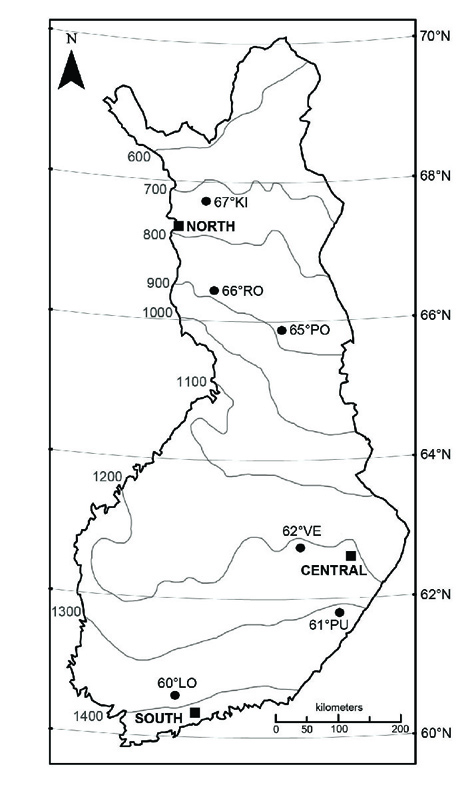
Herbivory may be changed by climate change and how does that affect the host plants? Find out in the Early View paper “Colonization of a host tree by herbivorous insects under a changing climate” by Kaisa Heimonen and co-workers. Below is their summary of the paper: Climate warming is predicted to increase the abundance of herbivorous insects due to increased survival, growth and multivoltinism. In addition, due to warming climate many insect species are predicted to shift their ranges to higher latitudes. Host plants are adapted to the present day herbivore pressure and insect communities but in the future the abundance of insects and the composition of herbivorous insect communities might change which can lead to more intense herbivore damage. We wanted to study the susceptibility of silver birch (Betula pendula Roth) populations from different latitudes to the insect herbivores that are expected to spread northwards in the future. To do this we established three common gardens with 26 genotypes of silver birch from six latitudinal populations in Finland ranging from 60°N to 67°N. The common gardens were located at three different latitudes 60°N, 62°N and 67°N. At each study site 260 silver birches were growing. This experimental setup is being used also for several other studies (see the project homepage: http://www.uef.fi/fi/birchadaption).

Figure 1. Map showing the three common garden sites (filled squares) and the six source populations (filled circles). Mean annual temperature isoclines are shown in grey.

Figure 1. Map showing the three common garden sites (filled squares) and the six source populations (filled circles). Mean annual temperature isoclines are shown in grey.

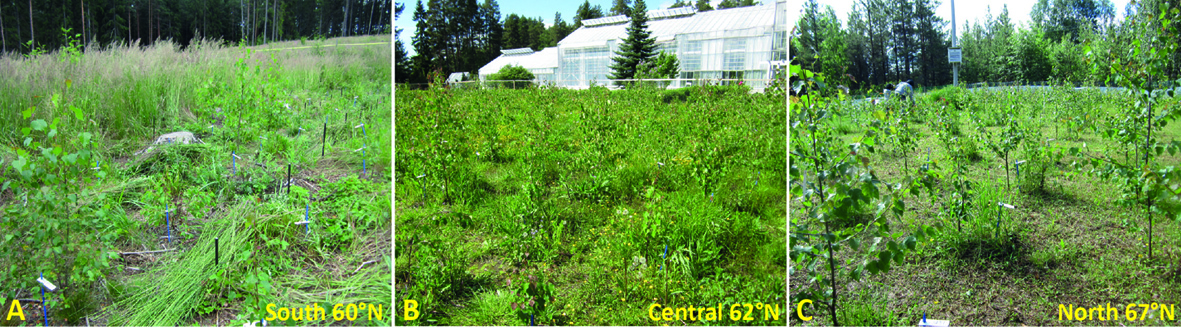
Figure 2. The three common garden sites in Finland where the study was conducted. A) Southern study site is located in Tuusula 60°N, B) Central study site is located in Joensuu 62°N and C) Northern study site is located in Kolari 67°N. Photo credits: Kaisa Heimonen.

Figure 2. The three common garden sites in Finland where the study was conducted. A) Southern study site is located in Tuusula 60°N, B) Central study site is located in Joensuu 62°N and C) Northern study site is located in Kolari 67°N. Photo credits: Kaisa Heimonen.

We wanted to study how the local insects at each of the common garden sites colonized the translocated birch genotypes. We asked if the insect herbivore density, species richness or community composition could be explained by the source population of the birch or by the direction or distance of the latitudinal translocation. The herbivore community on the study birches was examined during two growing seasons in 2011 and in 2012.

Figure 3. Kaisa Heimonen (lead author) observing the herbivorous insects on silver birch at the northern study site in 2012. Photo credits: Sari Kontunen-Soppela.

Figure 3. Kaisa Heimonen (lead author) observing the herbivorous insects on silver birch at the northern study site in 2012. Photo credits: Sari Kontunen-Soppela.

Herbivore density among the source populations differed in 2012 but not in 2011 and species richness was not affected by the source population. Latitudinal translocation could not explain the variation in the herbivore density or in the species richness. Community composition of the herbivores differed among the source populations at two of the three study sites and the similarity of the herbivore communities decreased with increasing latitudinal distance of the source populations.

Figure 4. Common insect species on silver birch belonging to the orders Lepidoptera, Coleoptera and Hymenoptera. A) White-shouldered smudge (Ypsolopha parenthesella), B) Birch leaf roller (Deporaus betulae) and C) Early birch leaf edgeminer (Fenusella nana). Photo credits: Kaisa Heimonen.

Figure 4. Common insect species on silver birch belonging to the orders Lepidoptera, Coleoptera and Hymenoptera. A) White-shouldered smudge (Ypsolopha parenthesella), B) Birch leaf roller (Deporaus betulae) and C) Early birch leaf edgeminer (Fenusella nana). Photo credits: Kaisa Heimonen.

Silver birch genotypes from source populations originating from closer geographical distance had more similar herbivore community composition at our experimental sites possibly because they are genetically more similar than the geographically more distant birch genotypes. All birch genotypes were colonized by some of the local herbivores at all three study sites suggesting that in the future herbivorous insects are able to colonize novel host plant genotypes. The results of this study show that compositional changes in the insect communities on their host plants are expected in the future. Newly structured herbivore communities might affect the herbivore damage and thereby also the plant growth.

I’ll talk politics with climate change deniers – but not science Updated for 2026


There are many complex reasons why people decide not to accept the science of climate change. The doubters range from the conspiracy theorist to the sceptical scientist, or from the paid lobbyist to the raving lunatic.

Climate scientists, myself included, and other academics have strived to understand this reluctance. We wonder why so many people are unable to accept a seemingly straight-forward pollution problem.

And we struggle to see why climate change debates have inspired such vitriol.

These questions are important. In a world increasingly dominated by science and technology, it is essential to understand why people accept certain types of science but not others.

In short, it seems when it comes to climate change, it is not about the science but all about the politics.

Risky business

Back in the late 1980s and early 1990s differing views on climate science were put down to how people viewed nature: was it benign or malevolent? In 1995 leading risk expert John Adams suggested there were four myths of nature, which he represented as a ball on different shaped landscapes.

  1. Nature is benign and forgiving of any insults that humankind might inflict upon it and it does not need to be managed.
  2. Nature ephemeral. Nature is fragile, precarious, and unforgiving and environmental management must protect nature from humans.
  3. Nature perverse/tolerant. Within limits, nature can be relied upon to behave predictably and regulation is required to prevent major excesses.
  4. Nature capricious. Nature is unpredictable and there is no point to management.

Different personality types can be matched on to these different views, producing very different opinions about the environment. Climate change deniers would map on to number one, Greenpeace number two, while most scientists would be number three. These views are influenced by an individual’s own belief system, personal agenda (either financial or political), or whatever is expedient to believe at the time.

However, this work on risk perception was ignored by mainstream science because science up to now operates on what is called the knowledge deficit model. This suggests that people do not accept the science because there is not enough evidence; therefore more needs to be gathered.

Scientists operate in exactly this way, and they assume wrongly the rest of the world is equally rational and logical. It explains why over the past 35 years a huge amount of work gone into investigating climate change.

However – despite many thousands of pages of IPCC reports – the weight of evidence argument does not seem to work with everyone.

No understanding of science?

At first failure of the knowledge deficit model was blamed on the fact that people simply did not understand science, perhaps due to a lack of education.

This was exacerbated as scientists from the late 1990s onwards started to be drawn into discussions about whether people believed or did not believe in climate change.

The use of the word ‘belief’ is important here, as it was a direct jump from the American-led argument between the science of evolution and the belief in creation.

But we know that science is not a belief system. You cannot decide that you believe in penicillin or the principles of flight while at the same time disbelieve humans evolved from apes or that greenhouse gases can cause climate change.

This is because science is an expert trust-based system that is underpinned by rational methodology that moves forward by using detailed observation and experimentation to constantly test ideas and theories.

It does not provide us with convenient yes/no answers to complex scientific questions, however much the media portrayal of scientific evidence would like the general public to ‘believe’ this to be true.

It’s all about the politics

However, many who deny climate change is an issue are extremely intelligent, eloquent and rational. They would not see the debate as one about belief and they would see themselves above the influence of the media.

So if the lack of acceptance of the science of climate change is neither due to a lack of knowledge, nor due to a misunderstanding of science, what is causing it?

Recent work has refocused on understanding people’s perceptions and how they are shared, and as climate denial authority George Marshall suggests these ideas can take on a life of their own, leaving the individual behind.

Colleagues at Yale University developed this further by using the views of nature shown above to define different groups of people and their views on climate change. They found that political views are the main predictor of the acceptance of climate change as a real phenomenon.

This is because climate change challenges the Anglo-American neoliberal view that is held so dear by mainstream economists and politicians. Climate change is a massive pollution issue that shows the markets have failed and it requires governments to act collectively to regulate industry and business.

In stark contrast neoliberalism is about free markets, minimal state intervention, strong property rights and individualism. It also purports to provide a market-based solution via ‘trickle down’ enabling everyone to become wealthier.

But calculations suggest to bring the incomes of the very poorest people in the world up to just $1.25 per day would require at least a 15 times increase in global GDP. This means huge increases in consumption, resource use and of course, carbon emissions.

It’s easier to deny climate change, than to deny our own ideologies

So in many cases the discussion of the science of climate change has nothing to do with the science and is all about the political views of the objectors. Many perceive climate change as a challenge to the very theories that have dominated global economics for the last 35 years, and the lifestyles that it has provided in developed, Anglophone countries.

Hence, is it any wonder that many people prefer climate change denial to having to face the prospect of building a new political (and socio-economic) system, which allows collective action and greater equality?

I am well aware of the abuse I will receive because of this article. But it is essential for people, including scientists, to recognise that it is the politics and not the science that drives many people to deny climate change.

This does mean, however, that no amount of discussing the ‘weight of scientific evidence’ for climate change will ever change the views of those who are politically or ideologically motivated.

Hence I am very sorry – but I will not be responding to comments posted concerning the science of climate change but I am happy to engage in discussion on the motivations of denial.


Mark Maslin is Professor of Climatology at University College London.

This article was originally published on The Conversation. Read the original article.

The Conversation


388305

I’ll talk politics with climate change deniers – but not science Updated for 2026


There are many complex reasons why people decide not to accept the science of climate change. The doubters range from the conspiracy theorist to the sceptical scientist, or from the paid lobbyist to the raving lunatic.

Climate scientists, myself included, and other academics have strived to understand this reluctance. We wonder why so many people are unable to accept a seemingly straight-forward pollution problem.

And we struggle to see why climate change debates have inspired such vitriol.

These questions are important. In a world increasingly dominated by science and technology, it is essential to understand why people accept certain types of science but not others.

In short, it seems when it comes to climate change, it is not about the science but all about the politics.

Risky business

Back in the late 1980s and early 1990s differing views on climate science were put down to how people viewed nature: was it benign or malevolent? In 1995 leading risk expert John Adams suggested there were four myths of nature, which he represented as a ball on different shaped landscapes.

  1. Nature is benign and forgiving of any insults that humankind might inflict upon it and it does not need to be managed.
  2. Nature ephemeral. Nature is fragile, precarious, and unforgiving and environmental management must protect nature from humans.
  3. Nature perverse/tolerant. Within limits, nature can be relied upon to behave predictably and regulation is required to prevent major excesses.
  4. Nature capricious. Nature is unpredictable and there is no point to management.

Different personality types can be matched on to these different views, producing very different opinions about the environment. Climate change deniers would map on to number one, Greenpeace number two, while most scientists would be number three. These views are influenced by an individual’s own belief system, personal agenda (either financial or political), or whatever is expedient to believe at the time.

However, this work on risk perception was ignored by mainstream science because science up to now operates on what is called the knowledge deficit model. This suggests that people do not accept the science because there is not enough evidence; therefore more needs to be gathered.

Scientists operate in exactly this way, and they assume wrongly the rest of the world is equally rational and logical. It explains why over the past 35 years a huge amount of work gone into investigating climate change.

However – despite many thousands of pages of IPCC reports – the weight of evidence argument does not seem to work with everyone.

No understanding of science?

At first failure of the knowledge deficit model was blamed on the fact that people simply did not understand science, perhaps due to a lack of education.

This was exacerbated as scientists from the late 1990s onwards started to be drawn into discussions about whether people believed or did not believe in climate change.

The use of the word ‘belief’ is important here, as it was a direct jump from the American-led argument between the science of evolution and the belief in creation.

But we know that science is not a belief system. You cannot decide that you believe in penicillin or the principles of flight while at the same time disbelieve humans evolved from apes or that greenhouse gases can cause climate change.

This is because science is an expert trust-based system that is underpinned by rational methodology that moves forward by using detailed observation and experimentation to constantly test ideas and theories.

It does not provide us with convenient yes/no answers to complex scientific questions, however much the media portrayal of scientific evidence would like the general public to ‘believe’ this to be true.

It’s all about the politics

However, many who deny climate change is an issue are extremely intelligent, eloquent and rational. They would not see the debate as one about belief and they would see themselves above the influence of the media.

So if the lack of acceptance of the science of climate change is neither due to a lack of knowledge, nor due to a misunderstanding of science, what is causing it?

Recent work has refocused on understanding people’s perceptions and how they are shared, and as climate denial authority George Marshall suggests these ideas can take on a life of their own, leaving the individual behind.

Colleagues at Yale University developed this further by using the views of nature shown above to define different groups of people and their views on climate change. They found that political views are the main predictor of the acceptance of climate change as a real phenomenon.

This is because climate change challenges the Anglo-American neoliberal view that is held so dear by mainstream economists and politicians. Climate change is a massive pollution issue that shows the markets have failed and it requires governments to act collectively to regulate industry and business.

In stark contrast neoliberalism is about free markets, minimal state intervention, strong property rights and individualism. It also purports to provide a market-based solution via ‘trickle down’ enabling everyone to become wealthier.

But calculations suggest to bring the incomes of the very poorest people in the world up to just $1.25 per day would require at least a 15 times increase in global GDP. This means huge increases in consumption, resource use and of course, carbon emissions.

It’s easier to deny climate change, than to deny our own ideologies

So in many cases the discussion of the science of climate change has nothing to do with the science and is all about the political views of the objectors. Many perceive climate change as a challenge to the very theories that have dominated global economics for the last 35 years, and the lifestyles that it has provided in developed, Anglophone countries.

Hence, is it any wonder that many people prefer climate change denial to having to face the prospect of building a new political (and socio-economic) system, which allows collective action and greater equality?

I am well aware of the abuse I will receive because of this article. But it is essential for people, including scientists, to recognise that it is the politics and not the science that drives many people to deny climate change.

This does mean, however, that no amount of discussing the ‘weight of scientific evidence’ for climate change will ever change the views of those who are politically or ideologically motivated.

Hence I am very sorry – but I will not be responding to comments posted concerning the science of climate change but I am happy to engage in discussion on the motivations of denial.


Mark Maslin is Professor of Climatology at University College London.

This article was originally published on The Conversation. Read the original article.

The Conversation


388305

UKIP uncut – acoloytes of America’s far-right corporate gunslingers Updated for 2026


Few if any of those electing the UKIP candidate in yesterday’s Rochester by-election knew of the party’s links with American right-wingers who support corporations’ rights above those of both people and planet.

But as an Ecologist investigation reveals, the party and three of its elected MEPs have links with the powerful by shadowy American Legislative Exchange Council (ALEC) and the associated Heartland Institute, a right-wing think tank reported to have received millions of dollars from fossil fuel interests.

ALEC is a truly American phenomenon: it’s a right-wing corporate lobbying group which shortcuts the traditional nuances of persuasion by drafting bills and encouraging lawmakers across the 50 states to sign up to them wholesale, and push them through their legislatures.

Typically 1,000 such bills are introduced every year, and several hundred are enacted.

The ‘charity’ that’s anything but charitable

And although it’s registered as a charity – giving it huge tax breaks and enabling it to anonymise much of its income – ALEC is not on the side of the angels.

ALEC-drafted legislation has provided fossil fuel industries with enormous subsidies; imposed connection surcharges on small ‘rooftop’ solar power generators; promoted the anti-evolution, pro-creationism agenda of extreme evangelical groups; stripped away restrictions on Americans’ right to carry guns; and even includes ‘Jim Crow’ laws to get poor Black voters off electoral registers.

Yet three UKIP MEPs have chosen to put their names to official ALEC correspondence.

One of the signatories, Roger Helmer MEP, UKIP’s energy spokesperson, has also spoken at numerous Heartland Institute climate change denial conferences including the 7th – taking place in May 2012 (see photo and Youtube presentation).

The conference was sponsored by nearly 60 organisations that had collectively received nearly $22m from Exxon Mobil and the Koch oil billionaire family since 1998, according to a Desmogblog analysis.

Heartland Institute is one of the US’s main organisations that denies climate change and promotes the interests of the fossil fuel industries which are among its principal funders.

It also has close links to big tobacco, having received both funds and support from Philip Morris, Altria and Reynolds American. And it strongly supports the privatisation of public services including health care provision and education.

‘I think the global warming theory is bad science’

Like Heartland, ALEC does all it can to challenge the global scientific consensus on climate change – its ‘model’ climate change bill suggested global warming is “possibly beneficial” to the planet.

Climate change deniers are encouraged to “educate” lawmakers by claiming there is no scientific consensus on the issue. Its most recent meeting in Dallas saw one of its speakers deliver a presentation dismissing the International Panel on Climate Change as being “not a credible source of man-made economics”.

ALEC’s incoming national chair, the Texan Republican Phil King, has said: “I think the global warming theory is bad science.” At a recent ALEC meeting in Dallas, Heartland’s President Joseph Bast led a workshop featuring a presentation arguing that:

  • “There is no scientific consensus on the human role in climate change.”
  • “There is no need to reduce carbon dioxide emissions and no point in attempting to do so.”
  • “Carbon dioxide has not caused weather to become more extreme, polar ice and sea ice to melt, or sea level rise to accelerate. These were all false alarms.”
  • The International Panel on Climate Change (IPCC) “is not a credible source of science or economics.”
  • “The likely benefits of man-made global warming exceed the likely costs.”

The presentation also reveals how Heartland Insitute works in partnership with ALEC – whose role is to draft legislation implementing Heartland’s right-wing agenda, and push it out to state legislatures. Draft bills would expedite fossil fuel developments, cut renewables out of energy markets and even “lift regulation of nuclear power”.

In the US, thanks to the strength of the Tea Party, this kind of extremism is tolerated and even celebrated. In Britain it would be challenged and ridiculed – which is why the deepening links between a British political party and UKIP needs highlighting.

Now here’s a funny thing … UKIP MEPs signing ALEC’s letter

The latest indications about Nigel Farage’s party’s anti-environment attitudes followed Google’s withdrawal from ALEC after a prolonged campaign by Forecast the Facts that denounced the contradiction of Google stated views on climate change and other issues, and ALEC’s legislative agenda.

Google’s Eric Schmidt’s conclusion that ALEC’s views on climate change are “hurting our children and our grandchildren” was greeted with condemnation by ALEC’s supporters – following which over 200 US legislators put their name to an angry letter to Google.

The letter blames “misinformation from climate activists” for Google’s decision. Instead it points to ALEC’s climate change policy, which suggests climate change only “may” be causing global warming, as evidence that it is upholds a moderate view. That just about says it all.

Scroll right down to the bottom of the letter, and you can spot something odd: three UKIP MEPs have also added their names. The three British signatories are those of south-east MEP Janice Atkinson, the West Midlands’ Bill Etheridge – and Roger Helmer.

It is Helmer who holds the key to all this, for he has perhaps the deepest relationship with ALEC of any other British politician. The group appointed Helmer ‘Adam Smith Scholar’ back in 2005.

He was also a member of its ‘international task force’ and boasts of having “developed close relationships with conservative political groups in the USA”. Since then he has pursued a bold policy on green issues that makes him one of Britain’s leading climate change deniers.

He spent £9,000 on a poster campaign attacking the “Great Climate Myth” in 2010. The poster suggested actions to address global warming were “probably unnecessary, certainly ineffectual, ruinously expensive”. After the campaign attracted inevitable criticism he insisted he was speaking for a majority of British voters.

The following year he appeared at ALEC’s annual meeting in a workshop called ‘benefit analysis of CO2‘. Not the most fascinating of meeting titles, you might say. In fact this was an alteration from its original name: ‘Warming Up to Climate Change: The Many Benefits of Increased Atmospheric CO2‘.

Helmer is also a supporter of the Citizens’ Alliance for Responsible Energy (CARE), whose ideological position of fossil fuels and climate change is identical to that of Heartland and ALEC – and a personal friend of its Executive Director Marita Noon (see photo).

‘Big Green tells lies’

Now Helmer is advocating an energy policy for Britain based on “proven technologies” including coal and gas. In his speech to the party’s conference in Doncaster this year, titled ‘Big green is obscene’, he told delegates:

“‘Big green’ hates industry, hates capitalism. ‘Big green’ campaigns against jobs and growth and prosperity. Oh, and by the way, ‘big green’ tells lies.”

Helmer’s speech focused on energy security, and argued that UKIP’s focus on energy independence, which includes repealing the 2008 Climate Change Act, contrasted with that of the Westminster parties.

“We in UKIP have carved out a distinctive position on energy that puts clear purple water between us and them. Look at what the old parties are doing, look at the Lib-Lab-Con policies. They slavishly follow Brussels diktats. They want a massive waste of resources on renewables. They want to cover the country in wind farms and solar arrays and they are wedded to green taxes, levies and subsidies. Now compare our position. UKIP’s policy has one clear objective: secure affordable energy for households and industry.”

In one recent blog, ‘Roger Harrabin’s new normal‘, he opines: “CO2 is just one minor factor amongst many in a vast and chaotic climate system which is poorly understood and very difficult to model. CO2 is not even the most serious greenhouse gas. Both water vapour and methane have a bigger effect – and we can do nothing about water vapour until we can stop the winds blowing over the ocean.”

UKIP – ALEC’s bridgehead across the Atlantic?

ALEC and Heartland may well be willing to assist UKIP’s cause – and with Helmer’s long-standing links with the American ‘charity’, they have already established a bridgehead across the Atlantic.

The involvement of Atkinson and Etheridge provides evidence that UKIP’s links with ALEC – and by extension with American corporate, fossil fuel and right-wing evangelical and ‘Tea Party’ interests – are only deepening as the party’s influence increases.

But there is something a little illogical about this. UKIP’s big-picture goal is a bid to achieve independence from the European Union – but in backing the agenda of ALEC and Heartland it appears only too keen to turn us into vassals of unaccountable American corporations.

Helmer’s response to these concerns is to dismiss them outright. “When will these people understand?” he asks. “We don’t want to leave the EU to join something else – we want to leave the EU to regain our independence.”

Resisting any kind of big government, promoting free-market rhetoric whatever the cost and, above all else, undermining the rationale behind acting on climate change … Helmer has a lot in common with ALEC.

UKIP’s ‘special relationship’ with ALEC, Heartland and CARE needs watching closely as the party’s influence in Britain and Europe gathers momentum.


Alex Stevenson is parliamentary editor of politics.co.uk, and a regular contributor to The Ecologist.

Oliver Tickell edits The Ecologist.


387082

We shall defend our island – if the cost-benefit analysis stacks up Updated for 2026


England’s flood defenses aren’t getting nearly the funding they need to respond to climate change: particularly if you live in a poorer area.

Faced with the threat of invasion in 1940, Winston Churchill defiantly declared: “We shall defend our island, whatever the cost may be”.

Today, faced with the threat of climate change, our leaders are pathetically pusillanimous. “We shall defend our island”, they croak, “if the cost-benefit analysis stacks up.”

The crumbling state of our defences was recently laid bare by the National Audit Office (NAO), in a new report on the state of England’s flood preparedness.

“Current spending is insufficient”, it states, “to meet many of the maintenance needs the [Environment] Agency has identified” for its flood defence assets. “This will increase the danger of asset conditions degrading, so increasing flood risk.”

All this, the NAO warns, at a time when climate change is increasing flood risk. The result is that the Environment Agency will have to let maintenance of some flood defences ‘lapse’ – or put less euphemistically, ‘collapse’. The government’s auditors conclude, tersely, that “the achievement of value for money in the long term remains subject to significant uncertainty”.

Atrocious neglect

Their verdict is a damning indictment of government neglect. It comes after Ministers quietly admitted that flood defence repairs from last winter have fallen behind schedule; and after insurers wrote to the Chancellor demanding he plug the £500m shortfall in flood defence investment needed to keep pace with climate change.

Yet the case for climate action shouldn’t have to come down to such a cold, calculating totting up of ledgers. The moral case for protecting people from rising seas and worsening floods is overwhelming.

Climate change is not something that has been caused by the people most affected by it. This is most patently true globally, when the world’s poorest in sub-Saharan Africa and southeast Asia are set to suffer the brunt of climate change. But it is also true of how climate change will hit the British Isles.

recent analysis by Oxfam showed that the most deprived English neighbourhoods have been three times more vulnerable to flooding than the most well-off in the past quarter-century.

The low-lying east coast of England, for example, is especially vulnerable to rising sea levels and storm surges, as witnessed last December when the worst tidal surge in six decades struck settlements from Essex to the Humber.

It is also an economically deprived part of the country, a coastline dotted with declining seaside towns often forgotten about by Westminster: the flood-prone town of Jaywick near Clacton, for instance, is the poorest ward in the country.

These communities bear scant responsibility for the pollution driving climate change – but they are in the front line of its impacts.

Flood defence money follows the money, not the need

All this is lost in the cold budgetary calculations of Whitehall. The Treasury enforces a system of payments for flood defences that places weight on the economic value of the properties being protected. Richer, urban areas inevitably attract more cash; poorer and smaller settlements get less.

The Chancellor’s latest wheeze is to oblige local businesses to chip in to the cost of flood defences whilst he cuts the public sector contributions. Make businesses pay by all means, but this will only exacerbate the inequality of flood protection: poorer communities with fewer businesses will simply not get defences.

Tellingly, the only part of the country where there is a legal duty to build flood defences is – yes, you guessed it – central London. Protect the metropolis; the rest can swim.

Alarmingly, the communities whose flood defences have been left to crumble may not even know the risks they are being exposed to. The report by the NAO states that the Environment Agency “has not communicated to communities the local effect on future flood risk from the de-prioritisation of maintenance in some areas.”

If true, this is genuinely shocking. But it wouldn’t be a great surprise if the communities being quietly neglected were more deprived and far from London.

When last winter’s floods struck, David Cameron was generous in his rhetoric, declaring that “money was no object” in helping people recover from the disaster.

Such apparent largesse meant little, however, coming after years of cuts to the flood defence budget – cuts that have clearly affected the state of our country’s defences and left them in a more fragile state.

Needed now – a £500 million investment

The Coalition needs to invest £500m to keep pace with climate change; the cost of last winter’s floods has already run to at least £1bn. To take a cost-benefit approach, it would have been better to invest in maintenance earlier, rather than have to pay out much more to mop up the mess later.

Yet even if the numbers did not stack up so clearly, there would be an overwhelming moral case to protect the whole country from climate change.

The more fossil fuels we burn, the more it will flood; the more we neglect our defences and force households to fend for themselves, the more the poorest will suffer.

We must prevent climate change getting any worse, and we must protect society from its impacts – the whole of society – not just those parts of it the Treasury deem most economically useful.


Guy Shrubsole is climate campaigner at Friends of the Earth. Previously he worked for the Public Interest Research Centre and the Department of the Environment, Food & Rural Affairs.

This article was published by Open Democracy under a Creative Commons Attribution-NonCommercial 3.0 licence.

Creative Commons License


386843

US-China climate deal: at last the big players are talking the right language Updated for 2026


Some great news at last, as China and the US announce a secretly negotiated deal to reduce their carbon emissions.

After years of seeming to get nowhere at all it looks like we have the beginnings of meaningful commitments.

If the rest of the world can fall in line with the combined targets of China, the US and EU, and if between us all we can enforce them, we would actually have progress. Not success, but for the first time we would have better-than-nothing global progress on climate change.

But just before we all relax, lets get things into perspective. Global emissions have been on a mathematically predictable exponential trajectory for at least 160 years.

The CO2 power law – doubling time 39 years

Cumulative CO2 emissions (broadly speaking that’s what determines the temperature change) continue to double every 39 years (see graph, right). Nothing that anyone has done to date has succeeded in making even the faintest detectable change in that.

To be blunt, our species has so far not demonstrated any ability whatsoever to influence global emissions growth through deliberate action on climate change. Savings in one place have simply popped up elsewhere.

And if we stay on our age-old trajectory we will shoot through the likely threshold of two degrees in the mid-2040s.

By that I mean that by about 2045 we will pass the point at which we will probably experience more than a 2°C rise even if no-one anywhere in the world ever again set fire to any coal, oil or gas.

And, roughly speaking, 39 years after that we will crash through the 4°C threshold which humans would be very likely to find extremely unpleasant.

Of course we don’t really know all that much about what level of temperature change will cause us what level of suffering and death. We don’t understand the climate discontinuities that we might trigger, and we don’t know how good we will be at adapting to change and we don’t know how good we will be at preserving world order if things get tough.

The mainstream consensus is that 2°C entails significant risk of something nasty happening while 4°C is probably very nasty indeed. No one knows for sure.

Coming off the curve

What we need is a global constraint on greenhouse gases. And it needs to be rapid enough to keep temperatures as close to 2°C rise as possible. This much, thankfully, seems to be uncontested these days among people who talk any sense on climate change.

So how far do the latest US and China pledges take us? If (and it’s still a big ‘if’) the world falls quickly in line with the US (27% cuts by 2025), China (peak by 2030 – by which time their emissions could be enormous) and EU (40% cut by 2030) announcements we will come off the exponential curve but still fly through the 2℃ threshold and well beyond.

Coming off the curve would be a huge achievement but not nearly enough.

So when I say we might actually stand a chance of getting somewhere, I don’t mean that things are looking rosy. But I do mean this gives me real hope, as big players are talking the right language at last.

All we need now is more of the same – and to make sure the words turn into enforced action. That will be enormously challenging but it is radically more hopeful position than the situation we have been in in which sticky plasters have been proposed, no amount of which could help.

What we need from here

  1. We need the rest of the world to come into the fold with similar commitments, so we get a leak-proof deal on leaving fuel in the ground. Any countries that don’t participate will probably end up growing their emissions to undo efforts made elsewhere, because that is how the system dynamics work to negate piecemeal actions.
  2. Binding targets need tightening up for everyone, beyond what is currently on the table, to take us a lot closer to topping out at 2°C.
  3. The deal needs enforcing. This is going to be tough, remember that the exponential global emissions curve has proved incredibly resilient to date.
  4. All the greenhouse gases need to be properly included in the plan.
  5. We need to head off a global dash for biofuels which will undoubtedly be at the expense of feeding the world’s poorest if left to market forces. Some smart and robust agreements are going to be needed on land use for biofuels.

While all this is being put in place we can start investing in the technologies we will urgently need – redirecting the money we have been channelling into fossil fuel research and development.

To sum up, the announcement is very encouraging. There may still be a long way to go yet and we all need to push hard for next year’s Paris talks to put it all in place – but it is starting to look as if it might actually be worth the effort.


Mike Berners-Lee is a Visiting Researcher at Lancaster University, and the founding director of Small World Consulting which helps organisations understand and respond to the climate change agenda.

This article was originally published on The Conversation. Read the original article.

The Conversation


386811

Climate deniers lost for words: 2014 set for hottest year on record Updated for 2026


Climate deniers have been left red-faced as the world basks in some of the hottest temperatures in living memory, with the National Oceanic and Atmospheric Administration (NOAA) predicting that 2014 could break all records.

Lord Lawson, who resigned as chancellor in the 1980s after overheating the British economy, has led the siren chorus of climate change denial – claiming that a recent plateau in global earth surface temperatures is proof that the threat of global warming has been wildly exaggerated. 

The deniers have either ignored or attacked the latest research, which shows that the heat created by increased carbon dioxide in the atmosphere has been absorbed into the oceans and that surface temperatures are likely to begin rising again.

England has enjoyed balmy evenings with golden sunsets lighting up parks and gardens where trees have retained their amber and green leaves. But this wonderful Mediterranean warmth should also be understood as a chilling warning. 

January to September were the warmest first nine months of a year recorded since the invention of the thermometer. This week, NASA scientists announced that September was the hottest of its kind in 135 years.

This is despite the fact that 2014 was not an El Nino year: a natural weather event that takes place every few years and boosts global average temperatures.

‘The contrarians were wrong’

Only a significant drop in temperatures in November and December, which is unlikely but not impossible, would result in the average measured temperature this year falling short of the record set in 2010. 

DeSmogUK approached the outspoken Dr Benny Peiser, director of a leading climate sceptic group, the Global Warming Policy Foundation (GWPF), founded by Lawson

But when asked what the record temperatures experienced meant for climate scepticism he simply refused to comment. When asked if this report undermines the GWPF’s claims that climate change had stopped, he replied by saying “No comment”

Peiser has not previously been coy about making statements to the media based on the temperature of a given day.

During Christmas one year he told The Times newspaper: “The predictions come in thick and fast, but we take them all with a pinch of salt. We look out of the window and it’s very cold, it does not seem to be warming.”

Climate deniers also created a media storm last year when England was hit by freezing temperatures and deluged by snow when a cold front usually found across Siberia swept the country.

Only weeks ago former environment secretary Owen Paterson claimed that the forecast effects of climate change have been consistently and widely exaggerated thus far – going on to call for the effective repeal of the UK’s Climate Change Act.

The warmest annual average temperature since 1880

Dr John Abraham, an expert in climate change, said of the soaring temperatures: “This year was not supposed to be hot, at least according to those who think climate change had stopped. But the real facts tell us a different story, the Earth is still warming, the ‘pause’ never really was, and once again … The contrarians were wrong.” 

NOAA climate scientist Jessica Blunden said in an interview with AP news agency that it was “pretty likely” that 2014 will be the warmest year on record.

Blunden explained that “persistent record warmth in the global ocean” was “strengthening the chances of the year’s final three months resembling the first nine.”

The report shows that from January through to September all months retained record warm temperatures with an average of 58.72 degrees. That’s 0.68°C above the 20th century average of 14.1°C, according to NOAA scientists. 

These records tie 2014 with 1998 and 2010 for the warmest first nine months on record. The United Nations has pointed out that 13 out of the 14 hottest years recorded have taken place since the turn of the 21st century. 

In a statement, NOAA said: “If the surface temperature remains elevated at the same level for the remainder of the year, then 2014 will set a new record for the warmest annual average temperature since records began in 1880.”

The laws of physics are non-negotiable

A more daunting prospect was recently announced by the UN’s World Meteorological Association (WMA) last month, stating an 80% chance that an El Nino was actually still expected to happen at the end of the year.

Jeff Masters, meteorology director for the private firm Weather Underground, said when talking to the Daily Mail that if an El Nino did happen then: “Next year could well bring Earth’s hottest year on record, accompanied by unprecedented regional heat waves and droughts.”

Explaining further, the WMA said: “Carbon dioxide remains in the atmosphere for many hundreds of years and in the ocean for even longer. Past, present and future CO2 emissions will have a cumulative impact on both global warming and ocean acidification. The laws of physics are non-negotiable.”

Climate change deniers are, of course, welcome to take silent refuge in the late October shadows into which they have uncharacteristically retreated. I’m surely not alone in hoping they stay there for a good long time to come.


This article was originally published by DeSmogUK.


386000

Climate ‘uncertainty’ is no excuse for climate inaction Updated for 2026


Former environment minister Owen Paterson has called for the UK to scrap its climate change targets.

In a speech to the Global Warming Policy Foundation, he cited “considerable uncertainty” over the impact of carbon emissions on global warming – a line that was displayed prominently in coverage by the Telegraph and the Daily Mail.

Paterson is far from alone: climate change debate has been suffused with appeals to ‘uncertainty’ to delay policy action. Who hasn’t heard politicians or media personalities use uncertainty associated with some aspects of climate change to claim that the science is ‘not settled‘?

Over in the US, this sort of thinking pops up quite often in the opinion pages of The Wall Street Journal. Its most recent article, by Professor Judith Curry, concludes that the ostensibly slowed rate of recent warming gives us “more time to find ways to decarbonise the economy affordably.”

What we do know – inspite of ‘uncertainty’

At first glance, avoiding interference with the global economy may seem advisable when there is uncertainty about the future rate of warming or the severity of its consequences.

But delaying action because the facts are presumed to be unreliable reflects a misunderstanding of the science of uncertainty.

Simply because a crucial parameter such as the climate system’s sensitivity to greenhouse gas emissions is expressed as a range – for example, that under some emissions scenarios we will experience 2.6°C to 4.8ºC of global warming or 0.3 to 1.7 m of sea level rise by 2100 – does not mean that the underlying science is poorly understood. We are very confident that temperatures and sea levels will rise by a considerable amount.

Perhaps more importantly, just because some aspects of climate change are difficult to predict (will your county experience more intense floods in a warmer world, or will the floods occur down the road?) does not negate our wider understanding of the climate.

We can’t yet predict the floods of the future but we do know that precipitation will be more intense because more water will be stored in the atmosphere on a warmer planet.

This idea of uncertainty might be embedded deeply within science but is no one’s friend and it should be minimised to the greatest extent possible. It is an impetus to mitigative action rather than a reason for complacency.

Uncertainty means more risk – not less

There are three key aspects of scientific uncertainty surrounding climate change projections that exacerbate rather than ameliorate the risks to our future.

First, uncertainty has an asymmetrical effect on many climatic quantities. For example, a quantity known as Earth system sensitivity, which tells us how much the planet warms for each doubling of atmospheric carbon dioxide concentration, has been estimated to be between 1.5°C to 4.5ºC.

However, it is highly unlikely, given the well-established understanding of how carbon dioxide absorbs long-wave radiation, that this value can be below 1ºC. There is a possibility, however, that sensitivity could be higher than 4.5ºC.

For fundamental mathematical reasons, the uncertainty favours greater, rather than smaller, climate impacts than a simple range suggests.

Uncertainty also makes adaptation harder

Second, the uncertainty in our projections makes adaptation to climate change more expensive and challenging. Suppose we need to build flood defences for a coastal English town.

If we could forecast a 1m sea level rise by 2100 without any uncertainty, the town could confidently build flood barriers 1m higher than they are today. However, although sea levels are most likely to rise by about 1m, we’re really looking at a range between 0.3m and 1.7m.

Therefore, flood defences must be at least 1.7m higher than today – 70cm higher than they could be in the absence of uncertainty. And as uncertainty increases, so does the required height of flood defences for non-negotiable mathematical reasons.

And the problem doesn’t end there, as there is further uncertainty in forecasts of rainfall occurrence, intensity and storm surges. This could ultimately mandate a 2 to 3m-high flood defence to stay on the safe side, even if the most likely prediction is for only a 1m sea-level rise.

Even then, as most uncertainty ranges are for 95% confidence, there is a 5% chance that those walls would still be too low. Maybe a town is willing to accept a 5% chance of a breach, but a nuclear power station cannot to take such risks.

Systemic uncertainties may be hiding the gravest of risks

Finally, some global warming consequences are associated with deep, so-called systemic uncertainty. For example, the combined impact on coral reefs of warmer oceans, more acidic waters and coastal run-off that becomes more silt-choked from more intense rainfalls is very difficult to predict.

But we do know, from decades of study of complex systems, that those deep uncertainties may camouflage particularly grave risks. This is particularly concerning given that more than 2.6 billion people depend on the oceans as their primary source of protein.

Similarly, warming of Arctic permafrost could promote the growth of CO2-sequestering plants, the release of warming-accelerating methane, or both.

Warm worlds with very high levels of carbon dioxide did exist in the very distant past and these earlier worlds provide some insight into the response of the Earth system; however, we are accelerating into this new world at a rate that is unprecedented in Earth history, creating additional layers of complexity and uncertainty.

Uncertainty is not the same as ignorance

Increasingly, arguments against climate mitigation are phrased as “I accept that humans are increasing CO2 levels and that this will cause some warming but climate is so complicated we cannot understand what the impacts of that warming will be.”

This argument is incorrect – uncertainty does not imply ignorance. Indeed, whatever we don’t know mandates caution. No parent would argue:

“I accept that if my child kicks lions, this will irritate them, but a range of factors will dictate how the lions respond; therefore I will not stop my child from kicking lions.”

The deeper the uncertainty, the more greenhouse gas emissions should be perceived as a wild and poorly understood gamble.

By extension, the only unequivocal tool for minimising climate change uncertainty is to decrease our greenhouse gas emissions.


Richard Pancost is Professor of Biogeochemistry, Director of the Cabot Institute at the University of Bristol. He receives funding from the NERC, the EU and the Leverhulme Trust.

Stephan Lewandowsky is Chair of Cognitive Psychology at the University of Bristol. He receives funding from the Australian Research Council, the World University Network, and the Royal Society.

This article was originally published on The Conversation. Read the original article.

The Conversation


385583