Tag Archives: Study

Climate change sparked Syria’s ruinous war Updated for 2026


In a dire chain of cause and effect, the drought that devastated parts of Syria from 2006 to 2010 was probably the result of climate change driven by human activities, a new study says.

And the study’s authors think that the drought may also have contributed to the outbreak of Syria’s uprising in 2011. The ensuing civil war has left at least 200,000 people dead, and has displaced millions of others.

The drought, which was the worst ever recorded in the region, ravaged agriculture in the breadbasket region of northern Syria, driving dispossessed farmers to the cities where poverty, government mismanagement and other factors created the unrest that exploded four years ago.

The study, by scientists from Lamont-Doherty Earth Observatory at Columbia University, US, is published in the Proceedings of the National Academy of Sciences.

The authors are clear that the climatic changes were human-driven (anthropogenic) and cannot be attributed simply to natural variability – but are careful to stress that their findings are tentative.

“We’re not saying the drought caused the war”, says Richard Seager, one of the co-authors. “We’re saying that, added to all the other stressors, it helped kick things over the threshold into open conflict. And a drought of that severity was made much more likely by the ongoing human-driven drying of that region.”

Climate link to violence

Their study, although it contains new material, is not the first to suggest a possible link between extreme weather and the likelihood of violence.

Some researchers have investigated whether there may be a link between El Niño and La Niña – the periodic Pacific weather disruptions – and outbreaks of unrest. Suggestions of a global connection between climate change and political instability is being taken seriously by two influential groups – insurers and military planners.

Syria was not the only country affected by the drought. It struck the Fertile Crescent, linking Turkey, Syria and Iraq, where agriculture and animal herding are believed to have started around 12,000 years ago.

The Levant has always seen natural weather swings. Other research has suggested that the Akkadian empire, spanning much of the Fertile Crescent about 4,000 years ago, probably collapsed during a long drought.

But the authors of the Lamont-Doherty study, using existing studies and their own research, showed that the area has warmed by between 1°C and 1.2°C since 1900, and has undergone a 10% reduction in wet season precipitation. They say this trend is a neat match for models of human-influenced global warming, and so cannot be attributed to natural variability.

Global warming has had two effects, they say. First, it appears to have indirectly weakened wind patterns that bring rain-laden air from the Mediterranean, reducing precipitation during the usual November-April wet season. And higher temperatures have increased the evaporation of moisture from soils during the hot summers.

Other researchers have observed the long-term drying trend across the Mediterranean region, and have attributed at least part of it to anthropogenic warming.

Government stuck with water-intensive cash crops

The government has also encouraged water-intensive export crops such as cotton, while illegal drilling of irrigation wells depleted groundwater, says co-author Shahrzad Mohtadi, an international affairs consultant at the US Department of State.

The drought’s effects were immediate and overwhelming. Agricultural production – typically, a quarter of Syria’s gross domestic product – fell by a third. In the northeast, livestock was practically wiped out, cereal prices doubled, and nutrition-related diseases among children increased steeply.

And Syria was especially vulnerable because of other factors – including a huge increase in population from four million in the 1950s to 22 million in recent years. As many as 1.5 million people fled from the countryside to cities already strained by waves of refugees from the war in neighbouring Iraq.

“Rapid demographic change encourages instability”, the authors say. “Whether it was a primary or substantial factor is impossible to know, but drought can lead to devastating consequences when coupled with pre-existing acute vulnerability.”

Solomon Hsiang, professor of public policy at the University of California, Berkeley, says the study is “the first scientific paper to make the case that human-caused climate change is already altering the risk of large-scale social unrest and violence.”


Alex Kirby writes for Climate News Network.


391003

Climate change sparked Syria’s ruinous war Updated for 2026


In a dire chain of cause and effect, the drought that devastated parts of Syria from 2006 to 2010 was probably the result of climate change driven by human activities, a new study says.

And the study’s authors think that the drought may also have contributed to the outbreak of Syria’s uprising in 2011. The ensuing civil war has left at least 200,000 people dead, and has displaced millions of others.

The drought, which was the worst ever recorded in the region, ravaged agriculture in the breadbasket region of northern Syria, driving dispossessed farmers to the cities where poverty, government mismanagement and other factors created the unrest that exploded four years ago.

The study, by scientists from Lamont-Doherty Earth Observatory at Columbia University, US, is published in the Proceedings of the National Academy of Sciences.

The authors are clear that the climatic changes were human-driven (anthropogenic) and cannot be attributed simply to natural variability – but are careful to stress that their findings are tentative.

“We’re not saying the drought caused the war”, says Richard Seager, one of the co-authors. “We’re saying that, added to all the other stressors, it helped kick things over the threshold into open conflict. And a drought of that severity was made much more likely by the ongoing human-driven drying of that region.”

Climate link to violence

Their study, although it contains new material, is not the first to suggest a possible link between extreme weather and the likelihood of violence.

Some researchers have investigated whether there may be a link between El Niño and La Niña – the periodic Pacific weather disruptions – and outbreaks of unrest. Suggestions of a global connection between climate change and political instability is being taken seriously by two influential groups – insurers and military planners.

Syria was not the only country affected by the drought. It struck the Fertile Crescent, linking Turkey, Syria and Iraq, where agriculture and animal herding are believed to have started around 12,000 years ago.

The Levant has always seen natural weather swings. Other research has suggested that the Akkadian empire, spanning much of the Fertile Crescent about 4,000 years ago, probably collapsed during a long drought.

But the authors of the Lamont-Doherty study, using existing studies and their own research, showed that the area has warmed by between 1°C and 1.2°C since 1900, and has undergone a 10% reduction in wet season precipitation. They say this trend is a neat match for models of human-influenced global warming, and so cannot be attributed to natural variability.

Global warming has had two effects, they say. First, it appears to have indirectly weakened wind patterns that bring rain-laden air from the Mediterranean, reducing precipitation during the usual November-April wet season. And higher temperatures have increased the evaporation of moisture from soils during the hot summers.

Other researchers have observed the long-term drying trend across the Mediterranean region, and have attributed at least part of it to anthropogenic warming.

Government stuck with water-intensive cash crops

The government has also encouraged water-intensive export crops such as cotton, while illegal drilling of irrigation wells depleted groundwater, says co-author Shahrzad Mohtadi, an international affairs consultant at the US Department of State.

The drought’s effects were immediate and overwhelming. Agricultural production – typically, a quarter of Syria’s gross domestic product – fell by a third. In the northeast, livestock was practically wiped out, cereal prices doubled, and nutrition-related diseases among children increased steeply.

And Syria was especially vulnerable because of other factors – including a huge increase in population from four million in the 1950s to 22 million in recent years. As many as 1.5 million people fled from the countryside to cities already strained by waves of refugees from the war in neighbouring Iraq.

“Rapid demographic change encourages instability”, the authors say. “Whether it was a primary or substantial factor is impossible to know, but drought can lead to devastating consequences when coupled with pre-existing acute vulnerability.”

Solomon Hsiang, professor of public policy at the University of California, Berkeley, says the study is “the first scientific paper to make the case that human-caused climate change is already altering the risk of large-scale social unrest and violence.”


Alex Kirby writes for Climate News Network.


391003

Climate change sparked Syria’s ruinous war Updated for 2026


In a dire chain of cause and effect, the drought that devastated parts of Syria from 2006 to 2010 was probably the result of climate change driven by human activities, a new study says.

And the study’s authors think that the drought may also have contributed to the outbreak of Syria’s uprising in 2011. The ensuing civil war has left at least 200,000 people dead, and has displaced millions of others.

The drought, which was the worst ever recorded in the region, ravaged agriculture in the breadbasket region of northern Syria, driving dispossessed farmers to the cities where poverty, government mismanagement and other factors created the unrest that exploded four years ago.

The study, by scientists from Lamont-Doherty Earth Observatory at Columbia University, US, is published in the Proceedings of the National Academy of Sciences.

The authors are clear that the climatic changes were human-driven (anthropogenic) and cannot be attributed simply to natural variability – but are careful to stress that their findings are tentative.

“We’re not saying the drought caused the war”, says Richard Seager, one of the co-authors. “We’re saying that, added to all the other stressors, it helped kick things over the threshold into open conflict. And a drought of that severity was made much more likely by the ongoing human-driven drying of that region.”

Climate link to violence

Their study, although it contains new material, is not the first to suggest a possible link between extreme weather and the likelihood of violence.

Some researchers have investigated whether there may be a link between El Niño and La Niña – the periodic Pacific weather disruptions – and outbreaks of unrest. Suggestions of a global connection between climate change and political instability is being taken seriously by two influential groups – insurers and military planners.

Syria was not the only country affected by the drought. It struck the Fertile Crescent, linking Turkey, Syria and Iraq, where agriculture and animal herding are believed to have started around 12,000 years ago.

The Levant has always seen natural weather swings. Other research has suggested that the Akkadian empire, spanning much of the Fertile Crescent about 4,000 years ago, probably collapsed during a long drought.

But the authors of the Lamont-Doherty study, using existing studies and their own research, showed that the area has warmed by between 1°C and 1.2°C since 1900, and has undergone a 10% reduction in wet season precipitation. They say this trend is a neat match for models of human-influenced global warming, and so cannot be attributed to natural variability.

Global warming has had two effects, they say. First, it appears to have indirectly weakened wind patterns that bring rain-laden air from the Mediterranean, reducing precipitation during the usual November-April wet season. And higher temperatures have increased the evaporation of moisture from soils during the hot summers.

Other researchers have observed the long-term drying trend across the Mediterranean region, and have attributed at least part of it to anthropogenic warming.

Government stuck with water-intensive cash crops

The government has also encouraged water-intensive export crops such as cotton, while illegal drilling of irrigation wells depleted groundwater, says co-author Shahrzad Mohtadi, an international affairs consultant at the US Department of State.

The drought’s effects were immediate and overwhelming. Agricultural production – typically, a quarter of Syria’s gross domestic product – fell by a third. In the northeast, livestock was practically wiped out, cereal prices doubled, and nutrition-related diseases among children increased steeply.

And Syria was especially vulnerable because of other factors – including a huge increase in population from four million in the 1950s to 22 million in recent years. As many as 1.5 million people fled from the countryside to cities already strained by waves of refugees from the war in neighbouring Iraq.

“Rapid demographic change encourages instability”, the authors say. “Whether it was a primary or substantial factor is impossible to know, but drought can lead to devastating consequences when coupled with pre-existing acute vulnerability.”

Solomon Hsiang, professor of public policy at the University of California, Berkeley, says the study is “the first scientific paper to make the case that human-caused climate change is already altering the risk of large-scale social unrest and violence.”


Alex Kirby writes for Climate News Network.


391003

Climate change sparked Syria’s ruinous war Updated for 2026


In a dire chain of cause and effect, the drought that devastated parts of Syria from 2006 to 2010 was probably the result of climate change driven by human activities, a new study says.

And the study’s authors think that the drought may also have contributed to the outbreak of Syria’s uprising in 2011. The ensuing civil war has left at least 200,000 people dead, and has displaced millions of others.

The drought, which was the worst ever recorded in the region, ravaged agriculture in the breadbasket region of northern Syria, driving dispossessed farmers to the cities where poverty, government mismanagement and other factors created the unrest that exploded four years ago.

The study, by scientists from Lamont-Doherty Earth Observatory at Columbia University, US, is published in the Proceedings of the National Academy of Sciences.

The authors are clear that the climatic changes were human-driven (anthropogenic) and cannot be attributed simply to natural variability – but are careful to stress that their findings are tentative.

“We’re not saying the drought caused the war”, says Richard Seager, one of the co-authors. “We’re saying that, added to all the other stressors, it helped kick things over the threshold into open conflict. And a drought of that severity was made much more likely by the ongoing human-driven drying of that region.”

Climate link to violence

Their study, although it contains new material, is not the first to suggest a possible link between extreme weather and the likelihood of violence.

Some researchers have investigated whether there may be a link between El Niño and La Niña – the periodic Pacific weather disruptions – and outbreaks of unrest. Suggestions of a global connection between climate change and political instability is being taken seriously by two influential groups – insurers and military planners.

Syria was not the only country affected by the drought. It struck the Fertile Crescent, linking Turkey, Syria and Iraq, where agriculture and animal herding are believed to have started around 12,000 years ago.

The Levant has always seen natural weather swings. Other research has suggested that the Akkadian empire, spanning much of the Fertile Crescent about 4,000 years ago, probably collapsed during a long drought.

But the authors of the Lamont-Doherty study, using existing studies and their own research, showed that the area has warmed by between 1°C and 1.2°C since 1900, and has undergone a 10% reduction in wet season precipitation. They say this trend is a neat match for models of human-influenced global warming, and so cannot be attributed to natural variability.

Global warming has had two effects, they say. First, it appears to have indirectly weakened wind patterns that bring rain-laden air from the Mediterranean, reducing precipitation during the usual November-April wet season. And higher temperatures have increased the evaporation of moisture from soils during the hot summers.

Other researchers have observed the long-term drying trend across the Mediterranean region, and have attributed at least part of it to anthropogenic warming.

Government stuck with water-intensive cash crops

The government has also encouraged water-intensive export crops such as cotton, while illegal drilling of irrigation wells depleted groundwater, says co-author Shahrzad Mohtadi, an international affairs consultant at the US Department of State.

The drought’s effects were immediate and overwhelming. Agricultural production – typically, a quarter of Syria’s gross domestic product – fell by a third. In the northeast, livestock was practically wiped out, cereal prices doubled, and nutrition-related diseases among children increased steeply.

And Syria was especially vulnerable because of other factors – including a huge increase in population from four million in the 1950s to 22 million in recent years. As many as 1.5 million people fled from the countryside to cities already strained by waves of refugees from the war in neighbouring Iraq.

“Rapid demographic change encourages instability”, the authors say. “Whether it was a primary or substantial factor is impossible to know, but drought can lead to devastating consequences when coupled with pre-existing acute vulnerability.”

Solomon Hsiang, professor of public policy at the University of California, Berkeley, says the study is “the first scientific paper to make the case that human-caused climate change is already altering the risk of large-scale social unrest and violence.”


Alex Kirby writes for Climate News Network.


391003

Herbivory effects of climate change Updated for 2026

Herbivory may be changed by climate change and how does that affect the host plants? Find out in the Early View paper “Colonization of a host tree by herbivorous insects under a changing climate” by Kaisa Heimonen and co-workers. Below is their summary of the paper: Climate warming is predicted to increase the abundance of herbivorous insects due to increased survival, growth and multivoltinism. In addition, due to warming climate many insect species are predicted to shift their ranges to higher latitudes. Host plants are adapted to the present day herbivore pressure and insect communities but in the future the abundance of insects and the composition of herbivorous insect communities might change which can lead to more intense herbivore damage. We wanted to study the susceptibility of silver birch (Betula pendula Roth) populations from different latitudes to the insect herbivores that are expected to spread northwards in the future. To do this we established three common gardens with 26 genotypes of silver birch from six latitudinal populations in Finland ranging from 60°N to 67°N. The common gardens were located at three different latitudes 60°N, 62°N and 67°N. At each study site 260 silver birches were growing. This experimental setup is being used also for several other studies (see the project homepage: http://www.uef.fi/fi/birchadaption).

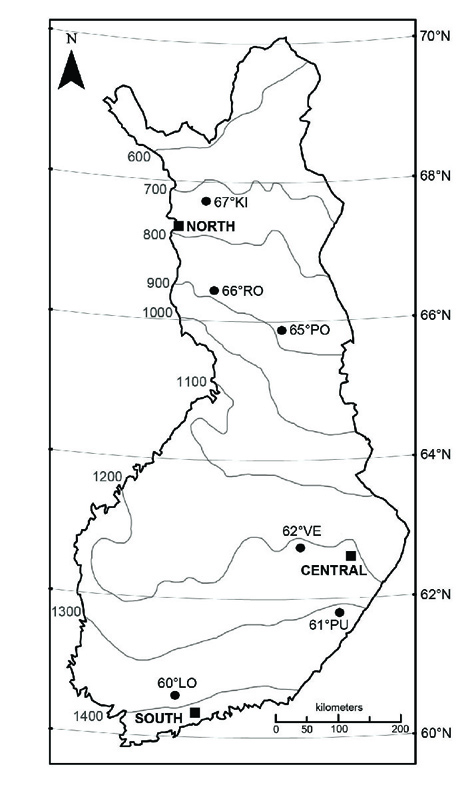
Figure 1. Map showing the three common garden sites (filled squares) and the six source populations (filled circles). Mean annual temperature isoclines are shown in grey.

Figure 1. Map showing the three common garden sites (filled squares) and the six source populations (filled circles). Mean annual temperature isoclines are shown in grey.

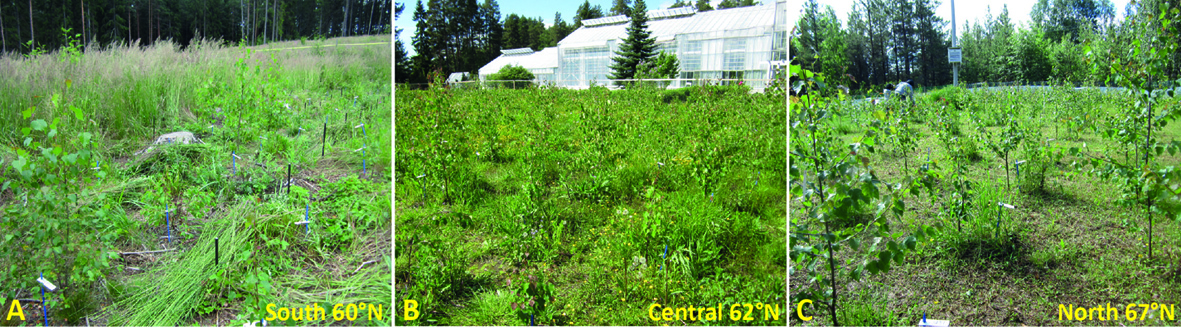
Figure 2. The three common garden sites in Finland where the study was conducted. A) Southern study site is located in Tuusula 60°N, B) Central study site is located in Joensuu 62°N and C) Northern study site is located in Kolari 67°N. Photo credits: Kaisa Heimonen.

Figure 2. The three common garden sites in Finland where the study was conducted. A) Southern study site is located in Tuusula 60°N, B) Central study site is located in Joensuu 62°N and C) Northern study site is located in Kolari 67°N. Photo credits: Kaisa Heimonen.

We wanted to study how the local insects at each of the common garden sites colonized the translocated birch genotypes. We asked if the insect herbivore density, species richness or community composition could be explained by the source population of the birch or by the direction or distance of the latitudinal translocation. The herbivore community on the study birches was examined during two growing seasons in 2011 and in 2012.

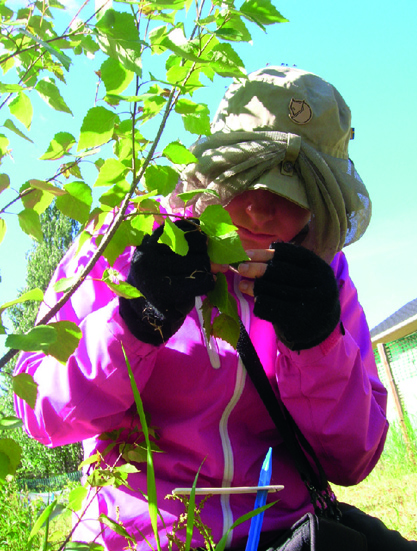
Figure 3. Kaisa Heimonen (lead author) observing the herbivorous insects on silver birch at the northern study site in 2012. Photo credits: Sari Kontunen-Soppela.

Figure 3. Kaisa Heimonen (lead author) observing the herbivorous insects on silver birch at the northern study site in 2012. Photo credits: Sari Kontunen-Soppela.

Herbivore density among the source populations differed in 2012 but not in 2011 and species richness was not affected by the source population. Latitudinal translocation could not explain the variation in the herbivore density or in the species richness. Community composition of the herbivores differed among the source populations at two of the three study sites and the similarity of the herbivore communities decreased with increasing latitudinal distance of the source populations.

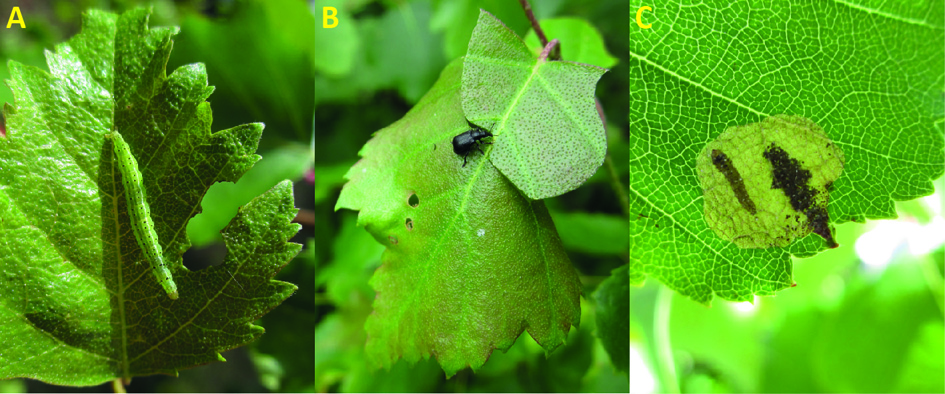
Figure 4. Common insect species on silver birch belonging to the orders Lepidoptera, Coleoptera and Hymenoptera. A) White-shouldered smudge (Ypsolopha parenthesella), B) Birch leaf roller (Deporaus betulae) and C) Early birch leaf edgeminer (Fenusella nana). Photo credits: Kaisa Heimonen.

Figure 4. Common insect species on silver birch belonging to the orders Lepidoptera, Coleoptera and Hymenoptera. A) White-shouldered smudge (Ypsolopha parenthesella), B) Birch leaf roller (Deporaus betulae) and C) Early birch leaf edgeminer (Fenusella nana). Photo credits: Kaisa Heimonen.

Silver birch genotypes from source populations originating from closer geographical distance had more similar herbivore community composition at our experimental sites possibly because they are genetically more similar than the geographically more distant birch genotypes. All birch genotypes were colonized by some of the local herbivores at all three study sites suggesting that in the future herbivorous insects are able to colonize novel host plant genotypes. The results of this study show that compositional changes in the insect communities on their host plants are expected in the future. Newly structured herbivore communities might affect the herbivore damage and thereby also the plant growth.

Stay or go for next clutch? Updated for 2026

Moving to a new site for next brood? Good or bad? And why? These questions are answered in the Early View paper “Mechanisms and reproductive consequences of breeding dispersal in a specialist predator under temporally varying food conditions” by Julien Terraube and co-workers.

In this study, we explored the factors linked to variations in breeding dispersal behaviour and their consequences in terms of reproductive parameters in a raptor species. Which factors influence individual dispersal decisions? Are Eurasian kestrels Falco tinnunculus able to increase their own reproductive success after moving from one site to the other between two consecutive breeding seasons? Is this relationship mediated by environmental factors like food abundance or individual traits like gender or age? All these fascinating questions are hard to answer particularly in avian predators because of methodological limitations associated to size of the study area and even more in species like Eurasian kestrels breeding in boreal ecosystems, which have high breeding dispersal propensity and in which movements are driven by cyclic fluctuations in abundance of main foods (voles) (see Vasko et al. 2011).

In spring 1977, a long-term study of a local kestrel population breeding in western Finland (the Kauhava region) was initiated along with the monitoring of Tengmalm’s owl populations (see Korpimäki and Hakkarainen 2012). Hard work in the field has generated a fantastic long-term, large-scale dataset combining data from breeding success and individual traits of breeding kestrel parents captured at their nest sites over the last 25 years (1983-2013).


A +1-year old male kestrel on hand after trapping. Photo: Erkki Korpimäki.

A +1-year old male kestrel on hand after trapping. Photo: Erkki Korpimäki.

Given the increasing demand for long-term population studies in order to understand current impact of environmental changes, the authors would like to stress the importance of long-term studies on demographic parameters in long-lived vertebrate populations. In this study, the assessment of breeding dispersal distances was made possible through systematic capture of most kestrel parents breeding in the main study areas, ringing and recovery of previous rings. We would like to focus here on the capture procedure that allowed collecting breeding dispersal data and share the experience acquired during the hours spent in “Wild-West” of Finland when checking traps.


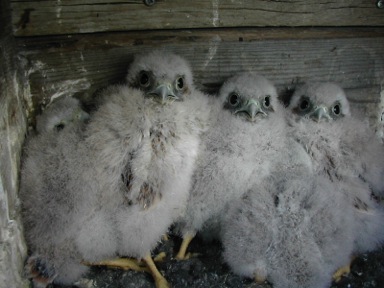
Three-week old nestlings in the nest-box. Photo: Erkki Korpimäki

Three-week old nestlings in the nest-box. Photo: Erkki Korpimäki

Capture occurs during the brood-rearing period when chicks are two-to-three weeks old, in order to avoid unnecessary disturbance of young nestlings during the most vulnerable phase. Virtually all the breeding population monitored breeds in nest-boxes that were set up on barns from early 1980s onwards. The total number of nest-boxes has varied from 350 to 450 throughout the study period in agricultural fields of the study area. We have used swing-door traps attached to the front of the nest box for trapping parents. The “trapping routine” starts by erecting the traps early in the morning from 5-6 am on a group of 5 to 10 breeding sites selected according to nestling age. Then trap-checking rounds are performed every two-to-three hours to check if any individual is trapped. The aim is to capture both female and male from each breeding site within 12 hours. Adults are ringed, measured and weighed near the breeding site and released as soon as possible. A capture day ends by giving newly-hatched rooster chickens to the kestrel nestlings to compensate for the decrease in prey delivery rates experienced during the trapping of their parents.

We have been lucky in the sense that voluntary birdwatchers and ringers have set up many large nest-box networks for kestrels in surrounding areas in western Finland. In addition, many voluntary ringers, particularly Erkki Rautiainen and Jussi Ryssy, have also made huge efforts to trap and ring kestrel parents and to ring fledglings at these nest-boxes.

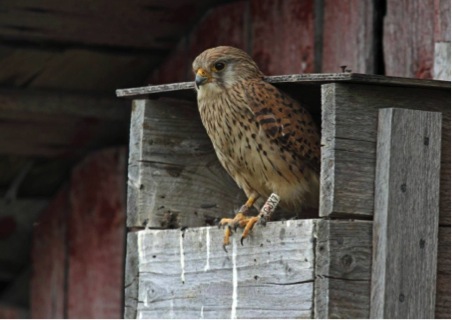
A female kestrel with metal and colour rings in the front of the nest-box. Photo: Benjam Pöntinen.

A female kestrel with metal and colour rings in the front of the nest-box. Photo: Benjam Pöntinen.

A total of 2089 males and 2544 females were trapped at nests during 1985 to 2011 in our study areas. Trapping success remained relatively constant over the period: of all the nesting attempts on average 70% of the male and 80% of the female parents were successfully captured yearly. This large-scale trapping and ringing program allowed us to collect 631 dispersal events from 1985 to 2011 that were analysed in this study.

Overall, we found that females dispersed further than males and older individuals dispersed further than yearlings. A noteworthy aspect of this study involved the evidence of body-condition dependent dispersal strategies in kestrels as the individual body condition index was positively correlated to breeding dispersal distances, particularly in females. Strikingly, our results also evidenced complex patterns of non-linear relationship between previous breeding success and dispersal distances. Finally, longer dispersal distances were associated with reproductive costs in males under increasing vole abundance, whereas those females dispersing further increased their breeding success under all conditions of food abundance.

These results call for further research as clearly there is more to learn about the link between potential pre- and post-breeding prospecting movements, optimal dispersal decisions and population dynamics in avian predators inhabiting fast changing boreal ecosystems.


References


Korpimäki, E. & Hakkarainen, H. 2012. The boreal owl: Ecology, Behaviour and Conservation of a Forest-Dwelling Predator. – Cambridge University Press, Cambridge. 372 pages.


Vasko, V., Laaksonen, T., Valkama, J. & Korpimäki, E. 2011. Breeding dispersal of Eurasian kestrels (Falco tinnunculus) under temporally fluctuating food abundance. – Journal of Avian Biology 42: 552-563. (doi: 10.1111/j.1600-048X.2011.05351.x)

New SE: Leif Egil Loe Updated for 2026

We welcome Professor Leif Egil Loe, Aas, Norway to the Oikos Editorial Board. Who is Leif Egil then? I asked some questions to get to know him better:

  1. What’s you main research focus at the moment?

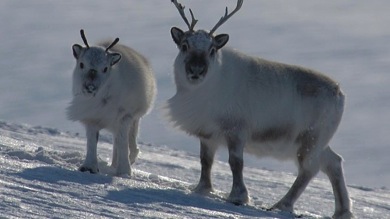
Loe2Most of what I am working on is related to ungulate ecology. I am involved in two long-term projects. The first is a population study of Svalbard reindeer initiated by Steve Albon and Rolf Langvatn in 1994 and still running on the 20th year. Current focusof that project is to understand mechanisms of population dynamics and aspects of life history evolution. I am also very interested in spatial ecology, so a subset of our reindeer is GPS-marked. One prediction from climate change is that ground icing events will happen increasingly often in Svalbard, and it has indeed happened two of the five years we have GPS-tracked animals. I am interested in the fitness consequences of different behavioural responses to such events. The second main project is a red deer study with Prof Atle Mysterud as PI. In the past few years we have focussed on the mechanisms of migration, again using GPS-data from several hundred marked red deer. Currently we have a stronger management focus, modelling functional management units and investigating how spatial harvesting patterns are predicted to be affected by climate change.

  1. Can you describe your research career? Where, what, when?

I have a masters degree from the University of Oslo (UiO) and the University Centre in Svalbard (UNIS) from 1999 and a PhD from UiO in 2004. The title of the masters was “Habitat selection and site fidelity in Svalbard reindeer” (supervised by Nils Chr. Stenseth and Rolf Langvatn) and the PhD was entitled “Patterns and processes in the life history of red deer” (supervised by Atle Mysterud, Stenseth and Langvatn). From 2004 to 2010 I had researcher positions in Atle Mysteruds lab continuing to work on the red deer project. So as you see I have very much pursued the first two projects I encountered. Between 2008 and 2013 I worked with PhD student Anagaw Atickem on a Mountain nyala conservation project in Ethiopia that at least expanded my study topics geographically. In 2010 I was employed as an Associate Professor in wildlife ecology and management at the Norwegian University of Life Sciences. In 2013 I got promoted to full professor.

Loe1

  1. How come that you became a scientist in ecology?

I think I followed a fairly common path. For as long as I remember I always liked birds, especially feeding them during winter, drawing them and learning their names. In my teens I started collecting butterflies that was a main hobby for 3-4 years. The starting point was identifying species of birds and insects. Starting at university, I got interested in ecology. A study year in Svalbard, and especially meeting Rolf Langvatn, became influential in my career and primed me in on ungulate ecology. Taking a PhD in Stenseths Centre of Ecological and Evolutionary Synthesis, with Atle Mysterud as the main supervisor was fantastic – the best career start one can wish for.

  1. What do you do when you’re not working?

I have two kids so a lot of time is devoted to family life. I am a keen small game hunter, like to hike and do cross country skiing in the forest and mountains. My favourite sports activity is “floor ball” that I play once a week.

Low Updated for 2026

Cotton grass on the shore of a lake

In a previous post, I wrote about the power of photography for ecologists. Now, it is time to provide some real tips for photographing ecologists. How to take home some pictures that will impress others, without – importantly – losing any working time?

Cotton grass on the shore of a lake

Most ecologists will take a camera into the field anyway. It is used to take pictures of their research site or subject, or record some important details for later. As you already have your camera in your hand, it will not cost you too much effort to take just one more picture.

Autumn seeds in Lapland

In that case, it might be a smart idea to get a little bit lower, up to the level of your study object, to check the world from its point of view.

Mountain mushroom

The combination of integrating your study object in the landscape and letting it stand out of the background results in more interesting images. It makes it possible for an observer to feel a connection with the subject and it makes the picture tell a much more interesting story.

Hiking in the Swedish mountains

Even if your study object is a dull bird or a boring plant, getting on its level will bring out the best in it and give it a soul.

House sparrow

If possible, try to include the horizon in the picture. It will ask a lot more of your knees, but the rewards are big. As the (obviously real) Lappish proverb goes: ‘A beautiful horizon can even make a dead lemming look poetic’.

Dead lemming on a rock

I did not invest too much time in getting a nice overview of my study species, the invasive plants in my plots. An awfully difficult subject for an artist, I have to admit, but by quickly spending two minutes as a photographer before you dive into the science, might have been rewarding even in this case.

Experimental plot

Take home message: low! Take your pictures from a low angle and give their stories a boost!

Achillea millefolium

 Want more from Jonas Lembrechts?

October 3, 2014

Frugivory and seed dispersal Updated for 2026

What is it that determines if a bird should deposit a seed from a fruit in a specific place or not? I the Early View paper “Seed dispersal in heterogeneous landscapes: linking field observations with spatially explicit models”, Jessica E Lavabre ad colleagues combines modelling with empirical studies to find out! Below is the author’s summary of the study.

Frugivorous birds play a critical role in the population dynamics of many fleshy-fruited plants by defining the template for the establishment of new individuals. Because successful germination and subsequent seedling survival is highly dependent upon the micro-habitat where a seed arrives, it is crucial to understand which factors drive seed deposition. In our study, we aimed to take an important step forward in understanding the complex mechanisms that generate the spatial patterns of seed dispersal. Few studies have previously modelled seed dispersal in a real landscape, mostly because real vegetation structure is often highly heterogeneous. Here, we have taken advantage of a simple study system to parametrize mechanistic seed-dispersal models with empirical field data, and we built three models that test three seed-dispersal predictors: distance from the source tree, microhabitat type, and a combination of both distance from the source and microhabitat type.

To our greatest surprise, the third model, combining distance and microhabitat type, did not perform significantly better than the other two, simpler models. Additionally, our results suggested that what we had initially considered as one population could instead be two functionally distinct patches, with distinct seed dispersal dynamics. Altogether, these results reinforce the hypothesis that functionally distinct groups of frugivore species generate scale specific seed rain patterns.

LaVera LaVera2